



What was Wolfgang Amadeus Mozart’s IQ?
A prodigy, and a number from 1926.
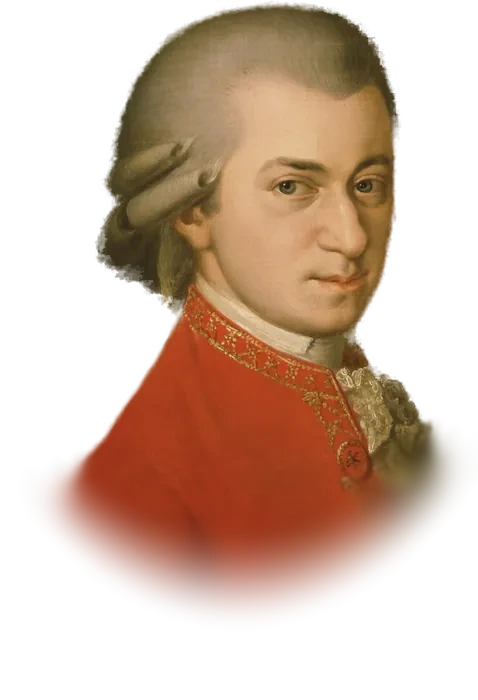
Mozart’s figure is one of the few on this site with a real academic origin — a 1926 Stanford study that estimated IQs for three hundred dead people, and whose method is more interesting than its results.
Wolfgang Amadeus Mozart’s estimated IQ
- Composing from the age of five and producing catalogued works by six; his first symphony was written at eight.
- In April 1770, aged fourteen, he is reported to have transcribed Allegri’s Miserere after hearing it performed in the Sistine Chapel — a work the Vatican did not permit to be copied.
- A working professional career of roughly 600 completed compositions before his death at thirty-five.
Cox’s method reads surviving biography and converts documented childhood achievements into a score. It measures how much of a childhood was written down at least as much as it measures the child.
- Born
- 27 January 1756, Salzburg
- Died
- 5 December 1791, Vienna
- Field
- Composition, performance
- Education
- Taught by his father, Leopold Mozart
- Known for
- Figaro, Don Giovanni, the Requiem
- Works
- c. 600 catalogued compositions
What an IQ of 150–165 actually means
Set the claim aside for a moment. If someone genuinely scored in this range, here is what that would represent.
Average is 100 by construction, and about two-thirds of people fall between 85 and 115. Take the test to place your own score on this scale.
| Score range | Classification | Share of people | What it indicates |
|---|---|---|---|
| 85 – 114 | Average | ~68% | The range most people fall into. |
| 115 – 129 | Above average | ~13.6% | Roughly one person in seven. |
| 130 – 144 | Gifted | ~2% | The threshold most high-IQ societies use. |
| Above 144 | Highly gifted | ~0.1% | Figures above this range are extrapolated from the curve rather than measured. |
Percentages are approximate and describe a normal distribution. The same number means different things on tests with different standard deviations.
Thirty questions gives you a measured position on this exact scale — your score, your percentile and the ability breakdown behind it.
Find out in 30 minutes →Who Wolfgang Amadeus Mozart was
Mozart was born in Salzburg in 1756. His father Leopold was deputy Kapellmeister to the archbishop and a published author on violin technique, and from 1762 he took Wolfgang and his sister Nannerl on performing tours through Munich, Vienna, Paris, London and Rome.
The London stay produced the first symphony, written when he was eight. The Rome visit produced the story that has done more for his reputation than any other: that having heard Allegri’s Miserere once in the Sistine Chapel, he wrote it out from memory.
He moved to Vienna in 1781 and worked freelance — Le nozze di Figaro, Don Giovanni, Così fan tutte, Die Zauberflöte — until his death in 1791 at thirty-five, with the Requiem unfinished.
 By Elora Mercer, Celebrity Research WriterFigures checked by Leon Falkner, Data & Research Analyst
Reviewed by Aarav Vardhan, Editor-in-Chief · Last reviewed August 2026
.jpg)
Wolfgang Amadeus Mozart: the documented record
The estimate above rests on this record. Every entry here is a matter of public fact, which is more than can be said for the number itself.
- 1756Born in Salzburg.
- 1761First recorded compositions, aged five.
- 1762Begins performing tours of the European courts with his father and sister.
- 1764Writes his first symphony in London, aged eight.
- 1770Visits Rome; the Miserere transcription is reported this April.
- 1781Settles in Vienna as a freelance composer.
- 1786Le nozze di Figaro premieres in Vienna.
- 1791Die Zauberflöte premieres; dies in December, leaving the Requiem unfinished.
Where the 165 figure came from
Following a claim back to its first appearance is the part almost nobody does — and it is what most people are actually asking.
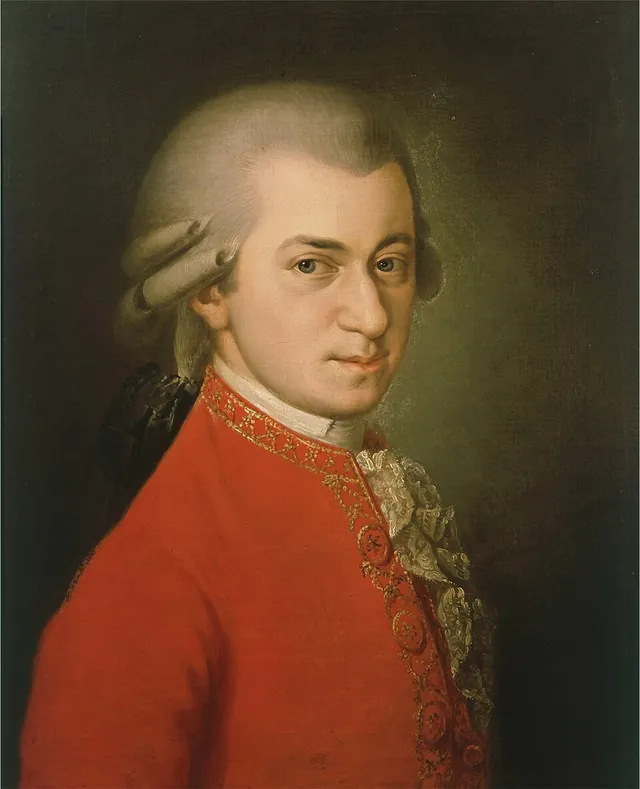
This entry, Voltaire and Goethe all come from the same 1926 volume, and reading them together shows the method’s weakness clearly. Cox’s scores correlate with how much biographical material survived about a subject’s childhood — and the families who documented their children most thoroughly were the wealthy, the literate and the already-famous.
Mozart is the extreme case. His father Leopold was a professional musician who kept detailed records, wrote letters constantly, and toured his children through the courts of Europe as a business. Almost no other eighteenth-century childhood is documented in comparable detail. A method that rewards documentation will rank him highly whatever his ability was.
That is not an argument that Mozart was ordinary. It is an argument that the number is measuring Leopold’s bookkeeping alongside Wolfgang’s mind, and that the two cannot be separated after the fact.
How we read a number →The origin of the figure. Cox gives two estimates per subject, one for childhood and one for youth, and states plainly that both are inferences from biography.
The standard chronological catalogue. Establishes the dating of the early works the estimate rests on.
Contemporary letters documenting the childhood tours, including the 1770 Rome visit. Also the reason so much detail survives at all.
Intelligence testing did not exist until more than a century after Mozart’s death.
Source URLs and first-appearance date pending audit.
Higher than either Cox estimate and not attributable to her study.
The sources behind our estimate
The figures that circulate for Wolfgang Amadeus Mozart, what we were able to confirm, and where the two diverge.
Figures from 150 to 165 circulate, and unusually for this site most of them do trace back to something real: Catharine Cox’s 1926 estimates.
Cox never claimed to have tested anybody. Her study assigned estimated IQs to historical figures by scoring the recorded achievements of their childhoods against the developmental norms of the day. The number is a scholarly inference from documents. It becomes false only when it is repeated as though somebody sat Mozart down with a test.
The lower figures are Cox’s own two estimates. The 165 appears later, in popular sources, and is not hers.
Want a number that does hold up? Every figure on this page is somebody’s claim. Take the 30-question test and get a percentile you can check rather than a figure you have to trust.
Wolfgang Amadeus Mozart — frequently asked
What was Mozart’s IQ?
He was never tested — intelligence testing did not exist in the eighteenth century. The 150–165 figures come from Catharine Cox’s 1926 historiometric study, which estimated scores from biographical records.
Is the Cox estimate reliable?
It is honest scholarship, but it measures documentation as much as ability. Subjects whose childhoods were recorded in detail score higher, and Mozart’s was recorded more thoroughly than almost anyone’s.
Did Mozart really write out the Miserere from memory?
It is reported in contemporary correspondence following the family’s April 1770 visit to Rome. It is the best-attested of the prodigy stories, though the piece is more repetitive than its reputation suggests, which makes the feat more plausible rather than less.
How old was Mozart when he wrote his first symphony?
Eight. It was written in London in 1764 during the family’s European tour.
Who scored highest in the Cox study?
Goethe, at an estimated 210 — the highest of the three hundred subjects. Mozart, Voltaire and Goethe are all profiled on this site from the same source.
Does being a prodigy mean a high IQ?
Early achievement and adult ability are related but far from the same thing. Most child prodigies do not become historically significant adults, and most historically significant adults were not prodigies.
How does my IQ compare with Wolfgang Amadeus Mozart?
You can find out in about fifteen minutes. The IQ Metrics assessment is 30 questions, scored on the same 100-mean scale used throughout this page, so your result and the estimate above are at least expressed in the same units — one measured, one inferred. Once you have a number, the leaderboard shows where it would sit, and how we score and norm it explains the benchmarking.
Where does this estimate come from?
From the documented record rather than a test — the method is named above and set out in full under how we read a number. Compare it against the other musicians profiles, starting with Brian May.
- Take the 30-question IQ test — get a measured score and percentile of your own
- Average IQ by country — how the scale behaves across populations
- How IQ Metrics scores its assessment — the method behind our own number
- More on how IQ testing works — reliability, error and what a score can and cannot say
- More musicians profiles — same field, same method
More musicians



Photograph by Diego Serrano (WrestleMania XL, April 2024), CC BY 2.0. Background removed for the portrait above. · Photograph by Raph_PH (Renaissance World Tour, June 2023), CC BY 2.0. Background removed for the portrait above. · Still from a video by K-POPIT 케이팝잇 on YouTube (Seoul, November 24, 2023), CC BY 3.0. Background removed for the portrait above.
_(cropped).jpg)
_(52946364598)_(best_crop).jpg)

An estimate is an inference.
Yours can be measured.
Thirty questions, scored against general-population benchmarks. Your score, your percentile, your ability breakdown and a printable IIF certificate.
Find your IQ score now! →