



What is Kurisu Makise’s IQ?
A published researcher at seventeen — inside the story, at least.

Kurisu Makise is introduced in Steins;Gate as a neuroscience researcher who published her first paper as a teenager — work serious enough to draw both academic attention and open ridicule from the field it was aimed at. Like every fictional profile on this site, the number here rates the writing, not a person.
Kurisu Makise’s estimated IQ
- Introduced as a neuroscience researcher affiliated with an American university while still a teenager, having published her first research paper — on time-axis theory — at seventeen, work that drew both academic interest and public ridicule for its subject matter.
- Consistently written as the technical authority the story’s other characters, including protagonist Rintarō Okabe, defer to on the mechanics of its central time-travel premise.
- Portrayed juggling an active research role in Japan alongside her American university affiliation well before the age most researchers finish a first degree.
As with every fictional estimate on this site, Kurisu is only as clever as the plot requires her to be at each point in the story, and the other characters only as puzzled as the narrative needs them to be. Read this range as a rating of the portrayal, not a person — and note that, unlike some characters on this site, no specific numeric IQ is stated in the source material itself.
- First appearance
- Steins;Gate visual novel (5pb. & Nitroplus, 2009)
- Created by
- 5pb. and Nitroplus
- In-story credential
- Published neuroscience research at seventeen
- Known for
- Serving as the story’s scientific authority on its time-travel premise
- Canonical IQ
- Not stated in the source material — see below
What an IQ of 165–185 actually means
Set the claim aside for a moment. If someone genuinely scored in this range, here is what that would represent.
Average is 100 by construction, and about two-thirds of people fall between 85 and 115. Take the test to place your own score on this scale.
| Score range | Classification | Share of people | What it indicates |
|---|---|---|---|
| 85 – 114 | Average | ~68% | The range most people fall into. |
| 115 – 129 | Above average | ~13.6% | Roughly one person in seven. |
| 130 – 144 | Gifted | ~2% | The threshold most high-IQ societies use. |
| Above 144 | Highly gifted | ~0.1% | Figures above this range are extrapolated from the curve rather than measured. |
Percentages are approximate and describe a normal distribution. The same number means different things on tests with different standard deviations.
Thirty questions gives you a measured position on this exact scale — your score, your percentile and the ability breakdown behind it.
Find out in 30 minutes →Who Kurisu Makise is
Steins;Gate began as a 2009 visual novel by 5pb. and Nitroplus, adapted into a 2011 anime series by White Fox. Kurisu Makise is introduced as a neuroscience researcher affiliated with an American university, drawn into the story’s central discovery of a device that can send messages into the past.
Nicknamed “Christina” by protagonist Rintarō Okabe, over her repeated objections, Kurisu functions as the story’s scientific anchor — the character who works out the rules and consequences of the time-travel mechanism the plot revolves around, even as the story’s events increasingly outpace conventional explanation.
 By Elora Mercer, Celebrity Research WriterFigures checked by Leon Falkner, Data & Research Analyst
Reviewed by Aarav Vardhan, Editor-in-Chief · Last reviewed August 2026

Kurisu Makise: the documented record
The estimate above rests on this record. Every entry here is a matter of public fact, which is more than can be said for the number itself.
- 2009Introduced in the Steins;Gate visual novel.
- 2011Appears in the White Fox anime adaptation of Steins;Gate.
Where the 17 figure came from
Following a claim back to its first appearance is the part almost nobody does — and it is what most people are actually asking.

Kurisu belongs with the majority of fictional profiles on this site rather than with Shikamaru Nara’s exception: the story establishes her as exceptional through credentials and other characters’ reactions, not through a stated figure. The specific, checkable detail is her age — seventeen — when the story places her first published paper, not a number attached to her mind.
That distinction matters for the same reason it matters throughout this site: a research paper at seventeen is a concrete, textual claim that can be pointed to. An IQ figure for a character the text never assigns one is, definitionally, fan invention layered onto the writing after the fact — the same gap this site documents for real people, one level removed.
How we read a number →Source of Kurisu’s introduction as a teenage-published neuroscience researcher and her role throughout the story.
Shikamaru is the rare fictional entry with a stated in-text figure; Kurisu, like L, has none — her reputation rests on credentials and other characters’ reactions instead.
The sources behind our estimate
The figures that circulate for Kurisu Makise, what we were able to confirm, and where the two diverge.
Fan discussion around “smartest anime characters” regularly places Kurisu alongside this site’s other Death Note and Naruto entries, though — unlike Shikamaru Nara — no specific IQ figure is ever stated in the original source material.
Steins;Gate never gives Kurisu a stated IQ, unlike Shikamaru Nara, whose “over 200” is an actual line of narration. Her reputation rests entirely on the story showing her research credentials and having other characters treat her as the resident authority on the science driving the plot — which makes any specific number attached to her online, including on fan wikis, an estimate with no textual anchor at all.
The absence of a stated figure produces the same wide, unanchored guessing this site documents for L and Sherlock Holmes — characters written as exceptional, with nothing in the text pinning the guess to a specific number.
Want a number that does hold up? Every figure on this page is somebody’s claim. Take the 30-question test and get a percentile you can check rather than a figure you have to trust.
Kurisu Makise — frequently asked
What is Kurisu Makise’s IQ?
The source material never states one. Steins;Gate establishes her intelligence through her research credentials — including a published paper at seventeen — and other characters’ reactions, not through a stated number.
Is there a canon IQ figure for Kurisu Makise?
No. Unlike Shikamaru Nara, whose IQ is stated directly in his source material, Kurisu is never assigned a specific figure in the visual novel or the anime.
What is Kurisu Makise known for in Steins;Gate?
Being introduced as a teenage-published neuroscience researcher who becomes the story’s scientific authority on its central time-travel device.
How old was Kurisu when she published her first paper, in the story?
Seventeen, according to her introduction in the visual novel and anime.
Why does Kurisu Makise appear on a real-world IQ site?
As a character frequently discussed in “smartest anime characters” conversations alongside this site’s other fictional entries; the page audits that reputation against what the source material actually states, the same way every other profile on this site does for a real figure.
How does Kurisu compare to L or Shikamaru on this site?
Like L, she has no stated figure and an estimate built entirely from portrayal. Shikamaru is the exception in this category: the only one with an actual number in the text.
How does my IQ compare with Kurisu Makise?
You can find out in about fifteen minutes. The IQ Metrics assessment is 30 questions, scored on the same 100-mean scale used throughout this page, so your result and the estimate above are at least expressed in the same units — one measured, one inferred. Once you have a number, the leaderboard shows where it would sit, and how we score and norm it explains the benchmarking.
Where does this estimate come from?
From the documented record rather than a test — the method is named above and set out in full under how we read a number. Compare it against the other fictional profiles, starting with Sherlock Holmes.
- Take the 30-question IQ test — get a measured score and percentile of your own
- Average IQ by country — how the scale behaves across populations
- How IQ Metrics scores its assessment — the method behind our own number
- More on how IQ testing works — reliability, error and what a score can and cannot say
- More fictional profiles — same field, same method
More fictional
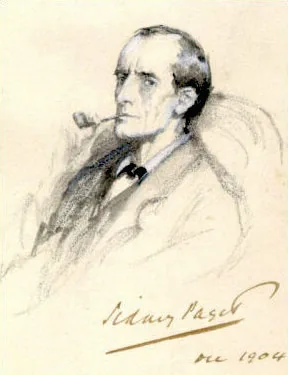
Illustration by Sidney Paget (1890s), public domain. · Illustration by Sidney Paget (1893), public domain. Background removed for the portrait above. · Illustration by Sidney Paget for The Strand Magazine (1893), public domain. Background removed for the portrait above.


An estimate is an inference.
Yours can be measured.
Thirty questions, scored against general-population benchmarks. Your score, your percentile, your ability breakdown and a printable IIF certificate.
Find your IQ score now! →