



What is Sharon Stone’s IQ?
The rare celebrity IQ claim that got retracted on the record.

Stone’s page is unusual for this site: the claim was not just unsourced, it was publicly retracted. In 2002, Mensa’s own marketing director confirmed on the record that she had never been a member.
Sharon Stone’s estimated IQ
- Described by Wikipedia as academically advanced as a child, entering second grade at age five.
- Admitted to Edinboro State College at 15 on a creative-writing scholarship — an unusually young admission, even though she left before completing the degree.
- Returned to Edinboro University in 2016, at 58, and completed the degree she had left decades earlier.
Grade-skipping and an early scholarship admission are real, documented signals, but they are school placement decisions, not test scores. This range should be read as looser than the site’s test-anchored estimates.
- Born
- 10 March 1958, Meadville, Pennsylvania
- Field
- Film and television acting
- Education
- Edinboro State College, entered at 15; completed the degree at Edinboro University in 2016
- Known for
- Basic Instinct (1992); Casino (1995), Golden Globe winner
What an IQ of 130–145 actually means
Set the claim aside for a moment. If someone genuinely scored in this range, here is what that would represent.
Average is 100 by construction, and about two-thirds of people fall between 85 and 115. Take the test to place your own score on this scale.
| Score range | Classification | Share of people | What it indicates |
|---|---|---|---|
| 85 – 114 | Average | ~68% | The range most people fall into. |
| 115 – 129 | Above average | ~13.6% | Roughly one person in seven. |
| 130 – 144 | Gifted | ~2% | The threshold most high-IQ societies use. |
| Above 144 | Highly gifted | ~0.1% | Figures above this range are extrapolated from the curve rather than measured. |
Percentages are approximate and describe a normal distribution. The same number means different things on tests with different standard deviations.
Thirty questions gives you a measured position on this exact scale — your score, your percentile and the ability breakdown behind it.
Find out in 30 minutes →Who Sharon Stone is
Sharon Stone was born in 1958 in Meadville, Pennsylvania, and was, by her own family’s and biographers’ accounts, an academically advanced child — she entered second grade at age five and was admitted to Edinboro State College on a creative-writing scholarship at fifteen.
She left college to model with the Ford Modeling Agency in 1977, building an acting career that led to Basic Instinct (1992) and an Academy Award nomination for Casino (1995), where she won a Golden Globe.
In 2016, at 58, she returned to Edinboro University and completed the degree she had left unfinished more than four decades earlier — a detail that gets far less attention than the Mensa claim, despite being the one part of her record that is entirely uncontested.
 By Elora Mercer, Celebrity Research WriterFigures checked by Leon Falkner, Data & Research Analyst
Reviewed by Aarav Vardhan, Editor-in-Chief · Last reviewed August 2026
.jpg)
Sharon Stone: the documented record
The estimate above rests on this record. Every entry here is a matter of public fact, which is more than can be said for the number itself.
- 1958Born in Meadville, Pennsylvania.
- c. 1963Enters second grade at age five.
- 1975Graduates Saegertown High School.
- c. 1973Admitted to Edinboro State College at fifteen on a creative-writing scholarship; later leaves without finishing.
- 1977Signed by the Ford Modeling Agency.
- 1992Basic Instinct is released.
- 1995Casino; wins the Golden Globe for Best Actress, Drama, and receives an Academy Award nomination.
- 2002Publicly retracts the Mensa-membership claim after being challenged by Mensa’s Jim Blackmore.
- 2016Returns to Edinboro University and completes her degree.
- 2021Publishes her memoir, The Beauty of Living Twice.
Where the 154 figure came from
Following a claim back to its first appearance is the part almost nobody does — and it is what most people are actually asking.
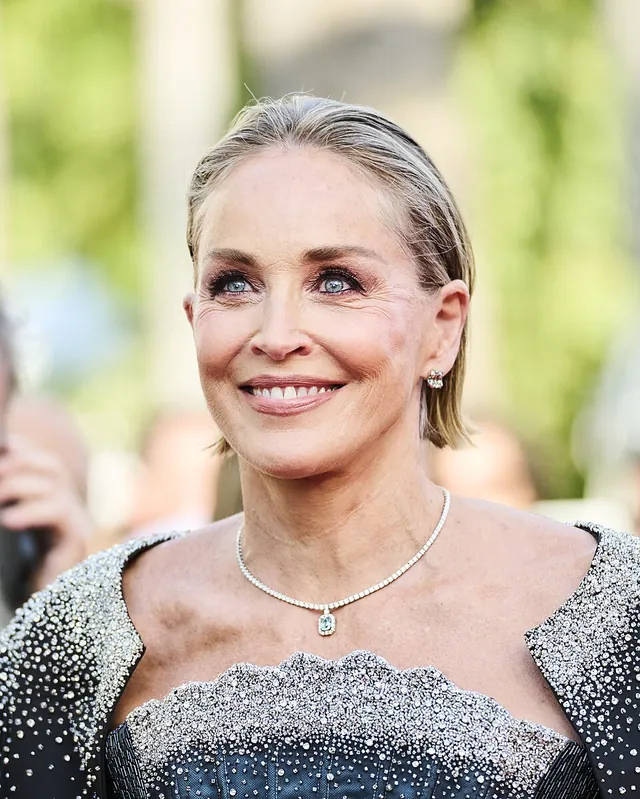
Stone’s entry differs from most others in this category, including James Woods, because the record here is a documented reversal rather than simple silence. A named Mensa official went on the record specifically to correct the claim.
What survived that correction is a real, if looser, academic story: advanced grade placement as a child and a scholarship admission to college at fifteen, both matters of school record rather than test result. Stone left before finishing the degree, then returned and completed it decades later, in 2016.
The 154 figure that still circulates predates none of this — it has no traceable first appearance, and it survived the 2002 retraction essentially untouched, which says more about how these numbers spread than about Stone herself.
How we read a number →The primary contemporary record of the retraction — Blackmore states directly that Stone was never a Mensa member and disputes her follow-up “Mensa school” explanation.
Confirms the scholarship admission at fifteen and the degree finished decades later.
No score report, school test or clinician’s account has ever been published — searched specifically, including in reviews of her 2021 memoir.
Source URLs and first-appearance date pending audit.
Multiple aggregator sites give different figures with no cited source; one vaguely gestures at “decades-old press claims” without naming any.
The sources behind our estimate
The figures that circulate for Sharon Stone, what we were able to confirm, and where the two diverge.
For years, Stone was widely understood to be a Mensa member, and figures as high as 154 (with 140, 148, 150 and 156 also appearing on different sites) circulate as her IQ.
Stone’s own Mensa claim was directly disputed and effectively withdrawn. In April 2002, Jim Blackmore, then Mensa’s national marketing director, told Salon: “It’s delightful to finally see Ms. Stone admit that she’s not and never has been a member of our society.” Stone’s follow-up explanation — that she had attended “a Mensa school” — was also disputed by Blackmore, who said Mensa has never operated schools. No score report, test or clinician’s account has ever been published.
A five-way spread across sources that cite nothing is, in this site’s recurring pattern, the signature of a number that was never measured — not evidence that several different measurements exist.
Want a number that does hold up? Every figure on this page is somebody’s claim. Take the 30-question test and get a percentile you can check rather than a figure you have to trust.
Sharon Stone — frequently asked
What was Sharon Stone’s IQ?
No test result exists on record. 154 is the most-repeated of several conflicting figures (140–156), none traceable to a document.
Is Sharon Stone a member of Mensa?
No. She publicly retracted the claim in 2002 after Mensa’s own marketing director, Jim Blackmore, disputed it on the record.
Did she really attend a “Mensa school”?
That was her explanation after the retraction. Blackmore disputed it too, saying Mensa has never operated schools.
Is there a real academic record behind the reputation?
Yes — she was advanced a grade as a child and admitted to college at fifteen on a scholarship, though she left before finishing and only completed the degree in 2016.
Where does the figure 154 come from?
Not traceable to any interview, test or original document. It survived Stone’s own 2002 retraction essentially unchanged.
How is this page different from most others on the site?
Most subjects here have simple silence — no record either way. Stone has an actual on-the-record correction, which is rarer and more citable than an absence alone.
How does my IQ compare with Sharon Stone?
You can find out in about fifteen minutes. The IQ Metrics assessment is 30 questions, scored on the same 100-mean scale used throughout this page, so your result and the estimate above are at least expressed in the same units — one measured, one inferred. Once you have a number, the leaderboard shows where it would sit, and how we score and norm it explains the benchmarking.
Where does this estimate come from?
From the documented record rather than a test — the method is named above and set out in full under how we read a number. Compare it against the other actors profiles, starting with Natalie Portman.
- Take the 30-question IQ test — get a measured score and percentile of your own
- Average IQ by country — how the scale behaves across populations
- How IQ Metrics scores its assessment — the method behind our own number
- More on how IQ testing works — reliability, error and what a score can and cannot say
- More actors profiles — same field, same method
More actors
Photograph by iDominick, CC BY-SA 2.0. Background removed for the portrait above. · Photograph by Kevin Paul, CC BY 4.0. Background removed for the portrait above. · Photograph by Bernhard Holub, CC BY-SA 4.0. Background removed for the portrait above.


An estimate is an inference.
Yours can be measured.
Thirty questions, scored against general-population benchmarks. Your score, your percentile, your ability breakdown and a printable IIF certificate.
Find your IQ score now! →