


Does Dual N-Back Training Raise IQ? What Replications Show
A 2008 PNAS study said dual n-back training raised fluid intelligence. Placebo-controlled replications found nothing, and meta-analyses put the gain at roughly 0 to 4 IQ-style points, smallest where the control group also had a task to do.

What you need to know
- The 2008 study by Jaeggi and colleagues trained 35 young adults on dual n-back for 8 to 19 days (about 25 minutes a day) and compared them with 35 untrained controls across four small experiments. Trained groups gained d = 0.65 on a 10-minute matrix test, but that is their own before-and-after change; the controls also gained d = 0.25 just from retaking it.
- Replications with a placebo task found no gain. Redick and colleagues (2013) trained adults for 20 sessions against a visual-search task and a no-contact group (73 analysed) and reported no positive transfer to any cognitive ability test and no dose effect, and Chooi and Thompson (2012) found no improvement in 93 completers.
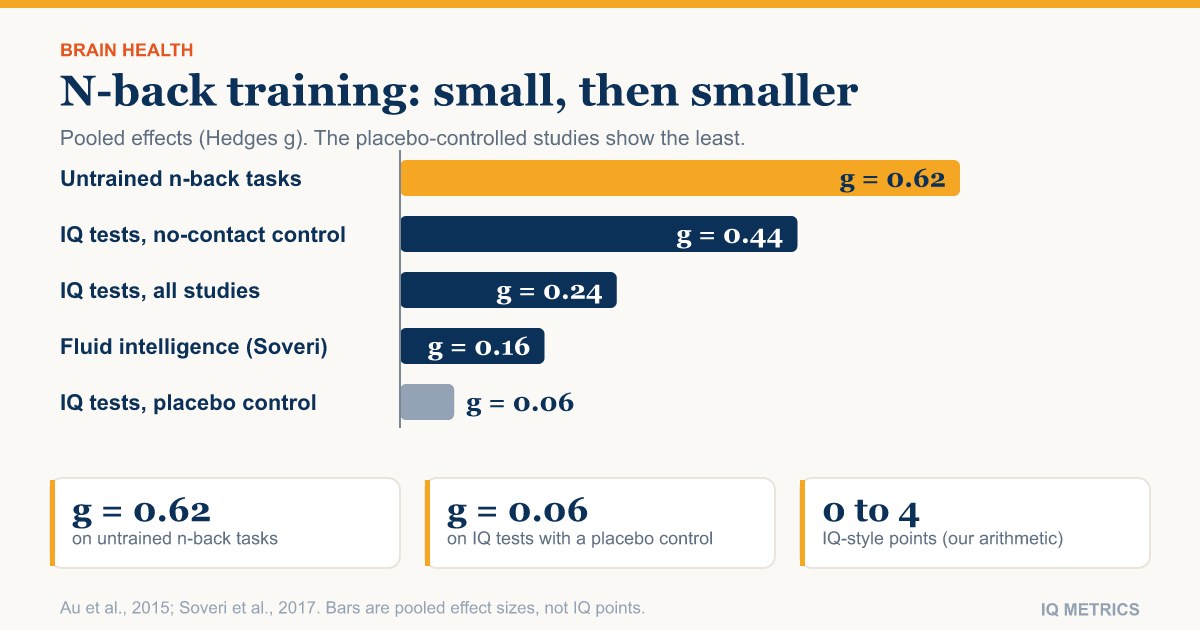
- Meta-analyses find a small average effect that depends on the control group. Au and colleagues (2015) found g = 0.24 overall (about 3 to 4 IQ points by the authors' estimate) but g = 0.06 with active controls against 0.44 with no-contact controls. Soveri and colleagues (2017) found g = 0.62 on untrained n-back tasks but only 0.16 on fluid intelligence.
- A 2022 paper in Nature Human Behaviour from the original lab pooled three trials of 460 people and found that gains on an untrained n-back task statistically mediated gains on matrix reasoning, although training itself did not raise matrix reasoning in two of the three trials.
Not reliably. Dual n-back training makes people clearly better at n-back, and a little better at similar memory tasks. Its effect on IQ-type test scores averages roughly 0 to 4 points in meta-analyses, and it is smallest in studies where the control group also got a task to do. No source we read supports the "raises IQ by 40%" figure that circulates online.
What is dual n-back?
An n-back task shows a stream of items and asks whether the current one matches the one shown n steps earlier. In the dual version used by Jaeggi and colleagues in 2008, two streams run at once: a square appears at one of eight screen locations while a consonant is played through headphones, and the person answers separately for each. Each item lasts 3 seconds, a session is 20 blocks of 20 plus n trials (about 25 minutes), and the level adapts: n rises by one when a block has fewer than 3 mistakes per stream and falls when it has more than 5.
It looks like a working-memory test, but the link is looser than the label suggests. In a 2010 study of 104 people by the same lab, dual n-back correlated .41 with Raven's matrices and .40 with the BOMAT matrix test, and only .26 with a standard complex-span memory task. For more on how memory and reasoning differ, read our guide to working memory and reasoning and try the digit span test.
What did the 2008 PNAS study find?
Jaeggi, Buschkuehl, Jonides and Perrig reported four separate experiments with 70 young adults (mean age 25.6) from the University of Bern. Half trained for 8, 12, 17 or 19 days and half did not train at all; one trainee dropped out, leaving 69. Fluid intelligence was measured with Raven's matrices (8-day group) or the BOMAT (the others), and test-takers had only 10 minutes, with the number correct as the score.
- Trained groups improved by d = 0.65 on the matrix test, but controls also improved by d = 0.25 by retaking it
- Against controls, the 12-day group showed only a trend (p = .09), and the 17-day and 19-day groups were significant at p < .05
- Gains rose with days of training, which the authors called dosage-dependent: "the more training, the more improvement in Gf"
- The paper has no placebo-task control and says it is unknown how long gains last
The size of the groups is the main concern. Redick and colleagues point out that each group in the four experiments had 7, 8 or 11 people, that two different matrix tests were used, and that by their reading only two of the four experiments showed transfer on their own. They also report, from a personal communication with the original authors, that the 19-day group had more time on the BOMAT than the 12- and 17-day groups; the PNAS text itself says 10 minutes, so we treat that detail as unconfirmed.
Did the replications confirm it?
Not the ones with a placebo task. Redick and colleagues (2013) randomised adults to 20 sessions of adaptive dual n-back, 20 sessions of an adaptive visual-search task as an active control, or a no-contact group. After exclusions, 73 people were analysed (24, 29 and 20). Both trained groups improved on their own tasks, yet the authors found "no positive transfer to any of the cognitive ability tests" and no evidence that more training meant more transfer. The tests covered reasoning, working memory, multitasking, crystallized intelligence and perceptual speed.
Chooi and Thompson (2012) tested 93 people who completed 8 or 20 days of dual n-back, an active control or a passive control, and found no significant gain in fluid intelligence or working-memory capacity. Both studies are modest in size, as the original was, but they used the control design the 2008 study lacked.
What do the meta-analyses say?
Au and colleagues (2015), including the original lab, pooled 20 n-back training studies of healthy adults aged 18 to 50 and found a small effect on fluid intelligence, g = 0.24 (standard error .07). The authors describe that as about the equivalent of 3 to 4 points on an IQ test. The control group changes the picture:
- Studies with a no-contact control: g = 0.44
- Studies with an active control that did a placebo task: g = 0.06
- Difference between the two: significant at p < .01
Au and colleagues explain the gap by the training groups doing better in no-contact studies, linked to payment and non-US samples, not by the controls doing worse. Critics read it the other way. Dougherty and colleagues re-analysed the same data with Bayes factors and found 7.7 to 1 in favour of no effect among the active-control studies, while the no-contact studies strongly favoured an effect.
Soveri and colleagues (2017) ran a multilevel meta-analysis of n-back training in randomised trials. The effect was medium on untrained n-back tasks (g = 0.62, 95% CI 0.44 to 0.81), small on other working-memory tasks (0.24), smaller on cognitive control (0.16) and 0.16 on fluid intelligence (CI 0.08 to 0.24). They conclude that a substantial part of the transfer is specific to the task. A broader 2016 review of all working-memory training, by Melby-Lervag, Redick and Hulme (87 publications, 145 comparisons), found no convincing evidence of reliable improvement when training was compared with a treated control; we read its abstract only.
Dual n-back training reliably improves n-back, and its effect on IQ-type scores shrinks toward zero when the control group has a task of its own.
What about the 2022 Nature Human Behaviour paper?
Pahor, Seitz and Jaeggi (2022) pooled three randomised trials with 460 people. They found that the improvement on an untrained n-back task statistically mediated the change in matrix reasoning, which they read as near transfer opening the door to far transfer. Their own abstract adds that the intervention itself had no effect on matrix reasoning in the second and third trials. A mediation result says that people who improved more on one task also improved more on the other, not that training reliably raises reasoning. We could read only the abstract and figure legends, since the paper is behind a paywall.
How many IQ points is that?
Converting an effect size to IQ points is arithmetic (g times 15) on one test score, and not a change to anyone's lifelong IQ. On that basis:
- Au overall, g = 0.24: about 3.6 points, which the authors put at 3 to 4
- Au, active-control studies only, g = 0.06: about 1 point
- Au, no-contact studies, g = 0.44: about 6.6 points
- Soveri, fluid intelligence, g = 0.16: about 2.4 points (range 1.2 to 3.6)
- Redick and Chooi and Thompson: no detectable gain
Those are gains on specific matrix tests in mostly young adult samples, and a retest alone gives some of that gain, as the control groups in 2008 showed. See our piece on the practice effect and whether IQ can change over time. The same pattern, gains on the trained task and little that spreads, is what brain-training app studies and the working-memory training reviewed in our article on working memory and maths found.
Is dual n-back worth doing?
If you enjoy it, it is a harmless puzzle with a clear score, and it improves what it trains. The evidence does not support paying for it as an IQ booster, or expecting a higher score on a real IQ test. A real test measures several abilities in one sitting, not only one memory task, and the one extra point or two the best studies show would be small against the margin of error of any single score, as we explain in our guide to IQ score error. Our list of ways to boost your brainpower and the Stroop test explainer show how other popular mind games fare.
Where would your own score land?
Want to see where you stand rather than train for a number? Take the IQ Metrics test and read your score against the bell curve.
Find your IQ score now! →To measure rather than train, take the IQ Metrics test, then see how the result sits on the IQ bell curve or the IQ percentile calculator.
Common questions
Does dual n-back raise IQ?
Not reliably. Training raises n-back performance and a little performance on similar memory tasks. On fluid intelligence, meta-analyses find g = 0.24 (Au, 2015) and g = 0.16 (Soveri, 2017), and the effect falls to 0.06 in studies with an active control group.
How many IQ points can n-back training add?
Our arithmetic (g times 15) gives about 2.4 points from the Soveri meta-analysis and about 3.6 from the Au analysis, which its authors put at 3 to 4. Studies with a placebo-task control give about 1 point, and two placebo-controlled replications found none.
What did the original 2008 dual n-back study find?
Four small experiments with 70 young adults found trained groups improved on a 10-minute matrix test by d = 0.65, against d = 0.25 for untrained controls retaking it. The study had no placebo-task control group, and later critics noted groups of 7, 8 or 11 people.
Has the dual n-back result been replicated?
Partly. Studies with no-contact controls often show an effect, but Redick and colleagues (2013) found no transfer to any ability test with an active control, and Chooi and Thompson (2012) found no gain in fluid intelligence. A 2022 paper reported a mediation effect in three trials.
Sources for this story
- Improving fluid intelligence with training on working memory. PNAS, 105(19), 6829-6833 (2008) — Jaeggi, Buschkuehl, Jonides and Perrig
- No evidence of intelligence improvement after working memory training: a randomized, placebo-controlled study. Journal of Experimental Psychology: General (2013) — Redick, Shipstead, Harrison, Hicks, Fried, Hambrick, Kane and Engle
- Improving fluid intelligence with training on working memory: a meta-analysis. Psychonomic Bulletin and Review, 22(2), 366-377 (2015) — Au, Sheehan, Tsai, Duncan, Buschkuehl and Jaeggi; Bayesian re-analysis by Dougherty, Hamovitz and Tidwell (2016)
- Working memory training revisited: a multi-level meta-analysis of n-back training studies. Psychonomic Bulletin and Review, 24(4), 1077-1096 (2017) — Soveri, Antfolk, Karlsson, Salo and Laine
- The relationship between n-back performance and matrix reasoning (2010); Working memory training does not improve intelligence in healthy young adults (2012) — Jaeggi and colleagues; Chooi and Thompson
- Near transfer to an unrelated N-back task mediates the effect of N-back working memory training on matrix reasoning. Nature Human Behaviour, 6, 1243-1256 (2022) — Pahor, Seitz and Jaeggi
Corrections: spotted an error? Email corrections@iqmetrics.org and we will update this story and note the change here.
Related stories
All news →Do Brain Training Apps Work? One Trial Survived 20 Years
A follow-up published in February 2026 tracked 2,802 adults for two decades after five weeks of cognitive training. One of the three training arms showed a lower rate of dementia diagnosis. The other two showed nothing.
Working Memory and Reasoning Are Closely Related. They Are Not the Same Thing
The correlation between them is one of the sturdier findings in cognitive psychology. How strong it is, and what it implies about training either one, is where the agreement stops.

Are C-Section Babies Smarter? What the IQ Studies Show
Searches for C-section and IQ run in both directions. The largest study with an intelligence test, 1.4 million Danes, found a gap of 0.36 points on a 78-item test. A Brazilian cohort found C-section teenagers 5.8 IQ points ahead, until the researchers adjusted for family and birth factors.
Read the research.
Then find your own number.
Our IIF-certified assessment reports your score with its scale, percentile and confidence range — and a breakdown of the cognitive domains behind it.
Start IQ Test →