



Smartest Dog Breeds Ranked: Coren's Order and What It Measures
The famous list of the smartest dog breeds is a vote by 199 obedience judges, not an IQ test. The Border Collie, Poodle and German Shepherd lead it, and a 2022 Science study found that breed explains just 9% of behavioural variation between dogs.


What you need to know
- The smartest dog breeds, in Stanley Coren's ranking: Border Collie, Poodle, German Shepherd Dog, Golden Retriever, Doberman Pinscher, Shetland Sheepdog, Labrador Retriever, Papillon, Rottweiler and Australian Cattle Dog.
- The ranking comes from 199 American and Canadian Kennel Club obedience judges, who ranked breeds on working and obedience ability. In Coren's words, a ranking of 133 breeds resulted once he kept breeds that at least 100 judges rated.
- It measures trainability. As summarised from the book, the top class learns a new command in fewer than 5 repetitions and obeys the first command 95% of the time or better; the bottom class needs 80 to 100 repetitions or more and obeys 25% of the time or worse.
- Breed predicts little for one dog. A 2022 Science study found "breed explains just 9% of behavioral variation in individuals", and no test gives dogs an IQ.
The smartest dog breeds, according to the best-known ranking, are the Border Collie, Poodle, German Shepherd Dog, Golden Retriever and Doberman Pinscher, followed by the Shetland Sheepdog, Labrador Retriever, Papillon, Rottweiler and Australian Cattle Dog. That list is the top 10 from psychologist Stanley Coren, based on a survey of 199 dog obedience judges. It ranks how well breeds learn commands and obey them. It is not an IQ test, and dogs have no IQ.
Below: how the ranking was made, what each class means, what the newest research says about breed and ability, and how to use a list like this without being fooled by it.
Which are the smartest dog breeds?
The ten breeds above, in that order, according to Coren's own account. He wrote that "according to the judges' rankings the top 10 dogs in terms of working and obedience intelligence are, in order" the breeds listed. At the other end, the summaries of his book place the Afghan Hound last, with the Basenji and the Bulldog just above it.
The judges largely agreed about the top. In the book, 190 of the 199 judges put the Border Collie in their top ten, a figure our dog IQ guide also reports. Rank, though, is only part of the story. The list was built to answer one narrow question.
How was the smartest dog breeds list made?
By asking experts to vote. Coren contacted the dog obedience judges registered with the American Kennel Club and the Canadian Kennel Club, and 199 of them gave usable answers. He asked them to rank breeds on "their working and obedience abilities".
In his words, "if we limit ourselves to breeds for which at least 100 judges provided assessments we ended up with a ranking of 133 breeds." Other summaries give 130 breeds placed in 79 ranks, with ties. The book appeared in 1994. Breeds that fewer than 100 judges rated were left out, and so were breeds the two kennel clubs do not recognize.
Coren defined three kinds of dog intelligence: instinctive, adaptive, and working and obedience intelligence. The ranking covers only the third.
What do the six classes of dog intelligence mean?
Each class is defined by how many repetitions a dog needs to learn a command and how often it obeys the first time. As summarised from the book, the classes are:
- Brightest dogs: a new command in fewer than 5 repetitions; obey the first command 95% of the time or better
- Excellent working dogs: 5 to 15 repetitions; 85% or better
- Above average: 15 to 25 repetitions; 70% or better
- Average: 25 to 40 repetitions; 50% or better
- Fair: 40 to 80 repetitions; 30% or better
- Lowest: 80 to 100 repetitions or more; 25% of the time or worse
These numbers come from the judges' impressions of typical dogs. Nobody timed 130 breeds in a lab. That is why the list is better described as a reputation than as a measurement.
The ranking asks how readily a breed takes to obedience work. It does not ask how smart your own dog is.
Does the ranking show which dogs are smartest?
Not in the sense we mean for people. Lists of the most intelligent dog breeds usually copy this ranking, so it helps to know its limits. Coren warned against using it as a shopping guide: "Does this mean that everyone should rush out and get one of the top 10 breeds of dogs? Definitely not."
A breed can be slow to obey and still be good at other things. A hound bred to follow a scent for hours has little reason to look at its handler. A dog that learns slowly in a trial can still solve a problem on its own, which is Coren's second kind of intelligence, and the judges were not asked about it.
Our guide to dog IQ explains why no test can give a dog a number on a human-style scale: an IQ is a position inside a norm sample, and no norm sample of dogs exists. For how a human IQ works, see the IQ bell curve.
What do newer studies say about breed and ability?
Two things, and both urge caution. First, breed explains little about an individual dog. A 2022 study in Science by Morrill and colleagues, covering 18,385 dogs, found that "breed explains just 9% of behavioral variation in individuals". That is owner-reported behaviour, not intelligence. But it means about 91% of the variation lies elsewhere. For a human parallel on how much inheritance explains, see our piece on twin studies and IQ heritability.
Second, some abilities do track breed. A 2019 study in Animal Cognition by Horschler and colleagues found that "larger-brained breeds performed significantly better on measures of short-term memory and self-control". A 2020 study by Gnanadesikan and colleagues put numbers on how much runs in breeds: self-control strongly, memory barely, as our dog IQ guide reports. These breed-level patterns are not Coren's order. A breed can sit low in his list and still do well on a memory task.
We found no study that compares Coren's order with these test results breed by breed, so we cannot say how closely they agree.
Can one dog be smarter than its breed suggests?
Yes, and an extreme case shows it. Chaser, a Border Collie studied by John Pilley and Alliston Reid, learned "the proper-noun names of 1022 objects" over three years of intensive training, according to their 2011 paper. That is one dog and one trainer. It tells you what a dog can learn, not what a typical Border Collie does. The smartest animals study and our piece on brain size and IQ add more context on comparing minds across species.
How should you use a smartest dog breeds list?
As a starting point for questions, not as a verdict. If you want a dog that takes to training quickly, the list tells you which breeds judges found easy to train. If you want a dog that suits your life, ask what the breed was bred to do and how much exercise and attention it needs.
Treat any list that prints an IQ for a breed with suspicion. It has invented a scale. Want a number that does mean something? Take the IQ Metrics test for your own score, ranked against a human norm sample.
Where would your own score land?
Curious how your own reasoning compares with other people's? Take the IQ Metrics test.
Find your IQ score now! →Our cat IQ guide asks the same question about cats, where there is no breed ranking at all.
Common questions
What is the smartest dog breed?
The Border Collie, in Stanley Coren's 1994 ranking of working and obedience intelligence. The Poodle and German Shepherd Dog follow.
How was the smartest dog breeds ranking made?
From a survey of 199 American Kennel Club and Canadian Kennel Club obedience judges, who ranked breeds on working and obedience ability. Breeds rated by at least 100 judges made the 133-breed ranking.
Is there a dog IQ test?
No. An IQ is a position within a norm sample, and no norm sample of dogs exists. Studies test narrow abilities such as memory, self-control and learning names.
Does breed predict how smart a dog is?
Only a little. A 2022 Science study found breed explains 9% of behavioural variation between individual dogs, though some abilities, such as self-control, do run in breeds.
Sources for this story
- Canine intelligence: breed does matter (2009) — Stanley Coren, Psychology Today
- The Intelligence of Dogs (1994): ranking, classes and criteria — Summaries on Wikipedia and ScienceAlert
- Ancestry-inclusive dog genomics challenges popular breed stereotypes (2022) — Science
- Absolute brain size predicts dog breed differences in executive function (2019) — Animal Cognition
- Border collie comprehends object names as verbal referents (2011) — Behavioural Processes
Corrections: spotted an error? Email corrections@iqmetrics.org and we will update this story and note the change here.
Related stories
All news →Brain Size and IQ: What a Correlation of 0.24 Means
The largest synthesis of the question pooled 88 imaging studies and put the association between brain volume and IQ at roughly 0.24. That is about six per cent of the variation in scores, which is enough to rule out the strong claim and the flat denial at the same time.
How Much of Our Brain Do We Use? The 10% Myth and What Scans Show
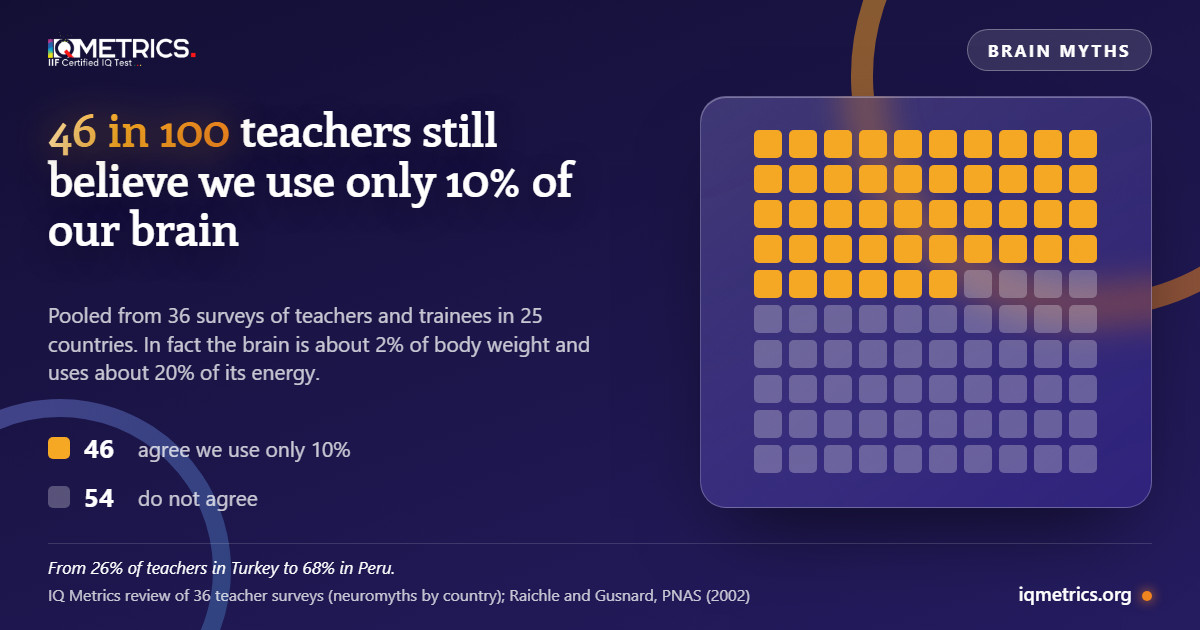
We use virtually all of our brain over a day. The 10% figure has no scientific source: it grew out of a 1907 essay that never mentioned brain tissue, yet about half of teachers in 36 surveys still agree with it.

Smartest European Country? PISA, Adult Skills and IQ Estimates
Estonia ranks first in Europe on PISA 2025, and Finland ranks first on adult skills and on national IQ estimates. Across 23 European countries the school and adult rankings barely agree, and the IQ estimates rest on small and uneven samples.
Read the research.
Then find your own number.
Our IIF-certified assessment reports your score with its scale, percentile and confidence range — and a breakdown of the cognitive domains behind it.
Start IQ Test →