Smartest animals: neurons vs test scores in 222 species
Which animal is the smartest? We put every published neuron count we could check, 222 species from shrews to elephants, beside the one self-control test given the same way to dozens of species. The answer changes with the measure, and the tests put ravens beside chimpanzees.

By Leon Falkner, Data & Research Analyst · Reviewed by Aarav Vardhan, Editor-in-Chief · Published 23 October 2026 · 12 min read
About this study
- Report type
- Data study from published research
- Data
- Neuron counts from 14 papers (2007-2022); self-control tests (2014, 2016); ManyPrimates memory test (2022); mirror tests (1970-2019)
- Covers
- 222 species with neuron counts (49 mammals, 65 birds, 108 reptiles); 39 species tested for self-control
- Checked
- 23 October 2026, every number against the papers' own tables
- Licence
- CC BY 4.0
- Version
- 2026.10
- Sources
- 33
There is no single smartest animal: the winner depends on what you measure. Across 222 species with published neuron counts, the African elephant has the most neurons (257 billion), the long-finned pilot whale the most in the cortex (37.2 billion) and humans the largest brain for their body (EQ 8.3). On a self-control test, ravens matched chimpanzees at 100%.
01 Key findings
- The top animal changes with the measure. Among 222 species, the African elephant has the heaviest brain (4.6 kg) and the most neurons (257 billion); the long-finned pilot whale has the most neurons in the cortex (37.2 billion, against 16.3 billion in humans); humans have the highest EQ (8.3).Neuron counts published 2007-2022 (Herculano-Houzel et al. 2014; Mortensen et al. 2014; Azevedo et al. 2009); n = 222 species
- Ravens tie chimpanzees on self-control. On the cylinder task, ravens and chimpanzees both scored 100%, jackdaws 97% and New Caledonian crows 92%, level with gorillas (94%) and above dogs (79%).MacLean et al. 2014 (open data) and Kabadayi et al. 2016; 35 species, 464 animals
- Bigger brains and more cortical neurons go with better self-control. In the 8 species with every measure, the rank correlation with the cylinder task is 0.80 for cortex or pallium neurons (95% CI 0.20 to 0.96), 0.74 for EQ and 0.73 for brain mass. The intervals overlap, so the data cannot yet single out one measure.IQ Metrics Research, October 2026; n = 8 species
- Birds pack about 3.9 times as many neurons into the pallium as mammals put in the cortex at the same 10-gram brain (95% CI 2.9 to 5.4).IQ Metrics Research fit of 65 birds and 44 mammals (Olkowicz et al. 2016; Kverkova et al. 2022 and others)
- Good at one test, good at another. Primate species that scored well on self-control also did well on the ManyPrimates short-term memory test (rank correlation 0.73, 95% CI 0.28 to 0.92).13 primate species in both studies (MacLean et al. 2014; ManyPrimates et al. 2022)
02 Statistics to quote
Neurons in an African elephant’s brain, the most counted in any animal (humans: 86.1 billion).
Herculano-Houzel et al. 2014; Azevedo et al. 2009Ravens and chimpanzees on the cylinder self-control task; dogs scored 79%.
MacLean et al. 2014; Kabadayi et al. 2016Neurons birds pack into the pallium, against mammals’ cortex, at the same 10-gram brain (95% CI 2.9 to 5.4).
IQ Metrics Research, 65 birds, 44 mammals03 What is the smartest animal?
Every “smartest animal” list picks one yardstick and calls the result intelligence. We put the main yardsticks side by side for the same animals, using only numbers measured in primary studies: brain mass, brain size for body size, neuron counts and scores on a test given the same way to dozens of species. No yardstick gives an animal an IQ score: IQ tests are built and normed for people.
- Brain mass
- The weight of the whole brain in grams. Big bodies need big brains to run them, so on this measure the largest animals win: the elephant (4.6 kg) and the pilot whale (3.6 kg) beat humans (1.5 kg) [11] [12] [4].
- Brain size for body size (EQ)
- The encephalization quotient: the brain mass divided by the mass expected for an animal of that body weight, here 0.12 x body mass2/3 in grams [20]. 1 = as expected; humans score 8.3, the dog 0.99.
- Neurons in the whole brain
- The total count of nerve cells, measured by dissolving the brain into a soup of cell nuclei and counting the ones that carry a neuron marker (the isotropic fractionator). Most of them sit in the cerebellum, which controls movement.
- Neurons in the cortex or pallium
- The cells in the mammal cerebral cortex, or in the bird pallium, which does the same kind of work: memory, planning and problem solving. Some neuroscientists argue that this count explains differences in thinking ability better than brain size does [11].
- Self-control score
- How often an animal holds back from reaching straight at visible food and takes the detour that works [16]. It is one ability, measured the same way across dozens of species, not a measure of overall intelligence.
Who comes first depends on what you measure
Rank among 14 well-known animals on three measures of brain capacity (1 = highest). Blue: climbs 3 or more places from brain mass to cortex or pallium neurons; orange-red: drops 3 or more. Whole-brain neurons are in Figure 2 and Table 1.
EQ = brain size for body size. Cortex neurons = the cerebral cortex in mammals, the pallium in birds. Chimpanzee: one animal, one hemisphere counted and doubled.
Source: IQ Metrics Research ranks from the published counts [1] [2] [8] [6] [4] [7] [3] [5] [9] [10] [11] [12] [13] [14]; EQ after Jerison [20]; body masses not given in the neuron papers from PanTHERIA [15]
Data table
| animal | Brain mass | EQ | Cortex neurons |
|---|---|---|---|
| Human | 3 | 1 | 2 |
| African elephant | 1 | 6 | 4 |
| Long-finned pilot whale | 2 | 2 | 1 |
| Chimpanzee | 5 | 4 | 3 |
| Yellow baboon | 8 | 3 | 5 |
| Giraffe | 4 | 10 | 7 |
| Brown bear | 6 | 11 | 12 |
| Lion | 7 | 12 | 9 |
| Dog | 9 | 9 | 10 |
| Pig | 10 | 14 | 11 |
| Cat | 11 | 8 | 13 |
| Common raven | 13 | 7 | 8 |
| Blue-and-yellow macaw | 12 | 5 | 6 |
| Rat | 14 | 13 | 14 |
Embed this chart
Paste this HTML into your page: it carries the numbers and the credit link to this figure.
Humans are near the top on every brain measure, but first on only one: EQ. The African elephant has the heaviest brain and 257 billion neurons, three times the human count, yet 251 billion of them (98%) sit in the cerebellum, which controls movement [11]. On neurons in the cortex, the long-finned pilot whale leads with 37.2 billion [12]. Birds climb the furthest: the blue-and-yellow macaw’s 21-gram brain ranks 12 of 14 by mass but 6 by cortex or pallium neurons (1.9 billion) [2].
04 Which animal has the most neurons?
The African elephant: 257 billion neurons in one adult male’s brain [11], against 86.1 billion in the adult human brain (four men counted) [3]. Counting only the cortex, the record holder is the long-finned pilot whale at 37.2 billion (neocortex, 10 whales) [12], then humans (16.3 billion) and the chimpanzee (about 7.4 billion, from one hemisphere) [5]. Our data set holds 222 species with a published count: 49 mammals, 65 birds and 108 reptiles, from 14 papers published 2007-2022.
Brain mass and neurons in 219 species
Each bubble is one species: brain mass across, neurons in the whole brain up. Both axes are logarithmic (each step is ten times the one before). Bubble area = body mass. At the same brain mass, birds sit above mammals and reptiles below.
Neurons in the whole brain (log scale)
Brain mass (grams, log scale)
Body mass keys: 1k = 1 kg, 100k = 100 kg, 1M = 1 tonne (grams).
Source: IQ Metrics Research from the published neuron counts (14 papers, 2007-2022) [1] [2] [8] [6] [4] [7] [3] [5] [9] [10] [11] [12] [13] [14] and PanTHERIA body masses [15]
Data table
| species | brain_mass_g | neurons_whole_brain | group | body_mass_g |
|---|---|---|---|---|
| Naked mole-rat | 0.4 | 26880000 | mammal | 23.3 |
| House mouse | 0.4 | 67870000 | mammal | 40.4 |
| Golden hamster | 1 | 84220000 | mammal | 168.1 |
| Rat | 1.7 | 188870000 | mammal | 315.1 |
| Spiny rat | 2.1 | 202090000 | mammal | 223.5 |
| Guinea pig | 3.7 | 233560000 | mammal | 311 |
| Prairie dog | 5.3 | 473940000 | mammal | 1515 |
| Grey squirrel | 5.5 | 453660000 | mammal | 500 |
| Rabbit | 9.1 | 494200000 | mammal | 4600 |
| Agouti | 17.6 | 795110000 | mammal | 2843.3 |
| Capybara | 74.7 | 1572560000 | mammal | 47500 |
| Tree shrew | 2.8 | 261400000 | mammal | 172.5 |
| Common marmoset | 7.8 | 635800000 | primate | 361 |
| Northern greater galago | 10.2 | 936000000 | primate | 946.7 |
| Owl monkey | 15.7 | 1468410000 | primate | 925 |
| Squirrel monkey | 30.2 | 3246430000 | primate | 749.5 |
| Capuchin monkey | 52.2 | 3690520000 | primate | 3340 |
| Gray mouse lemur | 1.8 | 254710000 | primate | 60 |
| Long-tailed macaque | 46.2 | 3440000000 | primate | 5700 |
| Bonnet macaque | 61.5 | 3780000000 | primate | 8012 |
| Yellow baboon | 151.2 | 10950000000 | primate | 8000 |
| Human | 1508 | 86100000000 | primate | 58540.6 |
| Ferret | 5.4 | 404430000 | mammal | 800 |
| Banded mongoose | 14.3 | 454020000 | mammal | 1500 |
| Raccoon | 34.2 | 2148070000 | mammal | 6200 |
| Cat | 34.9 | 1215210000 | mammal | 4500 |
| Dog | 86.5 | 2252690000 | mammal | 19700 |
| Striped hyena | 99.2 | 3884600000 | mammal | 40000 |
| Lion | 198.9 | 4667030000 | mammal | 180000 |
| Brown bear | 315 | 9585600000 | mammal | 350000 |
| Pig | 57.8 | 2220000000 | mammal | 100000 |
| Springbok | 102.1 | 3060000000 | mammal | 25000 |
| Blesbok | 155.1 | 3900000000 | mammal | 60000 |
| Greater kudu | 308.5 | 6090000000 | mammal | 218000 |
| Giraffe | 528 | 11210000000 | mammal | 470000 |
| African elephant | 4618.6 | 257040000000 | mammal | 3824539.9 |
| Smoky shrew | 0.2 | 36160000 | mammal | 7.8 |
| Northern short-tailed shrew | 0.3 | 50736300 | mammal | 16.2 |
| Hairy-tailed mole | 0.8 | 123600000 | mammal | 42.7 |
| Star-nosed mole | 0.8 | 131320000 | mammal | 41.4 |
| Eastern mole | 1.1 | 203780000 | mammal | 95.3 |
| Eastern rock elephant shrew | 1 | 129190000 | mammal | 45.1 |
| Four-toed elephant shrew | 2.4 | 156831000 | mammal | 132.5 |
| Hottentot golden mole | 0.8 | 65074000 | mammal | 79 |
| Rock hyrax | 16.9 | 755653000 | mammal | 2517 |
| Western tree hyrax | 12.8 | 504564000 | mammal | 1150 |
| Green-rumped parrotlet | 1.1 | 227200000 | bird | 23.2 |
| Budgerigar | 1.3 | 321820000 | bird | 35.3 |
| Cockatiel | 2.2 | 452770000 | bird | 101 |
| Eastern rosella | 2.7 | 641880000 | bird | 102 |
| Monk parakeet | 3.4 | 696770000 | bird | 94 |
| Alexandrine parakeet | 5.7 | 1096260000 | bird | 223 |
| Goffin's cockatoo | 8.3 | 1160590000 | bird | 244.8 |
| Grey parrot | 8.8 | 1565930000 | bird | 453.5 |
| Sulphur-crested cockatoo | 10.1 | 2121930000 | bird | 430 |
| Kea | 13.6 | 2148670000 | bird | 708 |
| Blue-and-yellow macaw | 20.7 | 3135790000 | bird | 1008 |
| Goldcrest | 0.4 | 163870000 | bird | 4.5 |
| Zebra finch | 0.5 | 135980000 | bird | 17.4 |
| Blackcap | 0.8 | 156730000 | bird | 16.6 |
| Great tit | 0.9 | 225980000 | bird | 17.1 |
| Common starling | 1.9 | 482500000 | bird | 73.1 |
| Common blackbird | 1.9 | 379410000 | bird | 85 |
| Azure-winged magpie | 3.4 | 740590000 | bird | 84.1 |
| Hill mynah | 3.7 | 906130000 | bird | 262.1 |
| Eurasian jay | 4.6 | 1085420000 | bird | 160 |
| Eurasian magpie | 5.4 | 897270000 | bird | 178.6 |
| Jackdaw | 6 | 967990000 | bird | 209.7 |
| Rook | 8.4 | 1508720000 | bird | 429.3 |
| Common raven | 14.1 | 2170680000 | bird | 1070.7 |
| Rock pigeon | 2.1 | 309960000 | bird | 322.5 |
| Red junglefowl (wild chicken) | 2.8 | 220840000 | bird | 861.3 |
| Barn owl | 5.6 | 689540000 | bird | 369.7 |
| Emu | 21.8 | 1335400000 | bird | 32600 |
| Eurasian sparrowhawk | 2.7 | 401751000 | bird | 162.4 |
| Common buzzard | 7.8 | 1001368000 | bird | 749 |
| Black vulture | 10 | 1009366000 | bird | 1747 |
| White-tailed eagle | 19.5 | 1654190000 | bird | 5228.2 |
| Wood duck | 3.8 | 305816000 | bird | 649.3 |
| Eurasian teal | 2.8 | 375409000 | bird | 284.9 |
First 80 of 219 rows; the Data button gives all of them.
Embed this chart
Paste this HTML into your page: it carries the numbers and the credit link to this figure.
The 20 animals with the most neurons in the cortex or pallium
Cortex in mammals, pallium in birds (the forebrain region that does the same work). Millions of neurons; select a column to sort.
| Long-finned pilot whale | 37,200 | – | 3608.2 | Mammal | [12] |
| Human | 16,300 | 86,100 | 1508.0 | Primate | [3] |
| Chimpanzee | 7,400 | – | 344.0 | Primate | [5] |
| African elephant | 5,590 | 257,040 | 4618.6 | Mammal | [11] |
| Yellow baboon | 2,880 | 10,950 | 151.2 | Primate | [7] |
| Blue-and-yellow macaw | 1,918 | 3,136 | 20.7 | Bird | [2] |
| Giraffe | 1,670 | 11,210 | 528.0 | Mammal | [10] |
| Bonnet macaque | 1,660 | 3,780 | 61.5 | Primate | [7] |
| Eurasian eagle-owl | 1,328 | 1,898 | 15.8 | Bird | [1] |
| Kea | 1,282 | 2,149 | 13.6 | Bird | [2] |
| Snowy owl | 1,270 | 1,808 | 17.8 | Bird | [1] |
| Common raven | 1,204 | 2,171 | 14.1 | Bird | [2] |
| Tawny owl | 1,153 | 1,581 | 8.9 | Bird | [1] |
| Sulphur-crested cockatoo | 1,136 | 2,122 | 10.1 | Bird | [2] |
| Capuchin monkey | 1,100 | 3,691 | 52.2 | Primate | [6] |
| Grey parrot | 850 | 1,566 | 8.8 | Bird | [2] |
| Rook | 821 | 1,509 | 8.4 | Bird | [2] |
| Long-tailed macaque | 801 | 3,440 | 46.2 | Primate | [7] |
| Greater kudu | 793 | 6,090 | 308.5 | Mammal | [10] |
| Long-eared owl | 673 | 991 | 5.4 | Bird | [1] |
Source: IQ Metrics Research from the published counts [1] [2] [8] [6] [4] [7] [3] [5] [9] [10] [11] [12] [13] [14]. Pilot whale: neocortex only; chimpanzee: neocortex of one hemisphere x 2
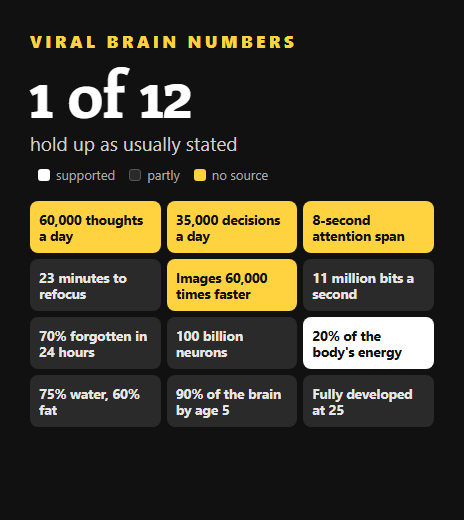
For scale: the whole nervous system of the worm C. elegans has 302 neurons [31] and the brain of a fruit fly 139,255 [32]. The 86 billion human figure replaced an older “100 billion” that nobody had counted: see our fact-check of viral brain numbers.
From 302 neurons to 257 billion
Whole nervous systems and brains counted cell by cell or with the same isotropic-fractionator method as the rest of this study.
| Animal | Neurons | What was counted |
|---|---|---|
| Nematode worm (C. elegans) [31] | 302 | whole nervous system, adult hermaphrodite |
| Fruit fly (Drosophila) [32] | 139,255 | whole brain, one adult female |
| House mouse [8] | 67,870,000 | whole brain |
| Common raven [2] | 2,170,680,000 | whole brain |
| Dog [9] | 2,252,690,000 | whole brain, mean of two dogs |
| Human [3] | 86,100,000,000 | whole brain, four men |
| African elephant [11] | 257,040,000,000 | whole brain, one male |
Source: White et al. 1986 [31], Dorkenwald et al. 2024 [32] and the brain counts in this study
05 Why do small bird brains hold so many neurons?
Bird neurons are smaller and packed more tightly. The median songbird brain holds 218,000 neurons per milligram and the median parrot 198,000, against 78,000 in primates and 63,000 in other mammals. In the pallium alone the gap is wider: about 143,000 neurons per milligram in songbirds and 157,000 in parrots, against 24,000 in the primate cortex.
How tightly brains are packed with neurons
Neurons per milligram of brain, in thousands, for every species with a whole-brain count. Box = the middle half of each group, line = the median species, whiskers = lowest to highest; each dot is one species.
Thousand neurons per milligram of brain.
Source: IQ Metrics Research from the published whole-brain counts and brain masses [1] [2] [8] [6] [4] [7] [3] [5] [9] [10] [11] [12] [13] [14]
Data table
| group | n | low | q1 | median | q3 | high |
|---|---|---|---|---|---|---|
| Songbirds | 13 | 153.6 | 180.5 | 218.3 | 246.9 | 459 |
| Parrots | 11 | 140.3 | 167.7 | 198.3 | 207.4 | 244.4 |
| Other birds | 41 | 40.5 | 84.8 | 110.5 | 146.7 | 215.2 |
| Primates | 10 | 57.1 | 71.1 | 78.1 | 93.1 | 141.6 |
| Other mammals | 36 | 19.7 | 34.1 | 63.4 | 95.6 | 203.9 |
| Reptiles | 108 | 14 | 35.8 | 47.5 | 67.3 | 179.2 |
Embed this chart
Paste this HTML into your page: it carries the numbers and the credit link to this figure.
Fitted across all 65 birds and 44 mammals with both counts, a 10-gram bird brain has about 3.9 times as many pallial neurons as a 10-gram mammal brain has in its cortex (95% CI 2.9 to 5.4; at 1 gram, 3.1 times). That is how a raven, with a 14.1 g brain, has 1.2 billion pallial neurons, more than the 528 million in the cortex of a dog whose brain weighs 86.5 g [2] [9]. Reptile brains are the least dense of the three classes [1].
06 Which animals score highest on intelligence tests?
Few tests have been given the same way to many species. The largest is a 2014 study in which researchers at many labs tested 567 animals of 36 species on two self-control tasks [16]; its data are open [19]. In the cylinder task an animal learns to take food from an opaque tube, then faces a see-through one: reaching straight at the food hits the wall. In the A-not-B task food is hidden twice in one place, then moved to another while the animal watches.
Self-control test scores of 35 species
Cylinder task: food sits inside a see-through tube open at both ends. The animal has to go round to an open end instead of reaching straight at the food. Score = share of 10 test trials done right, averaged over each species' animals (464 animals in all). The three crows (orange) were tested later with the same method.
Source: MacLean et al. 2014 individual data [16] [19] (32 species) and Kabadayi et al. 2016 [17] (3 corvids); species means computed by IQ Metrics Research
Data table
| label | value |
|---|---|
| Chimpanzee | 100 |
| Common raven | 100 |
| Orangutan | 99.1 |
| Jackdaw | 97 |
| Capuchin monkey | 95.9 |
| Bonobo | 95 |
| Coyote | 95 |
| Gorilla | 94.4 |
| New Caledonian crow | 92 |
| Rhesus macaque | 80 |
| Dog | 79.1 |
| Gray wolf | 77.3 |
| Western scrub jay | 76.7 |
| Olive baboon | 76.2 |
| Ruffed lemur | 69.7 |
| Mongolian gerbil | 68.9 |
| Ring-tailed lemur | 68.1 |
| Hamadryas baboon | 67.8 |
| Fox squirrel | 66.9 |
| Red-bellied lemur | 63.8 |
| Golden-headed lion tamarin | 63 |
| Mongoose lemur | 59 |
| Eurasian jay | 58.3 |
| Zebra finch | 52.2 |
| Aye-aye | 51 |
| Black lemur | 51 |
| Orange-winged amazon | 50.8 |
| Brown lemur | 43.3 |
| Coquerel's sifaka | 36.4 |
| Golden snub-nosed monkey | 35 |
| Squirrel monkey | 33.7 |
| Pigeon (White Carneau) | 32.5 |
| Common marmoset | 31.9 |
| Song sparrow | 26.5 |
| Swamp sparrow | 26.1 |
Embed this chart
Paste this HTML into your page: it carries the numbers and the credit link to this figure.
Great apes and crows lead; small songbirds trail. Chimpanzees scored 100%, orangutans 99%, bonobos 95%. Ravens, jackdaws and New Caledonian crows, tested in 2016 with the same method, scored 100%, 97% and 92% [17]. The A-not-B task ranks some species very differently: Asian elephants scored 0 of 7 [19], although elephants are among the few animals that have passed the mirror test.
Species that do well on one test tend to do well on another. Across the 13 primate species tested both on the cylinder task and in the ManyPrimates short-term memory study (421 animals, 41 species in all) [18], the rank correlation is 0.73 (95% CI 0.28 to 0.92).
07 Does a bigger brain make a smarter animal?
Only 10 species have both a neuron count and a cylinder-task score, and 8 of them also have a cortex or pallium count: Capuchin monkey, Chimpanzee, Dog, Zebra finch, Eurasian jay, Jackdaw, Common raven, Rock pigeon. On those 8, all three brain measures track self-control: neurons in the cortex or pallium (rank correlation 0.80, 95% CI 0.20 to 0.96), brain size for body size (0.74) and brain mass (0.73). Whole-brain neurons (0.43, 9 species) and neuron density (0.10) show weaker links.
Which brain measure tracks self-control best?
Rank correlation (Spearman) between each brain measure and the species' self-control score, with its 95% confidence interval. +1 = the bigger the measure, the better the score; 0 = no link. First view: the same 8 species for every measure (the fair comparison); the others use every species that has the measure, so the species differ from row to row.
Spearman rank correlation with the test score, -1 to +1; 0 = no link
Source: IQ Metrics Research from the neuron counts [1] [2] [8] [6] [4] [7] [3] [5] [9] [10] [11] [12] [13] [14] and the self-control data [16] [19] [17]; 95% intervals by Fisher’s z with the Fieller-Hartley-Pearson variance [21]
Data table
| test | study | detail | n | estimate | ci_low | ci_high |
|---|---|---|---|---|---|---|
| Cylinder task, the same 8 species | Neurons in the cortex or pallium | 8 species | 8 | 0.8 | 0.2 | 1 |
| Cylinder task, the same 8 species | Brain size for body size (EQ) | 8 species | 8 | 0.7 | 0.1 | 1 |
| Cylinder task, the same 8 species | Brain mass | 8 species | 8 | 0.7 | 0 | 0.9 |
| Cylinder task, every species with the measure (10 in all) | Brain mass | 10 species | 10 | 0.5 | -0.2 | 0.9 |
| Cylinder task, every species with the measure (10 in all) | Brain size for body size (EQ) | 10 species | 10 | 0.3 | -0.4 | 0.8 |
| Cylinder task, every species with the measure (10 in all) | Neurons in the whole brain | 9 species | 9 | 0.4 | -0.3 | 0.9 |
| Cylinder task, every species with the measure (10 in all) | Neurons in the cortex or pallium | 8 species | 8 | 0.8 | 0.2 | 1 |
| Cylinder task, every species with the measure (10 in all) | Neurons per milligram of brain | 9 species | 9 | 0.1 | -0.6 | 0.7 |
| A-not-B task, every species with the measure (8 in all) | Brain mass | 8 species | 8 | 0.8 | 0.2 | 1 |
| A-not-B task, every species with the measure (8 in all) | Brain size for body size (EQ) | 8 species | 8 | -0.2 | -0.8 | 0.6 |
| A-not-B task, every species with the measure (8 in all) | Neurons in the whole brain | 7 species | 7 | 0.4 | -0.6 | 0.9 |
| A-not-B task, every species with the measure (8 in all) | Neurons in the cortex or pallium | 6 species | 6 | 0.3 | -0.7 | 0.9 |
| A-not-B task, every species with the measure (8 in all) | Neurons per milligram of brain | 7 species | 7 | -0.9 | -1 | -0.4 |
Embed this chart
Paste this HTML into your page: it carries the numbers and the credit link to this figure.
Read the intervals before the ranking: with 8 species they overlap almost completely, so the data cannot say which measure matters most. Dropping any one species moves the cortex correlation between 0.71 and 0.92; over all 10 species, brain mass gives 0.49 and EQ 0.32. On the one-trial A-not-B task (8 species) brain mass comes first (0.81, 95% CI 0.22 to 0.97) and neuron density runs the other way (-0.89, 7 species): the dog, with the least tightly packed brain in that group, scored highest, and the Eurasian jay, with the most tightly packed, second lowest. MacLean and colleagues, with brain volumes for all 36 species and a method that allows for shared ancestry, found that absolute brain size predicted self-control better than brain size for body size [16].
How the measures move together
Spearman rank correlation for each pair, over every species with both values: 107 to 221 species for the brain measures, 8 to 10 for self-control. +1 = always rise together, 0 = no link, -1 = one rises as the other falls.
Source: IQ Metrics Research from the published neuron counts [1] [2] [8] [6] [4] [7] [3] [5] [9] [10] [11] [12] [13] [14] and the self-control data [16] [19] [17]
Data table
| measure | Body mass | Brain mass | Brain size for body size (EQ) | Neurons in the whole brain | Neurons in the cortex or pallium | Neurons per milligram of brain | Self-control (cylinder task) |
|---|---|---|---|---|---|---|---|
| Body mass | 1 | 0.8 | 0.1 | 0.6 | 0.6 | -0.5 | 0.5 |
| Brain mass | 0.8 | 1 | 0.7 | 1 | 0.8 | 0.1 | 0.5 |
| Brain size for body size (EQ) | 0.1 | 0.7 | 1 | 0.8 | 0.6 | 0.6 | 0.3 |
| Neurons in the whole brain | 0.6 | 1 | 0.8 | 1 | 0.9 | 0.2 | 0.4 |
| Neurons in the cortex or pallium | 0.6 | 0.8 | 0.6 | 0.9 | 1 | -0.1 | 0.8 |
| Neurons per milligram of brain | -0.5 | 0.1 | 0.6 | 0.2 | -0.1 | 1 | 0.1 |
| Self-control (cylinder task) | 0.5 | 0.5 | 0.3 | 0.4 | 0.8 | 0.1 | 1 |
Embed this chart
Paste this HTML into your page: it carries the numbers and the credit link to this figure.
Linked, not cause. These are correlations across species. Related species share brains and habits, so they are not independent data points, and a correlation says nothing about why one measure goes with another.
08 How does each animal's brain compare?
Pick an animal to see where it stands on five brain measures against 27 other well-known animals. The raven sits below the middle on brain mass but above it on cortex neurons and density; the brown bear is the reverse, a heavy brain with few cortical neurons.
Pick an animal: its brain on five measures
Each score is the share of the other 27 animals in this list that have a lower value on that measure (0 to 100). EQ = brain size for body size; cortex neurons = cortex in mammals, pallium in birds; density = neurons per milligram of brain. The dashed shape is the middle animal, 50 on every measure.
Source: IQ Metrics Research ranks within the 28 animals, from the published neuron counts [1] [2] [8] [6] [4] [7] [3] [5] [9] [10] [11] [12] [13] [14] and PanTHERIA body masses [15]
Data table
| animal | brain | eq | n | cx | dens |
|---|---|---|---|---|---|
| Human | 96.3 | 100 | 96.3 | 100 | 33.3 |
| African elephant | 100 | 85.2 | 100 | 96.3 | 29.6 |
| Yellow baboon | 81.5 | 96.3 | 88.9 | 92.6 | 48.1 |
| Long-tailed macaque | 66.7 | 63 | 74.1 | 59.3 | 51.9 |
| Capuchin monkey | 70.4 | 92.6 | 77.8 | 70.4 | 44.4 |
| Dog | 77.8 | 48.1 | 66.7 | 51.9 | 7.4 |
| Cat | 59.3 | 55.6 | 29.6 | 18.5 | 14.8 |
| Lion | 85.2 | 29.6 | 81.5 | 55.6 | 3.7 |
| Brown bear | 88.9 | 33.3 | 85.2 | 22.2 | 11.1 |
| Raccoon | 55.6 | 40.7 | 51.9 | 33.3 | 40.7 |
| Pig | 74.1 | 7.4 | 63 | 25.9 | 18.5 |
| Giraffe | 92.6 | 37 | 92.6 | 85.2 | 0 |
| Rabbit | 33.3 | 14.8 | 14.8 | 11.1 | 25.9 |
| Rat | 3.7 | 22.2 | 3.7 | 3.7 | 63 |
| House mouse | 0 | 18.5 | 0 | 0 | 92.6 |
| Common raven | 40.7 | 59.3 | 59.3 | 74.1 | 77.8 |
| Rook | 25.9 | 66.7 | 37 | 63 | 100 |
| Eurasian magpie | 14.8 | 77.8 | 22.2 | 40.7 | 88.9 |
| Jackdaw | 22.2 | 74.1 | 25.9 | 48.1 | 85.2 |
| Grey parrot | 29.6 | 70.4 | 40.7 | 66.7 | 96.3 |
| Blue-and-yellow macaw | 48.1 | 88.9 | 70.4 | 88.9 | 74.1 |
| Kea | 37 | 81.5 | 55.6 | 81.5 | 81.5 |
| Rock pigeon | 7.4 | 25.9 | 11.1 | 14.8 | 70.4 |
| Red junglefowl (wild chicken) | 11.1 | 11.1 | 7.4 | 7.4 | 55.6 |
| Snowy owl | 44.4 | 51.9 | 48.1 | 77.8 | 59.3 |
| Barn owl | 18.5 | 44.4 | 18.5 | 29.6 | 66.7 |
| Emu | 51.9 | 3.7 | 33.3 | 37 | 37 |
| Common ostrich | 63 | 0 | 44.4 | 44.4 | 22.2 |
| Middle animal | 50 | 50 | 50 | 50 | 50 |
Embed this chart
Paste this HTML into your page: it carries the numbers and the credit link to this figure.
09 Which animals pass the mirror test?
The mirror test asks whether an animal recognises its own reflection. Few species pass, and results within a species vary: one of three Asian elephants passed [26], and jackdaws, close relatives of the magpies that passed, did not [27] [28]. A fish, the cleaner wrasse, passed a modified version [30]. Of the animals in the table, only humans, chimpanzees, magpies, jackdaws and pigeons also have neuron counts in our data.
The mirror test, in the original studies
An animal is marked where it can only see the mark in a mirror. Touching or rubbing the mark in front of the mirror counts as a pass.
| Animal and study | Result in the study |
|---|---|
| Human children Amsterdam 1972 [24] | Pass, before age two |
| Chimpanzee Gallup 1970 [22] | Pass |
| Orangutan Suarez and Gallup 1981 [23] | Pass |
| Gorilla Suarez and Gallup 1981 [23] | No pass in that study |
| Monkeys Gallup 1970 [22] | No pass |
| Bottlenose dolphin Reiss and Marino 2001 [25] | Pass, 2 of 2 |
| Asian elephant Plotnik et al. 2006 [26] | 1 of 3 passed |
| Eurasian magpie Prior et al. 2008 [27] | 2 of 5 touched the mark |
| Jackdaw Soler et al. 2014 [28] | 0 of 9 passed |
| Rock pigeon Epstein et al. 1981 [29] | 3 of 3, after training |
| Cleaner wrasse (a fish) Kohda et al. 2019 [30] | 3 of 4 scraped the mark |
Source: The original papers, read October 2026 (abstracts and open full texts). Pigeons: the authors explain the result by training. Cleaner wrasse: a modified test with a coloured tag under the skin
10 How can teachers use this data?
The CSV and every figure may be reused with credit under CC BY 4.0, ready for a biology, psychology or neuroscience class. Four activities:
- Rank it three ways. Sort the CSV by brain mass, then EQ, then cortex or pallium neurons, and track five animals. Which one moves the most, and why?
- Work out an EQ. A dog has an 86.5 g brain and a 19.7 kg body. Compute 0.12 x 19,7002/3 = 87.5 g, then 86.5 / 87.5 = 0.99. Try it for a raven.
- Correlation is not cause. Take the 8 species named above Figure 5, rank them by brain mass and by test score, and compute a rank correlation by hand. Then ask what else, such as diet or family tree, could explain the link.
- Design a fair test. A cylinder suits a crow and a chimpanzee, but what about an elephant or a fish? Compare the A-not-B result for elephants with their mirror-test result.
Brain Awareness Week: 15 to 21 March 2027
The Dana Foundation’s week of public brain science runs 15 to 21 March 2027 [33]. Each figure has an Image button that saves a print-ready PNG for a poster or slide, with the source line included.
Our animal guides go deeper on single species: crows and ravens, parrots, chimpanzees, gorillas, dolphins, elephants, dogs, cats, pigs, horses, octopuses.
Animals have no IQ score. People can measure theirs.
The IQ Metrics test measures your own pattern reasoning, with no tools and no shortcuts.
Take the IQ test11 How we built the data set
- 01
Collect the counts
Every neuron count in the data set comes from a primary paper that counted whole brains with the isotropic fractionator (or, for the pilot whale and the chimpanzee, stereology and flow fractionation), read from the paper’s own tables: 14 papers, 2007-2022. We did not copy any secondary list.
- 02
Make them comparable
Whole brain without the olfactory bulbs; cortex with the hippocampus, as most of these papers count it. Bird pallium = telencephalon minus the subpallium share in Olkowicz et al. [2]. One-hemisphere counts are doubled (marked in the CSV).
- 03
- 04
- 05
Join by species name
Tests and counts are joined only when the scientific name matches. The one exception is the squirrel monkey, named only at genus level in the test file (flagged in the CSV).
- 06
Check every number
A script confirms that each typed number appears verbatim in its paper’s table; birds and reptiles are read straight from the papers’ files. 95% intervals for rank correlations use Fisher’s z with the Fieller-Hartley-Pearson variance [21]; the bird and mammal gap uses 4,000 bootstrap resamples.
What this study cannot tell you
- Only 10 species have both a neuron count and a self-control score (8 with a cortex or pallium count), so the correlations are uncertain and could change with a few more species. They do not allow for shared ancestry.
- The cortex counts of four small primates and the tree shrew (Herculano-Houzel et al. 2007) are only in a supplement we could not open, so those cells are blank. The capuchin’s cortex figure (1.1 billion) is the rounded number the same lab quotes.
- Most counts come from one to three animals per species, often zoo or culled animals; the chimpanzee is one 53-year-old female and the elephant one male.
- The cylinder and A-not-B tasks measure self-control with food. Animals differ in hands, beaks, eyesight and motivation, so a low score can reflect the task rather than the mind.
- The octopus is left out: its classic neuron count (Young, 1963) could not be checked in the original, and later summaries quote totals from about 30 million to 500 million.
- The public A-not-B file holds 345 records; the 2014 paper reports 344. We used the file as published.
- Brain mass and body mass come from the animals counted, not species averages, except where the CSV names PanTHERIA.
Updated 23 October 2026. We will refresh the data set before Brain Awareness Week in March 2027 and then once a year, adding neuron counts and multi-species test results published since. Corrections: tell us and we will check them for the next version.
Sources
- Proc Natl Acad Sci USA 2022;119(11):e2121624119. Dataset S1. Kverková K, Marhounová L, Polonyiová A, et al: The evolution of brain neuron numbers in amniotes. 2022. doi.org/10.1073/pnas.2121624119CC BY 4.0
- Proc Natl Acad Sci USA 2016;113(26):7255-7260. Tables S1, S3, S4. Olkowicz S, Kocourek M, Lučan RK, et al: Birds have primate-like numbers of neurons in the forebrain. 2016. doi.org/10.1073/pnas.1517131113PNAS open access option (open to read)
- J Comp Neurol 2009;513(5):532-541. Azevedo FAC, Carvalho LRB, Grinberg LT, et al: Equal numbers of neuronal and nonneuronal cells make the human brain an isometrically scaled-up primate brain. 2009. doi.org/10.1002/cne.21974Wiley (abstract)
- Front Hum Neurosci 2009;3:31. Table 2. Herculano-Houzel S: The human brain in numbers: a linearly scaled-up primate brain. 2009. doi.org/10.3389/neuro.09.031.2009Frontiers open access (use with credit)
- Proc Natl Acad Sci USA 2016;113(3):740-745. Collins CE, Turner EC, Sawyer EK, et al: Cortical cell and neuron density estimates in one chimpanzee hemisphere. 2016. doi.org/10.1073/pnas.1524208113PNAS (open to read)
- Proc Natl Acad Sci USA 2007;104(9):3562-3567. Table 1. Herculano-Houzel S, Collins CE, Wong P, Kaas JH: Cellular scaling rules for primate brains. 2007. doi.org/10.1073/pnas.0611396104PNAS (open to read)
- Brain Behav Evol 2010;76(1):32-44. Table 1. Gabi M, Collins CE, Wong P, et al: Cellular scaling rules for the brains of an extended number of primate species. 2010. doi.org/10.1159/000319872Karger (full text in PMC)
- Brain Behav Evol 2011;78(4):302-314. Table 1. Herculano-Houzel S, Ribeiro P, Campos L, et al: Updated neuronal scaling rules for the brains of Glires (rodents/lagomorphs). 2011. doi.org/10.1159/000330825Karger (full text in PMC)
- Front Neuroanat 2017;11:118. Table 1. Jardim-Messeder D, Lambert K, Noctor S, et al: Dogs have the most neurons, though not the largest brain: trade-off between body mass and number of neurons in the cerebral cortex of large carnivoran species. 2017. doi.org/10.3389/fnana.2017.00118CC BY 4.0
- Front Neuroanat 2014;8:128. Table 1. Kazu RS, Maldonado J, Mota B, Manger PR, Herculano-Houzel S: Cellular scaling rules for the brain of Artiodactyla include a highly folded cortex with few neurons. 2014. doi.org/10.3389/fnana.2014.00128CC BY 4.0
- Front Neuroanat 2014;8:46. Table 1. Herculano-Houzel S, Avelino-de-Souza K, Neves K, et al: The elephant brain in numbers. 2014. doi.org/10.3389/fnana.2014.00046CC BY 4.0
- Front Neuroanat 2014;8:132. Tables 1 and 2. Mortensen HS, Pakkenberg B, Dam M, et al: Quantitative relationships in delphinid neocortex. 2014. doi.org/10.3389/fnana.2014.00132CC BY 4.0
- Front Neuroanat 2009;3:8. Tables 1 and 2. Sarko DK, Catania KC, Leitch DB, Kaas JH, Herculano-Houzel S: Cellular scaling rules of insectivore brains. 2009. doi.org/10.3389/neuro.05.008.2009Frontiers open access (use with credit)
- Front Neuroanat 2014;8:5. Table 1. Neves K, Meireles Ferreira F, Tovar-Moll F, et al: Cellular scaling rules for the brain of afrotherians. 2014. doi.org/10.3389/fnana.2014.00005CC BY 3.0
- Ecology 2009;90(9):2648. Ecological Archives E090-184, adult body mass. Jones KE, Bielby J, Cardillo M, et al: PanTHERIA: a species-level database of life history, ecology, and geography of extant and recently extinct mammals. 2009. doi.org/10.1890/08-1494.1No copyright restrictions (data set metadata)
- Proc Natl Acad Sci USA 2014;111(20):E2140-E2148. Individual data: figshare 10.6084/m9.figshare.5579335. MacLean EL, Hare B, Nunn CL, et al: The evolution of self-control. 2014. doi.org/10.1073/pnas.1323533111Data CC BY 4.0 (figshare); paper PNAS
- R Soc Open Sci 2016;3(4):160104. Table 1. Kabadayi C, Taylor LA, von Bayern AMP, Osvath M: Ravens, New Caledonian crows and jackdaws parallel great apes in motor self-regulation despite smaller brains. 2016. doi.org/10.1098/rsos.160104CC BY 4.0
- Anim Behav Cogn 2022;9(4):428-516. Data: github.com/ManyPrimates/mp1_short_term_memory. ManyPrimates, Aguenounon G, Allritz M, et al: The evolution of primate short-term memory. 2022. doi.org/10.26451/abc.09.04.06.2022CC BY 4.0 (paper)
- figshare. MacLean E. L.: MacLean et al. PNAS 2014 Self-Control Data (one row per animal, cylinder and A-not-B tasks). 2017. doi.org/10.6084/m9.figshare.5579335CC BY 4.0
- Academic Press, New York (library copy on the Internet Archive). Jerison H. J.: Evolution of the Brain and Intelligence (the encephalization quotient, EQ = brain / 0.12 x body^2/3). 1973. archive.org/details/evolutionofbrain0000jeriBook; formula only
- Biometrika 44, 470. Fieller E. C., Hartley H. O., Pearson E. S.: Tests for rank correlation coefficients. I (the variance used for the 95% intervals). 1957. doi.org/10.2307/2332878Method only
- Science 167(3914), 86-87. Gallup G. G.: Chimpanzees: self-recognition. 1970. doi.org/10.1126/science.167.3914.86Abstract (Science)
- Journal of Human Evolution 10(2), 175-188. Suarez S. D., Gallup G. G.: Self-recognition in chimpanzees and orangutans, but not gorillas. 1981. doi.org/10.1016/S0047-2484(81)80016-4Title (Elsevier)
- Developmental Psychobiology 5(4), 297-305. Amsterdam B.: Mirror self-image reactions before age two. 1972. doi.org/10.1002/dev.420050403Title (Wiley)
- Proc Natl Acad Sci USA 98(10), 5937-5942. Reiss D., Marino L.: Mirror self-recognition in the bottlenose dolphin: a case of cognitive convergence. 2001. doi.org/10.1073/pnas.101086398PNAS (open to read)
- Proc Natl Acad Sci USA 103(45), 17053-17057. Plotnik J. M., de Waal F. B. M., Reiss D.: Self-recognition in an Asian elephant. 2006. doi.org/10.1073/pnas.0608062103PNAS (open to read)
- PLoS Biology 6(8), e202. Prior H., Schwarz A., Güntürkün O.: Mirror-induced behavior in the magpie (Pica pica): evidence of self-recognition. 2008. doi.org/10.1371/journal.pbio.0060202CC BY 4.0
- PLoS ONE 9(1), e86193. Soler M., Pérez-Contreras T., Peralta-Sánchez J. M.: Mirror-mark tests performed on jackdaws reveal potential methodological problems in the use of stickers in avian mark-test studies. 2014. doi.org/10.1371/journal.pone.0086193CC BY 4.0
- Science 212(4495), 695-696. Epstein R., Lanza R. P., Skinner B. F.: "Self-awareness" in the pigeon. 1981. doi.org/10.1126/science.212.4495.695Abstract (Science)
- PLoS Biology 17(2), e3000021. Kohda M., Hotta T., Takeyama T., et al.: If a fish can pass the mark test, what are the implications for consciousness and self-awareness testing in animals?. 2019. doi.org/10.1371/journal.pbio.3000021CC BY 4.0
- Phil Trans R Soc Lond B 314(1165), 1-340. White J. G., Southgate E., Thomson J. N., Brenner S.: The structure of the nervous system of the nematode Caenorhabditis elegans. 1986. doi.org/10.1098/rstb.1986.0056Abstract (Royal Society)
- Nature 634, 124-138. Dorkenwald S., Matsliah A., Sterling A. R., et al.: Neuronal wiring diagram of an adult brain. 2024. doi.org/10.1038/s41586-024-07558-yCC BY 4.0
- Dana Foundation. Dana Foundation: When is Brain Awareness Week? (upcoming dates: March 15-21, 2027). 2026. dana.org/faqs/when-is-brain-awareness-weekQuoted date only
Version history
- 2026.1023 October 2026First release.
Leon Falkner, Data & Research Analyst. Leon owns the arithmetic on IQ Metrics: the percentile tables, the score converter and the figures in everyone else's drafts. On the research desk Leon pulls the data, builds each index and writes the method. More about Leon.
Questions
What is the smartest animal?
It depends on the measure. Humans have the largest brain for their body size; the African elephant has the most neurons (257 billion); the long-finned pilot whale has the most in the cortex (37.2 billion). On the cylinder self-control test, chimpanzees and ravens tie at 100%.
Which animal has the most neurons?
The African elephant, with 257 billion in the whole brain of one adult male. In the cortex alone the long-finned pilot whale leads with 37.2 billion, more than twice the human 16.3 billion. Among birds, the blue-and-yellow macaw has the most pallial neurons counted (1.9 billion).
Do animals have an IQ?
No. IQ tests are built and normed for people, so no animal has an IQ score. Researchers compare species on single tasks, such as the cylinder self-control task, and on brain measures such as neuron counts.
Are birds smarter than mammals?
Not across the board, but crows and parrots match great apes on some tests, and bird brains are densely packed: at the same 10-gram brain mass, birds have about 3.9 times as many neurons in the pallium as mammals have in the cortex.
Can I use this data in a class or an article?
Yes. The data set and figures are published under CC BY 4.0: reuse them with credit to IQ Metrics Research and a link to this page. The neuron counts and test scores are other researchers' work; cite them as listed in the sources.
Share it, cite it, download it
You may reuse everything on this page under CC BY 4.0: in articles, reports, lessons and posts. The one condition is credit to IQ Metrics with a link to this page.
Cite this study
Version 2026.10. Citing the version lets readers find the exact numbers.
Archived copy with a DOI: 10.5281/zenodo.23589593 (report PDF and data on Zenodo).
Falkner, L. (2026). Smartest animals: neurons vs test scores in 222 species (Version 2026.10) [Data set]. IQ Metrics Research. https://iqmetrics.org/research/smartest-animals/ (DOI: 10.5281/zenodo.23589593)
Falkner, Leon. "Smartest animals: neurons vs test scores in 222 species." IQ Metrics Research, 23 Oct. 2026, iqmetrics.org/research/smartest-animals/. DOI: 10.5281/zenodo.23589593.
Falkner, Leon. "Smartest animals: neurons vs test scores in 222 species." IQ Metrics Research. October 23, 2026. https://iqmetrics.org/research/smartest-animals/. DOI: 10.5281/zenodo.23589593.
@misc{iqmetrics2026smartestanimals, author = {Falkner, Leon}, title = {Smartest animals: neurons vs test scores in 222 species}, institution = {IQ Metrics}, year = {2026}, version = {2026.10}, doi = {10.5281/zenodo.23589593}, url = {https://iqmetrics.org/research/smartest-animals/} }
Source: Leon Falkner, "Smartest animals: neurons vs test scores in 222 species." IQ Metrics Research, version 2026.10, https://iqmetrics.org/research/smartest-animals/ (DOI 10.5281/zenodo.23589593)
Embed the rankings
Paste this into your page or post. It lists the four leaders and credits the source.
Get the data
One row per species: 222 with published neuron counts (mammals, birds, reptiles) and 28 more that were only tested. Brain and body mass, EQ, whole-brain and cortex or pallium neurons, densities, self-control scores (cylinder and A-not-B), ManyPrimates short-term memory where available, and the source and licence of every row.
| Column | What it holds |
|---|---|
species, scientific_name, class, group | The animal; group = Primates, Other mammals, Songbirds, Parrots, Other birds or Reptiles |
body_mass_g, brain_mass_g, eq_jerison | Grams; EQ = brain / (0.12 x body^(2/3)) after Jerison (1973) |
neurons_whole_brain, neurons_cortex_or_pallium, cortex_or_pallium_mass_g | Counts of neurons; cortex in mammals, pallium in birds |
neurons_per_mg_brain, neurons_per_mg_cortex_or_pallium | Neuron density per milligram |
cylinder_task_pct_correct, cylinder_task_animals, a_not_b_task_pct_correct, a_not_b_task_animals | Species mean score (%) and the number of animals tested |
self_control_source, self_control_match | MacLean et al. 2014 or Kabadayi et al. 2016; species or genus-level match |
manyprimates_memory_pct_correct, manyprimates_animals | ManyPrimates short-term memory, % of trials correct (chance = 33%) |
neuron_source, neuron_source_2, body_mass_source, source_licence, notes | Where each number comes from and its licence |
For journalists, researchers and teachers
Everything on this page may be quoted, charted and republished with credit. No embargo and no sign-up. If you need a number that is not here, ask; if a newer count exists, tell us and we will check it for the next version.
Summary you can paste
Plain news style. Edit freely; keep the credit.
There is no single smartest animal, according to an IQ Metrics Research data set that puts published neuron counts for 222 species beside self-control test scores. The African elephant has the most neurons (257 billion), the long-finned pilot whale the most in the cortex (37.2 billion), humans the largest brain for their body (EQ 8.3), and ravens tie chimpanzees at 100% on the cylinder self-control task. Source: IQ Metrics Research, https://iqmetrics.org/research/smartest-animals/
Angles for a story
- A raven’s 14-gram brain matches a chimpanzee’s on self-control (the scores).
- The pilot whale has more cortical neurons than any human (the top 20).
- Bird brains pack about 3.9 times the neurons of mammal brains of the same mass (the density chart).
- Why “smartest animal” lists disagree: each yardstick crowns a different winner (the rankings).
- For Brain Awareness Week (15-21 March 2027): classroom activities with open data (for teachers).
Quotes you can use
Attributable as written, with the name and title. For a different angle or a quote on a specific figure, ask through the contact page.
There is no single smartest animal. Rank by brain mass and the elephant wins, by neurons in the cortex the pilot whale, by brain size for body size humans, and on self-control a raven ties a chimpanzee.
Leon Falkner, Data & Research Analyst, IQ Metrics ResearchA raven’s brain weighs 14 grams, a dog’s 86, yet the raven has more neurons in its forebrain. Bird neurons are packed about 3.9 times as tightly at the same brain size.
Leon Falkner, Data & Research Analyst, IQ Metrics ResearchEight species with every measure is not enough to crown one of them. Cortical neurons, brain size and EQ all track self-control and their intervals overlap; we need more species tested the same way.
Leon Falkner, Data & Research Analyst, IQ Metrics Research
Files
- CSV, one row per species, 25 columns (CC BY 4.0)
- Every figure as a print-ready PNG: white background, 2000 px wide, title and source line included. Use the Image button under each figure.
Terms, contact and corrections
Credit: “IQ Metrics Research, Smartest animals: neurons vs test scores (2026)” with a link to this page. On air or in print, “IQ Metrics” and the page address are enough.
The counts and test scores are other researchers’ work: cite each study as listed in Sources. The compilation, the rankings and the statistics are ours.
Corrections: made on this page with a dated note in the version history.