





Cat IQ: How Smart Are Cats Compared With Dogs and Humans?
Cats have no IQ: no validated test gives one. Studies measure narrower skills. Cats tell their own names from other words and follow a pointing finger as well as dogs do, but struggle with hidden-object puzzles, and a cat's cortex holds about 250 million neurons against 429 to 627 million in the dogs counted.

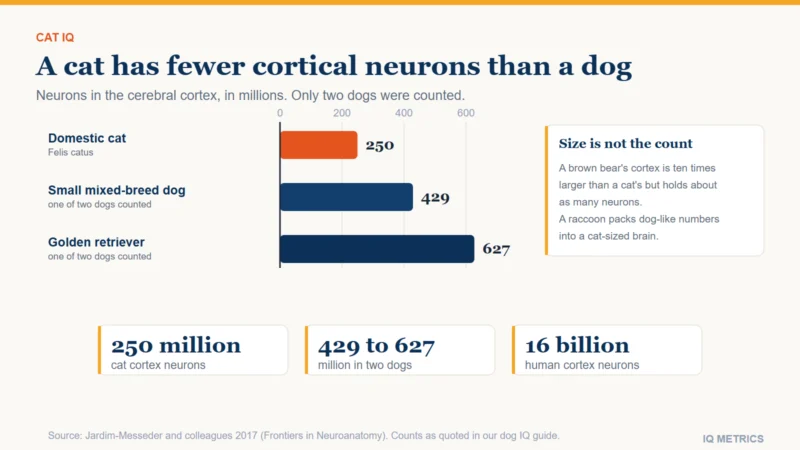
Cats do not have an IQ score. No validated intelligence test produces one for cats, so any number quoted as a cat IQ is not a test result. What researchers can measure is a list of separate abilities, and the list is shorter than it is for dogs: cats tell their own names from other words, follow a person's pointing finger about as well as dogs do and form attachment bonds with their owners, but they struggle with some hidden-object puzzles, and the cortex of a domestic cat holds about 250 million neurons against 429 to 627 million in the dogs counted. This guide sets out what the studies found, how cats compare with dogs and humans, and why a cat's result on any test is hard to read.
- Cat IQ: none. There is no norm sample of cats and no standard test, so researchers test one skill at a time.
- Names: household cats told their own names from general nouns in habituation experiments (Saito and colleagues, 2019).
- Pointing: cats and dogs both used human pointing gestures to find hidden food, with no significant difference between them (Miklósi and colleagues, 2005).
- Hidden objects: cats find an object that is moved visibly behind screens, but search in the wrong place when it is moved out of sight (Goulet and colleagues, 1994).
- Neurons: about 250 million in a cat's cerebral cortex, against 429 million in a small mixed-breed dog and 627 million in a golden retriever (Jardim-Messeder and colleagues, 2017).
The comparison most readers want is with dogs, and our dog IQ guide makes the same point for them: there is no dog IQ either, only separate tasks. Cats are also the less studied of the two. A 2019 paper in Current Biology opens by noting that domestic cats outnumber domestic dogs worldwide, yet dog social cognition has received far more scientific attention.
Is there a cat IQ test?
No. An IQ score is a position on a bell curve: a test is given to thousands of people, the results are ranked, and each person's rank is printed on a scale whose average is 100 (at the top of that scale, an IQ of 145 is about 1 person in 741). Nothing like that exists for cats. There is no standard test, no norm sample and no agreed way to make a cat try. Researchers therefore run single experiments, each measuring one narrow skill, and report whether cats as a group do better than chance. Our explainer on how IQ tests work shows what a real score needs that a cat experiment lacks.
The online quizzes that return a “cat IQ” are owner questionnaires or entertainment. The figures that circulate as a cat's IQ are often a different measure, such as brain size relative to body size, which is not a test of behaviour at all. A 2015 review in Animal Cognition surveyed cat research on perception, object permanence, memory, physical causality, quantity and time discrimination, response to human cues, vocal communication, attachment, personality and cognitive health, and concluded that the field is young: little scientific work had gone into the domestic cat, especially compared with the dog.
How smart are cats compared with dogs?
It depends on which ability you pick. On the few direct comparisons that exist, the two animals are closer than the stereotype suggests. The table sets out what the studies in this guide found.
| Ability | Cats | Dogs |
|---|---|---|
| Cerebral cortex neurons | About 250 million | 429 million (small mixed-breed dog), 627 million (golden retriever) |
| Using a human pointing gesture to find hidden food | Succeeded (Miklósi, 2005) | Succeeded; no significant difference from cats |
| Getting a person's attention when the food is out of reach | Lacked some attention-getting behaviours | Showed more of them in the same experiment |
| Attachment to a human caregiver | Distinct attachment styles shown (Vitale, 2019) | Secure attachments to humans documented in earlier studies |
Neuron counts favour dogs, but they are a crude proxy. The same 2017 count found that a brown bear's far larger cortex holds only about as many neurons as a cat's, and that raccoons have dog-like numbers of neurons in a cat-sized brain. More neurons do not simply mean more intelligence, and only two dogs were counted. For scale, the human cerebral cortex holds about 16 billion neurons, roughly 64 times the cat figure; no test puts the two on one scale.
What have scientists found that cats can do?
- Know their names. In a 2019 study of four experiments, household cats that had heard a series of general nouns, or the names of cats they lived with, showed a renewed response when they heard their own names, and the result held for general nouns spoken by unfamiliar people. Cats from a cat cafe told their names from general nouns but not from the names of the other cats living with them (Saito and colleagues, 2019).
- Keep a mental map of where their owner is. Cats left alone in a familiar room showed most surprise when their owner's voice, which they had just heard from one speaker, came from a different one. The reaction disappeared when the sound was another cat's vocalization or a non-vocal sound, so cats appear to link the owner's voice with the owner's position (Takagi and colleagues, 2021).
- Follow a pointing gesture. Cats and dogs both used four kinds of human pointing gesture to find hidden food, with no significant difference in performance. When the food was made inaccessible and the animal had to show a naive owner where it was, the cats lacked some of the attention-getting behaviours the dogs showed (Miklósi and colleagues, 2005).
- Form attachment bonds. Using behavioural criteria from the infant attachment literature, a 2019 study found that cats show distinct attachment styles toward their human caregivers, which suggests that attachment across species needs explanations broader than “dogs are special” (Vitale and colleagues, 2019).
Do cats understand that hidden objects still exist?
Object permanence, the understanding that an object keeps existing when it is out of sight, is one of the few cat skills tested against the stages of child development. A 1994 study found that cats find an object when it is visibly moved behind a succession of screens, but when the object is moved out of sight inside a container and then transferred behind a screen, they search at or near the container rather than at the true hiding place. The authors concluded that cats keep track of position changes they have directly seen but cannot infer movements they did not see (Goulet, Doré and Rousseau, 1994).
A 2025 study of 18 pet cats tested in their own homes shows how messy this kind of testing is. In trials where a toy was hidden in one of two boxes in plain view, 56% of the cats did not find the toy, and 42% of those cats did not even try, despite earlier research showing that cats can retrieve hidden objects (Forman, Rowe and Leavens, 2025). A cat that does not search is not necessarily a cat that does not understand.
Why are cats harder to test than dogs?
- Less research. The 2015 review of cat cognition found that little scientific work had been done on the domestic cat, especially compared with the dog (Vitale Shreve and Udell, 2015).
- Motivation. A cat that does not engage looks exactly like a cat that cannot do the task. In the 2025 object-permanence study many cats did not search at all, so a failure cannot be read as a lack of understanding.
- Setting. Cats are often tested at home, where the room, the owner and the cat's mood vary. In the name study, cats from a cat cafe behaved differently from household cats on the harder discrimination.
- No norms. Without a norm sample there is no average to compare against, so nothing can say that one cat is more or less intelligent than another in the way an IQ does for people. For why a person's score still needs a margin around it, see an IQ score is a range, not a number.
Where would your own score land?
Take the IIF-certified assessment and get your score with the scale it was measured on, the percentile it corresponds to and the confidence range around it — the three figures most online tests leave out.
Find your IQ score now! →Do cats lose their intelligence with age?
Cats can develop a form of dementia. Feline cognitive dysfunction syndrome shares features with human Alzheimer's disease, including deposits of beta-amyloid and tau protein in the brain, and its signs include excessive vocalization, changed interaction with owners, disturbed sleep-wake cycles, house-soiling, disorientation, altered activity, anxiety and learning or memory deficits (Sordo and Gunn-Moore, 2021). A review in the Journal of Small Animal Practice cited a study finding that 28% of pet cats aged 11 to 14 develop at least one geriatric-onset behavioural problem, rising to over 50% of cats aged 15 and older (Gunn-Moore and colleagues, 2007).
Not every change is dementia. Osteoarthritis, high blood pressure, an overactive thyroid, deafness and brain tumours can cause the same behaviours, and owners often mistake them for normal ageing, so a vet check comes before a diagnosis (Gunn-Moore, 2011). People face the same question about their own memory; see can an IQ test detect dementia.
Can you test your cat's intelligence at home?
You can play the games researchers use, but the result is a game, not an IQ. Three come straight from the studies above:
- Name game. From another room, say your cat's name and a few words of similar length in the same flat voice, and watch for an ear or head movement. A cat that reacts to its name and not to the others is showing the kind of discrimination the name study measured.
- Cup game. Hide a treat under one of two cups while the cat watches. Going to the right cup is the easy, visible version of object permanence; do not expect the version where the treat is moved out of sight.
- Pointing game. Put a treat under one of two bowls, point at it and see whether the cat follows your finger.
Repeat each a few times on a day the cat is interested, and treat a miss as “not interested today” rather than a score. One cat tested a handful of times has no norm to be compared with.
How do cats compare with other animals?
As far as we found, cats have not been given the large task batteries used on great apes or the tool-use puzzles used on crows, so there is no cat equivalent of those headline results. For what has been measured in other species, see dog IQ, crow IQ, chimpanzee IQ, gorilla IQ, dolphin IQ and octopus IQ.
Quick answers about cat IQ
- What is the IQ of a cat? There is none. No validated test produces a cat IQ.
- Are cats smarter than dogs? Not on the evidence available. Dogs have more cortical neurons in the animals counted, cats and dogs matched on a pointing task, and dogs have been studied far more. Neither animal has an IQ.
- How smart is a cat compared with a human? No test compares them. A human cerebral cortex holds about 16 billion neurons against about 250 million in a cat's.
- Do cats know their names? Household cats in a 2019 study told their own names from general nouns.
- Can cats get dementia? Yes. Feline cognitive dysfunction affects a large share of very old cats.
Sources
- Saito, A., Shinozuka, K., Ito, Y. and Hasegawa, T. (2019): Domestic cats (Felis catus) discriminate their names from other words, Scientific Reports, 9, 5394.
- Takagi, S., Chijiiwa, H., Arahori, M., Saito, A., Fujita, K. and Kuroshima, H. (2021): Socio-spatial cognition in cats: mentally mapping owner's location from voice, PLOS ONE, 16(11), e0257611.
- Miklósi, Á., Pongrácz, P., Lakatos, G., Topál, J. and Csányi, V. (2005): A comparative study of the use of visual communicative signals in interactions between dogs and humans and cats and humans, Journal of Comparative Psychology, 119(2), 179-186.
- Vitale, K.R., Behnke, A.C. and Udell, M.A.R. (2019): Attachment bonds between domestic cats and humans, Current Biology, 29(18), R864-R865.
- Vitale Shreve, K.R. and Udell, M.A.R. (2015): What's inside your cat's head? A review of cat cognition research past, present and future, Animal Cognition, 18(6), 1195-1206.
- Jardim-Messeder, D. et al. (2017): Dogs have the most neurons, though not the largest brain, Frontiers in Neuroanatomy, 11, 118.
- Goulet, S., Doré, F.Y. and Rousseau, R. (1994): Object permanence and working memory in cats, Journal of Experimental Psychology: Animal Behavior Processes, 20(4), 347-365.
- Forman, J., Rowe, J.S. and Leavens, D.A. (2025): Object permanence in domestic cats using violation-of-expectancy by owner and stranger, PLOS ONE, 20(7), e0312225.
- Sordo, L. and Gunn-Moore, D.A. (2021): Cognitive dysfunction in cats: update on neuropathological and behavioural changes plus clinical management, Veterinary Record, 188(1), e3.
- Gunn-Moore, D., Moffat, K., Christie, L.A. and Head, E. (2007): Cognitive dysfunction and the neurobiology of ageing in cats, Journal of Small Animal Practice, 48(10), 546-553.
- Gunn-Moore, D.A. (2011): Cognitive dysfunction in cats: clinical assessment and management, Topics in Companion Animal Medicine, 26(1), 17-24.
Keep reading
All articles →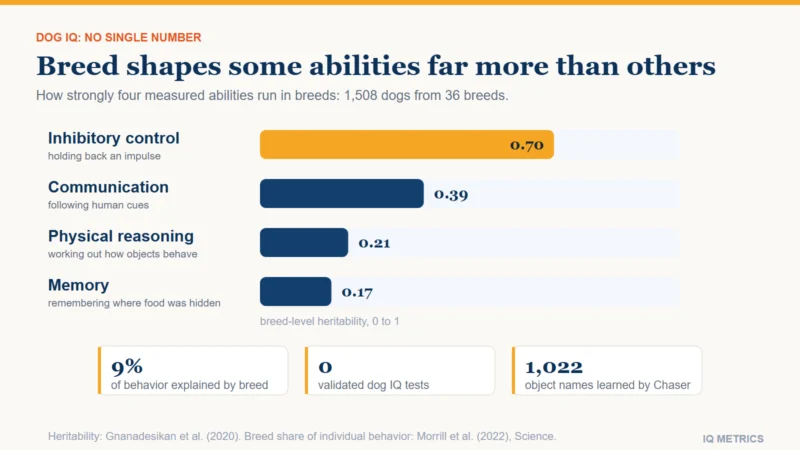 Understanding IQ
Dog IQ
Dogs do not have an IQ: no validated test gives them one. Researchers can measure trainability, memory, self-control and a small general factor, and those results say more about how dogs think than any breed ranking, at-home dog IQ test or "as smart as a toddler" comparison ever could.
 Understanding IQ
Chimpanzee IQ
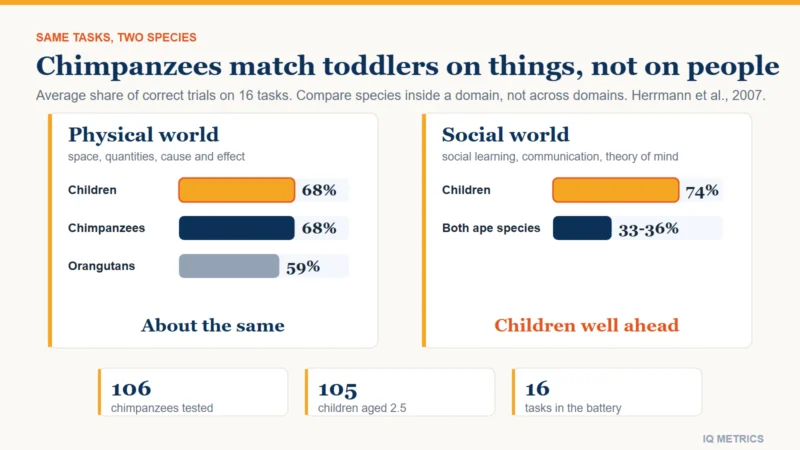
Chimpanzees have no IQ, but they have been tested. How chimps and 2.5-year-old children scored on the same 16 tasks, what a chimpanzee brain holds, the memory claim that did not survive practice, and whether chimps have a g factor.
 Understanding IQ
Crow and Raven IQ
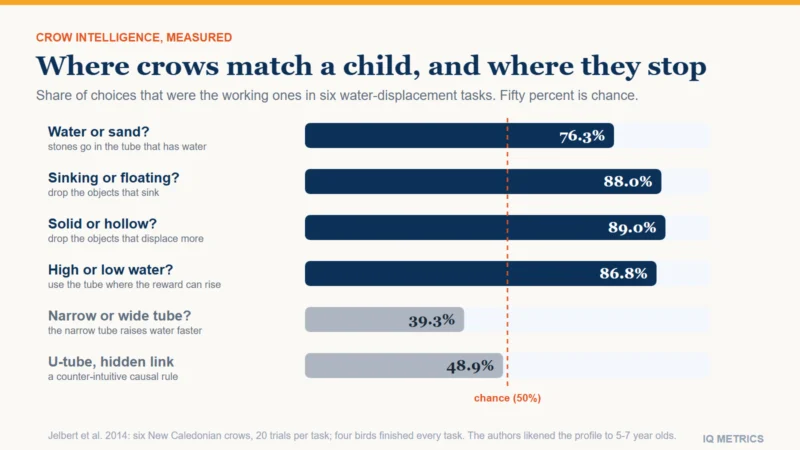
A crow has no IQ, but tests show what corvids can do: bend wire, plan hours ahead, count their own calls. The 7-year-old comparison traces to one 2014 study of six crows, who were at chance on two of six puzzles.