Does Short-Form Video Rot Your Brain? 45 Studies We Could Read, Mostly Correlational
Every study we could read on TikTok, Reels and Shorts and attention, memory or self-control, graded by design. 36 of 45 report worse results, but 31 are surveys and 13 are experiments.

By Leon Falkner, Data & Research Analyst · Reviewed by Aarav Vardhan, Editor-in-Chief · Published 18 November 2026 · 15 min read
About this study
- Report type
- Data study: our table of 45 studies of short-form video use and a cognitive outcome, graded by design
- Data
- 45 studies coded from 120 abstracts read (PubMed and OpenAlex, 2018 to 18 November 2026), plus 8 reviews and 67 excluded records with reasons; published meta-analysis numbers; Wikipedia pageviews; OpenAlex yearly counts
- Sources
- Study abstracts and DOIs (PubMed, Crossref), Nguyen et al. 2025 (accepted manuscript, CC BY 4.0), Oxford University Press, Wikimedia pageviews (CC0), OpenAlex (CC0)
- Dates
- Studies published 2021 to 2026; read and calculated on 18 November 2026; as of 18 November 2026
- Licence
- CC BY 4.0 (our dataset and charts)
- Version
- 2026.11
- Sources
- 54
Short-form video use goes with worse attention, memory and self-control in 36 of the 45 studies we could read, but the evidence is mostly correlational: 31 are cross-sectional and 13 are experiments, mostly short sessions in small samples. A published meta-analysis finds r = -.34 for cognition. IQ Metrics Research, 18 November 2026.
01 Key findings
- 45 studies coded from 120 abstracts read, and 13 are experiments. 9 have a control condition (grade A), 4 are other experiments, 1 is longitudinal and 31 are cross-sectional; only 2 abstracts say that people were randomly assigned.IQ Metrics table
- 36 of the 42 studies that state a direction report worse results on the cognitive measure, 5 find no clear difference and 1 finds better results (cognitive scores of rural adults aged 65 or older in China). Experiments: 12 of 13; cross-sectional: 24 of 29.IQ Metrics table
- The published meta-analysis (Psychological Bulletin, 2025) pools r = -.34 for cognition (14 studies; 95% CI -.42 to -.26), strongest for inhibitory control (-.41) and attention (-.38); problematic-use scales -.37, time spent -.20.Nguyen et al. 2025, Table 1
- The studies are small and acute: the median coded study has 177 participants (58.5 for experiments, which are short viewing sessions), and 12 abstracts print no sample size.IQ Metrics table
- 22 of the 35 studies with a country are Chinese and 32 are from Asia; we found none from Africa, Latin America or Oceania.IQ Metrics table
- Only 3 of the 32 observational abstracts say that general screen time or problematic social-media use was accounted for; the meta-analysis found about 10% of its studies controlled for some form of general social-media use.IQ Metrics table; Nguyen et al. 2025
- Papers mentioning short-video terms grew 41 times from 2018 to 2025 (456 to 18,781); Oxford named “brain rot” Word of the Year on 2 December 2024, with usage up 230% in a year.OpenAlex; Oxford University Press
02 Is brain rot real? The numbers to quote
IQ Metrics Research read 120 study abstracts about short-form video (TikTok, Douyin, Instagram Reels, YouTube Shorts and similar apps) and coded 45 of them as studies that measure short-form video use or viewing and a cognitive outcome, published 2021 to 2026. Of the 45, 36 report worse results on the cognitive measure with more use, 5 find no clear difference and 1 finds better results; 3 do not say in the abstract. The evidence is mostly correlational: 31 studies are cross-sectional surveys or group comparisons, 1 is longitudinal and 13 are experiments, 2 of which say that people were randomly assigned. A 2025 meta-analysis in Psychological Bulletin pooled r = -.34 for cognition [1]. “Brain rot” is a popular label for that concern; this page counts what the studies measured and how strong each design is, and it is a lower bound, not a census.
studies of short-form video and a cognitive outcome coded from 120 abstracts read (a lower bound), 2021 to 2026.
IQ Metrics tablestudies are experiments (9 with a control condition, 4 other); 31 are cross-sectional and 1 is longitudinal.
IQ Metrics tablestudies that state a direction report worse results on the cognitive measure with more short-form video use; 5 find no clear difference and 1 finds better results.
IQ Metrics tableexperiments report worse results after short-form viewing; they are short sessions (median n = 58.5) and 2 abstracts state random assignment.
IQ Metrics tablecross-sectional studies that state a direction report worse cognitive results with more use; design does not change the direction.
IQ Metrics tablepublished pooled correlation for short-form video engagement and cognition (14 studies, 95% CI -.42 to -.26); the authors did not test cause.
Nguyen et al. 2025published pooled r for problematic-use scales against time spent, for cognition: compulsive-use measures carry the stronger link.
Nguyen et al. 2025participants in the median coded study (33 abstracts print n; largest 5,754, smallest 26).
IQ Metrics tablestudies with a country are Chinese (63%); 32 are from Asia and none from Africa, Latin America or Oceania.
IQ Metrics tableobservational study abstracts state that general screen time or problematic social-media use was accounted for; the meta-analysis put the share at about 10%.
IQ Metrics table; Nguyen et al. 2025growth in papers that mention short-video terms, 456 in 2018 to 18,781 in 2025 (OpenAlex); mentions, not studies of effect.
OpenAlexrise in the use of the phrase “brain rot” between 2023 and 2024, when Oxford University Press named it Word of the Year on 2 December 2024.
Oxford University PressWhat this study does not say
This page describes what published studies measured. It does not say that short-form video harms thinking, and it gives no advice to parents, schools or users. Attention and inhibitory control here are lab tasks and questionnaires, not IQ. Reviews and meta-analyses are listed apart and never counted as studies.
03 What counts as short-form video, a cognitive outcome and a study here?
A study counts when the paper’s own exposure measure is about short-form video (vertical, algorithm-recommended clips of seconds to a few minutes) and it also measures a cognitive outcome. The exposure is time spent on short video, a problematic-use or “addiction” scale written for short-video apps, how often people use them, or an experiment in which people watch them. General screen time or general social-media measures with no short-video measure are out, and so are video games and television: the site has separate reports on screen time and cognitive test scores in children and on video games. The cognitive outcome is our coding of the paper’s own measure: attention, inhibitory control or self-control, working memory, episodic or prospective memory, executive function or a general cognition scale. School marks are recorded in a separate column (3 studies) and are not cognition, and a mental-health flag (6 studies) is recorded but is not part of any headline.
- Short-form video (SFV)
- Vertical, algorithm-recommended clips of seconds to a few minutes on apps such as TikTok, Douyin, Instagram Reels, YouTube Shorts and Kuaishou.
- Brain rot
- A popular phrase for the supposed decline of a person’s mental state from heavy use of trivial online content; Oxford University Press named it Word of the Year 2024. It is not a scientific term.
- Attention span
- In studies, a score on an attention task (for example the Attention Network Test or a sustained-attention task) or a self-report scale. It is not a number of seconds, and not IQ.
- Inhibitory control
- Holding back a response, measured with tasks such as go/no-go or Stroop, or with a self-control questionnaire.
- Problematic-use scale
- A questionnaire that scores compulsive or hard-to-control use of short-video apps, often called an “addiction” scale in the papers.
- Cross-sectional study
- Use and outcome measured at one time, so it cannot show which came first.
- Experiment with a control condition (grade A)
- People are assigned to watch short-form video or something else and then do a cognitive task. Only some papers say the assignment was random.
- Correlation (r)
- A number from -1 to +1 for how closely two measures move together; r = -.34 is a moderate negative link and says nothing about cause.
Each study gets a design grade before we look at its result, from a written rule: A is an experiment with a control condition (random assignment is recorded separately), B is any other experiment (within-subject, before and after, or a neuroimaging session), C is a longitudinal study, D is a cross-sectional survey or group comparison, and E (reviews) is kept apart. The grade says how strong the design is for a question about cause. It says nothing about whether a result is large, small, worse or better.
From 1,616 search records to 45 coded studies, 13 of them experiments
Unique records from the PubMed and OpenAlex searches (675 and 1,115 before merging), those passing the keyword screen, those with a short-video term and a cognitive term in the title, the abstracts we read, the studies we coded, and the experiments (grade A or B) among them. A lower bound: the 195 title-screened records we did not read are not counted. IQ Metrics count. As of 18 November 2026.
Source: PubMed [8]; OpenAlex [7]; IQ Metrics count
Data table
| stage | count | pct_of_first | pct_of_previous |
|---|---|---|---|
| Unique search records | 1616 | 100 | 100 |
| Pass the keyword screen | 1039 | 64.3 | 64.3 |
| Short-video and cognitive word in the title | 312 | 19.3 | 30 |
| Abstracts we read | 120 | 7.4 | 38.5 |
| Coded as a study row | 45 | 2.8 | 37.5 |
| Experiments (grade A or B) | 13 | 0.8 | 28.9 |
Embed this chart
Paste this HTML into your page: it carries the numbers and the credit link to this figure.
Our search is a lower bound. We ran three PubMed queries (all 675 results) and seven OpenAlex queries (the first 200 results of each, 1,115 unique records, because paging further was refused), merged them to 1,616, and kept 1,039 with a keyword screen. A person screened titles: 312 named both a short-video term and a cognitive word. We read 120 abstracts, which leaves 195 title-screened records unread, and coded 45. The rest were left out for a stated reason: 12 measured no cognitive outcome, 12 printed no usable result, 11 did not test short-form video as the exposure, 10 had no readable abstract, 8 were preprints or registrations, 8 were conceptual or descriptive, 4 were theses or datasets and 2 had no DOI. Every excluded record is in the CSV with its reason. No retraction notice was found for any study or review.
04 How many studies of short-form video and cognition are there?
We coded 45 studies, 36 of them published in 2025 or 2026 (80%), and the earliest is from 2021. The count is a lower bound for our search, but the pattern is clear: the literature is very young. Papers that merely mention short-video terms grew from 456 in 2018 to 18,781 in 2025 in OpenAlex, 41 times as many, while those whose title names a short-video term and a cognitive word rose from 14 in 2019 to 925 in 2025. Those are mentions, not studies of effect: most are about marketing, health communication or engineering.
36 of the 45 studies were published in 2025 or 2026, and the first coded experiment and the first coded survey are both from 2021
Coded studies per publication year, split by design grade: A = experiment with a control condition, B = other experiment, C = longitudinal, D = cross-sectional. 2022 has no coded study; 2026 runs to 18 November. IQ Metrics table. As of 18 November 2026.
Source: IQ Metrics table of coded studies
Data table
| year | A control experiment | B other experiment | C longitudinal | D cross-sectional | total |
|---|---|---|---|---|---|
| 2021 | 1 | 1 | 2 | ||
| 2022 | 0 | ||||
| 2023 | 1 | 1 | 2 | ||
| 2024 | 1 | 4 | 5 | ||
| 2025 | 2 | 1 | 1 | 11 | 15 |
| 2026 | 5 | 2 | 14 | 21 |
Embed this chart
Paste this HTML into your page: it carries the numbers and the credit link to this figure.
Papers that mention short-video terms grew 41 times, from 456 in 2018 to 18,781 in 2025
OpenAlex works per publication year whose title or abstract mention "short video", TikTok, Douyin, Reels, YouTube Shorts or a similar term, split into those whose TITLE names such a term and a cognitive word (attention, memory, cognitive, executive function, self-control) and all the others. These are papers that mention the terms, not studies of effect. 2026 runs to 18 November. OpenAlex counts. As of 18 November 2026.
Source: OpenAlex [7]; IQ Metrics query (filters printed in data/PLAN.md)
Data table
| year | Title names a short-video and a cognitive term | Other papers that mention a short-video term | total |
|---|---|---|---|
| 2018 | 456 | 456 | |
| 2019 | 14 | 661 | 675 |
| 2020 | 33 | 1267 | 1300 |
| 2021 | 85 | 2027 | 2112 |
| 2022 | 166 | 3593 | 3759 |
| 2023 | 322 | 6576 | 6898 |
| 2024 | 518 | 9690 | 10208 |
| 2025 | 925 | 17856 | 18781 |
| 2026 | 1543 | 22332 | 23875 |
Embed this chart
Paste this HTML into your page: it carries the numbers and the credit link to this figure.
Reviews already exist. The Psychological Bulletin meta-analysis found 71 studies and 98,299 participants, of which 14 studies were pooled for cognition (21% of its studies had a cognitive measure); 87% of its studies were correlational and 74% came from Asia [1]. A BMJ Public Health review of adults aged 18 to 29 included 17 studies from 519,101 records and judged cross-sectional designs and self-report the main limits [2]. A review of youth counted 42 studies, 88% cross-sectional with two longitudinal [3], and another 23 on short-video addiction and cognitive functioning [4]. None of these publishes a row-by-row open table. Ours adds the table, the design grades, newer studies after the meta-analysis (36 of ours are from 2025 or later) and the recounts.
Reviews and meta-analyses we found, listed apart and never counted as study rows (grade E)
| Review | Journal | Studies | Sample and design | What it reports |
|---|---|---|---|---|
| Nguyen et al. 2025 | Psychological Bulletin | 71 studies (70 pooled); 14 with a cognition measure | 98,299 participants; 87% correlational, 13% group comparison; 74% from Asia | r = -.34 (95% CI -.42 to -.26) for cognition; about 10% of studies controlled for general social-media use |
| Arouch et al. 2026 | BMJ Public Health | 17 studies of adults aged 18 to 29 | from 519,101 records, 8 databases 2014-2024 | associations with lower executive control markers; cross-sectional designs and self-report limit the evidence |
| Ebster et al. 2026 | Eur Child Adolesc Psychiatry | 42 studies of youth | N = 46,912; 88% cross-sectional, two longitudinal, one EEG, one MRI | heavy use associated with inattention, impulsivity and lower working memory (effect sizes not readable in the record) |
| Mona et al. 2026 | Int J Adolescence and Youth | 23 studies of adolescents and youth | short video addiction and cognitive functioning | attention and self-control the most affected domains in the authors’ words |
Source: Each review, linked by its DOI; IQ Metrics reading of the abstracts
05 How many of the studies are experiments, and how strong is each design?
13 of the 45 studies are experiments (29%); 31 are cross-sectional (69%) and 1 is longitudinal. Of the experiments, 9 have a control condition (grade A) and 4 do not (grade B), and only 2 abstracts say that people were randomly assigned. The first coded experiment is from 2021, and the first that states random assignment is from 2025, 4 years after the first coded study. A typical experiment has people watch short-form video or a control for 8 to 30 minutes where the abstract says, and then do a Stroop, memory or attention task [46] [28] [49]; a few use brain imaging during viewing [39] [48]. The one longitudinal study followed 590 university students for a year and found that self-control sat between problematic TikTok use and school engagement [27].
Attention has 16 studies and memory 13, but 2 of the attention studies and 6 of the episodic-memory studies are experiments
Number of coded studies for each cognitive domain (rows) and design grade (columns): A control experiment, B other experiment, C longitudinal, D cross-sectional. A blank cell is none. We found no coded study on reasoning or language. IQ Metrics table. As of 18 November 2026.
Source: IQ Metrics table of coded studies
Data table
| cognitive domain (studies) | A control experiment | B other experiment | C longitudinal | D cross-sectional |
|---|---|---|---|---|
| Attention (16) | 1 | 1 | 14 | |
| Inhibitory control and self-control (8) | 1 | 1 | 1 | 5 |
| Working memory (4) | 1 | 3 | ||
| Episodic and prospective memory (9) | 5 | 1 | 3 | |
| Executive function (4) | 1 | 3 | ||
| General cognition scale (4) | 1 | 3 |
Embed this chart
Paste this HTML into your page: it carries the numbers and the credit link to this figure.
36 of the 45 studies report worse results on the cognitive measure with more short-form video; 5 find no clear difference, 1 finds better results, 3 do not say in the abstract
Every coded study as one square, coloured by the direction the authors report for their main cognitive measure, ordered by design grade (A control experiment first, D cross-sectional last). The direction is the authors' reading of their own result. IQ Metrics table. As of 18 November 2026.
45 studiesone square = one study
Source: The studies listed under Sources; IQ Metrics coding of each study’s direction
Data table
| study | group | label | detail |
|---|---|---|---|
| s0 | Worse on the cognitive measure | Zheng 2021: working memory (A) | viewing short videos or resting, then a pattern recognition task; visual short-term memory (pattern recognition); n = not printed |
| s1 | Worse on the cognitive measure | Chiossi 2023: episodic memory (A) | between-subjects experiment: TikTok, Twitter, YouTube or no activity, then a prospective m; prospective memory task; n = 60 |
| s2 | Worse on the cognitive measure | Barton 2025: episodic memory (A) | between-groups experiment: unlimited or limited context-switching between short-form video; prospective memory and lexical decision task; n = 45 |
| s3 | Worse on the cognitive measure | Luo 2025: executive function (A) | randomised between-subjects experiment: 30 min of TikTok-style video, a documentary or no ; task-switching task (cue-target interval); n = 72 |
| s4 | Worse on the cognitive measure | Trajanov 2026: inhibitory control (A) | randomised controlled between-subjects experiment: 20 min of short-form video or a nature ; Color-Word Stroop reaction time; n = 26 |
| s5 | Worse on the cognitive measure | Wei 2026: episodic memory (A) | between-subjects: one continuous long video or several short videos matched for duration a; recall accuracy and fMRI activation; n = 57 |
| s6 | Worse on the cognitive measure | Wei 2026: episodic memory (A) | three experiments: learning from short or long videos under incidental and intentional enc; immediate memory accuracy and forgetting rate; n = not printed |
| s7 | Worse on the cognitive measure | Zhai 2026: episodic memory (A) | between-subjects experiment (Study 1): short videos before the task or long videos (contro; prospective memory accuracy (focal and non-focal cues); n = 106 |
| s8 | No clear difference | Meng 2026: attention (A) | 2 x 2 between-subjects online experiment: short or long video format, 8 or 16 minutes, the; Sustained Attention to Response Task (commission errors); n = 91 |
| s9 | Worse on the cognitive measure | Mahmoudi 2024: attention (B) | before and after 15 minutes of short-form videos, eye tracking (pupil diameter), no contro; pupil diameter during a learning task (processing load); n = not printed |
| s10 | Worse on the cognitive measure | Li 2025: episodic memory (B) | behavioural and eye-tracking experiment: acute exposure to random or personalised short vi; memory for continuous movies (event segmentation); n = not printed |
| s11 | Worse on the cognitive measure | Abu-Bajeh 2026: general cognition (B) | 21-day abstinence from short-video platforms (exposure removed), cognitive failures questi; Cognitive Failures Questionnaire (0-100); n = not printed |
| s12 | Worse on the cognitive measure | Hong 2026: inhibitory control (B) | within-subject fMRI while people watched short videos they chose (preferred videos watched; fMRI activity of dACC and dlPFC (control regions) during viewing; n = 56 |
| s13 | Direction not stated in the abstract | Liu 2025: inhibitory control (C) | one-year longitudinal survey, three waves six months apart; self-control scale (mediator between problematic TikTok use and school; n = 590 |
| s14 | Worse on the cognitive measure | Sha 2021: episodic memory (D) | survey of senior high school students, mediation by depression, anxiety and stress; self-reported memory loss; n = 3,036 |
| s15 | Worse on the cognitive measure | Walla 2024: attention (D) | visual oddball experiment comparing heavy (over 4 h a day) and regular (under 3 h) short-v; P300 event-related potential; n = 29 |
| s16 | Worse on the cognitive measure | Xu 2024: working memory (D) | cross-sectional survey of adolescents with brain activity (EEG) recorded during short-vide; working memory and cognitive control tasks; neural indicator of addict; n = 84 |
| s17 | Worse on the cognitive measure | Xu 2024: working memory (D) | cross-sectional survey of two adolescent age cohorts (12-13 and 15-16) with resting-state ; working memory and verbal ability; resting-state brain activity; n = not printed |
| s18 | Worse on the cognitive measure | Yan 2024: attention (D) | attention network test with EEG; correlation of short video addiction scores with brain ac; Attention Network Test, theta power of executive control; n = 48 |
| s19 | Worse on the cognitive measure | Al-Leimon 2025: attention (D) | cross-sectional survey of university students in 25 institutions; attention and memory scales; attention as mediator between short-form ; n = 1,029 |
| s20 | Worse on the cognitive measure | Alruwaili 2025: attention (D) | cross-sectional correlational survey, quota sample, structural equation model; self-reported attention difficulty, working memory disruption and cogn; n = 745 |
| s21 | Worse on the cognitive measure | Chiencharoenthanakij 2025: attention (D) | cross-sectional survey of guardians of children aged 6 to 12, adjusted for total screen ti; parent-rated inattentive behaviours (SNAP-IV short form); n = 528 |
| s22 | Worse on the cognitive measure | Rahayu 2025: episodic memory (D) | cross-sectional questionnaire of undergraduates, regression; self-rated memory capability and attention span; n = 297 |
| s23 | Worse on the cognitive measure | Rahayu 2025: episodic memory (D) | cross-sectional questionnaire of university, high school and middle school students, corre; self-rated memory capability; n = 878 |
| s24 | Worse on the cognitive measure | Shuja 2025: general cognition (D) | cross-sectional correlational survey of undergraduates; Cognitive Failures Questionnaire 2.0; n = 239 |
| s25 | Worse on the cognitive measure | Zhai 2025: attention (D) | attention network test and resting-state fMRI in active and passive short video users; alerting, orienting and executive control of the attention network tes; n = not printed |
| s26 | Worse on the cognitive measure | 冯 2025: attention (D) | short video addiction group against a non-addiction group, attention network test; attention network test (alerting, orienting, conflict); n = not printed |
| s27 | Worse on the cognitive measure | Arshad 2026: attention (D) | cross-sectional survey of college students, purposive sample; Attention-Related Cognitive Errors Scale (ARCES); n = 600 |
| s28 | Worse on the cognitive measure | Chen 2026: executive function (D) | problematic short video use group against a control group, task-switching paradigm; task-switching reaction times and switch costs; n = 177 |
| s29 | Worse on the cognitive measure | Feng 2026: working memory (D) | groups by daily short video use (low, moderate, high) and exercise habits, working memory ; working memory task reaction time and accuracy; n = 82 |
| s30 | Worse on the cognitive measure | Jiang 2026: inhibitory control (D) | problematic short-video users against matched controls, go/no-go and contingency degradati; go/no-go false-alarm rate (drift diffusion model); n = 58 |
| s31 | Worse on the cognitive measure | Li 2026: inhibitory control (D) | male students with problematic short-video use grouped by viewing time (low, moderate, hig; Go/Nogo task reaction time and accuracy; n = 58 |
| s32 | Worse on the cognitive measure | Li 2026: attention (D) | problematic short-video use group against a control group, attention network test; attention network test (alerting, orienting, executive control); n = 71 |
| s33 | Worse on the cognitive measure | Li 2026: inhibitory control (D) | short-video addiction tendency group against a control group, Go/No-go task with event-rel; Go/No-go task, N2 and P3 amplitudes; n = 61 |
| s34 | Worse on the cognitive measure | Luo 2026: inhibitory control (D) | cross-sectional survey of medical students, mediation and latent profile analysis; self-control scale; n = 892 |
| s35 | Worse on the cognitive measure | Wang 2026: general cognition (D) | cross-sectional survey of TikTok users; Cognitive Failure Questionnaire (everyday cognitive failure); n = 720 |
| s36 | Worse on the cognitive measure | Xiao 2026: executive function (D) | cross-sectional survey of adolescents, mediation by sleep quality; executive function scale; n = 978 |
| s37 | Worse on the cognitive measure | Zhao 2026: attention (D) | multicentre online survey of college students, latent profile analysis, mediation by inatt; inattention (self-report); n = not printed |
| s38 | No clear difference | Puaponpong 2023: attention (D) | cross-sectional online questionnaire of Thai and international high school students; everyday-life attention questionnaire; n = not printed |
| s39 | No clear difference | Aljehani 2025: attention (D) | cross-sectional survey of university students; attention span (self-report); n = 393 |
| s40 | No clear difference | Golding 2025: executive function (D) | cross-sectional survey of college students; executive function questionnaire; n = 346 |
| s41 | No clear difference | Hamed 2025: attention (D) | cross-sectional laboratory tasks in school boys aged 12 to 14, Spearman correlations; Stroop task and forward and backward digit span; n = not printed |
| s42 | Better on the cognitive measure | Fu 2026: general cognition (D) | cross-sectional two-stage cluster sample of adults aged 65 or older, adjusted for confound; Montreal Cognitive Assessment (MoCA); n = 1,501 |
| s43 | Direction not stated in the abstract | Zhang 2026: inhibitory control (D) | cross-sectional survey, network analysis of short video addiction, self-control and emotio; Brief Self-Control Scale; n = 5,754 |
| s44 | Direction not stated in the abstract | Zhang 2026: attention (D) | cross-sectional survey of undergraduate nursing students, network analysis of short video ; inattention symptoms (self-report); n = not printed |
Embed this chart
Paste this HTML into your page: it carries the numbers and the credit link to this figure.
The share of experiments did not rise as the literature grew: 33% of the studies to 2024, 20% in 2025 and 33% in 2026
Share of each period's coded studies that are experiments (grade A or B) and that are cross-sectional (D), as a percentage; periods hold 9, 15 and 21 studies (the longitudinal study is the remainder). IQ Metrics table. As of 18 November 2026.
Source: IQ Metrics table of coded studies
Data table
| design | To 2024 | 2025 | 2026 |
|---|---|---|---|
| Experiments | 33 | 20 | 33 |
| Cross-sectional | 67 | 73 | 67 |
Embed this chart
Paste this HTML into your page: it carries the numbers and the credit link to this figure.
06 Do experiments and surveys find the same thing?
Yes in direction: 12 of 13 experiments and 24 of 29 cross-sectional studies with a stated direction report worse results on the cognitive measure with more short-form video. That the two designs agree in direction is worth noting. It does not settle cause, because the experiments are short and small, because acute viewing of short clips is not the same as years of use, and because we cannot see unpublished studies. Experiments are the stronger design for a causal question, and they mostly show lab-task differences after minutes of viewing, for example a longer Stroop reaction time after 20 minutes (d = 0.78, 26 people) [46] or poorer recall after short against long videos in 57 people [48]. One experiment found no clear difference on a sustained-attention task after viewing for 8 or 16 minutes (N = 91) [45]. Two caveats cut both ways: small experiments are noisy, and a literature of mostly positive findings may leave null results unpublished, which we cannot test with 4 printed effect sizes.
Experiments and surveys point the same way: 12 of 13 experiments and 24 of 31 cross-sectional studies report worse results, so design does not change the direction, only how strong the evidence is (29 of the 31 state one)
Direction reported for the main cognitive measure, by design: counts of studies. Experiments are short viewing sessions in small samples (median n = 58.5 among the 8 that print one); cross-sectional studies are surveys and group comparisons. IQ Metrics table. As of 18 November 2026.
Source: IQ Metrics table of coded studies
Data table
| design | Worse | No clear difference | Better | Not stated |
|---|---|---|---|---|
| Experiments (A, B) (Short viewing sessions (8 to 30 minutes where stated)) | 12 | 1 | 0 | 0 |
| Longitudinal (C) (One-year survey with three waves) | 0 | 0 | 0 | 1 |
| Cross-sectional (D) (Surveys, scales and group comparisons) | 24 | 4 | 1 | 2 |
Embed this chart
Paste this HTML into your page: it carries the numbers and the credit link to this figure.
The five studies with no clear difference are a Thai high-school survey of everyday attention [13], a Saudi university survey of TikTok use and attention [20], a school sample of Saudi boys on a Stroop task and digit spans [25], the 91-person online experiment [45], and a survey of 346 college students in which TikTok use stopped predicting executive function once problematic social-media use was accounted for [24]. The one study with better results measured cognitive scores of 1,501 adults aged 65 or older in rural China with a screening test, and short-form video use went with higher scores [38]. It is a reminder that age and what people watch both matter, and that a cross-sectional link can run either way.
07 What does the published meta-analysis find, and does compulsive use matter more than time spent?
The published meta-analysis pools r = -.34 (95% CI -.42 to -.26) between short-form video engagement and cognition across 14 studies, a moderate negative link, with very high heterogeneity (I-squared 95.73%) [1]. By domain it is -.41 for inhibitory control (7 effect sizes) and -.38 for attention (5), weaker for working memory (-.21), language (-.16) and memory (-.14) with one or two effect sizes each, and not different from zero for reasoning (-.13, interval -.36 to .11, one effect size). Those numbers are the authors’. We did not re-pool them: only 2 of our abstracts print a correlation and none prints an interval, short of the 10 comparable correlations with intervals we set as the minimum for our own pooled estimate.
The published meta-analysis pools r = -.34 for cognition (14 studies) and finds the strongest links for inhibitory control (-.41) and attention (-.38); reasoning includes zero
Strength of the link between short-form video engagement and each cognitive domain, with its 95% interval, from Table 1 of Nguyen et al. (Psychological Bulletin, 2025); k = number of effect sizes. The axis shows -r: every pooled r is negative (more use, lower scores), so the dot at .34 is r = -.34, and the interval for reasoning crosses zero. Language, memory and reasoning rest on one effect size each. The authors' numbers with the sign flipped for display; we did not re-pool. As of 18 November 2026.
Source: Nguyen et al. 2025, Table 1 [1]; the authors’ pooled estimates, not re-pooled by IQ Metrics
Data table
| label | low | estimate | high |
|---|---|---|---|
| All cognition (k = 14) | 0.3 | 0.3 | 0.4 |
| Inhibitory control (k = 7) | 0.4 | 0.4 | 0.5 |
| Attention (k = 5) | 0.2 | 0.4 | 0.5 |
| Working memory (k = 2) | 0 | 0.2 | 0.4 |
| Language (k = 1) | 0.1 | 0.2 | 0.2 |
| Memory (k = 1) | 0.1 | 0.1 | 0.2 |
| Reasoning (k = 1) | -0.1 | 0.1 | 0.4 |
Embed this chart
Paste this HTML into your page: it carries the numbers and the credit link to this figure.
How use is measured matters more than we might expect. In the meta-analysis problematic-use scales give r = -.37 (9 effect sizes) and time spent -.20 (4), and the single study of emotional attachment (intensity) gives -.55 [1]. The same pattern appears in mental health (addiction scales -.32, time spent -.10), shown only as context. In our table the pattern appears too: of the 20 studies that measure use with a problematic-use scale, 16 report worse results, 1 reports no clear difference and 3 give no direction; of the 6 that measure time spent, 4 report worse results and 2 find no clear difference. A problematic-use scale may capture how hard use is to control, and it also overlaps with the cognitive scales, since several ask about concentration and impulse control. The contrast is between studies, not within them.
Compulsive-use scales go with stronger links than time spent: r = -.37 against -.20 for cognition in the published meta-analysis
Pooled correlation r for studies that measured short-form video use with an addiction-type (problematic use) scale against studies that measured time spent, for cognition (9 and 4 effect sizes) and, as context only, mental health (32 and 16). Different studies in each group, so this is a between-study contrast. Nguyen et al. 2025, Table 1. As of 18 November 2026.
Source: Nguyen et al. 2025, Table 1 [1]
Data table
| outcome (effect sizes) | Problematic-use scale | Time spent |
|---|---|---|
| Cognition (k = 9, 4) | -0.4 | -0.2 |
| Mental health, context (k = 32, 16) | -0.3 | -0.1 |
Embed this chart
Paste this HTML into your page: it carries the numbers and the credit link to this figure.
08 Which attention, memory and thinking skills have been tested?
Attention is the most tested outcome with 16 studies, then episodic or prospective memory (9), inhibitory control or self-control (8), working memory (4), executive function (4) and general cognition scales (4). We found no coded study on reasoning or language, although the meta-analysis has one effect size each. Within attention, 11 of 15 stated directions are worse and 4 are no clear difference; every memory study (13) reports worse results. Many of the attention and memory outcomes are self-rated scales or questionnaires, which measure what people say about their focus and memory, not what a task finds. They are lab tasks and questionnaires, not IQ, and we print no IQ number.
35 of the 45 studies name no platform; they flow into attention (16) and memory (13) mostly, and almost all end at worse results
Flow of the 45 coded studies from the platform the abstract names (left) to the cognitive domain measured (middle) to the direction reported (right). We make no comparison of apps: 7 studies name TikTok and 3 Instagram or Reels. IQ Metrics table. As of 18 November 2026.
Source: IQ Metrics table of coded studies
Data table
| from | to | step |
|---|---|---|
| TikTok named | Attention | 1 |
| TikTok named | Inhibitory control and self-control | 1 |
| TikTok named | Episodic and prospective memory | 2 |
| TikTok named | Executive function | 2 |
| TikTok named | General cognition scale | 1 |
| Instagram or Reels named | Attention | 2 |
| Instagram or Reels named | General cognition scale | 1 |
| No platform named | Attention | 13 |
| No platform named | Inhibitory control and self-control | 7 |
| No platform named | Working memory | 4 |
| No platform named | Episodic and prospective memory | 7 |
| No platform named | Executive function | 2 |
| No platform named | General cognition scale | 2 |
| Attention | Worse on the cognitive measure | 11 |
| Attention | No clear difference | 4 |
| Attention | Direction not stated in the abstract | 1 |
| Inhibitory control and self-control | Worse on the cognitive measure | 6 |
| Inhibitory control and self-control | Direction not stated in the abstract | 2 |
| Working memory | Worse on the cognitive measure | 4 |
| Episodic and prospective memory | Worse on the cognitive measure | 9 |
| Executive function | Worse on the cognitive measure | 3 |
| Executive function | No clear difference | 1 |
| General cognition scale | Worse on the cognitive measure | 3 |
| General cognition scale | Better on the cognitive measure | 1 |
Embed this chart
Paste this HTML into your page: it carries the numbers and the credit link to this figure.
35 of the 45 abstracts name no platform, 7 name TikTok and 3 Instagram or Reels. Because most do not separate apps, the evidence cannot say that one app is different from another, and this page ranks none. The 2025 meta-analysis also found similar effects for general short-form video use and for TikTok [1]. For two older concerns that this literature echoes, see the site’s report that the human attention span and the goldfish claim does not hold up as a number, and what is known about working memory and reasoning, which are not the same thing.
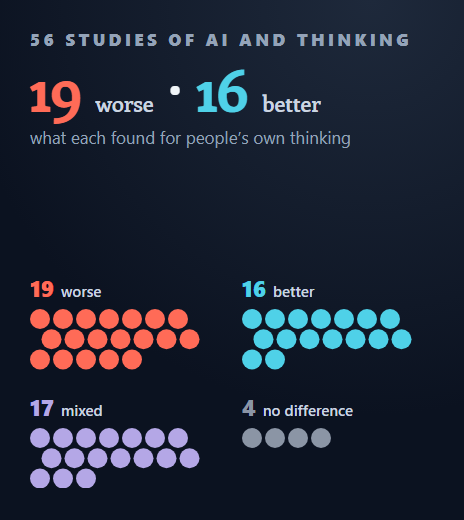
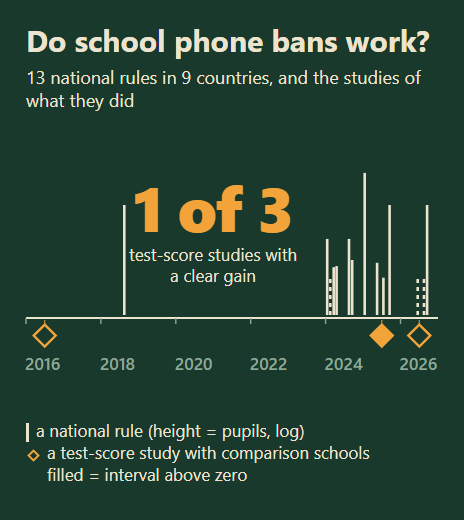
Two neighbouring questions have their own reports. Whether leaning on tools weakens memory is covered in AI and memory: what cognitive offloading research shows and in the study AI and your brain, which tabulates the studies on AI use. Whether phones in schools change school results is the subject of do school phone bans work, which concerns phone rules, not short-form video.
09 Who has been studied, how big are the samples, and where?
The median coded study has 177 participants (quartiles 60 to 720; range 26 to 5,754), and the 33 abstracts that print n add up to 19,707 participants, which is not a count of people because samples can overlap. Experiments are the smallest: a median of 58.5 participants among the 8 that print n, against 369.5 for cross-sectional studies. By age, 20 samples are university students or young adults, 6 adolescents, 3 adults, 1 older adults and 1 children (ages 6 to 12); 13 abstracts do not say. 22 of the 35 studies with a country are Chinese (63%) and 32 are from Asia, in line with the meta-analysis, where 74% of studies came from Asia [1]. Country here is the sample’s country where the abstract names it (14 studies) and otherwise the country of the first author’s institution, so “Chinese” means done in or from China. That is a fact about where the research was done in the sources we could search, not about where use is highest.
Experiments are small: the median experiment has 58.5 participants against 369.5 in a cross-sectional study, and 15 of the 33 studies that print n have under 100
Sample size of every coded study that prints one (33 of 45; 12 abstracts print none), by design: every study is a dot; the box covers the middle half, the line is the median, the whiskers run to the smallest and largest. Two group sizes were added where an abstract printed both groups. IQ Metrics table. As of 18 November 2026.
Source: The studies listed under Sources; IQ Metrics table
Data table
| design | n | low | q1 | median | q3 | high |
|---|---|---|---|---|---|---|
| Experiments (A, B) | 8 | 26 | 53.2 | 58.5 | 76.8 | 106 |
| Cross-sectional (D) | 24 | 29 | 79.2 | 369.5 | 881.5 | 5754 |
Embed this chart
Paste this HTML into your page: it carries the numbers and the credit link to this figure.
22 of the 35 studies with a country are Chinese (63%), and 32 are from Asia; we found none from Africa, Latin America or Oceania
Coded studies by country: the country the abstract names for the sample (14 studies), otherwise the country of the first author's institution in the PubMed record (21); 10 studies have neither. Grey means none in our table, not none published. The search is in English and the title screen needs English words. IQ Metrics table. As of 18 November 2026.
Source: The studies listed under Sources; IQ Metrics table
Data table
| country | iso2 | value |
|---|---|---|
| China | CN | 22 |
| Saudi Arabia | SA | 3 |
| Thailand | TH | 2 |
| Indonesia | ID | 2 |
| Malaysia | MY | 2 |
| Austria | AT | 1 |
| Jordan | JO | 1 |
| United Kingdom | GB | 1 |
| United States | US | 1 |
Embed this chart
Paste this HTML into your page: it carries the numbers and the credit link to this figure.
Reaction time on lab tasks and attention scores vary with age, sleep and mood, so a few of the studies also record them. The site’s explainers on reaction time by age, how reaction time is measured, sleep and sleep loss and test performance set out what those measures can and cannot tell. The cognitive outcomes here are different from processing speed and from memory as part of IQ, and the Stroop task used in several studies is available as a game on this site.
10 Do the studies account for general social-media use?
Few do, as far as the abstracts say: 3 of the 32 observational studies state that general screen time or problematic social-media use was accounted for [23] [24] [27], and 29 do not say. The meta-analysis found that “approximately 10%” of its studies controlled for some form of general social-media use, and that its pooled r was similar with covariates (-.34, 10 effect sizes) and without (-.35, 4), but those covariates were mostly age and gender [1]. This matters because general social-media use is linked to attention and well-being in older research, so a short-video effect that vanishes after adjustment would look different. One survey of 346 students found exactly that for TikTok use once problematic social-media use was in the model [24], and a survey of 528 Thai children adjusted for total screen time still found short-form video use associated with more inattentive behaviour [23]. We read abstracts, not full texts, so “not stated” is not “did not”.
11 How does the "brain rot" attention timeline compare with the arrival of evidence?
Most of the experiments came after the word. Oxford University Press named “brain rot” Word of the Year on 2 December 2024, reporting a 230% rise in its use between 2023 and 2024 [5]. On the English Wikipedia article for the phrase, daily views reached 17,544 on 3 December 2024, and the highest day was 20,856 on 18 October 2025, with 11 days above 10,000 in all [6]. The first meta-analysis was published in September 2025 and the BMJ review in July 2026. Of our 13 experiments, 10 are from 2025 or 2026 and 3 are older. Attention to a phrase is not evidence about the brain, and a count of papers is not a count of findings, so the calendar shows attention to the term only.
Daily views of the English Wikipedia article "Brain rot": 2,338,594 since 10 May 2024, with a peak of 20,856 on 18 October 2025 and 17,544 the day after Oxford named the phrase Word of the Year
Each square is one day of pageviews (user agents, all access types) for the article, 2024-05-10 to 2026-11-16: the Wikimedia API returns no earlier days for this title. The average a day was 1,689 in 2024 (from 10 May), 4,105 in 2025 and 1,380 in 2026 so far. This measures attention to the term, not harm. Wikimedia pageviews, CC0. As of 18 November 2026.
- Mon 2 Dec 2024 Oxford Word of the Year announced
- Sat 18 Oct 2025 Peak day, 20,856 views
Source: Wikimedia pageviews [6]; Oxford University Press [5]
Data table
| date | day |
|---|---|
| 2024-05-10 | 7 |
| 2024-05-11 | 5 |
| 2024-05-12 | 11 |
| 2024-05-13 | 25 |
| 2024-05-14 | 19 |
| 2024-05-15 | 21 |
| 2024-05-16 | 33 |
| 2024-05-17 | 21 |
| 2024-05-18 | 13 |
| 2024-05-19 | 12 |
| 2024-05-20 | 34 |
| 2024-05-21 | 46 |
| 2024-05-22 | 71 |
| 2024-05-23 | 86 |
| 2024-05-24 | 80 |
| 2024-05-25 | 64 |
| 2024-05-26 | 59 |
| 2024-05-27 | 73 |
| 2024-05-28 | 92 |
| 2024-05-29 | 74 |
| 2024-05-30 | 94 |
| 2024-05-31 | 106 |
| 2024-06-01 | 115 |
| 2024-06-02 | 145 |
| 2024-06-03 | 197 |
| 2024-06-04 | 200 |
| 2024-06-05 | 194 |
| 2024-06-06 | 162 |
| 2024-06-07 | 131 |
| 2024-06-08 | 117 |
| 2024-06-09 | 131 |
| 2024-06-10 | 262 |
| 2024-06-11 | 182 |
| 2024-06-12 | 191 |
| 2024-06-13 | 161 |
| 2024-06-14 | 176 |
| 2024-06-15 | 139 |
| 2024-06-16 | 127 |
| 2024-06-17 | 88 |
| 2024-06-18 | 64 |
| 2024-06-19 | 57 |
| 2024-06-20 | 8 |
| 2024-06-21 | 6 |
| 2024-06-22 | 4 |
| 2024-06-23 | 11 |
| 2024-06-24 | 10 |
| 2024-06-25 | 19 |
| 2024-06-26 | 11 |
| 2024-06-27 | 9 |
| 2024-06-28 | 112 |
| 2024-06-29 | 189 |
| 2024-06-30 | 152 |
| 2024-07-01 | 136 |
| 2024-07-02 | 204 |
| 2024-07-03 | 199 |
| 2024-07-04 | 198 |
| 2024-07-05 | 207 |
| 2024-07-06 | 168 |
| 2024-07-07 | 200 |
| 2024-07-08 | 208 |
| 2024-07-09 | 207 |
| 2024-07-10 | 199 |
| 2024-07-11 | 142 |
| 2024-07-12 | 121 |
| 2024-07-13 | 169 |
| 2024-07-14 | 102 |
| 2024-07-15 | 149 |
| 2024-07-16 | 179 |
| 2024-07-17 | 421 |
| 2024-07-18 | 498 |
| 2024-07-19 | 485 |
| 2024-07-20 | 459 |
| 2024-07-21 | 520 |
| 2024-07-22 | 619 |
| 2024-07-23 | 672 |
| 2024-07-24 | 612 |
| 2024-07-25 | 586 |
| 2024-07-26 | 392 |
| 2024-07-27 | 346 |
| 2024-07-28 | 382 |
First 80 of 921 rows; the Data button gives all of them.
Embed this chart
Paste this HTML into your page: it carries the numbers and the credit link to this figure.
Most of the experiments came after the word: Oxford named "brain rot" on 2 December 2024, and 10 of the 13 coded experiments are from 2025 or 2026
Dated events with a primary source: the Oxford announcement, the peak Wikipedia day, four reviews, and every coded experiment (grade A or B) at its publication year. A point date sits in the middle of its period; the Oxford and Wikipedia dates are exact. IQ Metrics table and the sources named. As of 18 November 2026.
Source: Oxford University Press [5]; Wikimedia [6]; Nguyen et al. [1]; Arouch et al. [2]; Ebster et al. [3]; Mona et al. [4]; IQ Metrics table
Data table
| lane | type | from | to | label | detail |
|---|---|---|---|---|---|
| The term | event | 2024-12-02 | Oxford Word of the Year | Oxford University Press, 2 December 2024: "brain rot" named Word of the Year; usage up 230% between 2023 and 2024 | |
| The term | event | 2025-10-18 | Wikipedia peak | Peak day on the English Wikipedia article: 20,856 views on 2025-10-18 | |
| Reviews | event | 2025-09 | Nguyen | Nguyen et al., Psychological Bulletin, September 2025: 71 studies, r = -.34 for cognition | |
| Reviews | event | 2026 | Ebster | Ebster et al., 2026: 42 studies of youth, 88% cross-sectional | |
| Reviews | event | 2026 | Mona | Mona et al., 2026: 23 studies of adolescents and youth | |
| Reviews | event | 2026-07 | Arouch | Arouch et al., BMJ Public Health, July 2026: 17 studies of adults 18-29 | |
| Experiments | event | 2021 | Zheng | Zheng 2021: viewing short videos or resting, then a pattern recognition task; worse on the cognitive measure | |
| Experiments | event | 2023 | Chiossi | Chiossi 2023: between-subjects experiment: TikTok, Twitter, YouTube or no activity, then a prospective memory task; worse on the cognitive measure | |
| Experiments | event | 2024 | Mahmoudi | Mahmoudi 2024: before and after 15 minutes of short-form videos, eye tracking (pupil diameter), no control group; worse on the cognitive measure | |
| Experiments | event | 2025 | Barton | Barton 2025: between-groups experiment: unlimited or limited context-switching between short-form videos, or no v; worse on the cognitive measure | |
| Experiments | event | 2025 | Li | Li 2025: behavioural and eye-tracking experiment: acute exposure to random or personalised short videos, then; worse on the cognitive measure | |
| Experiments | event | 2025 | Luo | Luo 2025: randomised between-subjects experiment: 30 min of TikTok-style video, a documentary or no video, the; worse on the cognitive measure | |
| Experiments | event | 2026 | Abu-Bajeh | Abu-Bajeh 2026: 21-day abstinence from short-video platforms (exposure removed), cognitive failures questionnaire be; worse on the cognitive measure | |
| Experiments | event | 2026 | Hong | Hong 2026: within-subject fMRI while people watched short videos they chose (preferred videos watched to the en; worse on the cognitive measure | |
| Experiments | event | 2026 | Meng | Meng 2026: 2 x 2 between-subjects online experiment: short or long video format, 8 or 16 minutes, then a sustai; no clear difference | |
| Experiments | event | 2026 | Trajanov | Trajanov 2026: randomised controlled between-subjects experiment: 20 min of short-form video or a nature documentar; worse on the cognitive measure | |
| Experiments | event | 2026 | Wei | Wei 2026: between-subjects: one continuous long video or several short videos matched for duration and content; worse on the cognitive measure | |
| Experiments | event | 2026 | Wei | Wei 2026: three experiments: learning from short or long videos under incidental and intentional encoding, wit; worse on the cognitive measure | |
| Experiments | event | 2026 | Zhai | Zhai 2026: between-subjects experiment (Study 1): short videos before the task or long videos (control), then a; worse on the cognitive measure |
Embed this chart
Paste this HTML into your page: it carries the numbers and the credit link to this figure.
12 What does this evidence not show?
The evidence does not show that short-form video changes how people think. Most coded studies are surveys: they show that more use goes with lower scores in the same people at one time, which could mean that use affects attention, that people with weaker attention or self-control use more, that a third factor such as sleep or stress drives both, or some mix. The experiments test short viewing sessions in mostly small, young samples, not months of use, and most do not say how people were assigned. The largest survey of cognition among the 45 has 5,754 students and measures self-control with a network analysis [52]. Several of the self-rated outcomes ask about the same things as the use scales, which can inflate a link. Mental health is recorded as a flag in 6 studies and is not part of any headline. We make no statement about any group of children, any school or any app.
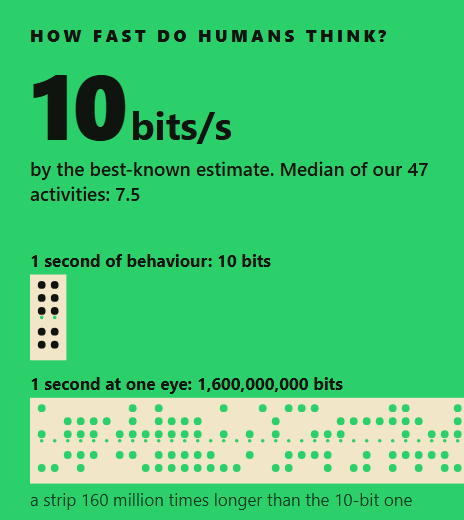
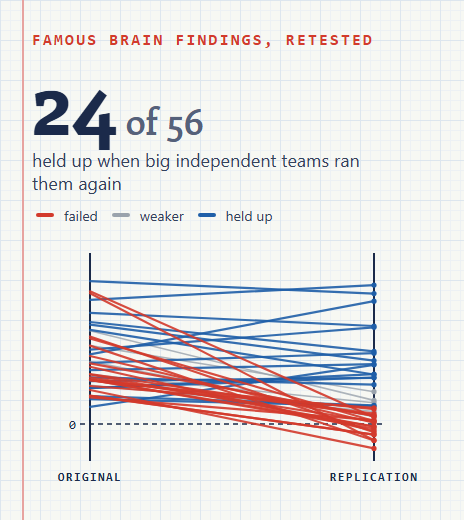
Other IQ Metrics studies show how evidence of this kind is checked and graded: the replication scorecard asks which famous brain findings held up when repeated, what raises or lowers IQ grades each factor’s evidence on one scale, neuromyths by country counts how widely brain myths are believed, how many brain papers are retracted counts retractions by field, and how fast humans think puts a rate on thinking.
Read every number with these in mind
- The PubMed part is the complete result of three queries; the OpenAlex part is a relevance-ranked sample (the first 200 results of each of seven queries), because OpenAlex refused further pages when its shared daily budget for keyless requests ran out.
- This is a lower bound from two searches and a title screen: 195 title-screened records were not read, 10 read records had no abstract text, and studies in other languages, in books or in outlets that PubMed and OpenAlex miss are not counted.
- All 45 rows were coded from the abstract of the record, not the full text: sample size, effect size and “controls for general social media” are printed only where the abstract says so (12 print no sample size, 4 print an effect size, none prints an interval). “Not stated” is not “no”.
- Directions are the authors’ words about their main cognitive measure. Several studies have more than one outcome; we code the first one the abstract states.
- Study quality is not graded beyond design: conference papers and journals of very different standing are included when they have a DOI and a readable abstract, and we did not rank them. Theses, datasets and preprints are left out.
- The published meta-analysis numbers are quoted from the accepted manuscript on Griffith Research Online; the journal version may differ in small details, and we did not re-pool: fewer than 10 of our rows print comparable correlations.
- 22 of 35 countries are China (the sample’s country where the abstract names one, otherwise the first author’s) and the English-language search may under-represent other regions. 10 studies have no country in our table.
- Grade A means a control condition, not proof of random assignment; only 2 abstracts say “randomly assigned” or “randomized”.
- Wikipedia views and Oxford’s usage figure measure attention to a phrase. They are not evidence about brains.
Using this in a class or thesis
The CSV (CC BY 4.0) has one row per coded study with its DOI, design grade, sample, outcome, direction and the abstract sentences each number was read from, plus the 8 reviews and 67 excluded records with their reasons. It cannot be used to estimate an effect size, to compare apps, or to say what any one child or school should do; it is a map of what was measured. Cite this page (use the “Cite” button), cite each study by its own DOI, and read each paper before relying on it.
Curious how reasoning is measured?
The attention and memory tasks in these studies are not IQ tests. An IQ test is how reasoning is measured.
Take the IQ test13 How was this dataset built, and what are its limits?
- 01
Define
DEFINITIONS.md and GRADE-RULE.md were written before any row was coded: what counts as short-form video, which cognitive outcomes count, how a design is graded and how a direction is coded. One amendment was made after reading abstracts and before coding: grade A includes a between-subjects experiment with a control condition that does not say how people were assigned, with random assignment recorded separately.
- 02
Search
Three PubMed queries (all 675 results) and seven OpenAlex queries (the first 200 results of each: 1,115 unique records), 2018 to 18 November 2026, short-video terms crossed with cognitive terms; every query string is in data/PLAN.md. Records merged by DOI to 1,616.
- 03
Screen
A keyword screen (1,039 kept), then a title screen by a person (312), then abstracts read one by one (120). Every decision, with its reason code, is in the CSV.
- 04
Code
Each study gets a design grade, outcome domain, exposure type, sample, direction and a short quote from its abstract. A script checks that each quote is whole sentences of the cached abstract and that the printed sample size and effect are inside it.
- 05
Check
Crossref confirmed every DOI and showed no retraction notice. analyse.py runs 291 checks and a second script, recount.py, recounts every number printed on this page from the open CSV.
- 06
Publish
The open CSV has all 120 records read. The page is refreshed quarterly; the next update is due 18 February 2027, or sooner if a randomised experiment or a longitudinal study is published.
14 Every study: the full table
All 45 coded studies, sortable by any column, with grade, direction and the effect where the abstract prints one. The CSV has the same rows with the quote each number was read from, and the reviews and excluded records.
Every coded study, one row each: 45 studies (as of 18 November 2026); grade A control experiment, B other experiment, C longitudinal, D cross-sectional; * = country of the first author's institution
| Zheng 2021 | not stated | not printed | A | experimental viewing | Working memory | not printed | worse | n/a |
| Chiossi 2023 | not stated | 60 | A | experimental viewing | Episodic and prospective memory | not printed | worse | n/a |
| Barton 2025 | United Kingdom* | 45 | A | experimental viewing | Episodic and prospective memory | not printed | worse | n/a |
| Luo 2025 | China* | 72 | A | experimental viewing | Executive function | not printed | worse | n/a |
| Meng 2026 | China | 91 | A | experimental viewing | Attention | not printed | no clear difference | n/a |
| Trajanov 2026 | not stated | 26 | A | experimental viewing | Inhibitory control and self-control | Stroop RT +27.7 ms, p = .046, d = 0.78 | worse | n/a |
| Wei 2026 | China* | 57 | A | experimental viewing | Episodic and prospective memory | not printed | worse | n/a |
| Wei 2026 | China* | not printed | A | experimental viewing | Episodic and prospective memory | not printed | worse | n/a |
| Zhai 2026 | China* | 106 | A | experimental viewing | Episodic and prospective memory | not printed | worse | n/a |
| Mahmoudi 2024 | not stated | not printed | B | experimental viewing | Attention | not printed | worse | n/a |
| Li 2025 | China* | not printed | B | experimental viewing | Episodic and prospective memory | not printed | worse | n/a |
| Abu-Bajeh 2026 | not stated | not printed | B | experimental viewing | General cognition scale | CFQ mean 52.97 (SD 12.48) before, 42.08 (SD 12.82) after | worse | n/a |
| Hong 2026 | China* | 56 | B | experimental viewing | Inhibitory control and self-control | not printed | worse | n/a |
| Liu 2025 | China | 590 | C | problematic use scale | Inhibitory control and self-control | not printed | not stated | yes |
| Sha 2021 | China | 3,036 | D | problematic use scale | Episodic and prospective memory | not printed | worse | not stated |
| Puaponpong 2023 | Thailand | not printed | D | frequency or engagement | Attention | not printed | no clear difference | not stated |
| Walla 2024 | Austria* | 29 | D | time spent | Attention | not printed | worse | not stated |
| Xu 2024 | China | 84 | D | problematic use scale | Working memory | not printed | worse | not stated |
| Xu 2024 | not stated | not printed | D | problematic use scale | Working memory | not printed | worse | not stated |
| Yan 2024 | China* | 48 | D | problematic use scale | Attention | r = -0.395, p = 0.007 | worse | not stated |
| Al-Leimon 2025 | Jordan | 1,029 | D | problematic use scale | Attention | not printed | worse | not stated |
| Aljehani 2025 | Saudi Arabia | 393 | D | problematic use scale | Attention | not printed | no clear difference | not stated |
| Alruwaili 2025 | Saudi Arabia | 745 | D | frequency or engagement | Attention | not printed | worse | not stated |
| Chiencharoenthanakij 2025 | Thailand | 528 | D | time spent | Attention | not printed | worse | yes |
| Golding 2025 | United States* | 346 | D | time spent | Executive function | not printed | no clear difference | yes |
| Hamed 2025 | Saudi Arabia | not printed | D | time spent | Attention | not printed | no clear difference | not stated |
| Rahayu 2025 | Indonesia | 297 | D | frequency or engagement | Episodic and prospective memory | B = -0.477, p < 0.001 (memory capability) | worse | not stated |
| Rahayu 2025 | Indonesia | 878 | D | frequency or engagement | Episodic and prospective memory | correlation -0.415 (printed with the symbol p) | worse | not stated |
| Shuja 2025 | not stated | 239 | D | problematic use scale | General cognition scale | not printed | worse | not stated |
| Zhai 2025 | China* | not printed | D | frequency or engagement | Attention | not printed | worse | not stated |
| 冯 2025 | not stated | not printed | D | problematic use scale | Attention | not printed | worse | not stated |
| Arshad 2026 | not stated | 600 | D | problematic use scale | Attention | not printed | worse | not stated |
| Chen 2026 | not stated | 177 | D | problematic use scale | Executive function | not printed | worse | not stated |
| Feng 2026 | China* | 82 | D | time spent | Working memory | not printed | worse | not stated |
| Fu 2026 | China | 1,501 | D | frequency or engagement | General cognition scale | not printed | better | not stated |
| Jiang 2026 | China* | 58 | D | problematic use scale | Inhibitory control and self-control | not printed | worse | not stated |
| Li 2026 | China* | 58 | D | time spent | Inhibitory control and self-control | not printed | worse | not stated |
| Li 2026 | Malaysia* | 71 | D | problematic use scale | Attention | not printed | worse | not stated |
| Li 2026 | Malaysia* | 61 | D | problematic use scale | Inhibitory control and self-control | not printed | worse | not stated |
| Luo 2026 | China* | 892 | D | problematic use scale | Inhibitory control and self-control | not printed | worse | not stated |
| Wang 2026 | China* | 720 | D | problematic use scale | General cognition scale | not printed | worse | not stated |
| Xiao 2026 | China | 978 | D | problematic use scale | Executive function | not printed | worse | not stated |
| Zhang 2026 | China* | 5,754 | D | problematic use scale | Inhibitory control and self-control | not printed | not stated | not stated |
| Zhang 2026 | China* | not printed | D | problematic use scale | Attention | not printed | not stated | not stated |
| Zhao 2026 | China* | not printed | D | problematic use scale | Attention | not printed | worse | not stated |
Source:
Sources
- Psychological Bulletin (American Psychological Association). Nguyen L, Walters J, Paul S, Monreal Ijurco S, Rainey GE, Parekh N, Blair G, Darrah M. Feeds, feelings, and focus: a systematic review and meta-analysis examining the cognitive and mental health correlates of short-form video use. Psychological Bulletin 151(9), 2025 [doi:10.1037/bul0000498; accepted manuscript on Griffith Research Online]. 2025. hdl.handle.net/10072/440165The accepted manuscript on Griffith Research Online carries a Creative Commons Attribution 4.0 (CC BY 4.0) licence on its record (read on 18 Nov 2026); the numbers quoted here come from its Table 1 and results text, and the published abstract states the same headline values
- BMJ Public Health. Arouch A et al. Short-form video, cognitive and mental health outcomes: a systematic review. BMJ Public Health 4(3), 2026 [doi:10.1136/bmjph-2025-004086]. 2026. doi.org/10.1136/bmjph-2025-004086CC BY-NC (publisher record): not copied; facts cited with credit (17 studies from 519,101 records, adults aged 18 to 29)
- European Child & Adolescent Psychiatry. Ebster et al. Taming the endless scroll? Short-form videos, digital routines and neurocognitive outcomes in youth: a systematic literature review. Eur Child Adolesc Psychiatry (2026) [doi:10.1007/s00787-026-03083-7]. 2026. doi.org/10.1007/s00787-026-03083-7Abstract facts only (42 studies, N = 46,912, 88% cross-sectional, two longitudinal); effect sizes in the abstract did not render and are not used
- International Journal of Adolescence and Youth. Mona et al. Short video addiction and its impact on cognitive functioning in adolescents and youth: a systematic review. Int J Adolescence and Youth (2026) [doi:10.1080/02673843.2026.2623337]. 2026. doi.org/10.1080/02673843.2026.2623337Abstract facts only (23 studies; attention and self-control the most affected domains in the authors' words)
- Oxford University Press. Oxford University Press. 'Brain rot' named Oxford Word of the Year 2024 (press office, 2 December 2024). 2024. corp.oup.com/news/brain-rot-named-oxford-word-of-the-year-2024Publisher's own announcement; one date (2 December 2024) and one usage figure (+230% between 2023 and 2024) cited with credit; no text copied
- Wikimedia Foundation. Wikimedia Foundation. Pageviews of the English Wikipedia article "Brain rot", user agents, daily, Wikimedia REST API, 10 May 2024 to 16 Nov 2026. 2026. wikimedia.org/api/rest_v1/metrics/pageviews/per-article/en.wikipedia/all-access/user/Brain_rot/daily/20230101/20261117CC0 (the Wikimedia dumps page for pageview data states: "All Analytics datasets are available under the Creative Commons CC0 dedication"; the REST API serves the same Analytics data)
- OurResearch (OpenAlex). OpenAlex works: counts per publication year of papers whose title or abstract mention short-video terms; candidate records for the search. 2026. api.openalex.org/worksCC0 ("Every record is released under a CC0 public-domain license", help.openalex.org/access/pricing; wording read by the retractions study on 16 Nov 2026 and copied here)
- National Library of Medicine. National Library of Medicine, PubMed E-utilities: titles and abstracts of the records returned by three published queries (2018 to 18 November 2026). 2026. eutils.ncbi.nlm.nih.gov/entrez/eutilsPublic service of a US government agency; abstracts belong to their publishers, so only facts and one to three sentences per study are quoted with credit
- Crossref. Crossref REST API: DOI, title, year, first author and update (retraction) notices for every study and review listed. 2026. api.crossref.org/worksCrossref metadata is openly available through its public REST API; we store DOI, year and flags only
- International journal of environmental research and public health. Sha et al. (2021). doi:10.3390/ijerph18168820 [International journal of environmental research and public h]. 2021. doi.org/10.3390/ijerph18168820Facts only (sample size, design, direction, one effect where the abstract prints it) and one to three sentences of the abstract quoted with credit; no table, figure or passage is copied.
- Advances in Social Science, Education and Humanities Research/Advances in social science, education and humanities research. Zheng et al. (2021). doi:10.2991/assehr.k.211220.314 [Advances in Social Science, Education and Humanities Researc]. 2021. doi.org/10.2991/assehr.k.211220.314Facts only (sample size, design, direction, one effect where the abstract prints it) and one to three sentences of the abstract quoted with credit; no table, figure or passage is copied.
- CHI Conference on Human Factors in Computing Systems. Chiossi et al. (2023). doi:10.1145/3544548.3580778 [CHI Conference on Human Factors in Computing Systems]. 2023. doi.org/10.1145/3544548.3580778Facts only (sample size, design, direction, one effect where the abstract prints it) and one to three sentences of the abstract quoted with credit; no table, figure or passage is copied.
- International Journal of Current Science Research and Review. Puaponpong et al. (2023). doi:10.47191/ijcsrr/v6-i8-66 [International Journal of Current Science Research and Review]. 2023. doi.org/10.47191/ijcsrr/v6-i8-66Facts only (sample size, design, direction, one effect where the abstract prints it) and one to three sentences of the abstract quoted with credit; no table, figure or passage is copied.
- International Symposium on Telecommunications. Mahmoudi et al. (2024). doi:10.1109/ist64061.2024.10843554 [International Symposium on Telecommunications]. 2024. doi.org/10.1109/ist64061.2024.10843554Facts only (sample size, design, direction, one effect where the abstract prints it) and one to three sentences of the abstract quoted with credit; no table, figure or passage is copied.
- Life (Basel, Switzerland). Walla et al. (2024). doi:10.3390/life14030290 [Life (Basel, Switzerland)]. 2024. doi.org/10.3390/life14030290Facts only (sample size, design, direction, one effect where the abstract prints it) and one to three sentences of the abstract quoted with credit; no table, figure or passage is copied.
- Proceedings.. Xu et al. (2024). doi:10.22318/icls2024.131890 [Proceedings.]. 2024. doi.org/10.22318/icls2024.131890Facts only (sample size, design, direction, one effect where the abstract prints it) and one to three sentences of the abstract quoted with credit; no table, figure or passage is copied.
- American Educational Research Association Annual Meeting (AERA). Xu et al. (2024). doi:10.3102/2100375 [American Educational Research Association Annual Meeting (AE]. 2024. doi.org/10.3102/2100375Facts only (sample size, design, direction, one effect where the abstract prints it) and one to three sentences of the abstract quoted with credit; no table, figure or passage is copied.
- Frontiers in human neuroscience. Yan et al. (2024). doi:10.3389/fnhum.2024.1383913 [Frontiers in human neuroscience]. 2024. doi.org/10.3389/fnhum.2024.1383913Facts only (sample size, design, direction, one effect where the abstract prints it) and one to three sentences of the abstract quoted with credit; no table, figure or passage is copied.
- Healthcare (Basel, Switzerland). Al-Leimon et al. (2025). doi:10.3390/healthcare13030252 [Healthcare (Basel, Switzerland)]. 2025. doi.org/10.3390/healthcare13030252Facts only (sample size, design, direction, one effect where the abstract prints it) and one to three sentences of the abstract quoted with credit; no table, figure or passage is copied.
- International Journal of Medicine in Developing Countries. Aljehani et al. (2025). doi:10.24911/ijmdc.51-1750323668 [International Journal of Medicine in Developing Countries]. 2025. doi.org/10.24911/ijmdc.51-1750323668Facts only (sample size, design, direction, one effect where the abstract prints it) and one to three sentences of the abstract quoted with credit; no table, figure or passage is copied.
- Acta psychologica. Alruwaili et al. (2025). doi:10.1016/j.actpsy.2025.105674 [Acta psychologica]. 2025. doi.org/10.1016/j.actpsy.2025.105674Facts only (sample size, design, direction, one effect where the abstract prints it) and one to three sentences of the abstract quoted with credit; no table, figure or passage is copied.
- Memory (Hove, England). Barton et al. (2025). doi:10.1080/09658211.2025.2521076 [Memory (Hove, England)]. 2025. doi.org/10.1080/09658211.2025.2521076Facts only (sample size, design, direction, one effect where the abstract prints it) and one to three sentences of the abstract quoted with credit; no table, figure or passage is copied.
- Brain and behavior. Chiencharoenthanakij et al. (2025). doi:10.1002/brb3.70656 [Brain and behavior]. 2025. doi.org/10.1002/brb3.70656Facts only (sample size, design, direction, one effect where the abstract prints it) and one to three sentences of the abstract quoted with credit; no table, figure or passage is copied.
- Behavioral sciences (Basel, Switzerland). Golding et al. (2025). doi:10.3390/bs15121748 [Behavioral sciences (Basel, Switzerland)]. 2025. doi.org/10.3390/bs15121748Facts only (sample size, design, direction, one effect where the abstract prints it) and one to three sentences of the abstract quoted with credit; no table, figure or passage is copied.
- International Journal of Academic Research in Progressive Education and Development. Hamed et al. (2025). doi:10.6007/ijarped/v14-i1/24752 [International Journal of Academic Research in Progressive Ed]. 2025. doi.org/10.6007/ijarped/v14-i1/24752Facts only (sample size, design, direction, one effect where the abstract prints it) and one to three sentences of the abstract quoted with credit; no table, figure or passage is copied.
- NPJ science of learning. Li et al. (2025). doi:10.1038/s41539-025-00378-3 [NPJ science of learning]. 2025. doi.org/10.1038/s41539-025-00378-3Facts only (sample size, design, direction, one effect where the abstract prints it) and one to three sentences of the abstract quoted with credit; no table, figure or passage is copied.
- Cyberpsychology Journal of Psychosocial Research on Cyberspace. Liu et al. (2025). doi:10.5817/cp2025-3-5 [Cyberpsychology Journal of Psychosocial Research on Cyberspa]. 2025. doi.org/10.5817/cp2025-3-5Facts only (sample size, design, direction, one effect where the abstract prints it) and one to three sentences of the abstract quoted with credit; no table, figure or passage is copied.
- Behavioral sciences (Basel, Switzerland). Luo et al. (2025). doi:10.3390/bs15081070 [Behavioral sciences (Basel, Switzerland)]. 2025. doi.org/10.3390/bs15081070Facts only (sample size, design, direction, one effect where the abstract prints it) and one to three sentences of the abstract quoted with credit; no table, figure or passage is copied.
- International Seminar on Intelligent Technology and Its Applications. Rahayu et al. (2025). doi:10.1109/isitia66279.2025.11137476 [International Seminar on Intelligent Technology and Its Appl]. 2025. doi.org/10.1109/isitia66279.2025.11137476Facts only (sample size, design, direction, one effect where the abstract prints it) and one to three sentences of the abstract quoted with credit; no table, figure or passage is copied.
- . Rahayu et al. (2025). doi:10.1109/icitee66631.2025.11338412 [journal]. 2025. doi.org/10.1109/icitee66631.2025.11338412Facts only (sample size, design, direction, one effect where the abstract prints it) and one to three sentences of the abstract quoted with credit; no table, figure or passage is copied.
- Journal of Nursing and Allied Health. Shuja et al. (2025). doi:10.37939/jnah.v3i03.172 [Journal of Nursing and Allied Health]. 2025. doi.org/10.37939/jnah.v3i03.172Facts only (sample size, design, direction, one effect where the abstract prints it) and one to three sentences of the abstract quoted with credit; no table, figure or passage is copied.
- Neuropsychologia. Zhai et al. (2025). doi:10.1016/j.neuropsychologia.2025.109291 [Neuropsychologia]. 2025. doi.org/10.1016/j.neuropsychologia.2025.109291Facts only (sample size, design, direction, one effect where the abstract prints it) and one to three sentences of the abstract quoted with credit; no table, figure or passage is copied.
- Advances in Psychology. 冯 et al. (2025). doi:10.12677/ap.2025.154247 [Advances in Psychology]. 2025. doi.org/10.12677/ap.2025.154247Facts only (sample size, design, direction, one effect where the abstract prints it) and one to three sentences of the abstract quoted with credit; no table, figure or passage is copied.
- Journal of Intelligent Decision Making and Information Science. Abu-Bajeh et al. (2026). doi:10.17762/jidmis.v3.2970 [Journal of Intelligent Decision Making and Information Scien]. 2026. doi.org/10.17762/jidmis.v3.2970Facts only (sample size, design, direction, one effect where the abstract prints it) and one to three sentences of the abstract quoted with credit; no table, figure or passage is copied.
- Kashmir Journal of Academic Research and Development. Arshad et al. (2026). doi:10.71317/kjard.2.7.2026.298 [Kashmir Journal of Academic Research and Development]. 2026. doi.org/10.71317/kjard.2.7.2026.298Facts only (sample size, design, direction, one effect where the abstract prints it) and one to three sentences of the abstract quoted with credit; no table, figure or passage is copied.
- Computers in Human Behavior Reports. Chen et al. (2026). doi:10.1016/j.chbr.2026.101284 [Computers in Human Behavior Reports]. 2026. doi.org/10.1016/j.chbr.2026.101284Facts only (sample size, design, direction, one effect where the abstract prints it) and one to three sentences of the abstract quoted with credit; no table, figure or passage is copied.
- Frontiers in psychology. Feng et al. (2026). doi:10.3389/fpsyg.2026.1875248 [Frontiers in psychology]. 2026. doi.org/10.3389/fpsyg.2026.1875248Facts only (sample size, design, direction, one effect where the abstract prints it) and one to three sentences of the abstract quoted with credit; no table, figure or passage is copied.
- Frontiers in public health. Fu et al. (2026). doi:10.3389/fpubh.2026.1873982 [Frontiers in public health]. 2026. doi.org/10.3389/fpubh.2026.1873982Facts only (sample size, design, direction, one effect where the abstract prints it) and one to three sentences of the abstract quoted with credit; no table, figure or passage is copied.
- NeuroImage. Hong et al. (2026). doi:10.1016/j.neuroimage.2026.121722 [NeuroImage]. 2026. doi.org/10.1016/j.neuroimage.2026.121722Facts only (sample size, design, direction, one effect where the abstract prints it) and one to three sentences of the abstract quoted with credit; no table, figure or passage is copied.
- BMC psychology. Jiang et al. (2026). doi:10.1186/s40359-026-04233-x [BMC psychology]. 2026. doi.org/10.1186/s40359-026-04233-xFacts only (sample size, design, direction, one effect where the abstract prints it) and one to three sentences of the abstract quoted with credit; no table, figure or passage is copied.
- Brain and behavior. Li et al. (2026). doi:10.1002/brb3.71552 [Brain and behavior]. 2026. doi.org/10.1002/brb3.71552Facts only (sample size, design, direction, one effect where the abstract prints it) and one to three sentences of the abstract quoted with credit; no table, figure or passage is copied.
- Cognitive processing. Li et al. (2026). doi:10.1007/s10339-026-01382-0 [Cognitive processing]. 2026. doi.org/10.1007/s10339-026-01382-0Facts only (sample size, design, direction, one effect where the abstract prints it) and one to three sentences of the abstract quoted with credit; no table, figure or passage is copied.
- Frontiers in psychology. Li et al. (2026). doi:10.3389/fpsyg.2026.1824227 [Frontiers in psychology]. 2026. doi.org/10.3389/fpsyg.2026.1824227Facts only (sample size, design, direction, one effect where the abstract prints it) and one to three sentences of the abstract quoted with credit; no table, figure or passage is copied.
- Frontiers in psychology. Luo et al. (2026). doi:10.3389/fpsyg.2026.1746374 [Frontiers in psychology]. 2026. doi.org/10.3389/fpsyg.2026.1746374Facts only (sample size, design, direction, one effect where the abstract prints it) and one to three sentences of the abstract quoted with credit; no table, figure or passage is copied.
- American journal of student research.. Meng et al. (2026). doi:10.70251/hyjr2348.4512981308 [American journal of student research.]. 2026. doi.org/10.70251/hyjr2348.4512981308Facts only (sample size, design, direction, one effect where the abstract prints it) and one to three sentences of the abstract quoted with credit; no table, figure or passage is copied.
- International Conference on Informatics and Information Technologies (CIIT). Trajanov et al. (2026). doi:10.1109/ciit68512.2026.11731573 [International Conference on Informatics and Information Tech]. 2026. doi.org/10.1109/ciit68512.2026.11731573Facts only (sample size, design, direction, one effect where the abstract prints it) and one to three sentences of the abstract quoted with credit; no table, figure or passage is copied.
- Addictive behaviors reports. Wang et al. (2026). doi:10.1016/j.abrep.2026.100675 [Addictive behaviors reports]. 2026. doi.org/10.1016/j.abrep.2026.100675Facts only (sample size, design, direction, one effect where the abstract prints it) and one to three sentences of the abstract quoted with credit; no table, figure or passage is copied.
- NPJ science of learning. Wei et al. (2026). doi:10.1038/s41539-025-00399-y [NPJ science of learning]. 2026. doi.org/10.1038/s41539-025-00399-yFacts only (sample size, design, direction, one effect where the abstract prints it) and one to three sentences of the abstract quoted with credit; no table, figure or passage is copied.
- Communications psychology. Wei et al. (2026). doi:10.1038/s44271-026-00476-x [Communications psychology]. 2026. doi.org/10.1038/s44271-026-00476-xFacts only (sample size, design, direction, one effect where the abstract prints it) and one to three sentences of the abstract quoted with credit; no table, figure or passage is copied.
- Brain and behavior. Xiao et al. (2026). doi:10.1002/brb3.71369 [Brain and behavior]. 2026. doi.org/10.1002/brb3.71369Facts only (sample size, design, direction, one effect where the abstract prints it) and one to three sentences of the abstract quoted with credit; no table, figure or passage is copied.
- Behavioral sciences (Basel, Switzerland). Zhai et al. (2026). doi:10.3390/bs16060904 [Behavioral sciences (Basel, Switzerland)]. 2026. doi.org/10.3390/bs16060904Facts only (sample size, design, direction, one effect where the abstract prints it) and one to three sentences of the abstract quoted with credit; no table, figure or passage is copied.
- BMC public health. Zhang et al. (2026). doi:10.1186/s12889-026-26394-5 [BMC public health]. 2026. doi.org/10.1186/s12889-026-26394-5Facts only (sample size, design, direction, one effect where the abstract prints it) and one to three sentences of the abstract quoted with credit; no table, figure or passage is copied.
- BMC nursing. Zhang et al. (2026). doi:10.1186/s12912-026-04731-8 [BMC nursing]. 2026. doi.org/10.1186/s12912-026-04731-8Facts only (sample size, design, direction, one effect where the abstract prints it) and one to three sentences of the abstract quoted with credit; no table, figure or passage is copied.
- Healthcare (Basel, Switzerland). Zhao et al. (2026). doi:10.3390/healthcare14050559 [Healthcare (Basel, Switzerland)]. 2026. doi.org/10.3390/healthcare14050559Facts only (sample size, design, direction, one effect where the abstract prints it) and one to three sentences of the abstract quoted with credit; no table, figure or passage is copied.
Version history
- 2026.1118 November 2026First release: 45 studies coded from 120 abstracts read on 18 November 2026. The evidence is changing fast: the page is refreshed quarterly, next on 18 February 2027, or sooner if a randomised experiment or a longitudinal study is published.
Leon Falkner, Data & Research Analyst. Leon owns the arithmetic on IQ Metrics: the percentile tables, the score converter and the figures in everyone else's drafts. On the research desk Leon pulls the data, builds each index and writes the method. More about Leon.
Questions
Is brain rot real?
"Brain rot" is a popular phrase, not a scientific term. Of 45 studies we coded, 36 report worse attention, memory or self-control results with more short-form video, but 31 are cross-sectional surveys and only 13 are experiments, so cause is not shown (18 November 2026).
Does TikTok affect attention span?
Studies link it to lower attention scores: 11 of 15 attention studies with a stated direction report worse results, and a meta-analysis pooled r = -.38 for attention. The evidence is mostly correlational and attention here is a lab task or questionnaire, not a number of seconds.
Does scrolling short videos damage your brain?
No study we coded shows damage to the brain. 13 experiments measured lab tasks after minutes of viewing, mostly in small samples (median n = 58.5), and 31 surveys found links with scores. These are associations on tasks and questionnaires, not measures of brain harm.
What did the 2025 meta-analysis find?
A Psychological Bulletin meta-analysis of 71 studies and 98,299 participants pooled r = -.34 between short-form video use and cognition (14 studies), strongest for inhibitory control (-.41) and attention (-.38). Most studies were correlational.
Is compulsive use or time spent the problem?
In the meta-analysis, problematic-use scales link to cognition more strongly (r = -.37) than time spent (r = -.20); in our table 16 of 17 studies with a stated direction using such scales report worse results. This is a between-study contrast that says nothing about cause.
How many studies are experiments?
13 of 45 coded studies (29%): 9 with a control condition and 4 other experiments, short viewing sessions (8 to 30 minutes where stated). Only 2 abstracts state random assignment, and the median experiment has 58.5 participants.
Do the studies control for general social-media use?
Rarely: 3 of 32 observational abstracts say they accounted for general screen time or social-media use, and the 2025 meta-analysis found about 10% of its studies did. Full texts were not read for this page, so "not stated" is not "no".
Where were the studies done?
22 of the 35 studies with a country are Chinese (63%) and 32 are from Asia; we found none from Africa, Latin America or Oceania, partly because our searches are in English.
Do any studies find better results?
One of 42 with a stated direction: a cross-sectional study of 1,501 adults aged 65 or older in rural China found higher cognitive scores among short-form video users. Five find no clear difference, so the literature is mostly, not entirely, one-directional.
Is this about IQ?
No. Attention, memory and self-control here are lab tasks and questionnaires, not IQ, and no IQ number is printed. Nothing on this page says that short-form video changes IQ, and it gives no advice to parents, schools or users.
Share it, cite it, download it
You may reuse everything on this page under CC BY 4.0: in articles, reports, lessons and posts. The one condition is credit to IQ Metrics with a link to this page.
Cite this study
Version 2026.11. Citing the version lets readers find the exact numbers.
Archived copy with a DOI: 10.5281/zenodo.24331115 (report PDF and data on Zenodo).
Falkner, L. (2026). Does Short-Form Video Rot Your Brain? 45 Studies We Could Read, Mostly Correlational (Version 2026.11) [Data set]. IQ Metrics Research. https://iqmetrics.org/research/does-short-form-video-rot-your-brain/ (DOI: 10.5281/zenodo.24331115)
Falkner, Leon. "Does Short-Form Video Rot Your Brain? 45 Studies We Could Read, Mostly Correlational." IQ Metrics Research, 18 Nov. 2026, iqmetrics.org/research/does-short-form-video-rot-your-brain/. DOI: 10.5281/zenodo.24331115.
Falkner, Leon. "Does Short-Form Video Rot Your Brain? 45 Studies We Could Read, Mostly Correlational." IQ Metrics Research. November 18, 2026. https://iqmetrics.org/research/does-short-form-video-rot-your-brain/. DOI: 10.5281/zenodo.24331115.
@misc{iqmetrics2026doesshortformvideorotyourbrain, author = {Falkner, Leon}, title = {Does Short-Form Video Rot Your Brain? 45 Studies We Could Read, Mostly Correlational}, institution = {IQ Metrics}, year = {2026}, version = {2026.11}, doi = {10.5281/zenodo.24331115}, url = {https://iqmetrics.org/research/does-short-form-video-rot-your-brain/} }
Source: Leon Falkner, "Does Short-Form Video Rot Your Brain? 45 Studies We Could Read, Mostly Correlational." IQ Metrics Research, version 2026.11, https://iqmetrics.org/research/does-short-form-video-rot-your-brain/ (DOI 10.5281/zenodo.24331115)
Get the data
One row per record read (120): 45 coded studies of short-form video use or viewing and a cognitive outcome (design grade A to D, sample, outcome, direction, the abstract sentences each number was read from), 8 reviews listed apart, and 67 excluded records with a reason. Rules: short-form-video-and-attention/data/DEFINITIONS.md and GRADE-RULE.md. Aggregate published findings only: no participant is in the file.
| Column | What it holds |
|---|---|
record_type | study (coded row), review (listed apart, grade E) or excluded (read, not coded) and its reason |
study_id, cand_id | A short key of the first author and year; the candidate id in our screening files |
first_author, year, doi, journal, pmid, openalex_id | Public scholarly citation of the paper: first-author surname, year, DOI, journal, PubMed id, OpenAlex id |
scope_basis | PubMed (indexed), conference (peer-reviewed proceedings) or journal (other journal article with a DOI) |
country, affil_country | Country the abstract names for the sample; country of the first author's institution in the PubMed record (a proxy) |
n, n_as_printed, n_basis | Sample size as analysed, the words as printed, and whether it is printed or a sum of two printed group sizes |
age_group, platform | Age group (children, adolescents, students and young adults, adults, older adults, mixed) and platform named |
exposure_measure | time spent, problematic use scale, frequency or engagement, or experimental viewing |
design, grade, random_stated | Design in a line, grade A to D (GRADE-RULE.md), and whether the abstract says random assignment |
outcome_domain, outcome_measure, academic | Cognitive domain (our coding), the paper's measure, and whether school results were also measured |
effect_as_printed, effect_type, effect_value, ci_low, ci_high | Effect as the abstract prints it (r, rho, B, d), its numeric value, and an interval where printed (none is) |
direction, controls_general_sm, mh_flag | worse / no clear difference / better / not stated (the authors' words); whether general screen or social-media use was accounted for; mental-health flag |
quote, evidence | The abstract sentences each number was read from; what text was read |
status, reason, title, label | For reviews and excluded records: the decision, the reason code and the title |
For journalists, researchers and teachers
Everything on this page may be quoted, charted and republished with credit. No embargo, no permission needed, no sign-up. If you need a number that is not here, ask.
Summary you can paste
Plain news style. Edit freely; keep the credit.
IQ Metrics Research read 120 abstracts and coded 45 studies of short-form video use and a cognitive outcome (2021 to 2026): 36 report worse results, 5 no clear difference, 1 better; 31 are cross-sectional and 13 are experiments. A published meta-analysis pools r = -.34 for cognition. The count is a lower bound and the page makes no causal claim. Source: IQ Metrics Research, https://iqmetrics.org/research/does-short-form-video-rot-your-brain/
Angles for a story
- Most studies are surveys. 31 of 45 coded studies of short-form video and cognition are cross-sectional and 13 are experiments, only 2 with stated random assignment.
- Experiments and surveys point the same way. 12 of 13 experiments and 24 of 29 cross-sectional studies report worse results, but experiments are short sessions with a median 58.5 participants.
- Compulsive use, not hours. A published meta-analysis pools r = -.37 for problematic-use scales and -.20 for time spent.
- The panic came first. Oxford named “brain rot” Word of the Year on 2 December 2024; 10 of 13 coded experiments are from 2025 or later.
- A Chinese-language evidence base. 22 of 35 studies with a country are Chinese.
- One finding runs the other way. Short-form video users aged 65 or older in rural China scored higher on a cognitive screen (n = 1,501).
Quotes you can use
Attributable as written, with the name and title. For a different angle or a quote on a specific figure, ask through the contact page.
Of 45 studies of short-form video and cognition we could read, 31 are surveys and 13 are experiments. The results mostly point one way, but the design cannot tell us which way the arrow runs.
Leon Falkner, Data & Research Analyst, IQ Metrics ResearchThe published meta-analysis finds r = -.34, and compulsive-use scales carry the link, not hours. That is an association between measures, and our table shows how few of the studies were built to test cause.
Leon Falkner, Data & Research Analyst, IQ Metrics ResearchBrain rot is a phrase. The studies measure attention, memory and self-control on lab tasks and questionnaires, and none of them is a measure of IQ or of harm to the brain.
Leon Falkner, Data & Research Analyst, IQ Metrics Research
Files
- CSV of all 120 records read: 45 coded studies with design grade, sample, outcome, direction and quote; 8 reviews; 67 excluded records with reasons (CC BY 4.0)
- Every figure as a print-ready PNG: use the Image button under each figure
- Embed code and data table under every figure
- Share images for social media in three sizes, with the credit line built in
- Citations in APA, MLA, Chicago, BibTeX and plain text
Terms, contact and corrections
Licence and credit: CC BY 4.0. Credit “IQ Metrics Research, Does short-form video rot your brain? (2026)” with a link to this page. On air or in print, “IQ Metrics” and the page address are enough.
What it covers: What published studies measured about short-form video and cognitive outcomes, with design grades. No cause is claimed, no app is ranked and no advice is given. Each study is cited by its DOI for facts; no table or passage is copied.
Contact: the research team, through the contact page. Corrections are made on this page with a dated note in the version history.