





Dyspraxia and IQ: What the Studies Show
Dyspraxia (DCD) is a motor condition, not a low-IQ condition. About 5 in 100 children have it. A UK cohort found mean IQ 93.5 against 105.4, and studies show lower processing speed and working memory. See what the numbers mean.

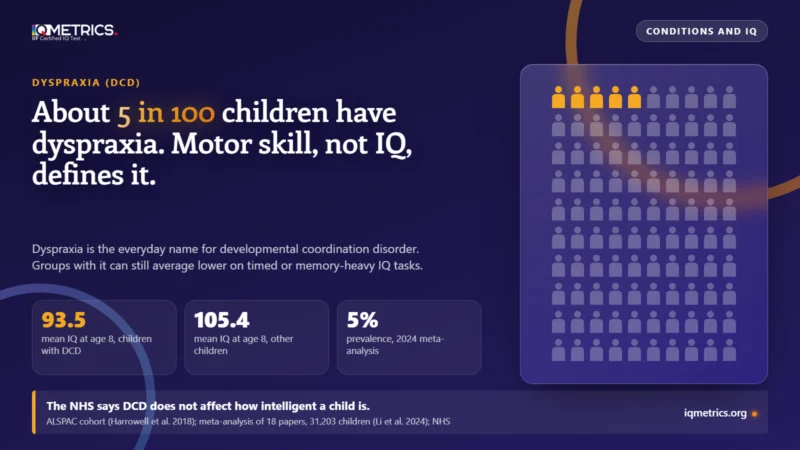
The short answer on dyspraxia and IQ: dyspraxia, which doctors call developmental coordination disorder (DCD), is a motor condition and not a low-IQ condition. The NHS says DCD “does not affect how intelligent a child is”. Yet in a UK birth cohort, children with DCD averaged an IQ of 93.5 against 105.4 for other children, and several studies find lower processing speed and working memory. Both facts are true, and this guide explains how they fit together.
Below: what dyspraxia means, how common it is, what the studies find on IQ, why some IQ subtests are harder with it, and what is known about dyspraxia and high IQ.
What is dyspraxia, and how is it different from DCD?
They are the same condition in everyday use. The NHS says developmental co-ordination disorder (DCD) is “also known as dyspraxia” and affects physical co-ordination. It adds that healthcare professionals prefer DCD, because dyspraxia can also describe movement problems that start later in life after a stroke or head injury. The international clinical recommendations (Blank and colleagues, 2019) agree. They recommend the term DCD, and we use dyspraxia in the title because it is the word most people search for.
How common is dyspraxia?
About 5 in 100 children is the most quoted figure, but estimates range from under 1% to 20% depending on how strictly the criteria are applied. The Blank recommendations say 5% to 6% is the most frequently quoted percentage and that boys are affected 2 to 7 times as often as girls.
| Source | Prevalence | What the figure covers |
|---|---|---|
| UK birth cohort (ALSPAC, Lingam 2009) | 1.7% | 119 of 6,990 children aged 7 to 8, strict criteria, IQ below 70 excluded |
| Same cohort, probable DCD (Lingam 2010) | 5.0% | 346 children below the 15th percentile with everyday impact |
| Meta-analysis (Li and colleagues, 2024) | 5% | 18 papers, 31,203 children; 7% of boys and 4% of girls |
| Most-quoted figure | 5-6% | Cited to the DSM-5 in the literature |
| South India study using DSM-5 | 0.8% | Reported in the Blank recommendations |
The spread is wide because DCD is defined by how much motor trouble affects daily life, and studies draw that line in different places. The 2024 meta-analysis, available in full online, settles near 5%.
What is the link between dyspraxia and IQ?
It is defined separately from intelligence. The DSM-5 criteria say the motor deficits must be “not better explained by intellectual disability (intellectual developmental disorder) or visual impairment”. So a diagnosis excludes motor problems that are fully explained by low intellectual ability. It does not require any particular IQ.
The international recommendations go further. They say that setting a specific IQ score below which DCD is ruled out “seems artificial”. They add that if a child has a normal history of school achievement, IQ testing is not needed, but a test of intellectual ability is recommended if there is any doubt. They also note that at least 2% of all individuals with typical intelligence experience severe consequences of DCD in everyday living.
Where would your own score land?
Take the IIF-certified assessment and get your score with the scale it was measured on, the percentile it corresponds to and the confidence range around it — the three figures most online tests leave out.
Find your IQ score now! →What is the average IQ of children with dyspraxia?
Groups with DCD often score a little lower on average, but studies disagree. The largest figures come from the Avon Longitudinal Study of Parents and Children, a UK cohort. At about age 8, an IQ test found 105.4 for 4,504 children without DCD and 93.5 for 202 children with it, a gap of 11.9 points. The authors report this in a study of secondary-school results.
| Study | Children | What it found |
|---|---|---|
| ALSPAC cohort, shortened WISC-III at 8.5 years (Harrowell 2018) | 202 with DCD, 4,504 controls | Mean IQ 93.5 against 105.4 |
| Sumner, Pratt and Hill 2016, WISC-IV | 52 with DCD, 52 matched | Poorer processing speed and working memory; Full Scale IQ in the typical range |
| Kastner and Petermann 2010, WISC-IV | 40 with DCD and a control group | Below average on all four indices and general IQ |
| Loh, Piek and Barrett 2011, WISC-IV | 62 in four groups; 11 with DCD only | Poorer perceptual reasoning in DCD groups |
Read this as a pattern, not a verdict. Full Scale IQ sat in the typical range in one study and below average in another. The most repeated weak spots are processing speed, working memory and visual reasoning. Children in the UK cohort with DCD were also more likely to be born early, to have a low birth weight and to face family difficulties, so the IQ gap is not proof that DCD lowers IQ.
Children with an IQ below 70 were left out of the DCD group by definition in that study. Only 202 of the 284 children with DCD had an IQ score, which is another reason to treat the 11.9-point gap with care.
Which IQ subtests are harder with dyspraxia?
The timed, hands-on ones. Sumner and colleagues describe the WISC-IV processing speed tasks as motor-demanding, which in their words “raises specific concerns about using this index of the IQ assessment in this population”. A separate study found children with DCD scored below children with dyslexia on the processing speed index, block design and symbol search.
Memory is the other weak spot. Alloway tested 55 children with DCD and found a pervasive memory deficit, worst for visuospatial short-term and working memory. A 2013 meta-analysis of 129 studies, covering 2,797 children with DCD and 3,407 without, found moderate to large effects across outcomes. It listed executive function among the areas of pronounced difficulty. Our guides to processing speed and digit span and working memory explain what these scores measure.
Test publishers have non-motor options. Pearson’s table for the WISC-V offers a non-motor Full Scale score that swaps in Block Design Multiple Choice and Naming Speed Quantity, for cases with no manipulatives or response booklets. The table does not name dyspraxia, so ask the examiner which index scores are being used and why.
Can someone have dyspraxia and a high IQ?
Yes, but little research exists. DCD is not defined by low IQ, and clinicians do diagnose it in able children. A 2024 study profiled 25 children diagnosed with DCD and identified as cognitively gifted. A small conference abstract compared 19 children with DCD and an IQ above 120 with 19 typical children. We found no guideline and no study of how often the two go together.
One study looked at the reverse question. It compared 30 gifted children (IQ of 130 or more) with 35 typical children and found that, as a group, they did not seem to be at risk of motor or praxis difficulties. So there is no evidence that high IQ makes dyspraxia more likely. Our guide to twice-exceptional (2e) children covers children who are gifted and have a learning difference.
What should parents and adults take from this?
- Dyspraxia is diagnosed on motor skill and daily impact. It does not mean low intelligence.
- Ask for index scores, not only a Full Scale IQ. Processing speed and working memory can pull a total down.
- Timed writing and drawing tasks can under-read ability. Our post on handwriting and IQ covers the link between handwriting and IQ.
- Extra help at school matters more than a label. The NHS notes that DCD can make learning harder, so children may need support to keep up.
- If you suspect DCD, talk to a GP or paediatrician. This guide is not medical advice.
For other conditions and test scores, see how ADHD, autism and dyslexia change what an IQ test measures and low IQ versus learning disability. To see where your own score sits, take the IQ test and use the IQ percentile calculator.
Keep reading
All articles →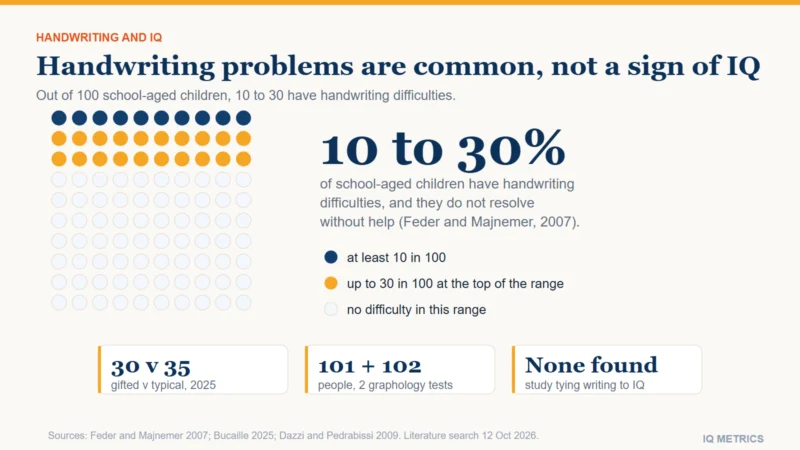 Mind & Everyday Life
Handwriting and IQ
Is bad handwriting a sign of a high IQ? We found no study that says so. Handwriting is a motor and attention skill that affects 10 to 30% of school-aged children, gifted children wrote with weaker quality in one small study, and graphology failed two direct tests. Here is the evidence.
 Understanding IQ
Processing Speed and IQ
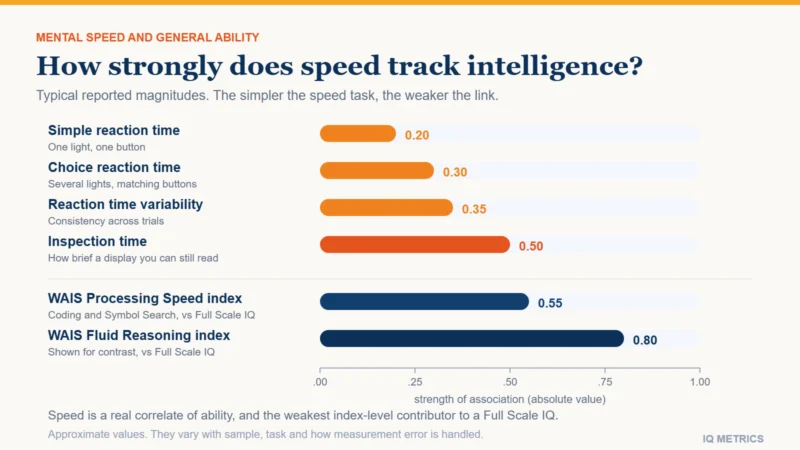
Fast thinkers are assumed to be smart thinkers, and there is a real finding underneath the stereotype: people who score higher on IQ tests do respond faster on tasks with no reasoning content at all. But the link is weaker than the folklore, and on a professional battery the speed index is the least g-loaded.
 Taking a Test
ADHD, Autism and Dyslexia in IQ Testing
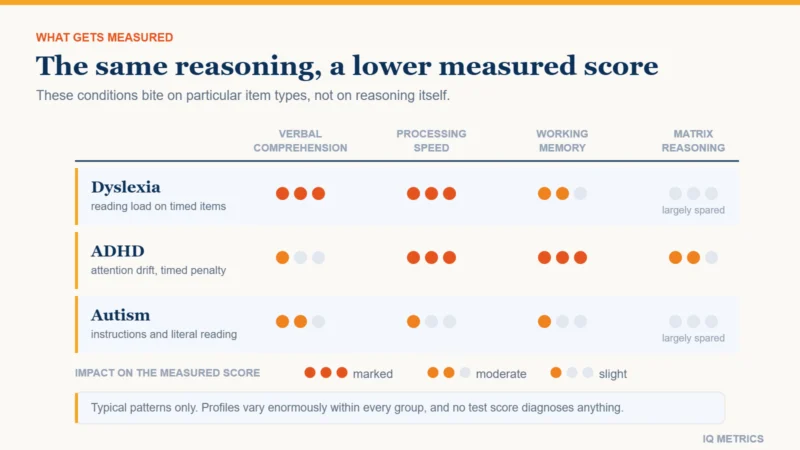
A test score is a measurement, and a measurement can be biased by the conditions under which it is taken. ADHD, autism and dyslexia each depress performance on particular kinds of item without lowering the reasoning underneath. Here is what actually interferes, condition by condition, and what to do next.