
Is 97 IQ Dumb? What a Score of 97 Actually Means
A score of 97 is average. It sits three points below the population mean, which is well inside the margin of error of any test that produced it, so 97 and 100 are the same result in every way that can be measured. The interesting question is not what 97 says about you, but how little any single number can say.
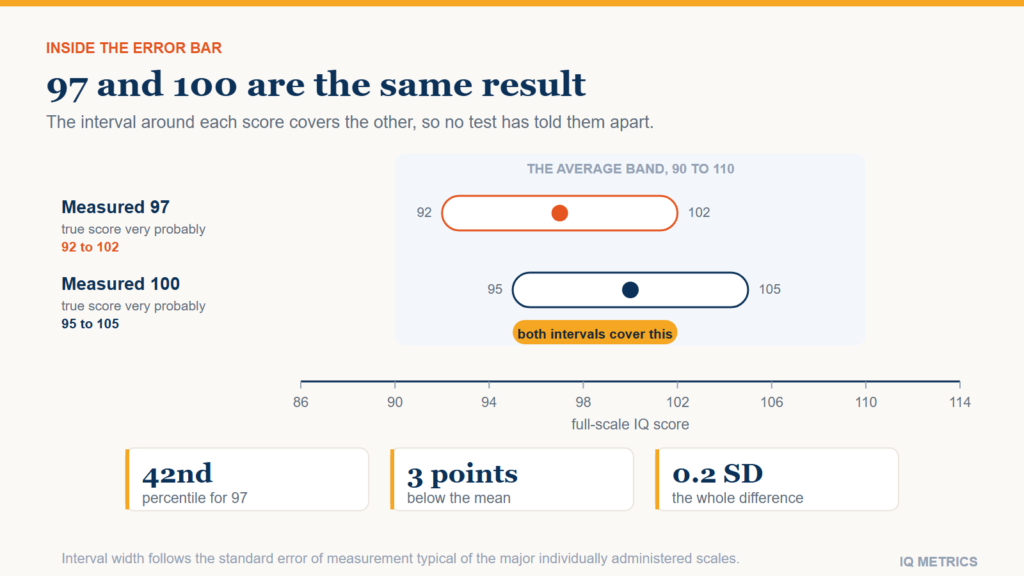
No. A score of 97 is average. It sits three points below the population mean of 100, at roughly the 42nd percentile, which puts it inside the widest band on the entire scale — the one that contains about half of everybody.
More than that: 97 and 100 are not really different numbers. The measurement error on a full-scale IQ score is larger than the gap between them, so no test has actually distinguished the two. That is the part worth understanding, and it is what the rest of this article is about.
Where 97 actually sits
An IQ score is a rank, not a quantity. The test is given to a large representative sample, the middle of that sample is defined as 100, and one standard deviation is defined as 15 points. Every score is then a statement about position relative to that reference group and nothing else.
Three points below the mean is 0.2 standard deviations. On a normal curve that lands at about the 42nd percentile:
- Roughly 42 percent of people score below 97.
- Roughly 58 percent score at or above it.
- Around half the population falls in the 90 to 110 band that contains it.
The band from 90 to 110 is not a category of person. It is the fat middle of a curve, and its width is the reason the label attached to it is simply “Average” in every published test manual. You can place any score against the same curve with the IQ percentile calculator.
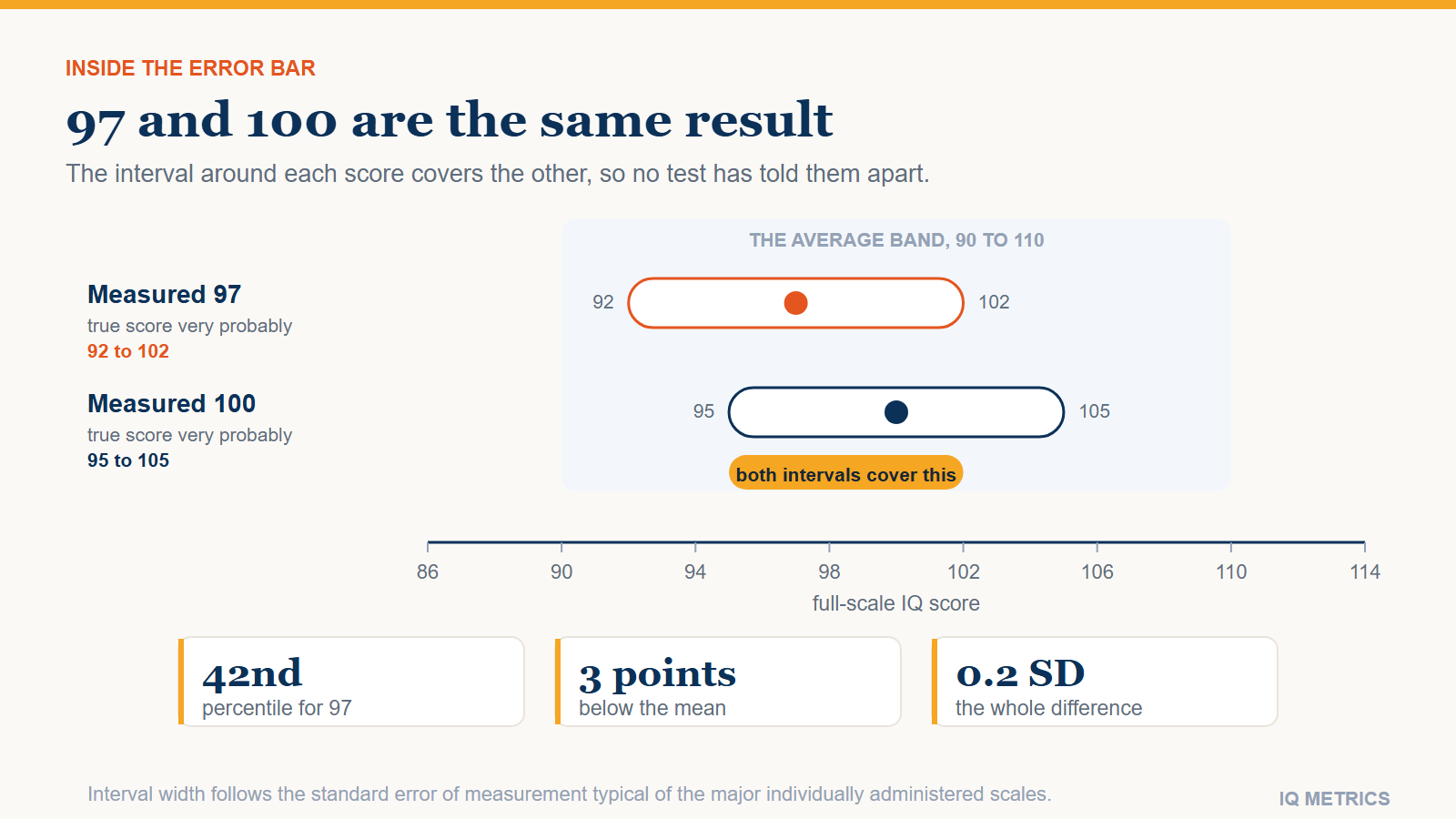
97 and 100 are the same score
This is the single most useful fact about a number like 97, and it is almost never printed next to it.
Every cognitive test reports with error. A well-built professional instrument carries a 95 percent confidence interval of about plus or minus 4 to 5 points on the full-scale score. Short online tests are considerably wider. So a measured 97 means something closer to “the true score is very probably between 92 and 102”.
That interval contains 100. It contains 99, 101 and 102. Which means the test has not established that the person who scored 97 differs from the population average at all — and it has certainly not established that they differ from someone who scored 101 on the same day. The margin of error explained works through the arithmetic, and how to read an IQ test report shows where the interval appears on a real score sheet.
Compare that with a score in a genuinely different band. A 85 has a confidence interval running roughly 80 to 90, which does not overlap 100 at all. That is a real distinction. A three-point gap is not.
Take the test again and the number will move
If the same person sits a comparable test a few weeks later, the score will change, and it will change for three reasons that have nothing to do with intelligence.
- Measurement error. The same true ability produces a spread of observed scores. Movement of several points between sittings is expected, not a sign that something went wrong.
- The practice effect. Second exposure to a cognitive test reliably raises the score, typically by several points on non-verbal material, and the gain is about familiarity with the format rather than ability. See the practice effect.
- Regression to the mean. An unusually low or high result tends to be followed by one closer to the middle, purely as a statistical consequence of the first result being partly luck. Regression to the mean has the detail.
None of this makes tests useless. It makes a single number a poor summary of a person, which is a different complaint. Anything that affected the sitting itself — sleep, illness, anxiety, an unfamiliar format — also shows up in the score, and the factors that affect an IQ test result lists what is known to move it.
Where would your own score land?
Take the IIF-certified assessment and get your score with the scale it was measured on, the percentile it corresponds to and the confidence range around it — the three figures most online tests leave out.
What "average" describes and what it leaves out
The label “average” is a statement about a reference sample. It says the score sat near the middle of the group the test was normed on, at the time it was normed. It is not a statement about a person’s ceiling, their working life, or what they are capable of learning.
Three things it specifically leaves out:
- The profile underneath. A full-scale 97 can be four flat index scores, or it can be a verbal comprehension of 115 against a processing speed of 80. Those describe very different people and produce the same headline number. Verbal versus non-verbal scores explains why the split matters more than the total.
- Conditions on the day. Test anxiety, poor sleep and an unfamiliar interface all pull scores down, and their effect is largest for people who are least practised at testing. See test anxiety and IQ scores.
- Everything the test does not sample. Motivation, conscientiousness, domain knowledge, social judgment and persistence are not on the test, and they carry real weight in outcomes. Is intelligence limited to IQ takes that seriously rather than as a consolation.
97 compared to what, exactly
Every IQ score is a comparison against a specific group of people tested at a specific time, and both halves of that sentence move the number.
The reference sample is usually national and stratified to match a census, so a score reported as 97 means “97 relative to this country’s population as sampled for this edition of this test”. Norm against a different group and the number changes without anything about the person changing. That is also why national average IQ comparisons are far weaker evidence than they are usually presented as.
Norms also expire. Raw performance on cognitive tests rose through most of the twentieth century, roughly three points a decade, so publishers periodically re-norm and the whole scale shifts back to a mean of 100. A person scoring 97 against 2010 norms would score differently against 1980 ones, on identical performance. The rise has stalled or reversed in several countries recently, which is its own story: why IQ norms expire.
The practical version of all this: a score is only as meaningful as the norm table behind it, and a test that does not publish one has not really produced a score at all.
What a 97 does not tell you about a life
Ability scores predict outcomes in the aggregate and predict individuals poorly. The correlation with school attainment is around 0.5, which sounds strong and means the score accounts for roughly a quarter of the variation. Three quarters of it sits elsewhere. At the level of one person, that residual is the whole story.
Concretely: within any band of a few points, the range of adult outcomes is enormous and overlapping. There is no attainment, occupation or qualification that a 97 excludes. There are thresholds set by other people — Mensa asks for the 98th percentile, some gifted programmes for 130 — but those are membership rules, not statements about capability.
If the number still bothers you
Two honest things can be said, and a third one cannot.
The first: the score you have is one estimate with a wide interval, and if it came from a short untimed quiz with no published norms, it is not really a measurement at all. What to check before trusting an online score is the list to run it against.
The second: what can be changed is real, but it is mostly about conditions and skills rather than the underlying ability. Familiarity with item formats, adequate sleep, and reducing anxiety all move measured scores. Correcting a genuine nutritional deficiency moves them; supplementing an already adequate diet does not. Can you improve your IQ is careful about which is which.
The third, which cannot honestly be said, is that the number does not matter at all. It measures something, and that something is related to how quickly unfamiliar abstract problems get solved under time pressure. It is simply a much smaller claim than the word “dumb” implies, and three points below a convention is not a finding about anyone.
Keep reading
 Scores & Scales
What an IQ of 85 Means
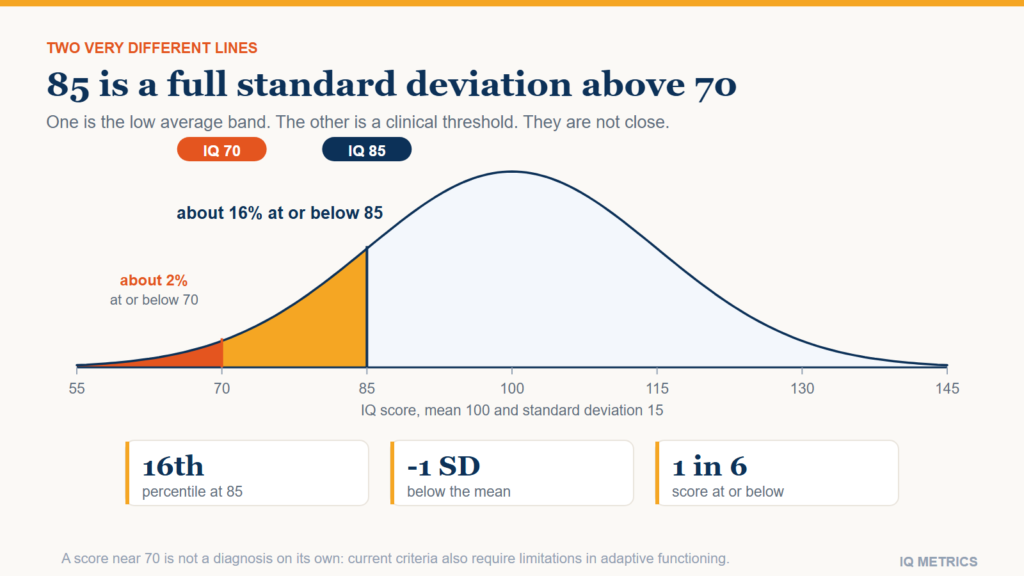
A score of 85 sits exactly one standard deviation below the population mean, at roughly the 16th percentile. It is the bottom edge of what test manuals call low average, it is well clear of any clinical threshold, and on its own it says considerably less about a person than the number appears to.
 Scores & Scales
What is Average IQ Test Score?
Is the meaning of intelligence tests something that interests you? How interested are you in learning the meaning of those figures? Then you should read this article. We will explore typical results and more in this enlightening piece that delves into the realm of IQ tests.
 Scores & Scales
How to Read an IQ Test Report
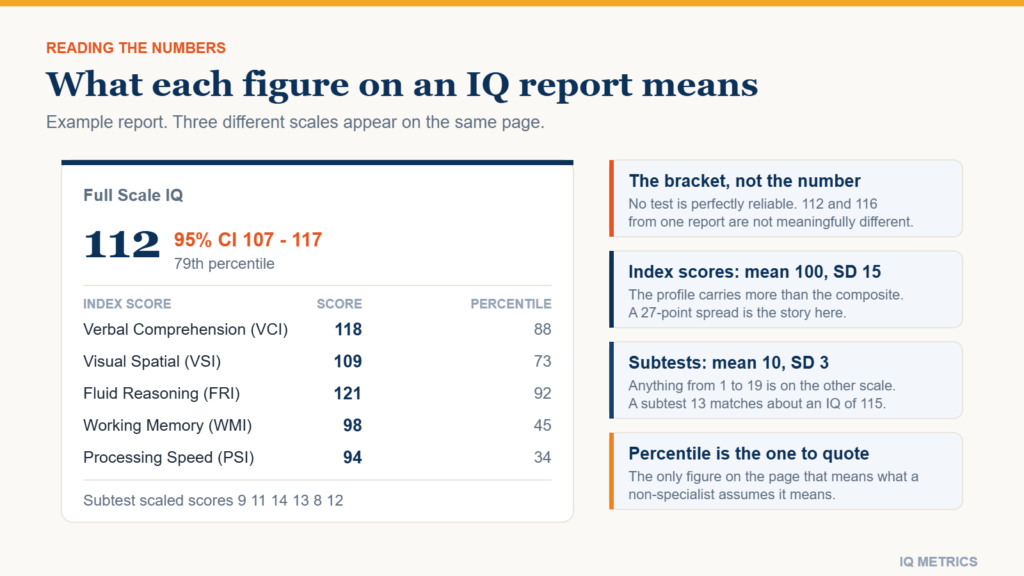
An IQ report puts numbers on at least three different scales and almost never explains which of them matters. Here is what FSIQ, the index scores, the subtest scaled scores, the percentile rank and that bracketed range each mean, and when the headline number should not be read at all.