
Do Video Games Raise Your IQ? Near Transfer vs Far Transfer
Action video games produce real, replicated gains in spatial ability and attention, some of the best near-transfer evidence in this batch. Push the test further away, toward the general reasoning an IQ test measures, and the effect all but disappears once the research is pooled properly.
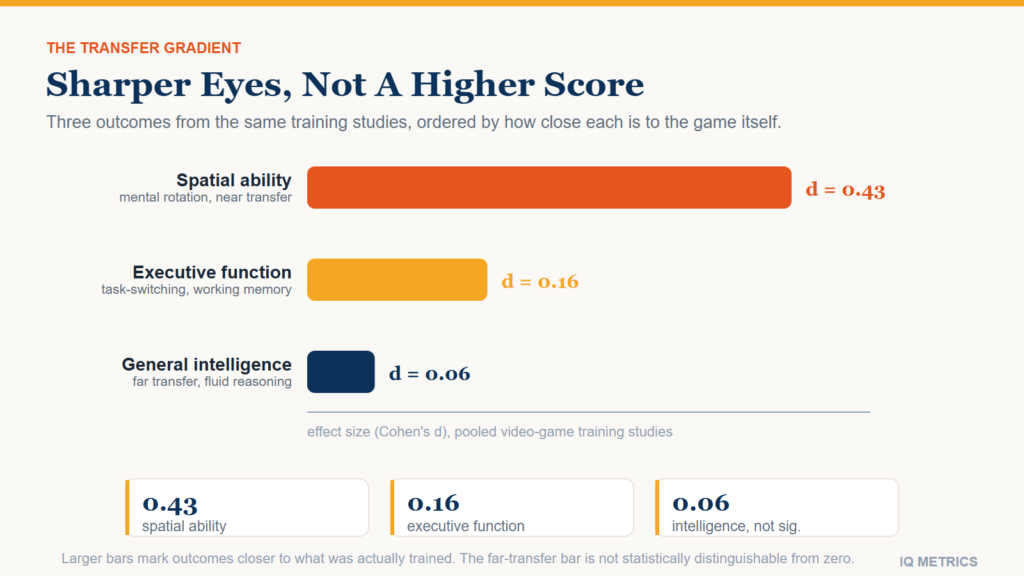
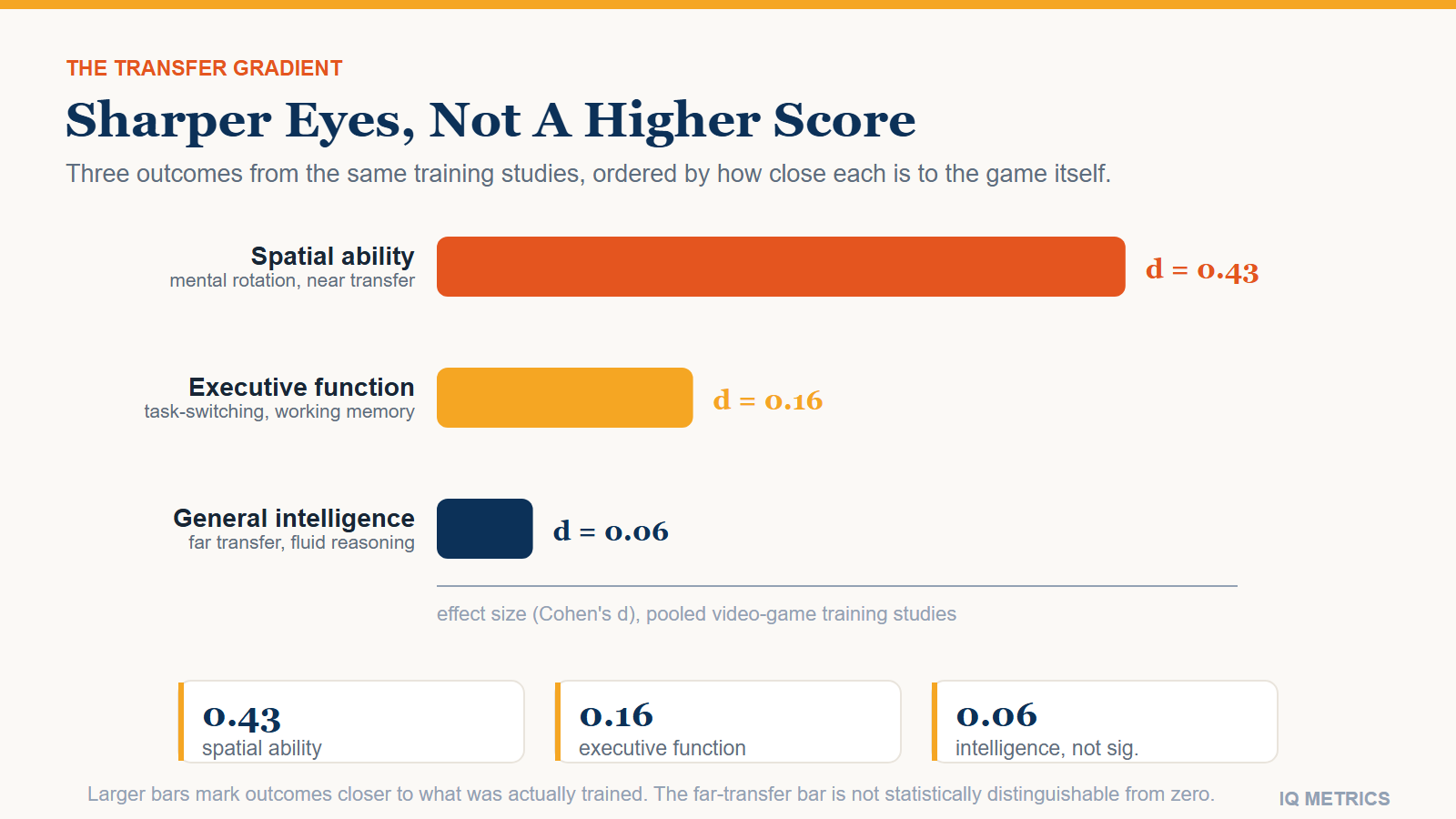
For a narrow set of specific skills, yes: well-controlled studies find real improvements after training on action video games. For general intelligence — the broad reasoning ability an IQ test is built to capture — the answer from the same body of research is close to no. The gap between those two findings is the whole story, and it is a cleaner version of the same near-transfer, far-transfer pattern that shows up with chess.
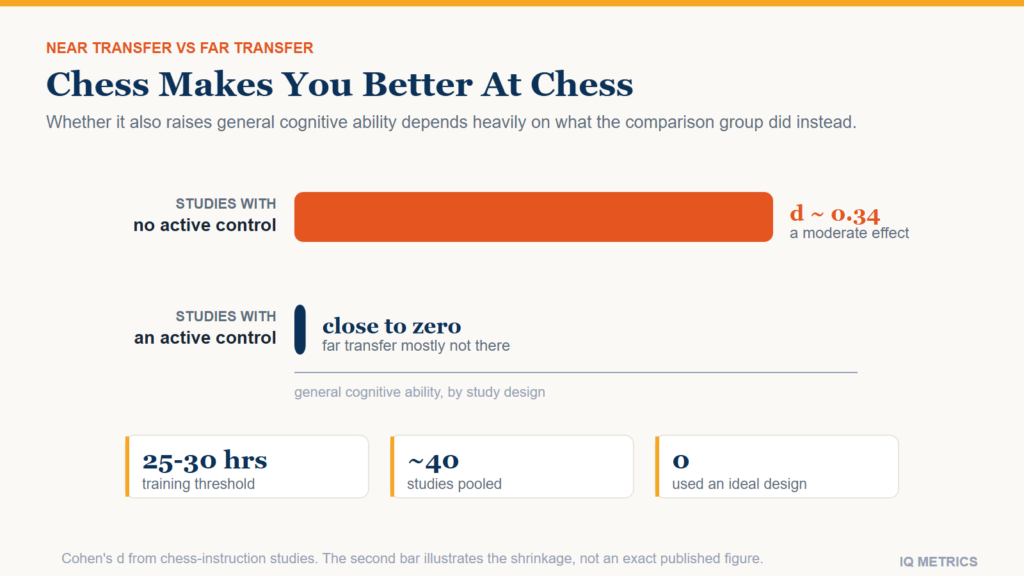
That comparison is worth making explicit, because chess and video games have been studied with a similar structure and hit a similar wall: real, replicated gains on the trained task and its closest neighbours, and gains that shrink toward nothing the further the test sits from what was actually practiced. The two questions even share a villain: early studies with no proper comparison group, which is exactly the design flaw that inflated the first wave of both literatures before better-controlled follow-ups brought the estimates back down.
What gets sharper
The clearest, most replicated finding in this literature concerns a fairly narrow skill: mental rotation and other tests of spatial ability, where meta-analyses combining dozens of training studies find a moderately strong improvement after action-game practice. Related measures of visual attention — how much of a busy screen someone can track at once, how quickly they find a target among distractors — move in the same direction, though usually by less.
Executive-function tasks, which cover things like switching between rules or holding several items in mind while working with them, show a real but small average improvement across studies. It is a genuine effect, not noise, but it is a fraction of the size of the spatial-ability finding, and it varies a lot from one study to the next.
Not all video games are the same
Almost all of the research behind the spatial-ability and attention findings comes from one specific genre: fast-paced action games, usually shooters, that demand tracking multiple moving targets under time pressure. That is a deliberate choice by researchers, not an accident — the genre plausibly exercises visual attention and spatial tracking more directly than most other kinds of game — but it also means the finding does not automatically generalize to gaming as a whole.
Puzzle games, city-builders and slower strategy titles have been studied far less, and what research does exist finds effects, when present at all, on narrower skills that match whatever the specific game demands rather than on spatial ability broadly. The honest version of this article’s headline claim is narrower than “video games raise your IQ” or even “video games sharpen your mind”: it is closer to “a specific, well-studied genre reliably sharpens a specific, narrow set of visual and attention skills.”
What does not move
None of the genre caveat changes the picture for the specific genre that has actually been tested. Push the test further from the game itself, toward the kind of abstract pattern-matching an IQ test actually uses, and the effect all but disappears. A comprehensive pooling of the video-game training literature put the average improvement in measured intelligence at essentially zero once study quality was accounted for — smaller than the executive-function effect, and not reliably different from no effect at all.
- Spatial ability. A real, moderately sized improvement — the strongest finding in the field.
- Executive function. A real but small improvement, well short of spatial ability.
- General intelligence. No reliable improvement once the studies are pooled properly.
Where would your own score land?
Take the IIF-certified assessment and get your score with the scale it was measured on, the percentile it corresponds to and the confidence range around it — the three figures most online tests leave out.
Who these studies actually tested
It is a fair question, and worth asking directly. Most of this research compares people who already play action games heavily against people who do not, or takes non-gamers and puts them through several weeks of training in a lab. Both designs have a real limitation. The comparison studies cannot fully separate “gaming made these people sharper” from “people who were already sharper in this specific way found gaming more rewarding and stuck with it” — the same selection problem that comes up with chess players. The lab-training studies handle that better by assigning people randomly, but they mostly recruit young adults over a few weeks, which says little about children, older adults, or what happens after months or years rather than weeks.
Brain training apps are a different, weaker story
It is worth separating action video games, the subject of the research above, from commercial brain-training apps built specifically to raise IQ or memory scores. That literature has been reviewed on its own, and it fares worse than the action-game research: the trained tasks are usually closer to the test used to measure improvement, which inflates near-transfer scores without producing anything that looks like a durable change in general ability. A game built to be fun and only incidentally demanding on attention has, perversely, produced more convincing evidence than software built explicitly to train cognition.
This is not a fringe opinion inside the field. A group of cognitive scientists published an open letter warning that brain-training marketing was running well ahead of the evidence, and in the United States regulators fined at least one major brain-training company over advertising claims a court found were not adequately supported. None of that means the underlying tasks are useless as puzzles — it means the specific claim “this software will raise your IQ or stave off cognitive decline” has repeatedly outrun what the data backing it could support.
What sharper attention is actually worth
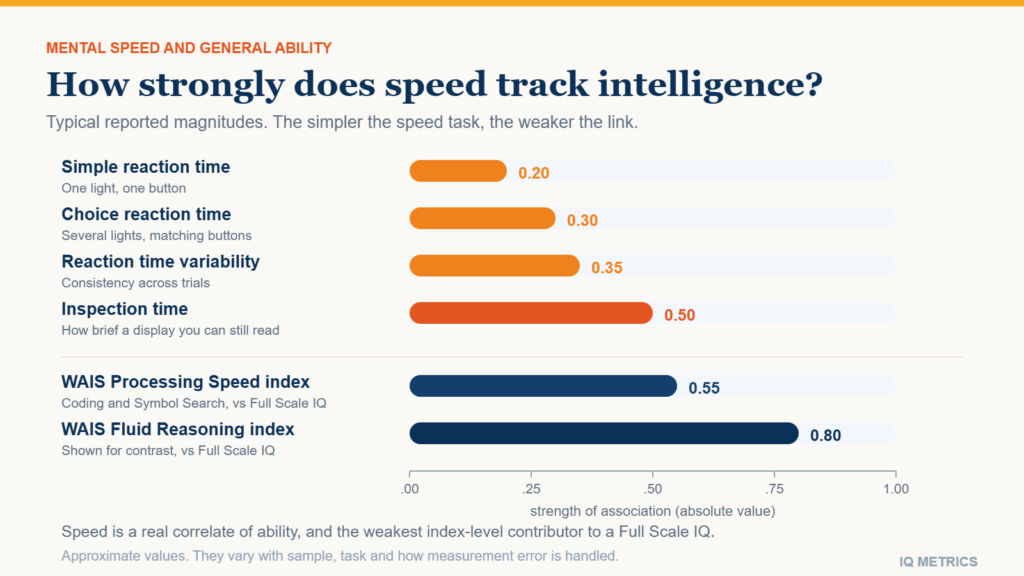
None of this makes the spatial and attention gains trivial. Faster, more accurate visual search and better mental rotation are useful in their own right — they plausibly touch some real-world tasks that lean on quick visual judgment — and they are large enough and reliable enough that a skeptical reader should not lump them in with the null result for general intelligence. What they are not is a stand-in for it. Processing speed is one of the specific abilities an IQ test does sample, and it is plausible some gaming-related gains touch it, but a faster reaction on a screen is a narrower thing than the reasoning an intelligence test is built to measure.
Some of the clearest demonstrations involve a measure called useful field of view: how much of a cluttered scene someone can take in and correctly identify in a single brief glance, without moving their eyes. Trained action-game players reliably outperform non-gamers on this measure, and non-gamers who are put through a training program show real gains within weeks. It is a genuinely useful skill outside a game, relevant to noticing a hazard at the edge of vision while driving, for instance — but it is a specific visual skill, not a general reasoning one, and it says little about how someone would perform on a matrix-reasoning IQ subtest that shows abstract shapes with no visual clutter to search through at all.
So should you game for a smarter brain
If the goal is a higher IQ score, action games are not a proven route to one, and the same is true of software marketed specifically as brain training. If the goal is a set of sharper, well-documented attention and spatial skills, the evidence for that is genuinely good. Those are different claims, and cognitive-training marketing has a long history of blurring them; this page on improving IQ covers what the wider evidence does and does not support, and reading is a useful contrast — a very different activity that moves a very different, more crystallized kind of ability instead.
The same test applies to anyone hoping a screen-based habit will double as brain training: ask what genre was actually studied, what the comparison group did, and whether the outcome measured was close to the game itself or genuinely far from it. A narrow, honest claim — “this sharpens visual attention” — has survived scrutiny here. The broader one has not.
Keep reading
 Mind & Everyday Life
Does Chess Raise Your IQ?
Chess is one of the oldest test cases for a big question: does practicing a demanding mental skill make you generally smarter, or just better at that skill? The honest summary from decades of research: real for chess itself, modest for a couple of related skills, and close to zero for general IQ.
 Mind & Everyday Life
Does Reading Raise Your IQ?
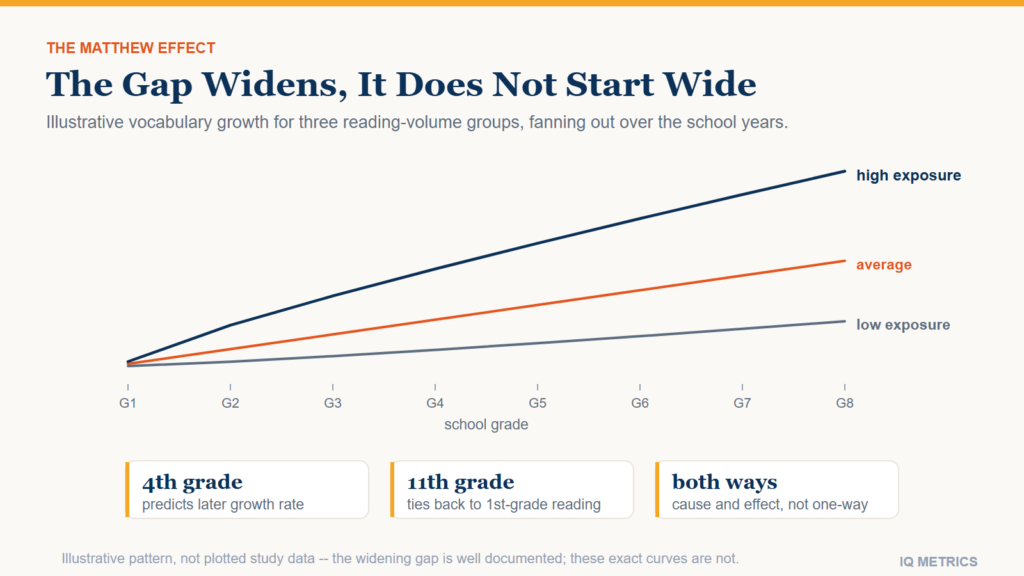
Reading volume and vocabulary growth are genuinely linked, and the relationship compounds over years rather than staying fixed. But it is mostly the verbal, crystallized side of ability that moves, not the abstract reasoning an IQ test also measures, and cause and effect run both ways.
 Understanding IQ
Processing Speed and IQ
Fast thinkers are assumed to be smart thinkers, and there is a real finding underneath the stereotype: people who score higher on IQ tests do respond faster on tasks with no reasoning content at all. But the link is weaker than the folklore, and on a professional battery the speed index is the least g-loaded.