Does Exercise Raise Your IQ? What Aerobic Fitness Changes
Aerobic exercise has some of the best-replicated cognitive evidence of any lifestyle factor, but not for a full IQ score. What reliably improves is executive function: working memory, inhibitory control, cognitive flexibility. One related skill, planning, barely moves at all.
For a specific, well-defined slice of cognition — called executive function, covering things like ignoring distraction, holding information in mind, and switching between tasks — yes: aerobic exercise has a real, repeatedly replicated benefit. For a full IQ score, the case is thinner, and unlike chess, video games or reading, exercise is not really a story about practicing a mental skill at all. It works, as far as anyone can tell, through the body.
That is a genuinely different mechanism from the other three activities in this batch, worth sitting with before comparing the results. Chess and reading are both about practicing something mentally specific and asking how far the benefit travels. Exercise is a physiological intervention that happens to have cognitive side effects, and the research asks a slightly different question: how much exercise, for whom, delivered how, and sustained for how long, rather than how many hours of deliberate practice a particular skill needs.
What moves, and by how much
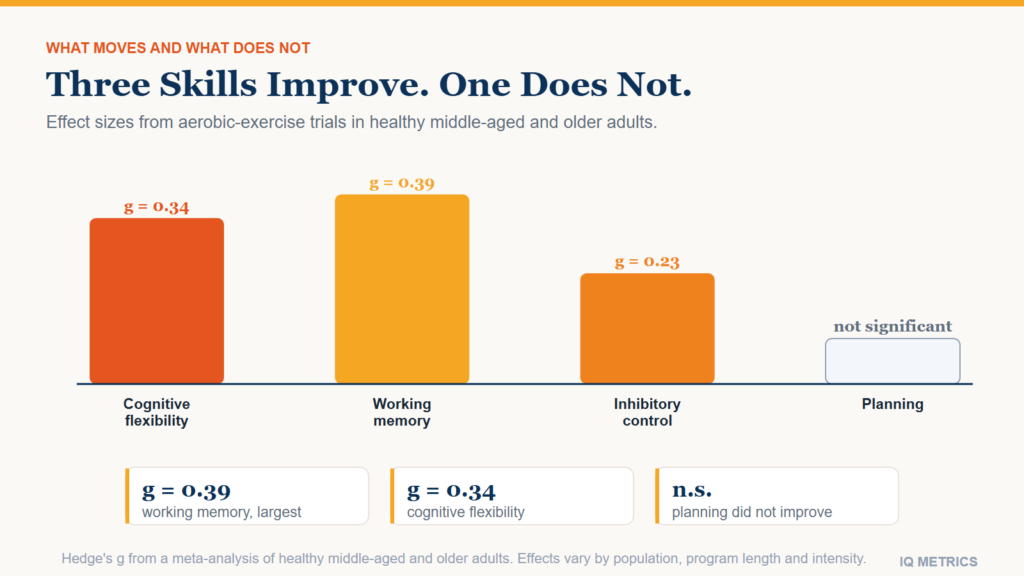
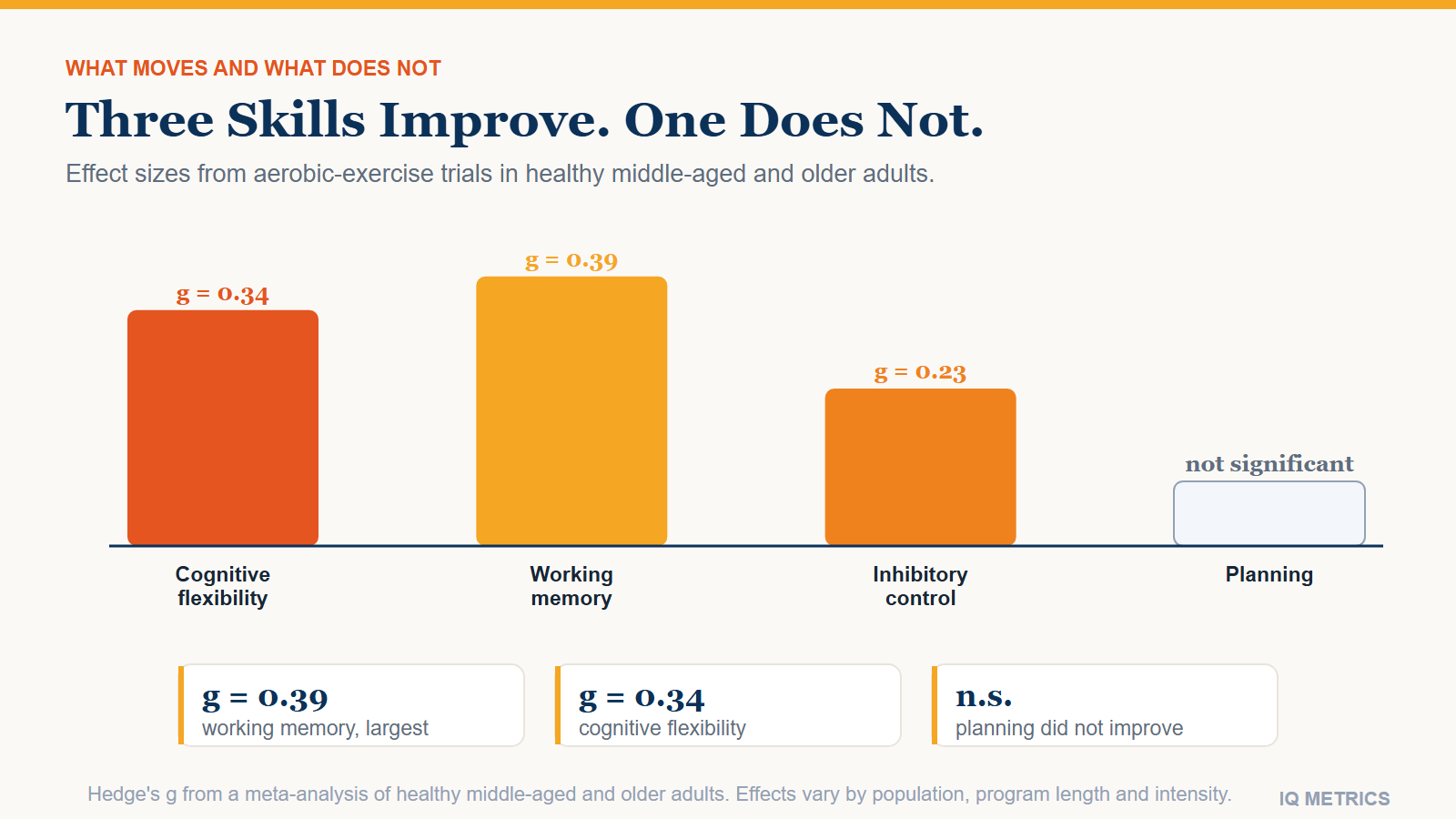
Meta-analyses of aerobic-exercise programs in healthy middle-aged and older adults find real improvements on three separate executive-function measures: cognitive flexibility, working memory, and inhibitory control — the ability to hold back an automatic but wrong response. All three effects are small to moderate in size and consistent enough across studies to be taken seriously.
A fourth measure, planning ability, did not show a statistically reliable improvement in the same body of research. That is worth including precisely because it is the negative result: exercise is not simply a uniform boost to every kind of executive skill, and a chart that only showed the three positive findings would be more flattering than accurate.
- Cognitive flexibility. A real, moderate improvement — the largest of the four.
- Working memory. A real, moderate improvement, close behind flexibility.
- Inhibitory control. A real but smaller improvement.
- Planning. No statistically reliable improvement in this population.
The same pattern in children
The adult numbers above are not an isolated finding. Separate reviews of aerobic-exercise programs in children and adolescents with ADHD found moderate improvements across the same three skills — inhibitory control, working memory and cognitive flexibility — and a review focused on overweight and obese children found a similar moderate improvement in overall executive function, driven mainly by inhibitory control and working memory rather than cognitive flexibility.
Lining those studies up next to each other matters more than any single number in them. Three reviews, three different populations — healthy older adults, children with ADHD, children carrying excess weight — using different exercise programs and different research teams, and all three land on roughly the same short list of skills: inhibitory control and working memory move fairly reliably, cognitive flexibility often does too, and the least consistent finding across all of them is planning. A single study finding a benefit could easily be a fluke. The same shape of result recurring across unrelated populations is a much harder pattern to explain away.
Why aerobic exercise might do this
The proposed mechanisms behind this are physiological rather than purely psychological in nature: sustained aerobic activity increases blood flow to the brain and appears to raise levels of growth factors involved in forming new connections between neurons, particularly in regions tied to memory and executive control. Human evidence for the exact chain from a training program to a measured cognitive gain is still being worked out, and much of what is confirmed comes from a mix of animal research and indirect markers in humans rather than one complete human causal pathway. The consistent behavioral result — better executive function after aerobic training — is on firmer ground than any single explanation for why it happens.
There is also a difference between a single session and a sustained program, and the two do not always point the same way. A single bout of moderate aerobic exercise can produce a short-lived boost to attention and inhibitory control lasting roughly an hour or two afterward, which researchers call an acute effect. A program of regular exercise sustained over weeks or months produces the more durable executive-function gains described above, through what looks like a slower, structural change rather than a temporary state. The two are related but not interchangeable, and a study measuring one says little about the other.
Where would your own score land?
Take the IIF-certified assessment and get your score with the scale it was measured on, the percentile it corresponds to and the confidence range around it — the three figures most online tests leave out.
Dose matters, and so does your starting point
The size of the benefit depends on how much exercise, how intense, and for how long, and studies that vary these do not all agree on the exact best combination. What is more consistent across this research is who benefits most: people who start out less fit, or with lower baseline cognitive performance, tend to show larger gains than people who were already fit and high-performing. The same general pattern — real benefits in children with attention difficulties, in sedentary older adults, and in children carrying excess weight — shows up across strikingly different groups, which is itself a form of evidence: a result this consistent across such different starting populations is harder to explain away as a fluke of any one study design.
That “lower baseline benefits more” pattern also shows up when comparing a single exercise session’s after-effects directly: people who perform worse on a cognitive task before exercising tend to show a bigger improvement afterward than people who already scored well. It is a pattern with an intuitive ceiling built in — there is more room for someone starting lower to move — but it also means the people most often used to headline this research, young healthy volunteers already near their own ceiling, may be exactly the group least likely to show a dramatic effect.
Executive function is not the same as a full IQ score
It matters that almost none of this research measures a full-scale IQ score directly. Executive function is one contributor to test performance, particularly on timed and working-memory-heavy sections, but a standard IQ battery also leans on things exercise research rarely touches, like accumulated vocabulary and abstract pattern reasoning. Processing speed and working memory are the parts of a typical test most plausibly connected to what exercise studies actually measure; treating a gain on an executive-function task as equivalent to a higher IQ score overstates what the research supports.
This is also why exercise and diet sit oddly next to chess, video games and reading in one respect: none of the exercise research reviewed here reports a full-scale IQ score before and after a program, the way a handful of the chess and brain-training studies at least attempt to. What exists is evidence about specific, named cognitive skills that overlap with part of what an IQ test measures, not a demonstrated change in the composite score itself. That is a genuine gap in the evidence, not a minor technicality, and a fair summary of this research has to say so rather than round “executive function improved” up to “IQ went up”.
So should you exercise for a sharper mind
For executive function specifically, aerobic exercise has some of the best-replicated evidence in this entire batch of questions, consistent across ages from childhood through later life; see how cognitive performance shifts across the lifespan and what early scores predict about later-life health for the surrounding picture. For a general IQ score, treat exercise the way this site treats diet: a real contributor among several, not a single lever. Nutrition and this article cover two of the more physiological factors; the full picture of what does and does not move the number ties them together.
The version of this claim worth actually believing is the modest one: regular aerobic activity is one of the better-supported ways to keep specific, useful mental skills sharp, particularly for anyone starting from a lower baseline, and that is true regardless of what it does or does not do to a single test score.
Keep reading
 Mind & Everyday Life
Does Chess Raise Your IQ?
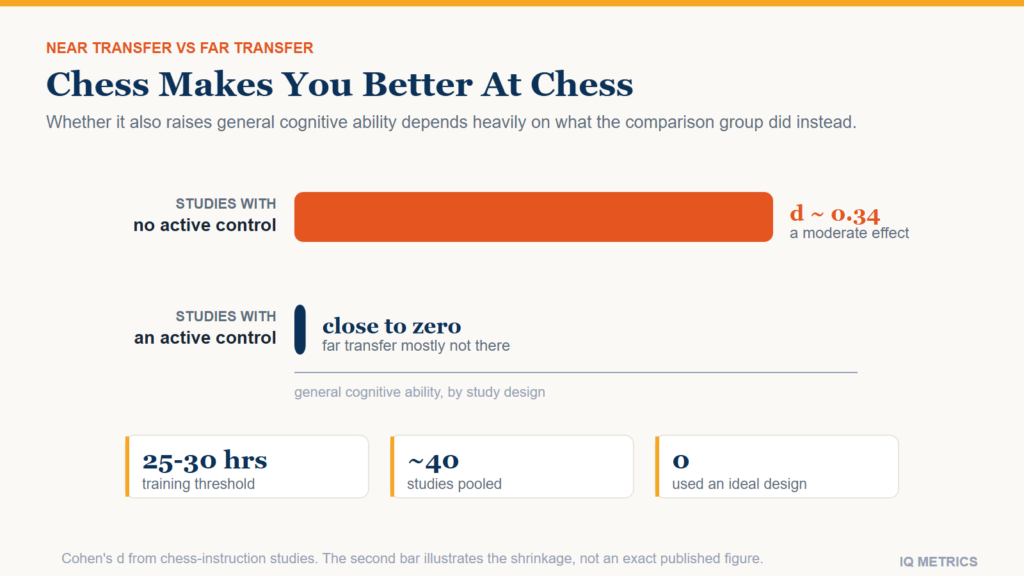
Chess is one of the oldest test cases for a big question: does practicing a demanding mental skill make you generally smarter, or just better at that skill? The honest summary from decades of research: real for chess itself, modest for a couple of related skills, and close to zero for general IQ.
 Mind & Everyday Life
Does Reading Raise Your IQ?
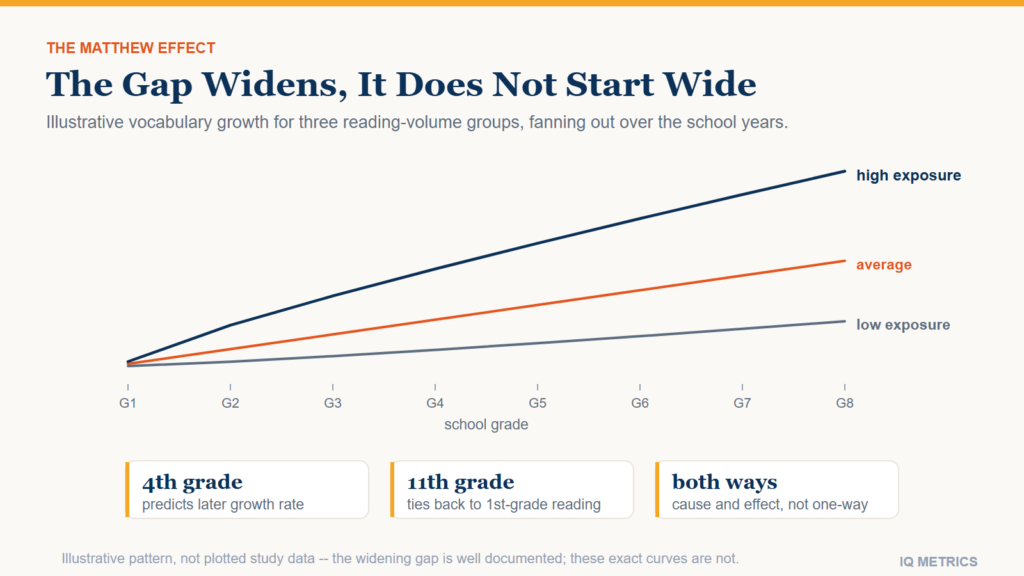
Reading volume and vocabulary growth are genuinely linked, and the relationship compounds over years rather than staying fixed. But it is mostly the verbal, crystallized side of ability that moves, not the abstract reasoning an IQ test also measures, and cause and effect run both ways.
 Research & Evidence
Nutrition and IQ
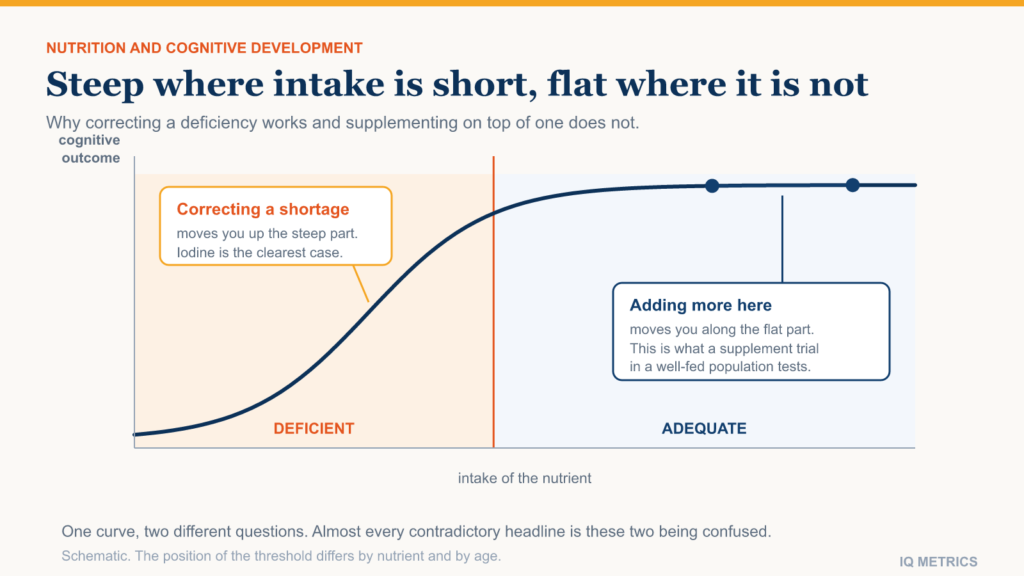
The evidence on diet and intelligence looks contradictory until you separate two questions that get asked as one. Fixing a real deficiency produces some of the largest effects in the field. Adding more of the same nutrient to an already adequate diet produces close to nothing.