





Does a Great Memory Mean You're Smart? Memory and IQ, Explained
The world's best memory athletes can memorize 71 shuffled words in twenty minutes. Their IQ scores are not measurably different from a matched control group who could only manage 40. If a spectacular memory is not the same thing as a high IQ, what actually is the difference?

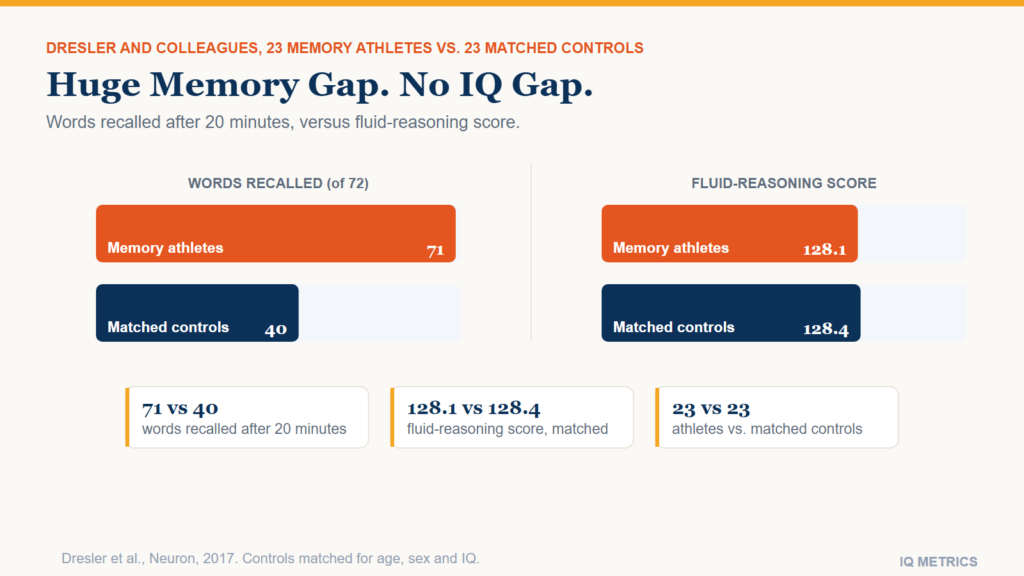
Not especially, no — and the cleanest evidence for that comes from a study that took the question as literally as possible. Researchers recruited 23 of the world’s top memory athletes, people who can memorize a shuffled deck of cards in under a minute, and compared them against 23 ordinary people matched for age, sex and IQ. On memory tasks, the athletes were not close — they recalled 71 of 72 words after a 20-minute delay against 40 for the controls. On a standard measure of fluid reasoning, the two groups scored 128.1 and 128.4. Statistically indistinguishable.
That gap between a massive skill difference and a nonexistent IQ difference is the whole story here, and it says something specific about what IQ tests measure that most people get wrong on their own — including, often, people who assume a sharp memory for names, dates or trivia is itself a sign of a high IQ.
The study that tested this directly
Dresler and colleagues, publishing in the journal Neuron in 2017, gathered 23 of the world’s top-50-ranked competitive memorizers and compared them, brain scans included, against 23 controls deliberately matched for age, sex, handedness and IQ — recruited partly from Mensa and academic-foundation mailing lists specifically so the comparison group would already be drawn from a high-functioning population, not an average one. That design choice matters: it means this study cannot tell you whether memory athletes outscore the general population on IQ (they likely do, since both groups here were well above average). It can tell you something more useful — whether the specific skill of extreme memorization tracks with reasoning ability even among people who already reason well. It does not.
Competitive memory itself is a real, standardized sport with its own disciplines: memorizing the order of a shuffled deck of playing cards as fast as possible, recalling long strings of random binary digits, matching dozens of unfamiliar faces to names seen once, and reciting memorized decimal digits of pi. None of these events resemble an IQ test’s matrix-reasoning or analogy items even slightly — they reward a specific, trainable encoding skill applied to arbitrary material, not the ability to spot a novel pattern you have never been drilled on.
A huge gap on one measure, none on the other
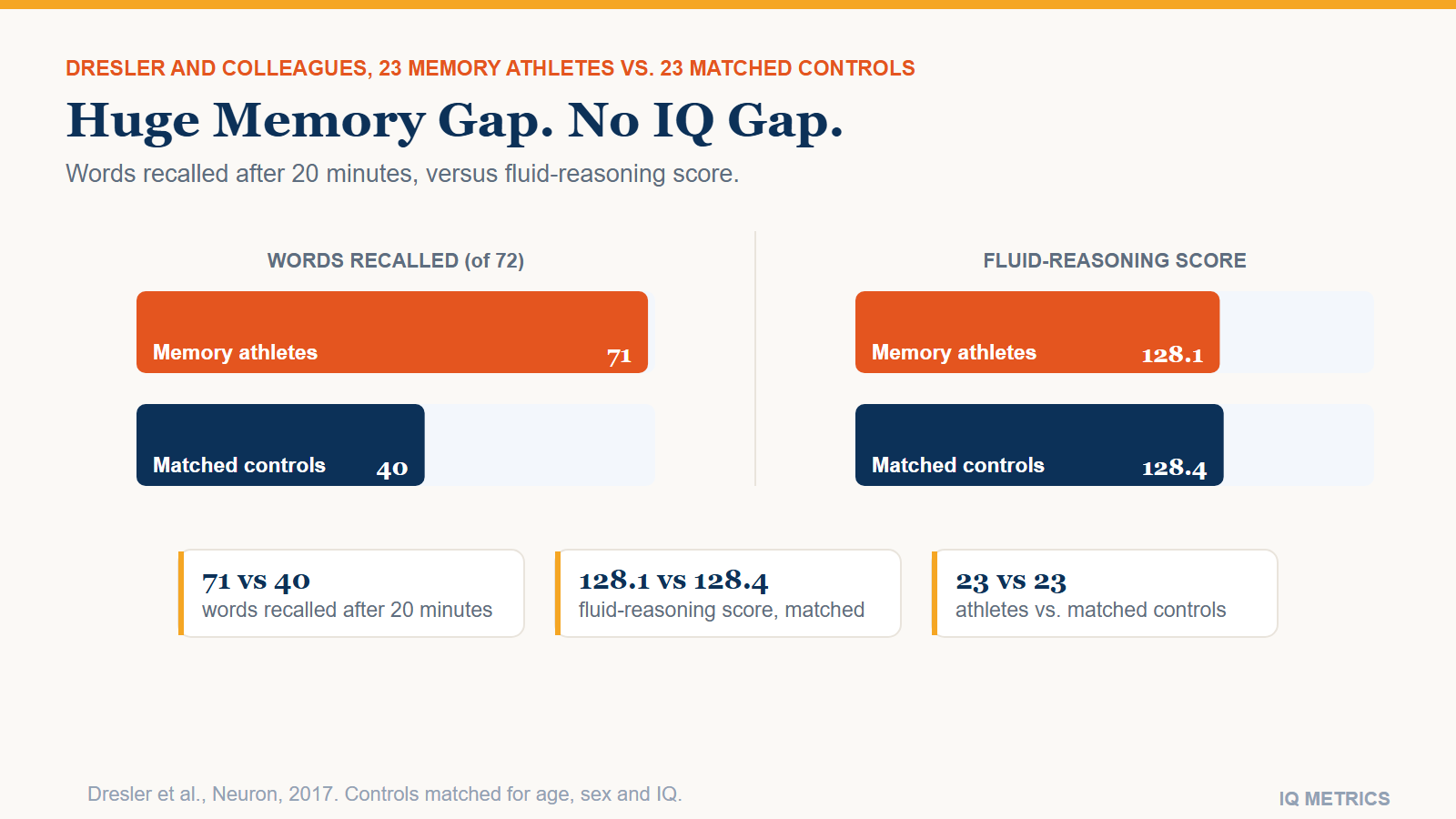
After studying a list of 72 words for a fixed period, memory athletes recalled an average of 71 of them 20 minutes later. Matched controls recalled 40 — a real skill, just not a remotely comparable one. On the fluid-reasoning measure, though, the two groups landed at 128.1 and 128.4 respectively, a difference small enough to be noise. The athletes were dramatically better at one very specific thing and not measurably better at the kind of on-the-spot problem-solving an IQ test is built to capture.
What made the athletes better, if not IQ
Brain imaging pointed to connectivity, not raw processing power: memory athletes showed stronger functional connections between brain networks involved in memory and in visual processing, consistent with the technique nearly every competitive memorizer uses, the method of loci — mentally placing items to be remembered along a familiar route and "walking" that route to retrieve them. The most striking part of the study is what happened when naive controls were taught this technique and given six weeks to practise: many approached the athletes’ recall performance, closing a gap that had looked biological. That result belongs to a pattern seen again and again across skill research, and this site has covered it before — see how much of expert performance generally comes down to technique and deliberate practice rather than a fixed, innate ceiling.
Where would your own score land?
Take the IIF-certified assessment and get your score with the scale it was measured on, the percentile it corresponds to and the confidence range around it — the three figures most online tests leave out.
Find your IQ score now! →Does training your memory make you smarter
This study is also a useful, if indirect, data point against a much broader claim: that training one narrow cognitive skill hard enough produces general gains in intelligence. The memory athletes in this study have trained one specific skill for years, often at a serious competitive level, and it produced exactly the outcome you would predict if training were narrow rather than general — a huge improvement on the trained skill and no detectable improvement on fluid reasoning. Commercial "brain training" programmes make a version of the opposite promise, and the research on whether narrow drills transfer to general intelligence is genuinely mixed at best; this study is a fairly clean illustration of why skepticism is the reasonable default position to start from.
Why IQ tests barely touch this kind of memory
IQ tests do include a memory component, but it is a narrower one than most people picture: working memory, typically tested with tasks like repeating a string of digits forwards and then backwards, or holding a small amount of information in mind while manipulating it. That is genuinely a different cognitive skill from what a memory athlete trains, which is long-term, associative memory for large amounts of arbitrary material — a skill IQ tests were never designed to assess, because it responds so strongly to technique and practice rather than to the kind of novel, on-the-spot reasoning the tests are built around. For more on why even working memory itself is not the same thing as reasoning, see this site's companion piece on the news desk, and for the IQ-test component that measures how fast you process information rather than how much you can hold, see processing speed and IQ.
The everyday version of this confusion
The same mix-up shows up outside competitive memorizing. "Photographic memory" as popularly imagined — a perfect, effortless mental snapshot of anything seen once — has never been reliably documented in a controlled study of an adult. What looks like it in daily life is usually domain-specific expertise: chess masters can reconstruct a mid-game board position from a glance not because their memory is generically superior, but because years of practice let them recognize and "chunk" familiar patterns instead of memorizing 32 pieces one at a time. This was demonstrated decades earlier, well before the memory-athlete study, in a classic experiment by Chase and Simon: put those same chess masters in front of a board with pieces placed randomly, in configurations that never occur in real play, and their recall advantage over a novice mostly disappears — because there are no real game patterns left to recognize. The skill was pattern recognition trained on a specific domain, not raw memory capacity, and it evaporates the moment the domain-specific structure is removed. The same logic applies to a memory athlete: ask one to recall a list of 72 unrelated, un-memorable historical dates instead of 72 concrete words their method of loci was built to handle, and the advantage would very plausibly shrink for exactly the same underlying reason.
None of this is a knock on the athletes. Encoding 72 words in a way that survives 20 minutes is a genuinely difficult, learnable skill, and they are simply better at it than almost anyone alive.
What this means if you are prepping for an IQ test
Mnemonic tricks are worth learning for their own sake, but they will not meaningfully move a real IQ test score, because the tests are deliberately built around novel problems you have not seen before and cannot pre-memorize a solution to. A digit-span task, which does appear on most IQ tests as part of the working-memory component, is one of the few places a memorized technique could theoretically help a little — but it is a small slice of the overall score, and the matrix-reasoning and verbal-analogy sections that carry most of the weight are immune to memorization by design. For what actually helps in the days before sitting one, see this site's guide to preparing for an IQ test. And if raw memory is not what separates an ordinary score from an exceptional one, the next question is what does — which is exactly where the numbers get genuinely interesting: at the far, rarely-discussed end of the scale, covered in a look at what sits above Mensa.
Keep reading
All articles →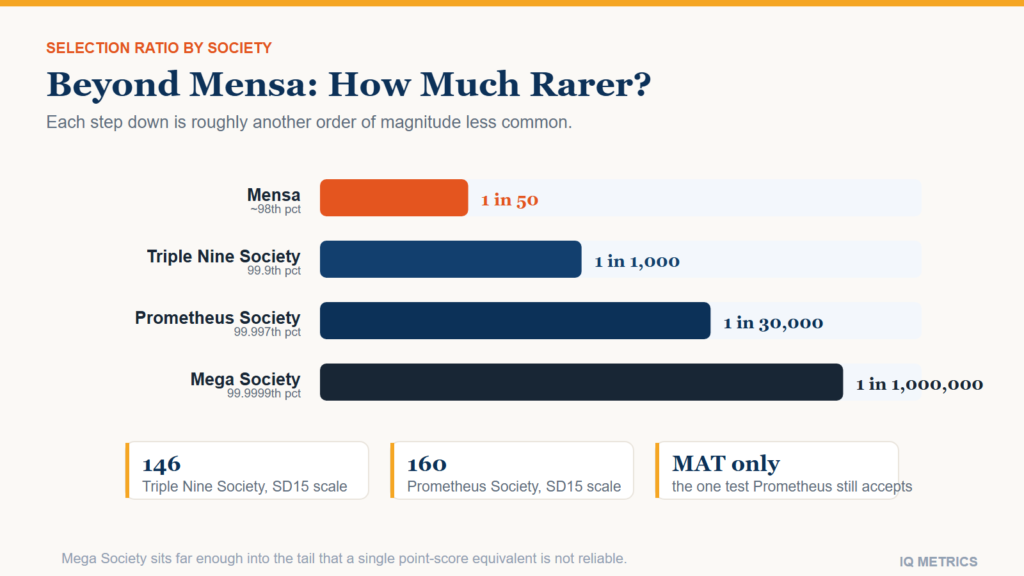 Scores & Scales
High-IQ Societies Explained
Mensa is the famous one, but it is nowhere near the most exclusive. The Triple Nine Society admits one person in a thousand; the Prometheus Society, one in thirty thousand. Here is how each threshold is actually set, what test you would need, and why the further out you go, the less any single number can be trusted.
 Research & Evidence
Talent vs Practice
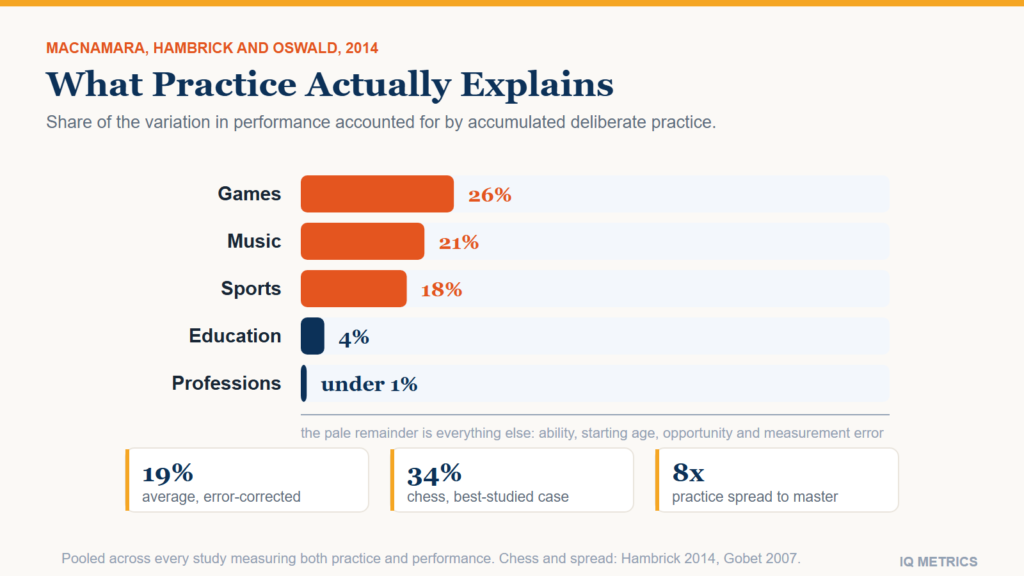
The 10,000-hour rule made a strong claim: expert performance is built by practice, not given by talent. When researchers pooled the studies that had actually measured it, practice explained about a quarter of the difference between people in games and almost none in professional work. Here is what fills the rest of the gap.
 Understanding IQ
Processing Speed and IQ
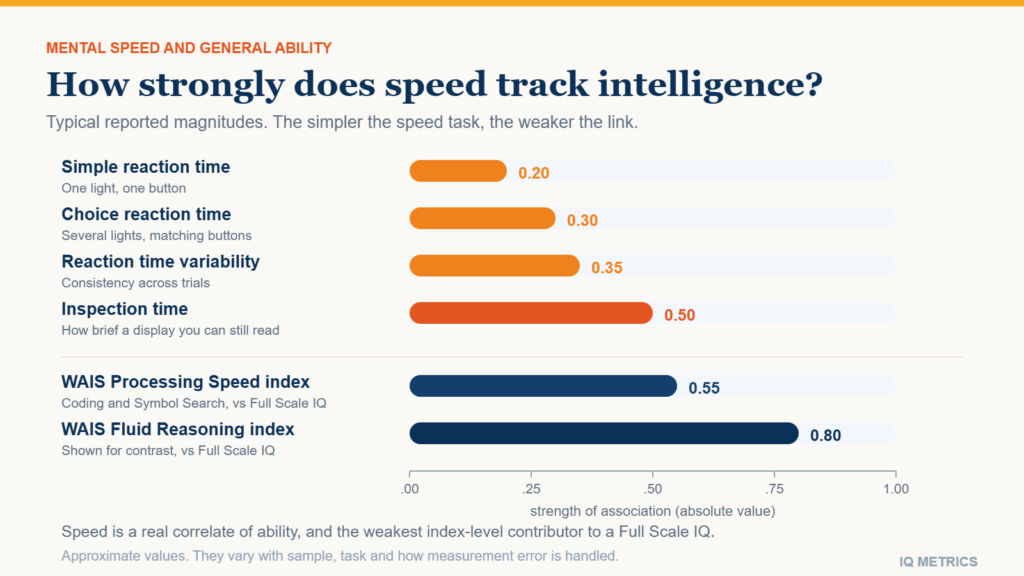
Fast thinkers are assumed to be smart thinkers, and there is a real finding underneath the stereotype: people who score higher on IQ tests do respond faster on tasks with no reasoning content at all. But the link is weaker than the folklore, and on a professional battery the speed index is the least g-loaded.