





Air Pollution and IQ: What the Research Actually Shows
A 2024 meta-analysis pooling six studies and 4,860 children found that every rise in fine-particle air pollution came with a small, statistically significant drop in IQ scores. The same pattern shows up in aging adults living near traffic, and in a household exposure route this conversation usually leaves out entirely.

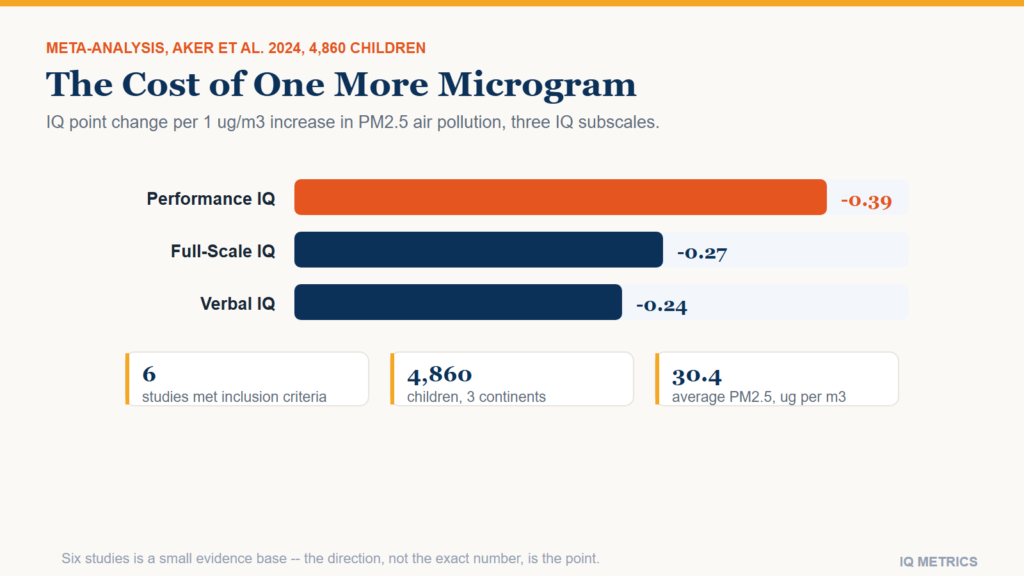
Yes, and the evidence is more consistent than most people expect for a topic this new. A 2024 meta-analysis pooling six studies and 4,860 children across three continents found that every increase in fine-particle air pollution was associated with a small, statistically significant drop in IQ scores. The important word there is small: this is a population-level pattern, visible when averaging across thousands of children, not a prediction about what pollution did to any one child. Six included studies is also a genuinely thin evidence base for a meta-analysis, worth saying plainly rather than treating the finding as settled.
Fine particulate matter — PM2.5, particles smaller than 2.5 micrometers, small enough to lodge deep in the lungs and, a growing body of research suggests, to reach the bloodstream — sits alongside lead as one of the more actively studied environmental exposures in child cognitive development. The two are not the same exposure and do not share a source, but they raise a similar question: what does an involuntary, population-wide exposure do to a developing brain.
What the largest analysis to date found
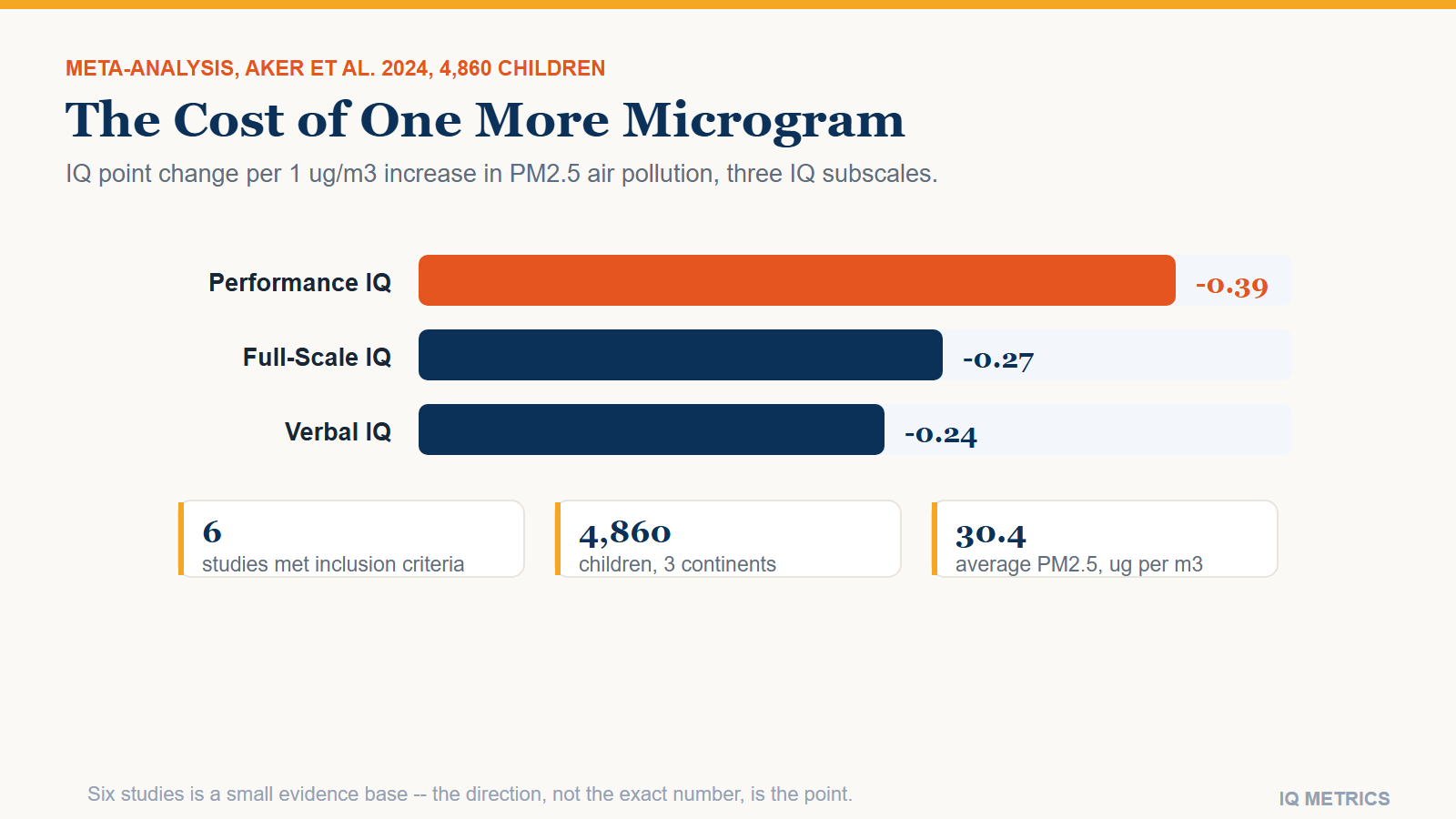
Published in the journal Environmental Health in 2024, the meta-analysis screened 1,107 publications against PRISMA guidelines across seven databases and found six studies that met its inclusion criteria: 4,860 children across North America, Europe and Asia, exposed to a mean PM2.5 concentration of 30.4 ± 24.4 micrograms per cubic meter, tested at an average age of 8.9. Using a random-effects model, the researchers calculated that each 1 microgram-per-cubic-meter increase in PM2.5 was associated with a 0.27-point drop in Full-Scale IQ (p<0.001), a 0.39-point drop in Performance IQ (p=0.003), and a 0.24-point drop in Verbal IQ (p=0.021). Performance IQ, the nonverbal and perceptual-reasoning subtests, showed the largest and most consistent hit of the three — the studies included do not settle why, though a similar pattern of nonverbal and processing measures being the most exposure-sensitive shows up elsewhere in the environmental-neurotoxin literature.
How something this small could reach a developing brain
PM2.5 is defined by size, not by a single chemical identity — it is a mix of combustion byproducts, metals and organic compounds small enough to bypass the lungs' normal filtering and settle deep in the smallest airways. From there, the leading proposed mechanisms are a systemic inflammatory response that reaches the brain through the bloodstream, and a separate, more direct route in which the smallest particles are thought to travel along the olfactory nerve into brain tissue itself, bypassing the blood-brain barrier entirely. Neither pathway is fully settled science, and researchers are still working out how much each contributes relative to the other. What is better established is the downstream signature: postmortem and imaging studies have found markers of neuroinflammation and, in some cases, combustion-derived particles themselves inside brain tissue, which is the kind of physical evidence that turns a statistical association into a plausible causal story rather than a coincidence.
Pollution at school, not just at home
A 2015 prospective study led by researchers at Barcelona's Centre for Research in Environmental Epidemiology followed 2,715 children across 39 schools, testing their cognitive development four separate times over 12 months. The angle was deliberately different from most exposure research: many schools sit close to busy roads, and traffic pollution peaks during the exact hours children are inside them. Children attending higher-traffic-pollution schools showed measurably slower growth in working memory over that year than children at lower-pollution schools — a finding that points at a policy-addressable variable, where schools get built and how close to traffic, rather than only a home-level exposure families have less power to change.
Where would your own score land?
Take the IIF-certified assessment and get your score with the scale it was measured on, the percentile it corresponds to and the confidence range around it — the three figures most online tests leave out.
Find your IQ score now! →It does not stop at childhood
A separate and growing body of cohort research links long-term air pollution exposure to faster cognitive decline and higher dementia risk in older adults: a U.S. cohort study associating midlife air pollution and road proximity with incident dementia, a Swedish longitudinal study linking traffic-related pollution to dementia incidence, France's long-running Three-City Study finding a similar association, and a Neurology-published analysis of cognitive-decline trajectories in older adults exposed to long-term air pollution. All four are observational cohort studies, not randomized trials, and carry the obvious open question any pollution-and-health cohort does: whether people living nearer to heavy traffic differ in other ways — income, housing quality, access to care — that could independently affect cognitive aging. Researchers adjust statistically for exactly these factors, which narrows but does not eliminate the concern. What makes the overall pattern harder to dismiss is that it shows up twice, independently, in childhood development data and in adult cognitive-aging data, using different cohorts, different countries and different outcome measures.
The exposure route this conversation usually skips
Nearly all popular coverage of air pollution and cognition focuses on outdoor, traffic-related PM2.5 in wealthy cities. The far larger exposure, by concentration, happens indoors. The World Health Organization's 2021 guidelines halved the recommended annual PM2.5 limit from 10 to 5 micrograms per cubic meter; field measurements in poorly ventilated homes using wood or coal cookstoves have documented indoor PM2.5 concentrations around 5,000 micrograms per cubic meter — roughly a thousand times that guideline. Household air pollution is linked to an estimated 70 percent of all air-pollution-attributed deaths in children under 5, and young children are disproportionately exposed because they typically stay close to their mothers during cooking, absorbing concentrations far closer to a cook's own exposure than to anything measured outdoors nearby. Read against that number, this is substantially a global-equity question, not only a question about traffic congestion in wealthy cities, and it is the exposure route least likely to come up in a conversation about air pollution and cognition even though it is, by concentration, by far the larger one.
What narrows the exposure
None of this is a reason for panic, and it is not a reason to treat every city as equally dangerous — exposure varies enormously by location, season and even time of day, and the effect sizes above are population averages, not individual predictions. A handful of concrete, evidence-backed steps do meaningfully reduce personal exposure, for a family or a school weighing what is actually worth changing:
- Indoor air filtration (a HEPA filter measurably lowers indoor PM2.5 in homes near heavy traffic or wildfire smoke)
- Checking a local air quality index before strenuous outdoor exercise, particularly near arterial roads
- Ventilation improvements or cleaner-burning cookstoves, the single highest-leverage change in the household-exposure settings described above
- Advocating for school siting and traffic-calming decisions, since the Barcelona finding above ties exposure directly to where a building sits
The honest bottom line
The size of the effect, point for point, is small enough that no single study proves anything about any individual child or adult. What makes environmental epidemiologists take it seriously anyway is that the same direction of harm turns up repeatedly: across a meta-analysis of six independent studies, in a dedicated school-exposure cohort, and separately in adult cognitive-aging research, using different populations and different measurement methods each time. Six studies feeding one meta-analysis is not a large evidence base, and a skeptical reader is right to want more before treating the exact numbers — 0.27, 0.39, 0.24 points per microgram — as fixed. The more defensible claim is the direction and the breadth of it: several independent lines of research, run by different teams on different continents using different children and different adults, keep landing on the same conclusion, which is a higher bar to clear by accident than any one of them would be alone.
That is a different, more airborne kind of early-life exposure than this site's companion piece on prenatal smoking, which covers a chemically distinct toxin crossing the placenta directly rather than the lungs; both sit alongside the site's piece on chronic early-life stress as reminders that a developing brain can be shaped by exposures that have nothing to do with inherited ability.
Keep reading
All articles →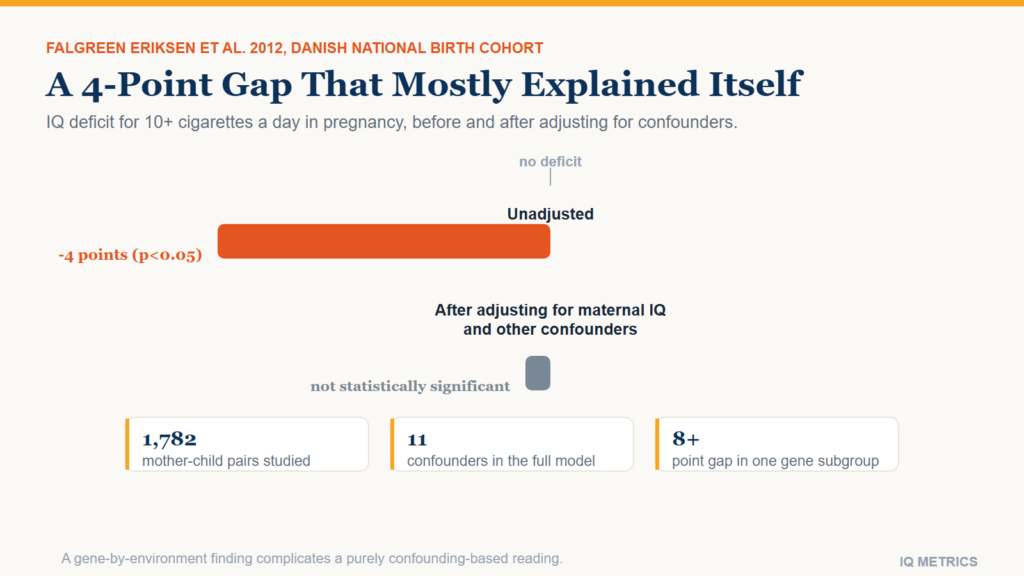 Research & Evidence
Prenatal Smoking and IQ
Several studies link smoking during pregnancy to a lower child IQ score. Then a Danish cohort of 1,782 mothers adjusted for the one variable most of the earlier research had not: the mother's own IQ. What was left afterward is a genuinely more complicated story than the headline number suggests.
 Research & Evidence
Lead, Pollution and IQ
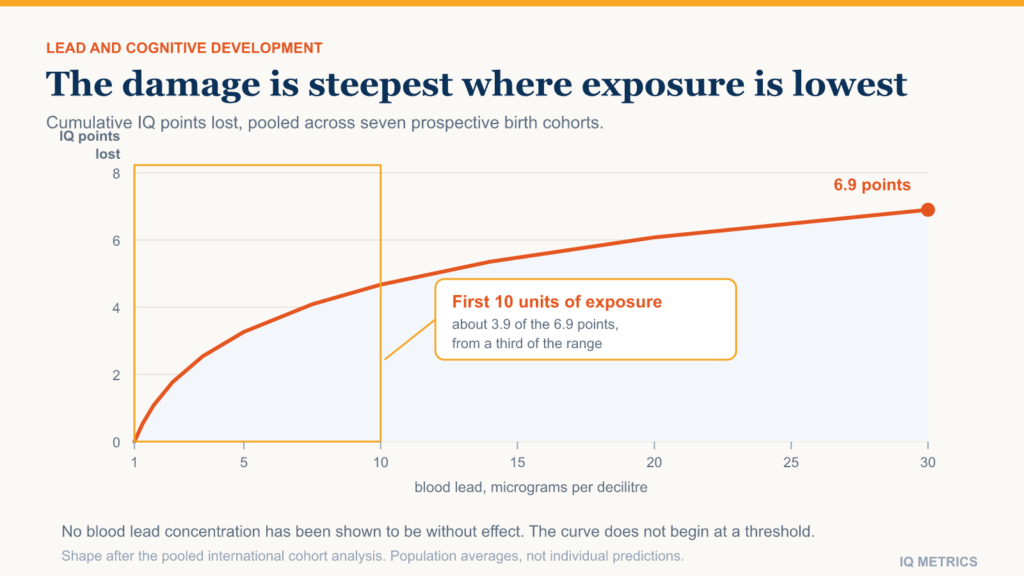
Most things people believe raise or lower intelligence turn out to be small, contested or confounded. Childhood lead exposure is the exception: one of the best-established environmental effects on cognitive test scores anywhere in the literature, with a dose-response curve most people find counterintuitive.
 Research & Evidence
Toxic Stress and IQ
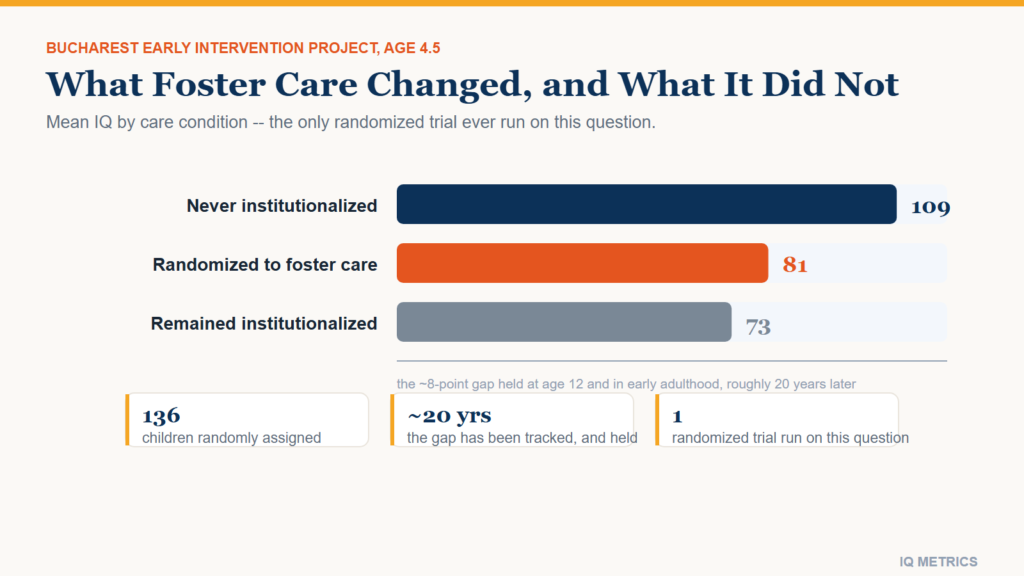
Researchers in Romania did something that can never be done again for ethical reasons: they randomly assigned some institutionalized children to foster care and left others in the institution, then followed both groups for twenty years. The IQ gap that opened up has held at every check-in since. What has not held up as cleanly is the famous claim about exactly when the window closes.