





Signs of a Gifted Child: What the Research Actually Finds
The "reads early, has a big vocabulary" checklist misses what a 2024 systematic review actually found: an uneven cognitive profile, a documented speed-accuracy tradeoff, asynchronous development, and real gaps in who gets identified. What the research says, and what to do with a hunch.

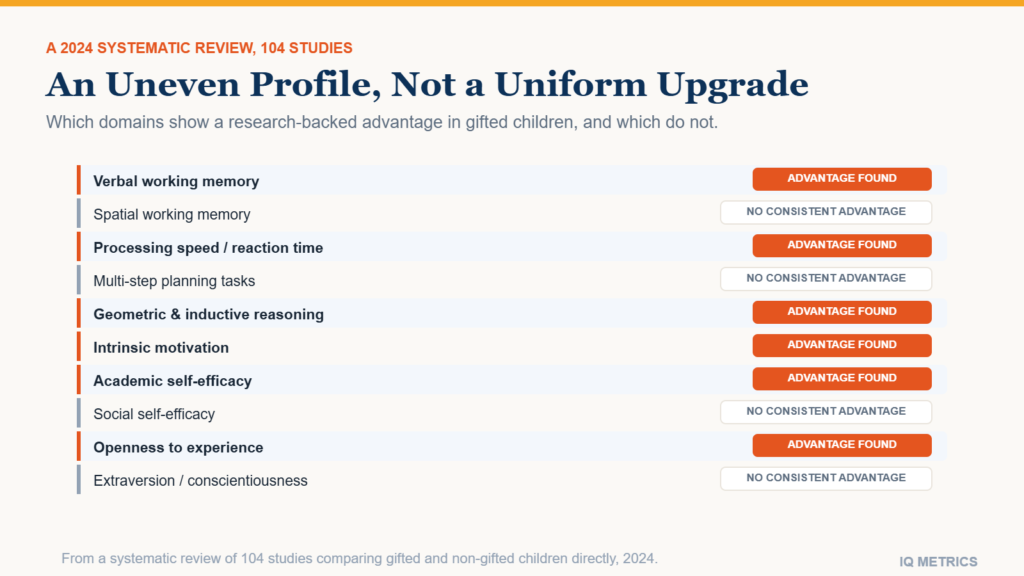
The signs researchers actually find in gifted children are more specific, and less convenient, than the "reads early, has a big vocabulary" checklists that circulate online. A 2024 systematic review pulling together over a hundred studies found real, measurable differences — but unevenly: an advantage on some memory tasks and not others, faster reaction times more often than higher accuracy, and a psychological profile that carries real costs alongside the advantages. None of this substitutes for an actual evaluation, but it is a considerably better starting point than a generic list.
This is a different question from the cutoff score
It is worth separating this from a question the site has already covered from another angle. Gifted cutoff scores is about the number — why 130 is a convention rather than a discovery, and how much measurement error surrounds it. This article is about what you might actually notice in a child’s behavior and development before, or instead of, any formal number. They are related questions, and IQ ceiling effect covers a narrower, more clinical piece of the same territory: how psychologists choose an instrument for a child who may be too able for a standard test to measure accurately.
The cognitive pattern, and its limits
The clearest signal in the research is not a uniform upgrade across every kind of thinking — it is specific, and the specificity is more useful than a blanket claim would be. The review behind these numbers drew on 104 separate studies comparing gifted and non-gifted children directly, rather than resting on a single research group’s findings, which is part of why the unevenness in its results is worth taking seriously rather than explaining away. Five of six studies reviewed found gifted children outperforming peers on verbal working memory tasks, such as recalling a growing list of digits or words. The same children showed no consistent advantage on spatial working memory tasks. Processing speed turned up as a genuine pattern too: gifted children were faster across a majority of reaction-time comparisons, roughly 70–83% depending on the specific task, though the review documented a real speed-accuracy tradeoff — a child is not necessarily both faster and more accurate on the same task, just more likely to be ahead on one of the two.
| Domain | What the research found |
|---|---|
| Verbal working memory (digit span, word recall) | Advantage found in most studies |
| Spatial working memory (block-tapping tasks) | No consistent advantage |
| Processing speed / reaction time | Faster in a majority of comparisons, not all |
| Planning (multi-step puzzle tasks) | No consistent advantage |
| Geometric and inductive reasoning | Advantage found |
| Intrinsic motivation | Higher, consistently across studies |
| Academic self-efficacy | Higher |
| Social self-efficacy | No consistent difference |
| Openness to experience (Big Five) | Higher |
| Extraversion, agreeableness, conscientiousness | No consistent difference |
Two negatives in that table matter as much as the positives: no advantage on classic multi-step planning tasks, and no broader "gifted personality" beyond openness to experience. Giftedness, in the research, is not a general-purpose upgrade — it is a specific profile with real gaps in it.
Where would your own score land?
Take the IIF-certified assessment and get your score with the scale it was measured on, the percentile it corresponds to and the confidence range around it — the three figures most online tests leave out.
Find your IQ score now! →Asynchronous development: the pattern behind the confusing part
The National Association for Gifted Children uses the term asynchronous development for something many parents notice before any test result: a child’s cognitive, social, emotional and physical development proceeding at different rates in the same child, and the gap between them tends to widen as measured ability increases. A child reading two grade levels ahead and also having an outsized meltdown over a minor frustration is not showing two unrelated traits — it is frequently the same underlying pattern, viewed from two different angles. In practice, this often shows up years before any formal testing: a preschooler reading simple books independently while still needing help with shoelaces and taking turns is displaying the same pattern, not two unrelated facts about one child. The systematic review found only limited data on children under six specifically — just 22 of the 104 studies it covered looked at that age range — so some caution is warranted about how far the more granular cognitive findings above extend to toddlers and preschoolers. What does hold up at every age in the broader literature is the asynchronous-development pattern itself: intellectual development running ahead of social, emotional or physical development, rather than all four moving together.
Heightened sensitivity to criticism and failure shows up repeatedly in this literature, and so does boredom driven by a curriculum pitched at age rather than ability — one of the most common presenting complaints, and one that is sometimes read as an attention or behavior problem rather than what it usually is: a mismatch problem. The same intensity that shows up as heightened sensitivity has a well-documented flip side, too: a tendency toward perfectionism, where the gap between a child’s own standards and what they judge themselves capable of becomes a source of real distress rather than motivation. This is not itself a research-established cognitive marker in the way the findings above are, but it recurs often enough in clinical and educational accounts to be worth naming alongside the better-evidenced material.
The psychological profile, and who gets missed
Beyond the cognitive pattern, the review found gifted children consistently report higher intrinsic motivation and higher academic self-efficacy than peers — but not higher social self-efficacy, an asymmetry worth knowing about if a child seems confident about schoolwork and considerably less so about friendships. On personality measures, the only consistent difference was higher openness to experience; extraversion, agreeableness and conscientiousness did not reliably differ from peers.
Gifted children in the review also earned higher grades and performed better on standardized exams, which will surprise nobody — but it is worth being precise about what that finding is and is not. Better achievement is a downstream outcome of ability plus schooling plus motivation together, not an early sign in the way a working-memory or processing-speed advantage is. A struggling grade in one subject does not rule out giftedness, and a strong one does not confirm it on its own.
Identification research adds a separate, important caveat: real giftedness goes unrecognized in well-documented, systematic ways. Quiet, compliant, high-achieving children who do not match a teacher’s mental picture of what giftedness looks or acts like are routinely missed, and so are children in families who are simply unaware a referral pathway exists at all. Universal screening for gifted programs covers the policy side of closing that gap.
A second, separate way giftedness gets missed deserves its own mention: a child can be genuinely gifted and also have a learning disability, ADHD, or an autism spectrum diagnosis at the same time — sometimes described as twice-exceptional. In these children, strong verbal reasoning can mask a real reading disorder, or intense focus on a preferred subject can be misread as the opposite of an attention difficulty. Each condition can hide the other from a casual observer, which is one more reason a pattern-match against a list, including this one, is not a substitute for an evaluation by someone looking at the whole child.
What to do with a hunch
A single behavior on a single day is not a pattern. What research and experienced evaluators both look for is consistency across time and context — the same trait showing up at home, at school and with peers, not only in the one setting where a parent happens to be watching most closely. A teacher, a pediatrician, or a school psychologist can all be a reasonable first conversation, and none of them requires a firm conclusion going in — "here is the pattern I am noticing, and here is why I think it is worth a closer look" is a complete and useful starting point.
Everything above describes patterns, not a diagnosis. Early cognitive development does not move in only one direction, either — for a look at the other tail, what early biological risk factors such as gestational age predict rather than early advantage, see premature birth and IQ. The only way to get an actual number, rather than a pattern-match against a research summary, is an actual assessment. IQ testing for children covers what that process involves and when it tends to make sense, and the kids IQ test is built specifically for this age range, with a report meant to be read together rather than delivered as a verdict.
Keep reading
All articles →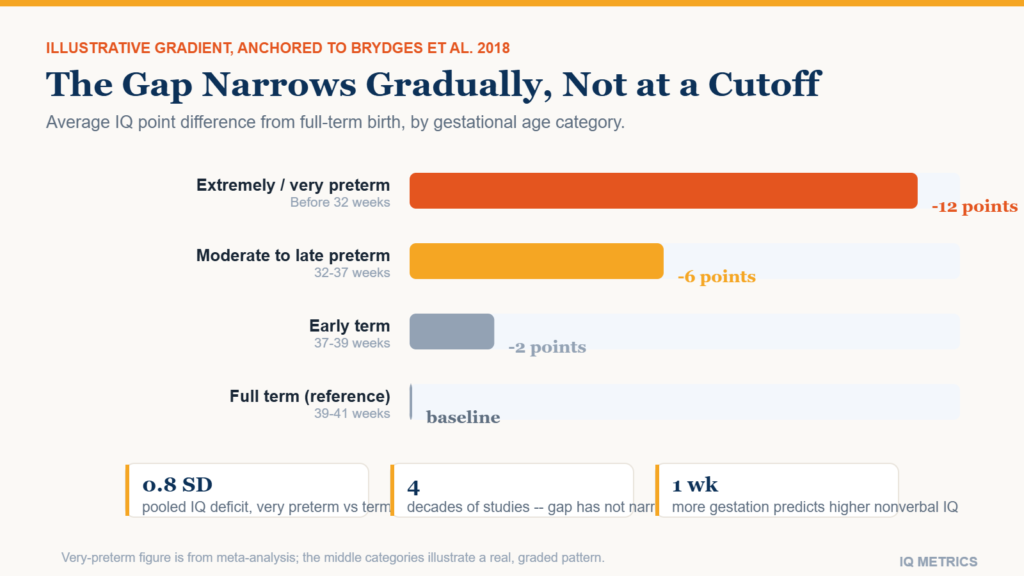 Research & Evidence
Premature Birth and IQ
Children born very preterm score, on average, about 0.8 of a standard deviation lower on IQ tests than children carried to term. Here is what a 2018 meta-analysis and the studies since actually found: the gestational-age gradient, what is really driving the gap, and what it does not tell you about one specific child.
 Scores & Scales
Gifted Cutoff Scores
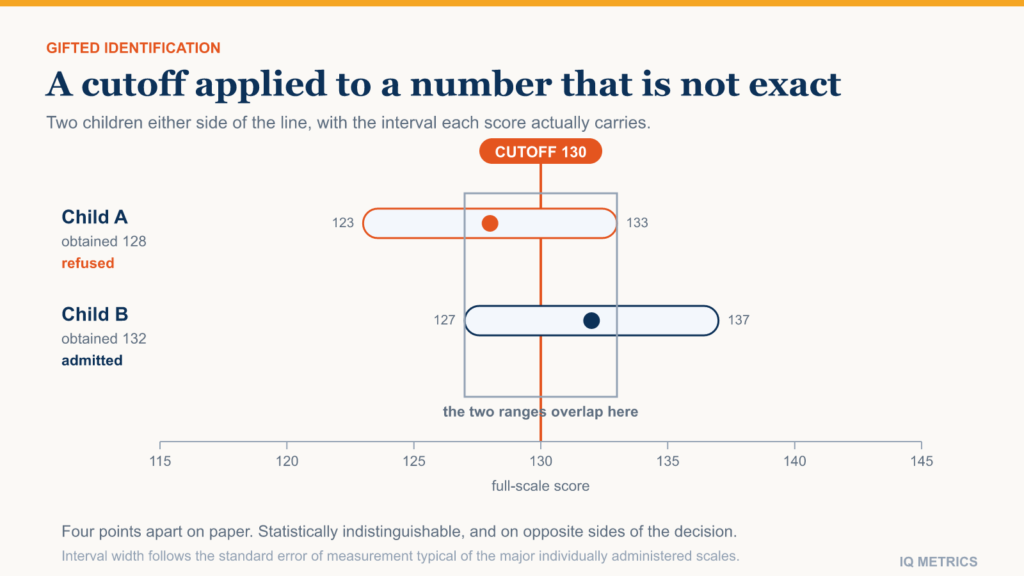
Most gifted programmes draw their line at an IQ of 130. The number is a statistical convention rather than a boundary in nature, and three well-documented features of how the score is produced and used mean a strict cutoff reliably excludes children who belong on the other side of it.
 Taking a Test
IQ Testing for Children
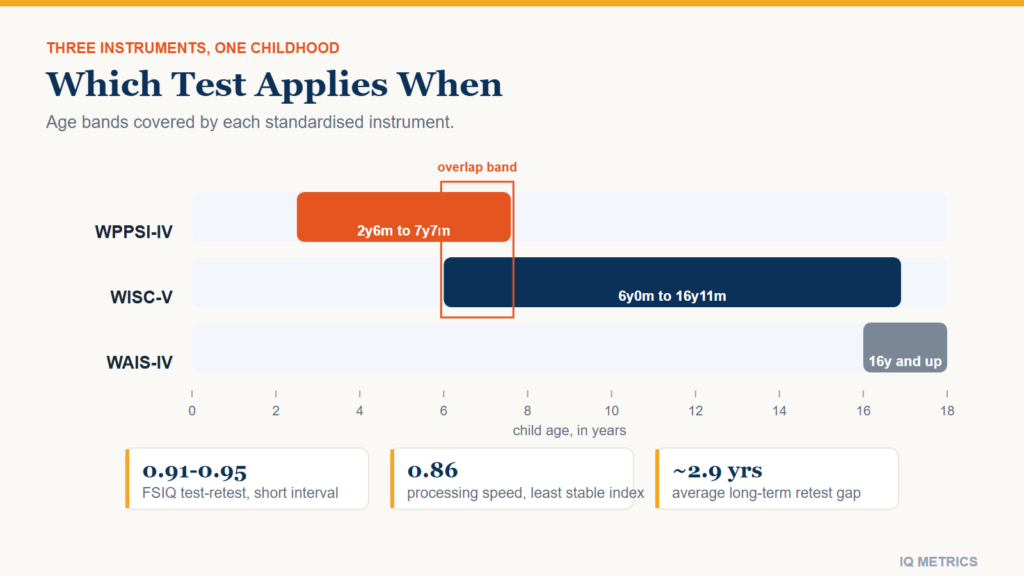
Children are not tested on the same instrument as adults, and the test itself changes twice before age eighteen. Here is which one applies when, how reliable an early score really is, and what a parent should and should not conclude from a single number.