





The Highest IQ Ever Recorded: What the Famous Numbers Actually Rest On
The highest IQ ever recorded is usually given as Marilyn vos Savant's 228 or William James Sidis's claimed 250 to 300 - neither from a test in use today. Where the famous numbers actually come from, and what a modern test can really report.

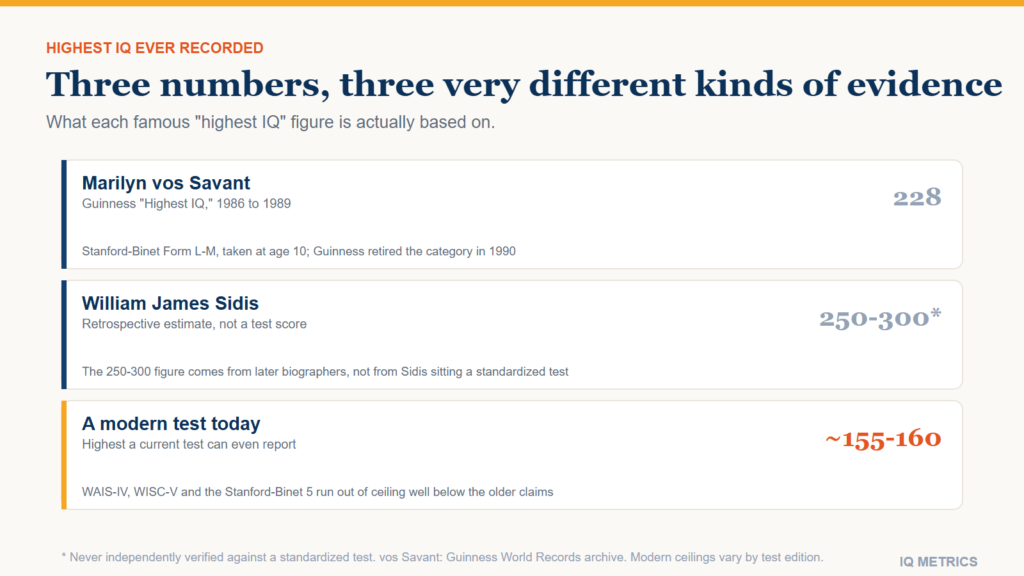
No single person holds a verified “highest IQ ever recorded.” The two numbers that circulate most — Marilyn vos Savant’s 228 and William James Sidis’s claimed 250 to 300 — come from a discontinued Guinness category and a number nobody ever actually measured, not from a test anyone uses today. This article covers where each famous figure really comes from, why “IQ over 200” claims keep circulating anyway, and what the highest score a modern test can even report looks like.
Marilyn vos Savant and the Guinness record
Marilyn vos Savant is the source of the most-cited number: 228, reportedly scored on the Stanford-Binet Form L-M at age ten. Guinness World Records listed her under “Highest IQ” from 1986 to 1989, then retired the category entirely in 1990, citing concerns that scores at the extreme end of any test are far less reliable than scores nearer the middle of the curve. vos Savant later entered the Guinness Hall of Fame instead, and Guinness has not run a “highest IQ” category since.
That retirement is itself the most important fact about the number. A ratio-scored childhood test like the Form L-M, built on age norms, compresses enormous uncertainty into one figure once a child is answering questions written for people twice their age. The 228 was real in the sense that it was a documented score on a real test, but it was never intended, even by the test’s own authors, to be read the way “228” gets read now.
vos Savant went on to write the long-running “Ask Marilyn” column in Parade magazine, and her most famous moment there had nothing to do with her IQ score. In 1990 she correctly solved the Monty Hall probability problem in print and was met with thousands of letters, many from mathematicians and PhDs, insisting she was wrong. She was not: later simulations and formal proofs confirmed her answer. The episode is often cited as a real demonstration of the reasoning ability behind the number, independent of whether 228 itself was ever the right way to state it.
William James Sidis and the 250-to-300 estimates
Sidis is the name attached to the highest numbers of all, often quoted as 250 to 300. The important detail is that Sidis never sat a modern standardized IQ test and produced that number himself. The figure originates from later biographers and popular writers, working backward from his documented precocity — reading fluently at eighteen months, lecturing Harvard mathematicians at eleven — not from a scored assessment. It is an estimate of an estimate, several steps removed from anything a psychometrician would call data.
None of that means Sidis was not exceptionally able; his early academic record is well documented and genuinely remarkable. It means the specific number 250 or 300 is best read as folklore that attached itself to a real person, not as a test result comparable to anyone else’s score.
Why do old "genius" scores look so much bigger than modern ones?
Both numbers above come from an era when child IQ scores were commonly calculated as ratio IQ: mental age divided by chronological age, multiplied by 100. Deviation IQ vs ratio IQ covers why psychologists abandoned that formula, but the short version matters here directly: a bright seven-year-old answering questions written for a twelve-year-old produces a ratio score well above 150 almost automatically, because the formula rewards raw age-advancement rather than measuring how rare that advancement actually is among same-age peers.
Modern tests use deviation IQ instead, scored against people the same age, on a scale with a fixed standard deviation — usually 15 or 16 points, as this comparison of the two conventions explains. That single change is most of the reason nobody produces a documented score anywhere near 200 today: the scale itself no longer allows the kind of runaway number a precocious child could generate under the old formula.
A worked example makes the mechanism concrete. A seven-year-old who can correctly answer questions written for an average twelve-year-old has a mental age of twelve against a chronological age of seven: 12 divided by 7, times 100, works out to a ratio IQ of about 171, purely from being five years ahead on that test’s ladder of questions. Push the same child two more years ahead and the ratio IQ climbs past 200, without the child’s underlying ability changing at all — only the arithmetic changes. A deviation-scored test never does this, because it asks a different question entirely: not “how many years ahead is this child,” but “how rare is this performance among children the same age.”
Where would your own score land?
Take the IIF-certified assessment and get your score with the scale it was measured on, the percentile it corresponds to and the confidence range around it — the three figures most online tests leave out.
Find your IQ score now! →A modern contrast: how today's exceptional scorers talk about their own numbers
Mathematician Terence Tao is sometimes cited as having tested around 230 as a child, a ratio-IQ-era number from the same mold as vos Savant’s and Sidis’s. Tao himself has repeatedly downplayed the figure in interviews, pointing out that raw processing speed and pattern recognition — the kind an early ratio-IQ test rewards heavily — matter far less to real mathematical work than sustained effort, collaboration, and simply working on the right problem at the right time. That is a useful corrective on its own: even someone who would plausibly test in the far tail of ability today treats a single childhood number as far less meaningful than the internet treats it.
What can a modern test actually report?
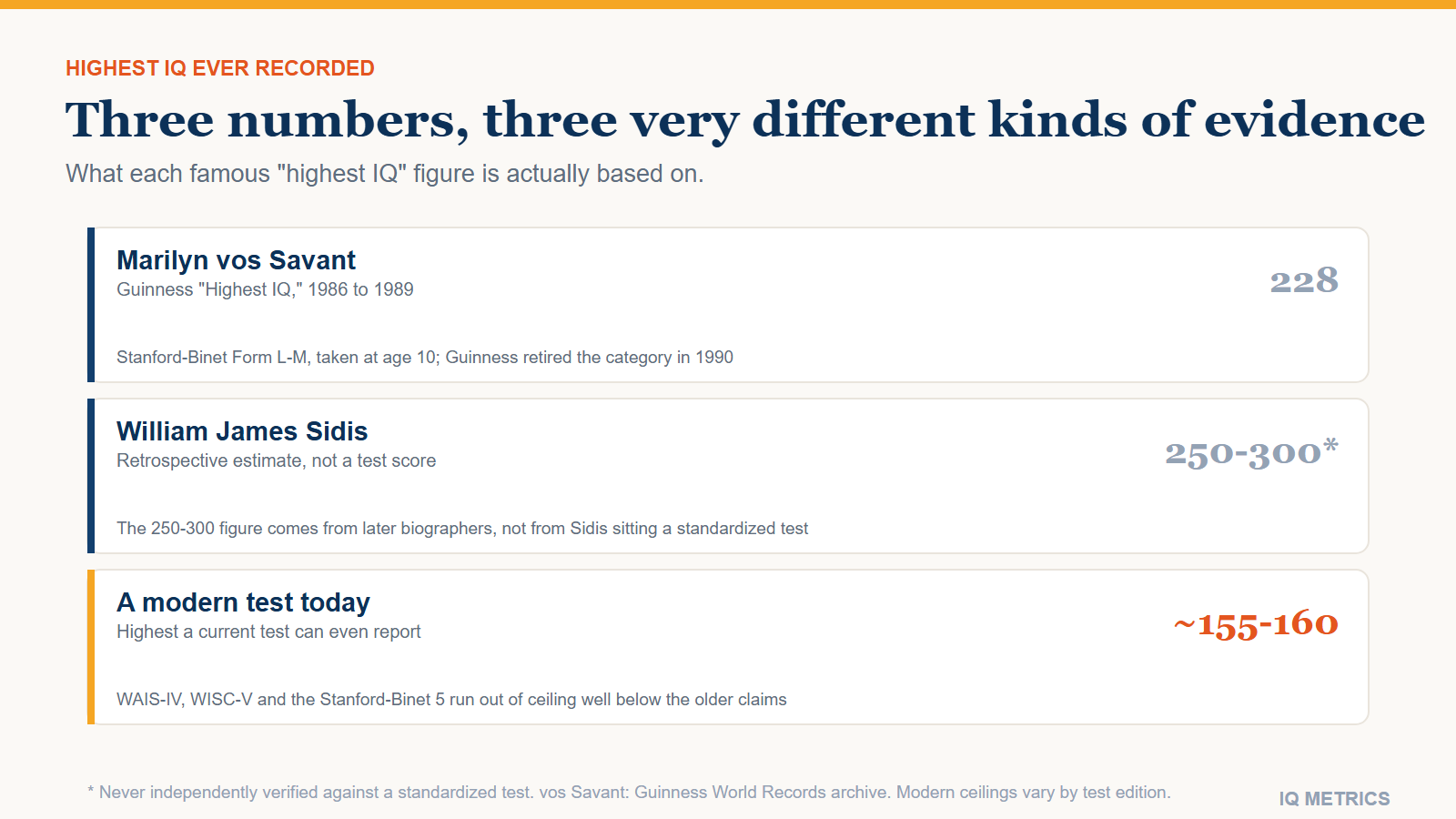
Every real test has a ceiling — the highest score its norming sample can support with any precision — and it sits far below the old headline numbers. How high a test can score you and the ceiling effect both cover this in depth; in practice, the Wechsler scales top out in the neighborhood of 155 to 160, and the Stanford-Binet 5 reports similarly. Past that point, too few people in any norming sample answer every question correctly to say with any confidence whether one exceptional scorer is more or less able than another.
That ceiling is a feature of honest measurement, not a limitation to work around. A test that claimed to distinguish a 190 from a 250 would be reporting false precision — certainty the underlying data cannot support — which is exactly the failure mode Guinness cited when it dropped the category. The same problem matters well outside trivia, too: cognitive tests used in hiring top out in a similar range, so a candidate’s raw score past the mid-140s tells an employer very little more than a score in the 130s would.
So who has the highest IQ in the world today?
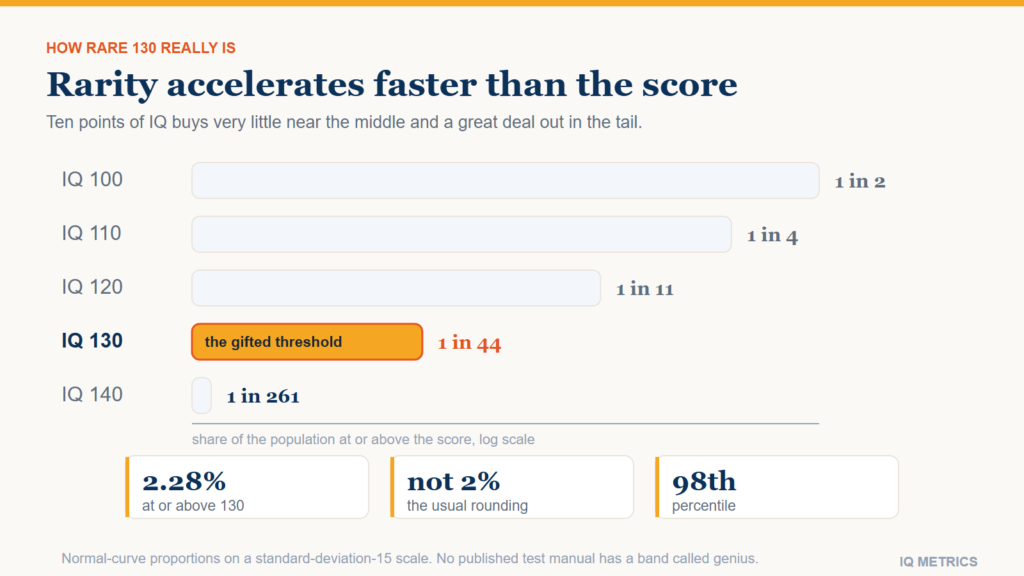
There is no defensible answer, and that is the honest one. High-IQ societies such as Mensa set admission around the 98th percentile, roughly 130 on a standard-deviation-15 scale — see Mensa’s admission requirements — while more selective societies reach further into the tail, and what genius IQ level means and whether 130 counts as genius both cover how that upper range gets classified. None of those societies claims to crown a single “highest” member, because past a certain point measurement error swamps any real difference between two exceptional scorers.
Any specific name attached to “world’s highest IQ” online today deserves the same scrutiny vos Savant’s and Sidis’s numbers get: ask what test produced it, who administered it, and whether the scale in question even reports a number that high. Most of the time, at least one of those answers is missing.
Other names that circulate in "highest IQ" lists
Christopher Langan and Kim Ung-Yong are two more names that turn up regularly in “smartest person alive” roundups, both linked to self-reported or informally administered scores rather than a documented, mainstream test result. That is not a comment on either person’s actual ability — Kim, for instance, had a well-documented career as a child prodigy and later became a civil engineering professor — it is the same pattern as vos Savant and Sidis: a headline number that predates, or sits outside, the kind of standardized, norm-referenced testing this site otherwise covers.
Keep reading
All articles →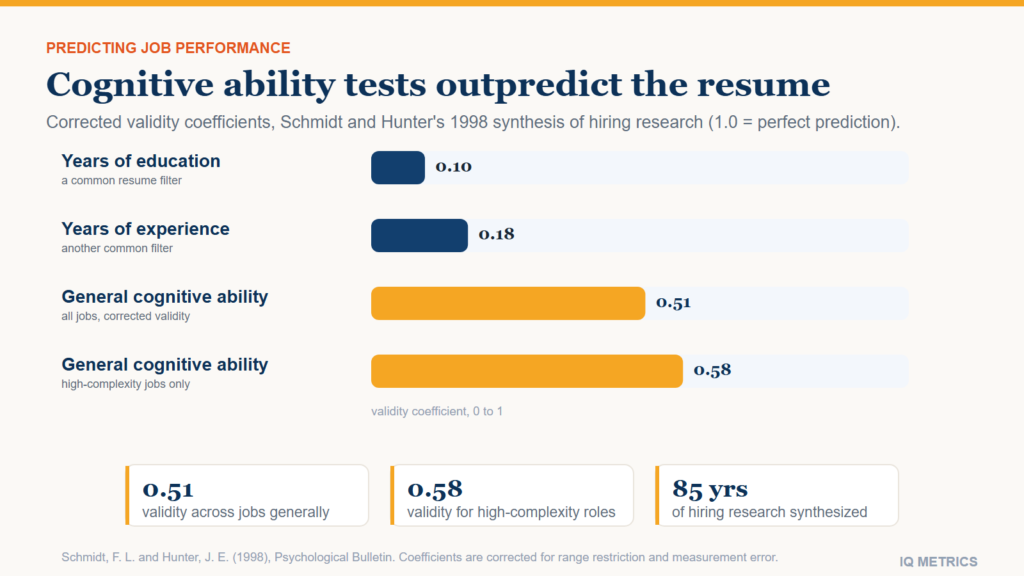 Taking a Test
IQ Tests in Job Interviews
An IQ test for a job interview is usually branded a cognitive ability assessment, like the Wonderlic. What it actually measures, why a 1998 meta-analysis made employers take it seriously, whether it is legal, and how to prepare.
 Scores & Scales
IQ Score Ceiling Effects
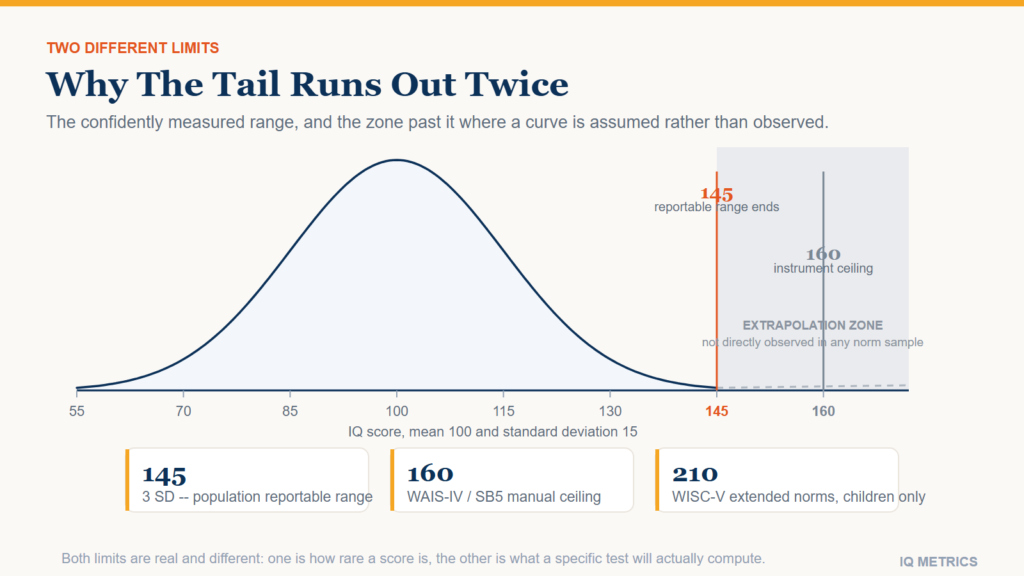
Two different numbers get used as "the top of the scale," 145 and 160, and they come from two different kinds of limit. One is a statement about population statistics; the other is about what a specific test manual will actually compute.
 Scores & Scales
Is 130 IQ a Genius Score?
A score of 130 is the conventional threshold for gifted identification and for high-IQ society membership, and it is reached by about one person in 44. It is not, however, a "genius" score, because no published test defines such a band. The word is a popular import, and the difference is worth understanding.