





Can a Concussion Lower Your IQ? What the Meta-Analyses Show
Can a concussion lower your IQ? Meta-analyses of mild and severe head injury show scores dip in the first days, recover within weeks for most people and stay lower after moderate or severe injury. See the effect sizes in IQ points, why clinic samples look worse and why a baseline is rarely available.

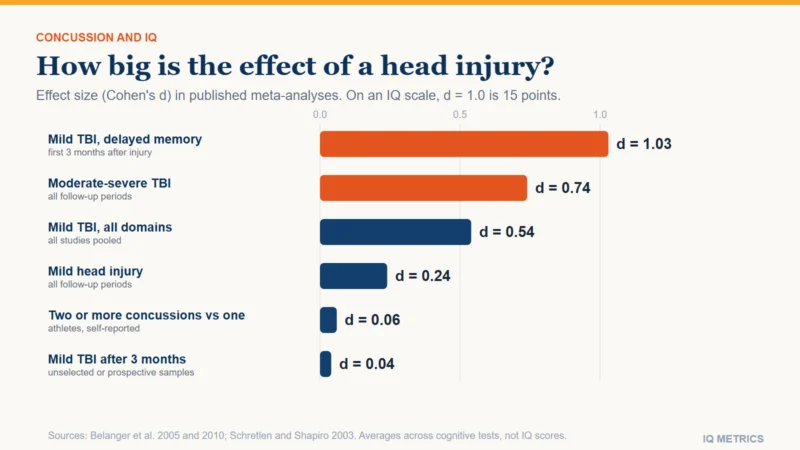
Can a concussion lower your IQ? For most people a single concussion does not leave a lasting drop, but the effect is real in the first days and weeks, and it is larger and longer-lasting after moderate or severe brain injury. A meta-analysis of 39 studies of mild traumatic brain injury (1,463 cases and 1,191 controls) found a moderate overall effect on cognitive tests (d = .54) that had disappeared by 3 months in unselected or prospective samples (d = .04). For sports concussion, a 21-study analysis found no residual impairment when testing was done more than 7 days after injury. Moderate-to-severe brain injury is different: it averages d = −0.74 and remains markedly impaired beyond 2 years. This guide turns those effect sizes into IQ points, explains why clinic samples look worse than community samples, and shows why a true before-and-after IQ comparison is rare.
- Most single concussions: cognitive scores recover within weeks. In unselected or prospective samples, mild injury showed no residual effect by 3 months (d = .04).
- The first days: the biggest effects are on memory and global cognitive functioning; after a sports concussion, no residual impairment was found when testing was done beyond 7 days.
- Who you sample matters: at 3 months or later, clinic-based samples showed d = .74 and litigation samples d = .78, against .04 in unselected samples.
- Repeated concussions: across 8 athlete studies, overall d = .06, with poorer delayed memory and executive functioning.
- Moderate and severe injury: d = −0.74 on average, more than three times the mild-injury figure, and still markedly impaired more than 2 years after injury.
What counts as a concussion, and how is it different from a severe brain injury?
A concussion is commonly defined as a mild traumatic brain injury (MTBI): a blow or jolt that briefly disrupts how the brain works, with symptoms such as confusion, headache, dizziness or gaps in memory. Clinicians grade traumatic brain injury (TBI) as mild, moderate or severe, mainly by the Glasgow Coma Scale, how long consciousness was lost and how long memory was affected. The research below keeps the groups apart because they behave differently, and because a concussion and a severe injury are different questions. These studies did not measure a place on the IQ classification scale; they measured performance on cognitive tests.
What happens to cognitive scores in the first days and weeks?
Belanger and Vanderploeg (2005) pooled 21 studies of sports-related concussion (790 cases, 2,014 controls) and found an overall effect of d = 0.49. Within 24 hours of injury the effects were largest for delayed memory (d = 1.00), memory acquisition (1.03) and global cognitive functioning (1.42). Beyond 7 days after injury, they found no residual neuropsychological impairment, although delayed memory in studies with a control group was still a problem at 7 days. Using athletes with a history of prior head injury appeared to inflate the effect sizes for the current concussion.
Belanger and colleagues (2005) found the same shape in non-sports mild TBI across 39 studies: the acute effects (under 3 months) were greatest for delayed memory (d = 1.03) and fluency (d = .89). Schretlen and Shapiro (2003) add that the natural logarithm of the follow-up interval correlated very strongly with the effect size after mild head injury, and that overall cognitive functioning “recovers most rapidly during the first few weeks” and essentially returns to baseline within 1 to 3 months.
| Group and timing | Cohen d | IQ points at SD 15 | Source |
|---|---|---|---|
| Sports concussion, first 24 hours, global cognitive functioning | 1.42 | 21 | Belanger and Vanderploeg 2005 |
| Mild TBI, under 3 months, delayed memory | 1.03 | 15 | Belanger et al. 2005 |
| Mild TBI, under 3 months, fluency | 0.89 | 13 | Belanger et al. 2005 |
| Moderate-severe TBI, all follow-up periods | 0.74 | 11 | Schretlen and Shapiro 2003 |
| Mild TBI, all studies and domains | 0.54 | 8 | Belanger et al. 2005 |
| Sports concussion, all studies | 0.49 | 7 | Belanger and Vanderploeg 2005 |
| Mild head injury, all follow-up periods | 0.24 | 4 | Schretlen and Shapiro 2003 |
| Two or more concussions vs one (athletes) | 0.06 | 1 | Belanger et al. 2010 |
| Mild TBI, 3+ months, unselected or prospective samples | 0.04 | less than 1 | Belanger et al. 2005 |
Read the third column with care. It simply multiplies d by 15 to show the size on the familiar IQ scale (see SD 15 vs SD 16). The effect sizes themselves are group averages across cognitive tests, mostly memory, attention and executive measures, not full-scale IQ scores, and an average hides individuals who recover slowly or fast.
What happens after 3 months?
This is where the headline numbers split. In unselected or prospective samples, Belanger and colleagues found no residual neuropsychological impairment by 3 months after mild TBI (d = .04). In clinic-based samples and in samples that included people in litigation, the effects at 3 months or later were larger (d = .74 and .78), and litigation was associated with cognitive functioning that stayed the same or got worse over time. The abstract does not give the reasons, and we will not guess at any one person’s. What it shows is that the lingering effect you read about depends heavily on who was sampled: people drawn from the community and followed from the injury had recovered on average, and people who came through clinics or legal claims showed larger effects. A person who still has trouble months later deserves a proper assessment either way.
Do repeated concussions lower IQ?
Belanger, Spiegel and Vanderploeg (2010) pooled 8 studies, all of athletes, comparing 614 people with more than one self-reported mild TBI against 926 with just one. The overall effect was minimal and not significant (d = 0.06), but a history of multiple self-reported concussions went with poorer delayed memory and executive functioning. The samples were athletes tested after self-reported histories, so the result cannot speak for people outside sport or for those with severe injuries.
Where would your own score land?
Take the IIF-certified assessment and get your score with the scale it was measured on, the percentile it corresponds to and the confidence range around it — the three figures most online tests leave out.
Find your IQ score now! →What about moderate and severe injuries, and children?
Schretlen and Shapiro (2003) pooled 39 mostly cross-sectional studies (48 comparisons; 1,716 patients and 1,164 controls). Averaged across follow-up periods, the effect of moderate-severe TBI (d = −0.74) was more than three times the effect of mild head injury (d = −0.24). Cognitive functioning improved over the first two years after moderate-severe TBI but remained markedly impaired among patients tested more than 2 years after injury.
For children, Babikian and Asarnow (2009) summarized 28 publications from 1988 to 2007. In severe pediatric TBI they report moderate to very large impairments in intellectual functioning, mainly performance IQ, with substantial recovery in longitudinal studies, especially for performance relative to verbal IQ, although by the longest follow-up the severe group showed impairments in all the domains the review covered. For children with moderate TBI they say some deficits persist beyond two years compared with matched peers. Index scores such as processing speed matter in these evaluations; our guide to processing speed and IQ explains what that index measures.
If nobody tested your IQ before, how can anyone tell it dropped?
Usually they cannot, directly. Few people have a baseline IQ score from before an injury, so clinicians estimate premorbid ability from skills that hold up, such as reading irregular words aloud. The best-known example is the National Adult Reading Test (NART). In a study by McGurn and colleagues (2004), an IQ test taken at age 11 correlated r = .63 with NART scores at about age 80 in people who had developed dementia and r = .60 in those who had not, and after controlling for age-11 IQ, mean NART scores did not differ between the groups. That study was about dementia; clinicians apply the same logic after brain injury, with reading tests such as the NART or Pearson’s WTAR and TOPF.
A correlation of .60 explains about 36% of the variance (r squared), so a reading-based estimate is a range, not a number, and a drop of a few points will not stand out against it. Our guides to whether an IQ test can detect dementia and how long an IQ result stays valid cover the same limits from other angles. Brief tests also have a role in these evaluations; see our KBIT-2 guide for one example of a short IQ screen.
What should you do if you are worried?
If symptoms continue longer than expected after a head injury, or a child’s schoolwork changes, ask a physician about a neuropsychological evaluation. An online IQ quiz cannot separate injury from effort, mood, sleep, pain or medication, and it cannot show change without a baseline; what it can tell you is described in our guide to whether IQ tests are reliable. Attention and executive-control tasks, such as the Stroop test (see also our executive function vs IQ guide), are part of the toolkit clinicians use alongside IQ tests, not a substitute for them.
Quick answers
- Can a concussion lower your IQ? Temporarily, yes: cognitive scores dip in the first days and weeks. In unselected samples there was no residual effect by 3 months after mild injury.
- Does a concussion cause a lasting drop in cognitive scores? Not in group averages for most single concussions, but clinic-based samples show larger long-term effects and moderate-severe injuries do.
- How long does it take cognitive function to recover after a concussion? For sports concussion, no residual impairment was found beyond 7 days; for non-sports mild TBI, by about 3 months.
- Do multiple concussions lower IQ? Overall d = .06 across 8 athlete studies, with poorer delayed memory and executive functioning.
- How many IQ points is a d of 0.5? About 7.5 points on a 15-point scale, but these are cognitive-test averages, not IQ scores.
- How do doctors know your IQ before a head injury? They usually estimate it from reading tests such as the NART, which correlated about .60 with age-11 IQ.
Sources
- Belanger, H.G., Curtiss, G., Demery, J.A., Lebowitz, B.K. and Vanderploeg, R.D. (2005): Factors moderating neuropsychological outcomes following mild traumatic brain injury: a meta-analysis, Journal of the International Neuropsychological Society, 11(3), 215-227.
- Belanger, H.G. and Vanderploeg, R.D. (2005): The neuropsychological impact of sports-related concussion: a meta-analysis, Journal of the International Neuropsychological Society, 11(4), 345-357.
- Belanger, H.G., Spiegel, E. and Vanderploeg, R.D. (2010): Neuropsychological performance following a history of multiple self-reported concussions: a meta-analysis, Journal of the International Neuropsychological Society, 16(2), 262-267.
- Schretlen, D.J. and Shapiro, A.M. (2003): A quantitative review of the effects of traumatic brain injury on cognitive functioning, International Review of Psychiatry, 15(4), 341-349.
- Babikian, T. and Asarnow, R. (2009): Neurocognitive outcomes and recovery after pediatric TBI: meta-analytic review of the literature, Neuropsychology, 23(3), 283-296.
- McGurn, B. et al. (2004): Pronunciation of irregular words is preserved in dementia, validating premorbid IQ estimation, Neurology, 62(7), 1184-1186.
Keep reading
All articles →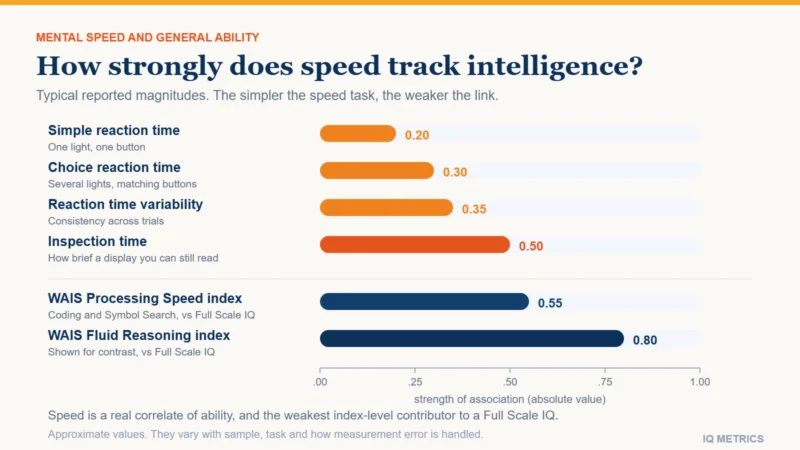 Understanding IQ
Processing Speed and IQ
Fast thinkers are assumed to be smart thinkers, and there is a real finding underneath the stereotype: people who score higher on IQ tests do respond faster on tasks with no reasoning content at all. But the link is weaker than the folklore, and on a professional battery the speed index is the least g-loaded.
 Taking a Test
Can an IQ Test Detect Dementia?
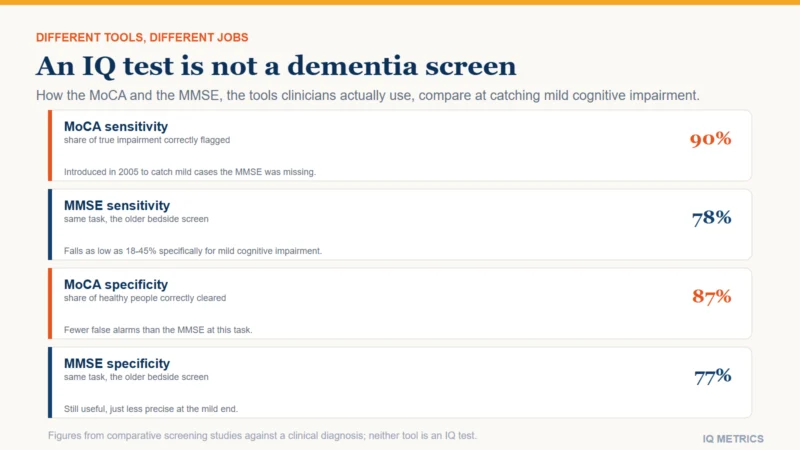
A standard IQ test cannot diagnose dementia; it has no personal baseline and was not built to screen for decline. How the MMSE and the more sensitive MoCA compare, why a normal score can hide early decline, and what actually helps catch it.
 Taking a Test
How long is IQ test valid?
Do you want to know how long an IQ test is valid for? Have you ever wondered how accurate it is and how it affects your IQ? Stop searching now. To better understand the significance of IQ test results, this article will investigate the validity period of these assessments.