





Walking Speed and IQ: What the Gait Research Shows
Walking speed and IQ are linked: in 904 adults aged 45, higher full-scale IQ went with faster walking (0.38). See what else went with gait speed, why childhood brain health at age 3 mattered, what walking speed predicts in older adults and why it is a health marker, not an IQ test.

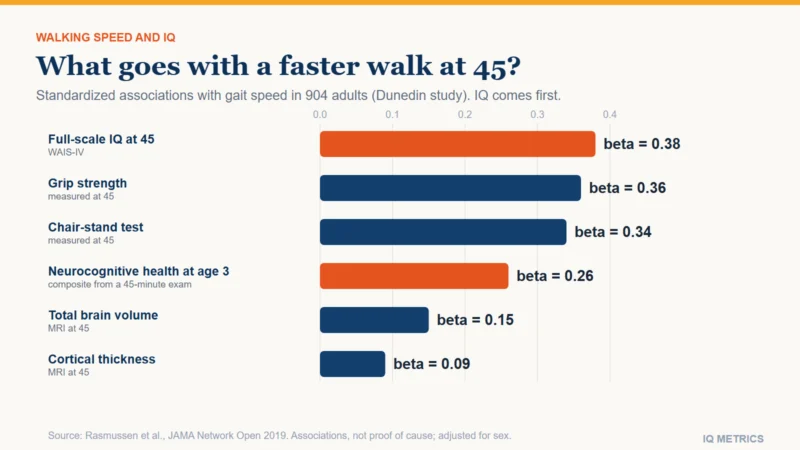
Walking speed and IQ are related: in a New Zealand cohort of 904 adults aged 45, people with a higher full-scale IQ walked faster, with a standardized association of 0.38 (95% CI 0.32 to 0.44). That was larger than the association with total brain volume (0.15), and poor neurocognitive functioning measured as early as age 3 also predicted slower walking in midlife (0.26). It is an association measured at one point in adulthood. It does not show that walking faster raises IQ, or that a slow walker has a low IQ. Gait speed seems to work as a marker of general physical and brain health. This guide covers what the study measured, what else walking speed went with, what it predicts in older adults and how to read the numbers.
- The study: Dunedin cohort, 904 adults at age 45; gait speed measured three ways (usual pace, walking while reciting letters, maximum pace).
- The IQ link: full-scale WAIS-IV IQ was associated with a composite gait speed at 0.38; each of the four WAIS-IV indexes was also associated (all P < .001).
- Beyond IQ: grip strength (0.36), the chair-stand test (0.34), a faster pace of aging (−0.33) and childhood neurocognitive health at age 3 (0.26) all went with gait speed.
- Older adults: across 9 cohorts of 34,485 people aged 65 and over, each 0.1 m/s faster gait was associated with a hazard ratio for death of 0.88 (Studenski et al., 2011).
- The catch: an association at one time point; gait speed was not measured before age 45.
What did the Dunedin study find?
Rasmussen and colleagues (2019) used the Dunedin Multidisciplinary Health and Development Study, a population-based 1972 to 1973 birth cohort in New Zealand. Of 1,037 original participants, 997 were alive at 45, and 904 (90.7%) had their walking speed measured. Walking was timed under three conditions: usual pace from a standing start; the same pace while reciting alternate letters of the alphabet aloud (dual-task gait); and as fast as safely possible. The means were 1.30 meters a second (SD 0.17) for usual gait, 1.16 (SD 0.23) for dual-task gait and 1.99 (SD 0.29) for maximum gait. The three conditions were combined into a composite gait speed.
At 45, each person also took the WAIS-IV, which gives a full-scale IQ (mean 100.1, SD 14.9 in this cohort) and four index scores: processing speed, working memory, perceptual reasoning and verbal comprehension. Higher full-scale IQ went with faster composite gait, with a standardized regression coefficient of 0.38 (95% CI 0.32 to 0.44). For full-scale IQ the coefficients ranged from 0.23 to 0.39 across the individual walking conditions, and each of the four indexes was also associated with gait speed (all P < .001). The authors adjusted for sex, and report further adjustments for leg length, body composition and childhood socioeconomic status in supplementary tables.
What else goes with a slower walk?
IQ was one of many correlates, which is the main point. Gait speed also went with physical function, biological aging and brain structure, as the table shows. The authors’ conclusion is that gait speed is associated with more than geriatric functional status; it is also associated with midlife aging and lifelong brain health.
| Measure | Coefficient | Direction |
|---|---|---|
| Full-scale IQ at 45 | 0.38 | higher IQ, faster walking |
| Grip strength | 0.36 | stronger grip, faster walking |
| Chair-stand performance | 0.34 | better performance, faster walking |
| 2-minute step test | 0.33 | better performance, faster walking |
| Pace of biological aging | −0.33 | faster aging, slower walking |
| Balance | 0.28 | better balance, faster walking |
| Self-reported physical limitations | −0.27 | more limitations, slower walking |
| Neurocognitive functioning at age 3 | 0.26 | poorer functioning, slower walking in midlife |
| Visual-motor coordination | 0.24 | better coordination, faster walking |
| Total brain volume | 0.15 | smaller volume, slower walking |
| Cognitive change from childhood to 45 | 0.10 | greater decline, slower walking |
| Cortical thickness | 0.09 | more thinning, slower walking |
The childhood results matter most for interpretation. A composite of neurocognitive functioning at age 3, built from a 45-minute exam that included a pediatric neurologist, standardized tests of intelligence, language and motor skills, and ratings of emotional and behavioral regulation, predicted walking speed four decades later (0.26). Cognitive decline from childhood to midlife also went with slower gait (0.10). For the speed side of WAIS-IV scores, see our guide to processing speed and IQ.
Does walking faster mean you have a higher IQ?
No, and the study does not claim it. The data are associations, and the authors list a clear limitation: they had no walking measurement before age 45 and no brain imaging before then, so they could not follow change over time. A person who walks faster is also, on average, stronger, better balanced and biologically younger in this cohort, which is why the authors describe gait speed as associated with midlife aging and lifelong brain health. Gait speed is better read as a broad marker than as a measure of intelligence: it does not tell you someone’s IQ, and it is not part of any IQ test.
Whether exercise itself changes cognitive scores is a different question, and a different kind of evidence. Our guide to exercise and IQ covers the trials.
Why would walking relate to the brain?
Walking looks automatic but draws on balance, sensory input and attention, which is one reason researchers add a mental task and watch what happens. In the Dunedin cohort, reciting letters aloud slowed the average walk from 1.30 to 1.16 meters a second, about 11%. The study does not isolate a mechanism, and we will not offer one; what it shows is that slower walking at 45 went, on average, with weaker brain, body and childhood indicators. The executive side of that dual-task burden is the subject of our guide to executive function vs IQ.
Where would your own score land?
Take the IIF-certified assessment and get your score with the scale it was measured on, the percentile it corresponds to and the confidence range around it — the three figures most online tests leave out.
Find your IQ score now! →What does walking speed predict in older adults?
Studenski and colleagues (2011) pooled individual data from 9 cohort studies of 34,485 community-dwelling adults aged 65 and over, followed for 6 to 21 years. The mean gait speed was 0.92 meters a second (SD 0.27), and there were 17,528 deaths. Gait speed was associated with survival in every study, with a pooled hazard ratio of 0.88 per 0.1 meters a second faster (95% CI 0.87 to 0.90). Survival increased across the whole range of speeds, and predictions from age, sex and gait speed were as accurate as predictions from age, sex, chronic conditions, smoking history, blood pressure, body mass index and hospitalization.
A 2016 meta-analysis by Beauchet and colleagues pooled 12 studies and found that poor gait performance, defined by standardized walking tests, predicted dementia: a pooled hazard ratio of 1.53 for any dementia, 1.79 for vascular dementia and 1.89 for non-Alzheimer dementias. The finding was weaker for Alzheimer disease (1.03). That is a statement about groups followed over time; a single slow walk is not a diagnosis. For what IQ tests can and cannot show about dementia, see our guide to whether an IQ test can detect dementia.
How should you read a walking-speed result?
Treat it as a health indicator, not an intelligence score. If walking has become slower or less steady, that is a reason to talk to a physician, whatever your IQ. If what you want to know is where you stand on the IQ scale, a walking test cannot tell you; a full test can, and the IQ test on this site or an official IQ test does. Our guide to the reaction time test covers another simple speed measure.
Quick answers
- Are walking speed and IQ related? Yes, in one large cohort: full-scale IQ at 45 was associated with composite gait speed at 0.38 (95% CI 0.32 to 0.44).
- Do people with a higher IQ walk faster? On average, in that study, yes, but it is an association, and many other things (strength, balance, aging, brain structure) went with gait speed too.
- Does walking faster raise your IQ? The study cannot say. It measured both at one time point and had no earlier gait data.
- What walking speeds did the studies record? In the Dunedin adults at 45, the mean usual pace was 1.30 meters a second; in pooled adults aged 65 and over, 0.92.
- Does early childhood brain health predict adult walking speed? A composite of neurocognitive functioning at age 3, which included standardized tests of intelligence, predicted walking speed at 45 (0.26).
- Does slow walking predict dementia? Poor gait predicted any dementia with a pooled hazard ratio of 1.53 in a 12-study meta-analysis, and Alzheimer disease only weakly (1.03).
Sources
- Rasmussen, L.J.H. et al. (2019): Association of neurocognitive and physical function with gait speed in midlife, JAMA Network Open, 2(10), e1913123.
- Studenski, S. et al. (2011): Gait speed and survival in older adults, JAMA, 305(1), 50-58.
- Beauchet, O. et al. (2016): Poor gait performance and prediction of dementia: results from a meta-analysis, Journal of the American Medical Directors Association, 17(6), 482-490.
Keep reading
All articles →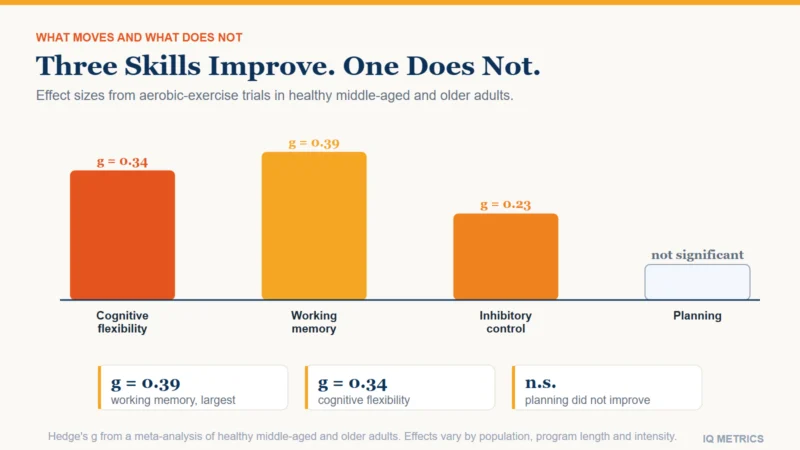 Mind & Everyday Life
Does Exercise Raise Your IQ?
Aerobic exercise has some of the best-replicated cognitive evidence of any lifestyle factor, but not for a full IQ score. What reliably improves is executive function: working memory, inhibitory control, cognitive flexibility. One related skill, planning, barely moves at all.
 Understanding IQ
Processing Speed and IQ
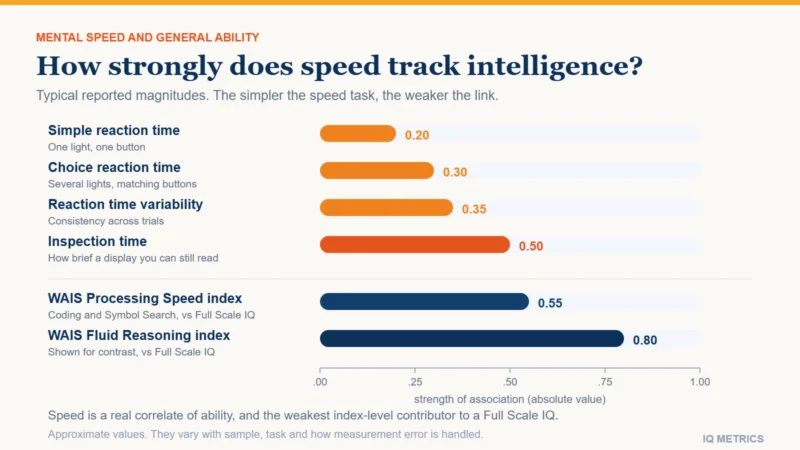
Fast thinkers are assumed to be smart thinkers, and there is a real finding underneath the stereotype: people who score higher on IQ tests do respond faster on tasks with no reasoning content at all. But the link is weaker than the folklore, and on a professional battery the speed index is the least g-loaded.
 Taking a Test
Can an IQ Test Detect Dementia?
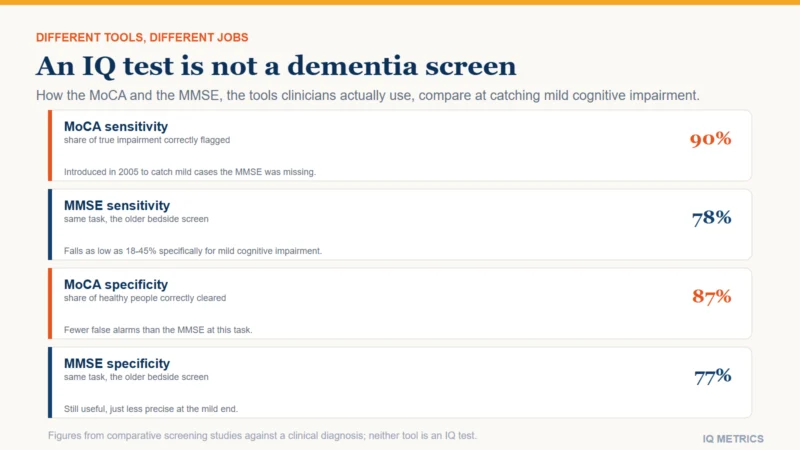
A standard IQ test cannot diagnose dementia; it has no personal baseline and was not built to screen for decline. How the MMSE and the more sensitive MoCA compare, why a normal score can hide early decline, and what actually helps catch it.