



What is Elizabeth Holmes’ IQ?
Early admission to Stanford, a President’s Scholar research stipend and a patent filing at 19 are documented. A degree and an IQ test result are not.
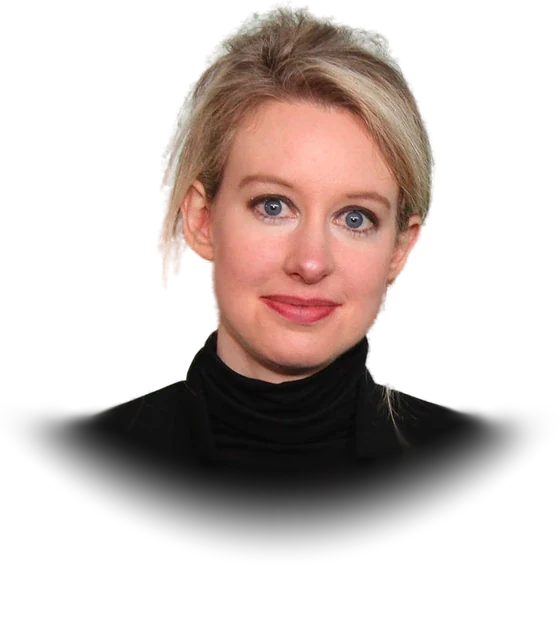
Elizabeth Holmes’s IQ has never been published: no IQ test, SAT or ACT result appears in any source we opened, and no page we found prints an Elizabeth Holmes IQ score. What is documented is early admission to Stanford, a President’s Scholar research stipend, two years of chemical engineering without a degree and a patent filing at 19, the record behind this page’s estimated IQ of 120–140.
Elizabeth Holmes’ estimated IQ
- Admitted to Stanford University by early decision and named a Stanford President’s Scholar; Fortune put the program’s research stipend at $3,000 in 2014 and says she used it for a summer in a Singapore lab that was developing tests for the SARS virus. Wikipedia reports that she majored in chemical engineering from 2002 and worked as a student researcher and laboratory assistant in the School of Engineering.
- Named with three co-inventors, Shaunak Roy, John Howard and Chengwang Wang, on U.S. patent 7,291,497 B2, “Medical device for analyte monitoring and drug delivery,” which has a priority date of September 11, 2003, when she was 19 (Google Patents). Fortune counted her in June 2014 as co-inventor on 82 U.S. and 189 foreign patent applications, of which 18 U.S. and 66 foreign patents had been granted.
- Learned Mandarin as a teenager, which Fortune says qualified her for the Singapore post, and, it reports, started a business in high school selling C++ compilers to Chinese universities; both are her account as told to one magazine, and no second source was opened.
- Left Stanford’s School of Engineering in March 2004, at 20, without a degree, according to Wikipedia, so no grades, class rank, honors beyond the scholars designation or test scores are on record in the sources checked.
No IQ, SAT or ACT score has been published for Elizabeth Holmes, so this range is inferred from an admission, two years of coursework and patent credit, not from a test. The range is wide because the record is short: she left before a degree, patent credit is shared among co-inventors and does not show who conceived what, and nothing in her later career is a measurement of reasoning ability, so it is left out of the range.
- Born
- February 3, 1984, Washington, D.C.
- High school
- St. John’s School, Houston
- University
- Stanford University, chemical engineering, 2002 to March 2004; no degree
- Stanford honor
- President’s Scholar (research stipend)
- Stanford mentor
- Channing Robertson, professor of chemical engineering; later the company’s first board member
- Patents
- Co-inventor on 82 U.S. and 189 foreign applications, 18 U.S. and 66 foreign granted (Fortune, June 2014); U.S. 7,291,497 B2, priority date September 11, 2003
- Test record
- None found: no IQ, SAT or ACT score published
- Known for
- Founding Theranos, a health technology company, in 2003
What an IQ of 120–140 actually means
Set the claim aside for a moment. If someone genuinely scored in this range, here is what that would represent.
| Score range | Classification | Share of people | What it indicates |
|---|---|---|---|
| 85 – 114 | Average | ~68% | The range most people fall into. |
| 115 – 129 | Above average | ~13.6% | Roughly one person in seven. |
| 130 – 144 | Gifted | ~2% | The threshold most high-IQ societies use. |
| Above 144 | Highly gifted | ~0.1% | Figures above this range are extrapolated from the curve rather than measured. |
Percentages are approximate and describe a normal distribution. The same number means different things on tests with different standard deviations.
Thirty questions gives you a measured position on this exact scale — your score, your percentile and the ability breakdown behind it.
Find out in 30 minutes →Who Elizabeth Holmes is
How smart is Elizabeth Holmes, judged only by what can be checked? Elizabeth Anne Holmes was born on February 3, 1984, in Washington, D.C., and graduated from St. John’s School in Houston, according to Wikipedia and Wikidata. Fortune reports that she studied Mandarin in summer language programs at Stanford and, later, at two universities in Beijing, and that she started a business in high school selling C++ compilers to Chinese universities, an account that rests on that one magazine. She was admitted to Stanford University by early decision and attended from 2002, majoring in chemical engineering and working as a student researcher and laboratory assistant in the School of Engineering.
Elizabeth Holmes’s Stanford record is short and specific. She was named a President’s Scholar, and Fortune reports that she took Channing Robertson’s freshman seminar on advanced drug-delivery devices, spent the summer of 2003 in the Singapore lab and, back in Palo Alto, wrote a patent application for a wearable patch that would deliver a drug and monitor the patient’s blood, which she showed to him. In the fall of 2003, a 19-year-old sophomore, she asked him to start a company with her. Wikipedia says the company was founded in 2003 as Real-Time Cures and renamed Theranos the same year, and Stanford’s Graduate School of Business says Robertson became its first board member. She left Stanford’s School of Engineering a semester later: Wikipedia dates it to March 2004, when she was 20, so an account that has her dropping out at 19 is slightly early. She was 19 at the 2003 priority date of the patent described below and 20 when she left. Wikidata records Stanford as a school she attended without a degree. For what coursework does and does not say about measured ability, see how well IQ predicts school success.
Patents are the most checkable technical record, and they are shared credit. Google Patents lists Elizabeth A. Holmes with Shaunak Roy, John Howard and Chengwang Wang on U.S. patent 7,291,497 B2, “Medical device for analyte monitoring and drug delivery”, with a priority date of September 11, 2003, an application filed September 10, 2004 and a publication date of November 6, 2007; it fits the wearable-patch application by title and date, though Fortune gives no patent number. Fortune counted her in June 2014 as co-inventor on 82 U.S. and 189 foreign patent applications, 18 and 66 of them granted. A named inventor shares credit with co-inventors, so the count measures participation in filings, not who conceived what, and it is not an IQ test.
The U.S. Department of Justice records that a federal jury convicted her on January 3, 2022 of one count of conspiracy to commit fraud on investors and three counts of committing fraud on individual investors and that she was sentenced on November 18, 2022 to 135 months in federal prison. A conviction says nothing about IQ either way, and this page estimates Elizabeth Holmes’s IQ from the documented academic record only. On that record the range is 120–140: an early-decision admission, a research stipend, two years of chemical engineering and shared patent credit support a range well above average, and the top, an IQ of 140, is the most a record with no degree and no test could be stretched to support.
 By Elora Mercer, Celebrity Research WriterFigures checked by Leon Falkner, Data & Research Analyst
Reviewed by Aarav Vardhan, Editor-in-Chief · Last reviewed August 2026
.jpg)
Elizabeth Holmes: the documented record
The estimate above rests on this record. Every entry here is a matter of public fact, which is more than can be said for the number itself.
- 1984Born February 3 in Washington, D.C.
- Before 2002Attends summer Mandarin language programs at Stanford and, later, at two universities in Beijing, and graduates from St. John’s School in Houston.
- 2002Enters Stanford University by early decision and studies chemical engineering; named a Stanford President’s Scholar.
- Summer 2003Works in a lab at the Genome Institute in Singapore, then writes a patent application for a wearable patch, Fortune reports.
- 2003The priority date of U.S. patent 7,291,497, “Medical device for analyte monitoring and drug delivery,” is September 11; she is 19 and one of four named inventors.
- Fall 2003As a 19-year-old sophomore, asks professor Channing Robertson to start a company with her; it is founded in 2003 as Real-Time Cures and renamed Theranos.
- March 2004Leaves Stanford’s School of Engineering at 20, without a degree.
- 2007U.S. patent 7,291,497 B2 is published on November 6.
- June 2014Fortune reports she is co-inventor on 82 U.S. and 189 foreign patent applications, of which 18 U.S. and 66 foreign have been granted.
- 2022On January 3, a federal jury convicts her on one count of conspiracy to commit fraud on investors and three counts of committing fraud on individual investors; on November 18 she is sentenced to 135 months in federal prison, the U.S. Department of Justice reports.
Why no figure circulates
Following a claim back to its first appearance is the part almost nobody does — and it is what most people are actually asking.
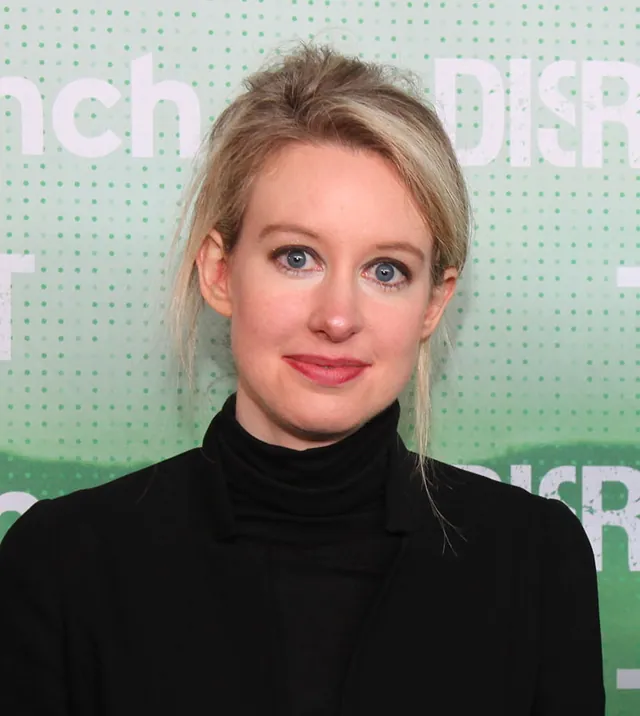
No Elizabeth Holmes IQ score circulates, and that is itself the finding. Searches for “elizabeth holmes iq”, “elizabeth holmes iq score” and “elizabeth holmes estimated iq” returned biographies and reference pages rather than a number, and the IQ Estimates Substack database, which derives celebrity figures from SAT, income and technical-ability assumptions, has no entry for her. With no number to audit, the question people type, “is Elizabeth Holmes a genius?”, has to be answered from the record. For how figures usually take hold when one does appear, see where celebrity IQ numbers come from.
The documented record is academic and specific. Fortune reported in June 2014 that she was admitted to Stanford by early decision and named one of the freshman “president’s scholars”, a designation that came with a $3,000 research stipend, and Stanford’s Graduate School of Business also calls her a Stanford President’s Scholar. Fortune says she persuaded her chemical engineering professor Channing Robertson, now listed by Stanford as the Ruth G. and William K. Bowes Professor in the School of Engineering, Emeritus, to let her use the stipend on a project in his lab alongside PhD students, and that she spent that summer in a lab at the Genome Institute in Singapore, a post she could fill because she had learned Mandarin as a teenager. None of these accounts gives a grade, a class rank or a test score; for how a score would convert if one existed, see SAT score to IQ conversion.
The “genius” story rests on admiration, not measurement. In the Fortune profile Robertson, who had taught thousands of undergraduates over 33 years, says he knew she was different, that the novelty of her approach to a complex technical problem was unique in his experience, and that he felt he could as easily have been looking into the eyes of Steve Jobs or Bill Gates. Henry Kissinger says he has not seen anyone with her special attributes and names iron will and strong determination. Those are judgments of originality and drive, not of test-style reasoning; both men sat on her company’s board, according to Stanford’s Graduate School of Business, and neither gives a score. A text check of the Fortune profile finds neither “genius” nor “prodigy”, so in that article the label is a reader’s summary of comparisons like these, not a word the magazine used. A claim of genius-level IQ needs a score, and none exists.
Placed among the business profiles here, Elizabeth Holmes’s 120–140 sits below Peter Thiel’s 135–150, which rests on two completed Stanford degrees, and below Mark Zuckerberg’s 135–145, which uses the same academic-record method. It is well under Steve Jobs’s 150–160, whose record shows a single semester at Reed College, and Bill Gates’s 150–160, which is anchored in an SAT-derived figure that has no counterpart here, and it overlaps only the bottom of Jack Ma’s 108–122. The placement reflects how thin the record is, not a verdict on the person: she left Stanford before any degree was awarded, so the evidence for a higher ceiling is simply absent.
How we read a number →None appears in Fortune’s 2014 profile, Stanford’s Graduate School of Business page, Wikipedia or Wikidata. Searches for “elizabeth holmes iq”, “elizabeth holmes iq score” and “elizabeth holmes estimated iq” returned no page that prints a figure, and the IQ Estimates Substack database has no entry for her.
Early-decision admission to Stanford; the “president’s scholars” designation with a $3,000 research stipend; Robertson’s freshman seminar and lab project; the summer in the Genome Institute lab in Singapore after learning Mandarin; the wearable-patch application shown to Robertson in the fall of 2003 by a 19-year-old sophomore; Robertson’s “I knew she was different” and his Steve Jobs and Bill Gates remark; Henry Kissinger on her “special attributes”; summer Mandarin programs at Stanford and in Beijing; a high-school business selling C++ compilers; 82 U.S. and 189 foreign patent applications, 18 and 66 granted, source not stated; dropped out a semester later. A text check found neither “genius” nor “prodigy”. Used for biography only (see the 2015 correction below).
The author’s correction, linked from a note on the June 2014 profile, concerns a statement about how many tests the company offered. It does not mention her education, patents or any of the biographical details used here, which is why the 2014 profile is cited for those only.
States that she majored in chemical engineering, persuaded professor Channing Robertson to let her do research with PhD students and was named a Stanford President’s Scholar, using the stipend to travel to Singapore to study SARS; that Robertson became her company’s first board member and that the board includes Henry Kissinger; and that the startup was founded in 2003. Gives no grade, rank or test score.
Lists him as the Ruth G. and William K. Bowes Professor in the School of Engineering, Emeritus, in chemical engineering. The profile does not mention Theranos or Elizabeth Holmes.
Inventors Elizabeth A. Holmes, Shaunak Roy, John Howard and Chengwang Wang; priority date 2003-09-11, application filed 2004-09-10, published 2007-11-06.
Source for the one sentence on the federal case: the January 3, 2022 verdict on one count of conspiracy to commit fraud on investors and three counts of committing fraud on individual investors, and the November 18, 2022 sentence of 135 months in federal prison. Used for nothing else on this page.
Confirms this is Elizabeth Holmes, the American founder of Theranos: born February 3, 1984, in Washington, D.C.; no date of death recorded; educated at Stanford University (recorded without a degree) and St. John’s School.
Orientation for the 2002 start at Stanford in chemical engineering as a student researcher and laboratory assistant, the March 2004 departure, the 2003 founding as Real-Time Cures and the renaming to Theranos.
The database lists celebrity IQ estimates, mathematical and arbitrary, with the method stated as correlations of SAT, wealth and technical ability with IQ; it has no entry for Elizabeth Holmes.
The sources behind our estimate
The figures that circulate for Elizabeth Holmes, what we were able to confirm, and where the two diverge.
No page we found puts a number on Elizabeth Holmes’s IQ level. Searches for “elizabeth holmes iq”, “elizabeth holmes iq score” and “elizabeth holmes estimated iq” returned biographies, news coverage and reference pages, not a figure.
No Elizabeth Holmes IQ test result has been published, and no SAT or ACT score either. Fortune’s 2014 profile, Stanford’s Graduate School of Business page, Wikipedia and Wikidata mention none. The IQ Estimates Substack database, which builds celebrity figures from SAT, income and technical-ability assumptions, has no entry for her, so there is no circulating number to trace and none to mark as wrong.
With no figure circulating, the spread is only the width of this page’s own range, 20 points, wider than most profiles here because the record ends before a degree. If a number for Elizabeth Holmes does turn up later, treat it as an estimate: the documented record holds no test result for it to be a copy of.
Want a number that does hold up? Every figure on this page is somebody’s claim. Take the 30-question test and get a percentile you can check rather than a figure you have to trust.
Elizabeth Holmes — frequently asked
What is Elizabeth Holmes’s IQ?
Elizabeth Holmes’s IQ is unknown: no IQ test result has been published for her. This site’s estimate of her IQ, 120–140, is inferred from early admission to Stanford, two years of chemical engineering there and shared patent credit, not from any score. No page we found prints an Elizabeth Holmes IQ score.
Did Elizabeth Holmes take an IQ test?
No Elizabeth Holmes IQ test result has been published, and no SAT or ACT score either. Fortune’s 2014 profile, Stanford’s Graduate School of Business page and Wikipedia mention none. The only formal recognitions in the record are an early-decision admission to Stanford and a President’s Scholar research stipend, and neither is an IQ test.
Is Elizabeth Holmes a genius?
“Genius” is a label for achievement, not a score, and no IQ result exists to test it. The documented parts of Elizabeth Holmes’s record are early admission to Stanford, a President’s Scholar research stipend, two years of chemical engineering and patent credit from age 19. A degree and a test result are missing, so this site gives a range, 120–140.
How smart is Elizabeth Holmes?
Judged by the academic record alone, she appears well above average: a selective admission, undergraduate research and named patent credit at 19 point to an estimated IQ of 120–140 on this site. That is an estimate from documents, not a measurement, and it does not use her later career as evidence.
What did Elizabeth Holmes study at Stanford?
Elizabeth Holmes entered Stanford University in 2002 and majored in chemical engineering, working as a student researcher in the School of Engineering and, with professor Channing Robertson’s agreement, doing research with PhD students. She was named a President’s Scholar. She left in March 2004 without a degree, according to Wikipedia.
How old was Elizabeth Holmes when she left Stanford?
She was 20. Born February 3, 1984, she left Stanford’s School of Engineering in March 2004, according to Wikipedia. Fortune places the start of her company in the fall of 2003, when she was a 19-year-old sophomore, and says she dropped out a semester later, so a “dropped out at 19” account is slightly early.
How does Elizabeth Holmes’s estimated IQ compare with Peter Thiel’s?
This site’s estimate for Elizabeth Holmes, 120–140, overlaps Peter Thiel’s 135–150 between 135 and 140 but sits lower at both ends. Both are inferred from documented records, not tests, and both involve Stanford, but Thiel completed a bachelor’s degree and a J.D. there while Holmes left without a degree.
How does my IQ compare with Elizabeth Holmes?
You can find out in about fifteen minutes. The IQ Metrics assessment is 30 questions, scored on the same 100-mean scale used throughout this page, so your result and the estimate above are at least expressed in the same units — one measured, one inferred. Once you have a number, the leaderboard shows where it would sit, and how we score and norm it explains the benchmarking.
Where does this estimate come from?
From the documented record rather than a test — the method is named above and set out in full under how we read a number. Compare it against the other business & tech profiles, starting with Steve Jobs.
- Take the 30-question IQ test — get a measured score and percentile of your own
- Average IQ by country — how the scale behaves across populations
- How IQ Metrics scores its assessment — the method behind our own number
- More on how IQ testing works — reliability, error and what a score can and cannot say
- More business & tech profiles — same field, same method
More business & tech


Photograph by John Phillips, CC BY 2.0. Background removed for the portrait above. · Photograph by Xuthoria, CC BY-SA 4.0. Background removed for the portrait above. · Photograph by Tyren Redd, CC BY 4.0. Background removed for the portrait above.
.jpg)
.jpg)
.png)
An estimate is an inference.
Yours can be measured.
Thirty questions, scored against general-population benchmarks. Your score, your percentile, your ability breakdown and a printable IIF certificate.
Find your IQ score now! →