



What was Steve Jobs’ IQ?
One name, two numbers.

Search his name and you will find 160. Search again and you will find 168. Here is where each figure came from, and what his biographers actually recorded.
Steve Jobs’ estimated IQ
- Admitted to Reed College in 1972; withdrew after one semester and continued auditing courses, including calligraphy.
- Co-founded Apple at 21 and led product definition across four separate categories that each reshaped their market.
- No standardised test score for Jobs has ever been published, so the estimate rests on record rather than measurement.
This is an estimate inferred from a documented record, not a test result. Historiometric estimates carry wide error margins and cannot be treated as equivalent to an administered assessment.
- Born
- 24 February 1955, San Francisco
- Died
- 5 October 2011, Palo Alto
- Field
- Consumer technology and product design
- Education
- Reed College — one semester, 1972
- Known for
- Apple, NeXT, Pixar
- Nationality
- American
What an IQ of 150–160 actually means
Set the claim aside for a moment. If someone genuinely scored in this range, here is what that would represent.
Average is 100 by construction, and about two-thirds of people fall between 85 and 115. Take the test to place your own score on this scale.
| Score range | Classification | Share of people | What it indicates |
|---|---|---|---|
| 85 – 114 | Average | ~68% | The range most people fall into. |
| 115 – 129 | Above average | ~13.6% | Roughly one person in seven. |
| 130 – 144 | Gifted | ~2% | The threshold most high-IQ societies use. |
| Above 144 | Highly gifted | ~0.1% | Figures above this range are extrapolated from the curve rather than measured. |
Percentages are approximate and describe a normal distribution. The same number means different things on tests with different standard deviations.
Thirty questions gives you a measured position on this exact scale — your score, your percentile and the ability breakdown behind it.
Find out in 30 minutes →Who Steve Jobs was
Steve Jobs co-founded Apple in 1976, was forced out in 1985, and returned in 1997 to lead the company through the iMac, iPod, iPhone and iPad. He attended Reed College for a single semester before withdrawing and auditing classes informally.
That combination — enormous impact, minimal formal credentialing — is exactly the shape that generates IQ speculation. The number gets attached afterwards, as an explanation for the achievement. Which is worth noticing, because it runs backwards: nobody measured a score and then predicted Apple.
 By Elora Mercer, Celebrity Research WriterFigures checked by Leon Falkner, Data & Research Analyst
Reviewed by Aarav Vardhan, Editor-in-Chief · Last reviewed August 2026

Steve Jobs: the documented record
The estimate above rests on this record. Every entry here is a matter of public fact, which is more than can be said for the number itself.
- 1972Enrols at Reed College, withdraws after one semester, keeps auditing classes including calligraphy.
- 1974Works briefly at Atari, then travels in India.
- 1976Co-founds Apple with Steve Wozniak and Ronald Wayne.
- 1984Introduces the Macintosh.
- 1985Forced out of Apple; founds NeXT.
- 1986Buys Lucasfilm’s Graphics Group; it becomes Pixar.
- 1997Returns to Apple as interim CEO.
- 2001iPod.
- 2007iPhone.
- 2010iPad.
- 2011Resigns as CEO in August; dies in October.
Where the 160 figure came from
Following a claim back to its first appearance is the part almost nobody does — and it is what most people are actually asking.
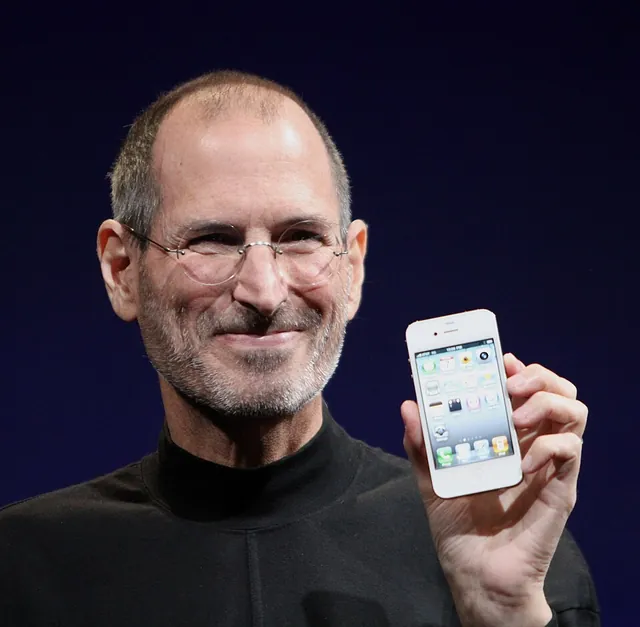
The 160 figure appears across dozens of “smartest people” listicles, each presenting it as settled. None cites an origin. When a number is repeated at that volume without attribution, the repetition itself starts to function as evidence — which is how an unsourced claim quietly becomes common knowledge.
A second figure, 168, circulates alongside it. Two numbers can’t both be the output of one assessment, and the existence of the second is good reason to think neither is anchored to a real one.
What the record does contain is a well-documented life: Reed College for a single semester, the Atari and Homebrew years, Apple in 1976. What it doesn’t contain is a test score.
How we read a number →Authorised biography drawing on extensive interviews and archival access. Contains no IQ test result. Recorded as a documented absence, not as support for any figure.
Source URLs and first-appearance date pending audit.
Identifying the earliest published instance is the open task for this profile.
Flagged in the August 2026 review as unsourced and scheduled for correction. A site that traces other people’s figures should trace its own first.
The sources behind our estimate
The figures that circulate for Steve Jobs, what we were able to confirm, and where the two diverge.
The figure repeated most often across IQ listicles and aggregator sites. In every instance we checked it appears without attribution — the same number restated, never sourced.
We haven’t found a record of Steve Jobs sitting an IQ test. Walter Isaacson’s authorised 2011 biography — built on extensive interviews and archival access — contains no score. Rather than pick one of the circulating numbers, we’ve set them out and shown what backs them, which at present is nothing we can point to.
An eight-point gap between the two most common figures, with no methodology attached to either. That two numbers circulate for one person is itself a clue about how both were arrived at.
Want a number that does hold up? Every figure on this page is somebody’s claim. Take the 30-question test and get a percentile you can check rather than a figure you have to trust.
Steve Jobs — frequently asked
What is Steve Jobs’s IQ?
No verified score exists. Our estimate of 150–160 is inferred from his documented record, not from a test. Any site presenting a precise figure as fact is repeating a number nobody has sourced.
Did Steve Jobs ever take an IQ test?
There is no public record of one. Walter Isaacson’s authorised biography draws on extensive interviews and archival access and contains no test result.
Where does the figure of 160 come from?
It circulates across IQ listicles without attribution. A second figure, 168, circulates alongside it — two numbers cannot both come from one assessment.
Did Steve Jobs go to college?
He enrolled at Reed College in 1972 and withdrew after one semester, then continued auditing courses informally for around eighteen months.
Was Steve Jobs a genius?
He had extraordinary judgement about products and an unusual ability to recruit and direct talent. Whether that maps onto a reasoning-test score is exactly the question this page declines to answer with false precision.
How does my IQ compare with Steve Jobs?
You can find out in about fifteen minutes. The IQ Metrics assessment is 30 questions, scored on the same 100-mean scale used throughout this page, so your result and the estimate above are at least expressed in the same units — one measured, one inferred. Once you have a number, the leaderboard shows where it would sit, and how we score and norm it explains the benchmarking.
Where does this estimate come from?
From the documented record rather than a test — the method is named above and set out in full under how we read a number. Compare it against the other business & tech profiles, starting with Elon Musk.
- Take the 30-question IQ test — get a measured score and percentile of your own
- Average IQ by country — how the scale behaves across populations
- How IQ Metrics scores its assessment — the method behind our own number
- More on how IQ testing works — reliability, error and what a score can and cannot say
- More business & tech profiles — same field, same method
More business & tech


Photograph by Krd (LinuxCon Europe, October 2014; cropped by Von Sprat), CC BY-SA 4.0. Background removed for the portrait above. · Photograph by Gleuschk (MSRI, May 2007), CC BY-SA 3.0. Background removed for the portrait above. · Photograph by Gage Skidmore (Scottsdale, Arizona, 2022), CC BY-SA 3.0. Background removed for the portrait above.
.jpg)
.jpg)

An estimate is an inference.
Yours can be measured.
Thirty questions, scored against general-population benchmarks. Your score, your percentile, your ability breakdown and a printable IIF certificate.
Find your IQ score now! →