





Humor and IQ: Are Funny People Smarter?
Are funny people smarter? In student studies, the ability to write funny captions correlates about .25 with abstract reasoning and .38 with vocabulary. That is a real but moderate link: a high scorer is somewhat more likely to be funny on demand, but IQ cannot identify funny people. See the odds, the evidence and its limits.

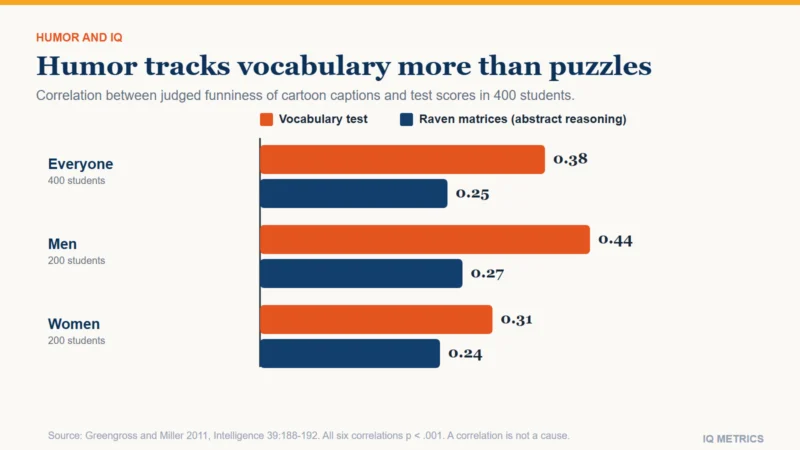
Humor and IQ are related, but only moderately, and only for one kind of humor. In student studies where judges rated how funny people’s cartoon captions were, funniness correlated about .25 with abstract reasoning and .38 with vocabulary in the largest study we reviewed, which had 400 people. That means smarter people are somewhat more likely to be funny on demand, not that funny people can be identified by their IQ, and not that a good sense of humor in the everyday sense is a sign of high intelligence. This guide explains what was measured, how big the link is in plain odds, and where the evidence stops.
- What was measured: humor production, meaning writing something funny on demand, such as a caption for a cartoon that has none, scored by judges. It is not the same as enjoying jokes or being thought of as having a good sense of humor.
- How strong: .25 with a matrix reasoning test and .38 with a vocabulary test in a 2011 study of 400 students; a 2018 study of 270 adults estimated a large effect of general intelligence on humor production (.51 in a latent-variable model).
- In plain odds (our calculation): with a correlation of .38, someone in the top quarter on vocabulary has about a 42% chance of being in the top quarter for humor production, against 25% by chance.
- Verbal over abstract: vocabulary predicted humor production better than matrix reasoning, and in the 2018 study general intelligence and idea-retrieval ability carried the effect while fluid reasoning had no separate effect beyond general intelligence.
- Limits: student samples, subjective judging, and correlation rather than cause. A 2025 twin study found no additive genetic effect on caption-writing scores.
Humor draws on abilities we describe elsewhere: the word-finding fluency measured in the verbal fluency test, the verbal side of verbal and non-verbal IQ scores, and the idea generation covered in creativity and IQ.
What do studies of humor and intelligence actually measure?
Almost all of the evidence concerns humor production: coming up with something funny on the spot. Researchers hand people a cartoon with the caption removed and ask for a new one, or ask for a witty reply to an absurd question, and then have judges rate how funny the answers are. Feingold and Mazzella (1991), as summarized by Greengross and Miller, did this with 147 adults in three groups, including Harvard graduate students and volunteers recruited in Central Park, and found correlations of .31 to .52 between a vocabulary test and rater-judged humor tasks.
Howrigan and MacDonald (2008) used 185 college students and tasks such as funny responses to emails, mock descriptions of stereotyped characters and funny drawings. Greengross and Miller report correlations of .12 to .23 with the Raven matrices. In the authors’ analysis general intelligence predicted judged humor even after the Big Five personality traits were counted, and extraversion also predicted it, to a lesser degree.
How strong is the link between humor and IQ?
The largest of these studies is Greengross and Miller (2011). They gave 400 university students (200 men and 200 women) a matrix reasoning test (Raven’s Advanced Progressive Matrices), a 46-item vocabulary test and a humor task in which judges rated the funniness of captions the students wrote for three cartoons. Across all 400, humor ability correlated .38 with vocabulary and .25 with the matrices, and the difference between those two correlations was statistically significant. For men the figures were .44 and .27; for women .31 and .24.
| Study | Sample | Intelligence measure | Result |
|---|---|---|---|
| Feingold and Mazzella (1991) | 147 adults in three groups | Vocabulary | r = .31 to .52 (as summarized by Greengross and Miller) |
| Howrigan and MacDonald (2008) | 185 college students | Raven matrices (general intelligence) | r = .12 to .23 (as summarized by Greengross and Miller); general intelligence predicted judged humor beyond the Big Five |
| Greengross and Miller (2011) | 400 university students | Vocabulary and Raven matrices | r = .38 and .25 |
| Christensen et al. (2018) | 270 young adults | Fluid reasoning, vocabulary and retrieval factors | General intelligence predicted humor production (standardized effect .51, 95% CI .32 to .70) |
Those numbers are real but moderate. A correlation of .38 means vocabulary accounts for about 14% of the differences in judged funniness, and .25 for about 6%; most of what makes one person funnier than another is something else. In practical terms (our calculation, assuming both measures follow a normal curve), a person in the top quarter on vocabulary has about a 42% chance of being in the top quarter for humor production, against 25% for a random person, and about a 62% chance of being above the median. With the matrix test (.25) those odds are about 36% and 58%. That is a tilt, not a sorting rule.
Which kind of intelligence matters most for being funny?
Vocabulary mattered more than abstract reasoning in the 2011 study, which Greengross and Miller took to be unsurprising for tasks that are verbal. A 2018 study by Christensen and colleagues refined the picture. Using the Cattell-Horn-Carroll model, they measured fluid reasoning, vocabulary knowledge and broad retrieval ability (how fluently a person can generate ideas and words) in 270 young adults, along with a battery of humor production tasks. All three specific factors correlated with humor, and a model with general intelligence on top found a large effect of g on humor ability (.51). In a bifactor model, humor was predicted mainly by g and by retrieval ability, not by fluid reasoning once those were counted.
That fits the intuition that generating many candidate words and ideas quickly is a large part of being funny on demand, though the studies do not test that directly. Our guide to CHC theory explains those factors, fluid versus crystallized intelligence covers the reasoning and knowledge sides, and the verbal fluency test measures a close relative of retrieval ability.
Is a good sense of humor a sign of high IQ?
Partly, with large caveats. The studies measure the ability to produce humor, not the experience of enjoying it, and not the way friends describe someone as having a good sense of humor. A moderate correlation across a group says nothing certain about any one person: plenty of people with ordinary scores are very funny, and plenty of high scorers are not. The idea behind the research is that humor production may be an honest indicator of intelligence, and the authors tie it to mating success; correlations like these are consistent with that idea but cannot test it. We did not find, in the sources used for this page, a comparably large study of humor appreciation and IQ, so we do not claim one way or the other.
Where would your own score land?
Take the IIF-certified assessment and get your score with the scale it was measured on, the percentile it corresponds to and the confidence range around it — the three figures most online tests leave out.
Find your IQ score now! →Is humor inherited? What a 2025 twin study adds
A 2025 study of 448 pairs of identical and 196 pairs of fraternal twins from the UK twin registry (median age 66) tested whether humor production runs in families. The twins rated their own humor ability, rated their co-twin, and wrote funny captions for captionless cartoons, and they also completed a short cognitive ability test. Self-rated humor ability showed both genetic and non-shared environmental influence. The objectively rated caption-writing score showed no evidence of additive genetic effects; individual differences were shaped by shared and non-shared environment, although the authors say a small genetic effect cannot be ruled out. They conclude that humor production may be more complex and harder to assess than other cognitive abilities. To see how twin and sibling designs work, our guide to whether siblings have similar IQs explains the logic with real numbers.
Where does the evidence stop?
Five limits are worth keeping in mind:
- Samples are mostly university students or volunteers, which narrows the range of scores.
- Funniness is judged by raters with their own taste, and a caption task is one narrow slice of humor.
- Correlations show a relationship, not a cause: a larger vocabulary may help produce wittier captions, or both may reflect something else, such as verbal experience.
- Results vary between studies, from .12 to .52, because measures and samples differ.
- The studies described here used English-language tasks, so vocabulary here means English vocabulary.
If you are curious how your own reasoning compares, you can take the IQ test. Humor is not scored in it, and these studies do not support the reverse inference that a lower reasoning score means a smaller sense of humor.
Quick answers
- Are funny people smarter? On average, modestly. In the largest study we reviewed, the ability to write funny captions correlated .25 with abstract reasoning and .38 with vocabulary.
- Does a sense of humor mean a high IQ? Not reliably. The studies measure producing humor on demand, and the link is moderate: a high scorer has a better than average chance of being funny, but IQ does not identify funny people.
- Is humor related to verbal intelligence? More than to abstract reasoning: .38 versus .25 in the 2011 study, and idea-retrieval ability mattered in the 2018 study.
- Is being funny genetic? A 2025 twin study found genetic influence on self-rated humor ability but none detectable on an objectively rated caption task.
- Do smart people appreciate jokes more? The sources used here do not answer that; they concern producing humor.
Sources
- Greengross, G. and Miller, G. (2011): Humor ability reveals intelligence, predicts mating success, and is higher in males, Intelligence, 39(4), 188-192.
- Howrigan, D.P. and MacDonald, K.B. (2008): Humor as a mental fitness indicator, Evolutionary Psychology, 6(4).
- Feingold, A. and Mazzella, R. (1991): Psychometric intelligence and verbal humor ability, Personality and Individual Differences, 12(5), 427-435.
- Christensen, A.P., Silvia, P.J., Nusbaum, E.C. and Beaty, R.E. (2018): Clever people: intelligence and humor production ability, Psychology of Aesthetics, Creativity, and the Arts, 12(2), 136-143.
- Greengross, G. et al. (2025): Heritability of humor production ability: a twin study, Twin Research and Human Genetics, 28(3), 265-272.
- Our calculations: the odds of top-quarter and above-median humor production are derived here from the reported correlations, assuming both measures follow a normal curve. They are not reported in the sources.
Keep reading
All articles →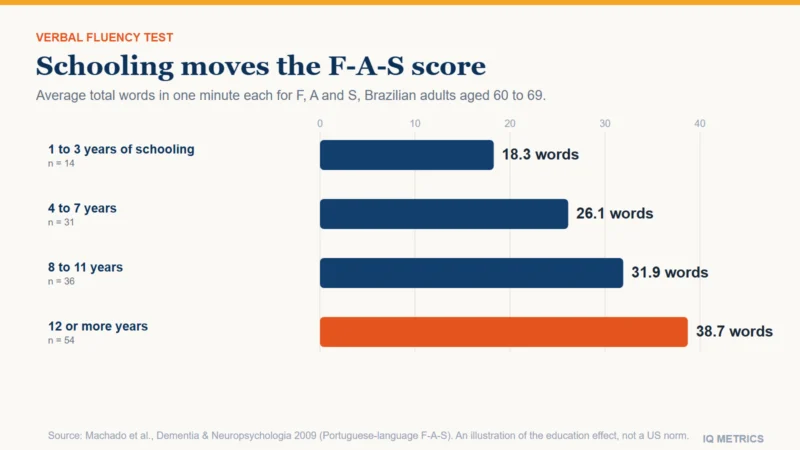 Taking a Test
Verbal Fluency Test
A verbal fluency test asks you to name as many words as you can in 60 seconds, by letter (F-A-S) or category (animals). See how it is scored, why education can move the score by about 20 words, what the task really measures and what a low count can and cannot tell you.
 Understanding IQ
Creativity and IQ
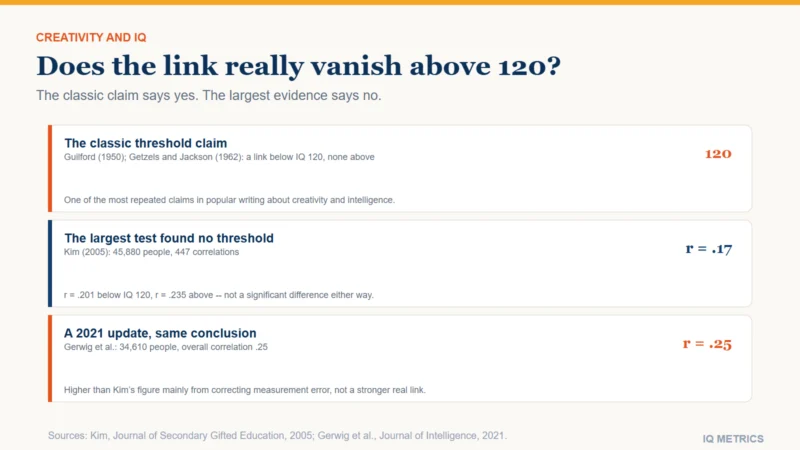
Creativity and IQ correlate only weakly. The largest meta-analysis ever run on the question, covering 45,880 people, found no significant threshold at IQ 120, just a modest overall link of about .17 to .25. See what the strongest evidence shows, and why the classic claim does not hold up.
 Scores & Scales
Verbal vs Non-Verbal IQ Scores
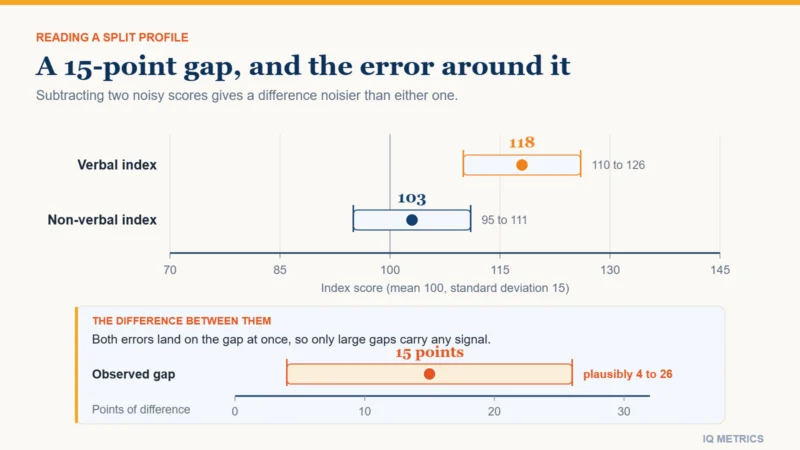
Two people can hold the same IQ number and have completely different profiles, and a split between the verbal and non-verbal indexes is far commoner than most test-takers expect. Here is what base-rate tables and compounding measurement error say about how large a gap has to be before it means anything.