





Big Five Personality Traits Explained: What the Five Factors Measure
The Big Five personality traits are openness, conscientiousness, extraversion, agreeableness and neuroticism: five spectrums that came out of decades of research on the words people use to describe each other. Here is what each trait means, how it is measured, what it predicts and how it changes.

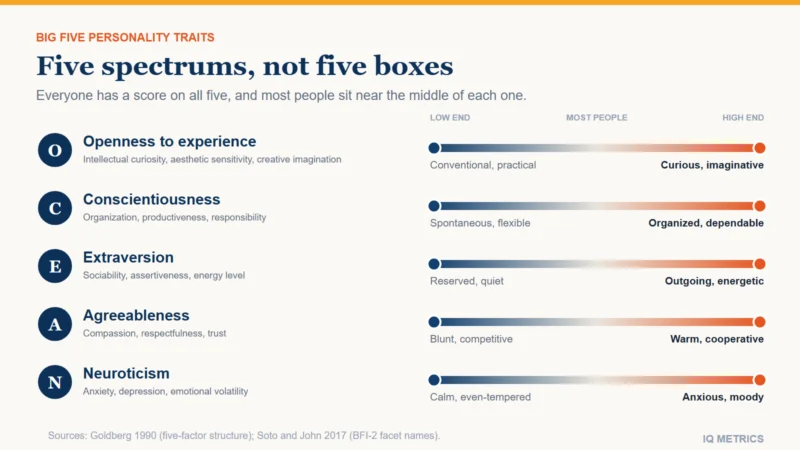
The Big Five personality traits are five broad dimensions that describe how people differ: openness to experience, conscientiousness, extraversion, agreeableness and neuroticism, often remembered as OCEAN. Each one is a spectrum rather than a type, and everyone has a score on all five. The model did not come from a single theorist. It grew out of decades of research on the words people use to describe each other, and it is now the standard framework in academic personality research. This guide explains what each trait means, how the traits are measured, what they predict, and how much they change over a lifetime.
- Five spectrums: openness, conscientiousness, extraversion, agreeableness and neuroticism. Most people score somewhere in the middle of each one, not at either end.
- Where they came from: studies of the trait words in everyday language, starting with a list of 4,504 trait adjectives compiled in 1936, kept producing the same five factors.
- What they predict: in a classic meta-analysis, conscientiousness was the one trait linked to job performance in every occupational group, and it predicts grades largely independently of intelligence.
- How heritable: about 40% of the differences between people, averaged across 62 independent estimates; twin studies alone give about 47%.
- How stable: people tend to become more conscientious and emotionally stable between 20 and 40, and their standing relative to others steadies with age.
- Not intelligence: of the five, only openness has a consistent link with IQ, and a modest one.
This page is about personality itself. How the five traits relate to intelligence is set out in more depth in IQ vs personality, and the four-style model used in workplace training is explained in our companion guide to the DISC personality model.
What are the Big Five personality traits?
Think of the five traits as five separate dials. They were chosen to be as independent of each other as possible, so a high score on one does not settle the others: someone can be very extraverted and very anxious, or quiet and highly agreeable. Each trait also groups narrower facets. The table uses the facet names of the Big Five Inventory-2 (BFI-2), a research questionnaire published in 2017 that splits each trait into three facets.
| Trait | Facets (BFI-2) | High scorers tend to be | Low scorers tend to be |
|---|---|---|---|
| Openness to experience | Intellectual curiosity, aesthetic sensitivity, creative imagination | Curious, imaginative, drawn to new ideas and art | Practical, conventional, happier with the familiar |
| Conscientiousness | Organization, productiveness, responsibility | Organized, persistent, dependable | Flexible, spontaneous, less organized |
| Extraversion | Sociability, assertiveness, energy level | Outgoing, talkative, energetic | Quiet, reserved, content on their own |
| Agreeableness | Compassion, respectfulness, trust | Warm, cooperative, trusting | Blunt, skeptical, competitive |
| Neuroticism | Anxiety, depression, emotional volatility | Prone to worry, low mood and mood swings | Calm, even-tempered, resilient |
Two of the names vary between questionnaires. The BFI-2 calls neuroticism negative emotionality and openness open-mindedness, and many researchers reverse neuroticism and report emotional stability instead. They are the same dimensions. Neither end of a trait is a fault in itself: each has costs and benefits depending on the situation.
Openness to experience
Openness describes an appetite for ideas, art, imagination and new experiences. It is the trait most closely tied to intellectual interests and the only one of the five with a consistent positive correlation with IQ, typically around 0.2 to 0.3 in the studies summarized in our IQ vs personality guide. On average it rises in adolescence and falls in old age.
Conscientiousness
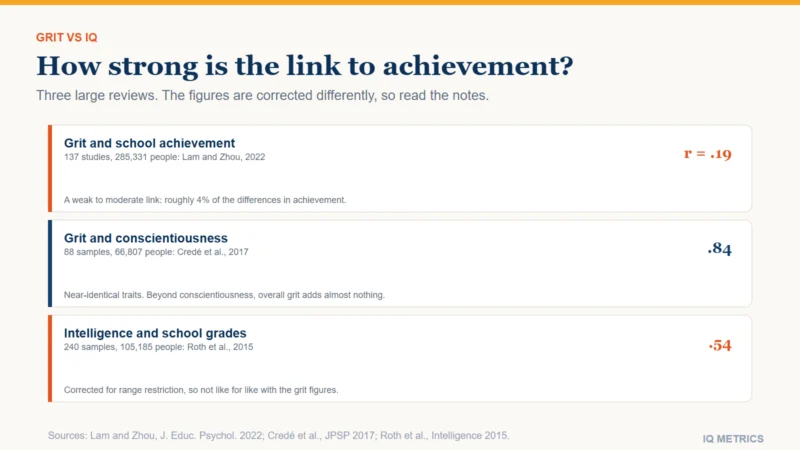
Conscientiousness covers self-discipline, organization and reliability. It is the most consistently useful of the five for predicting work and school outcomes, and it overlaps heavily with grit: our grit vs IQ guide reports a correlation of .84 between the two in a large meta-analysis. Average conscientiousness rises through young adulthood.
Extraversion
Extraversion is about sociability, assertiveness and energy. Researchers often split it into a social-dominance side and a social-vitality side, and the two age differently: social dominance rises in young adulthood, while social vitality rises in adolescence and falls in old age. In the workplace data, extraversion predicted performance in management and sales.
Agreeableness
Agreeableness describes compassion, trust and cooperation. In the long-term studies it changed little until old age. A low score is not the same as unkindness: it shows up as a readiness to disagree, compete and question other people’s motives.
Neuroticism
Neuroticism is the tendency to feel negative emotions such as anxiety, sadness and irritability, and to react strongly to stress. Its mirror image, emotional stability, tends to increase between the ages of 20 and 40. Neuroticism is a measure of everyday emotional style, not a diagnosis.
Where the Big Five came from
The model rests on the lexical hypothesis: if a difference between people matters, everyday language will have words for it. In 1936 Gordon Allport and Henry Odbert went through an English dictionary and listed 4,504 adjectives for relatively stable traits. Later researchers reduced long lists like theirs with factor analysis, a statistical method that groups the words people tend to apply to the same person.
In 1961 two US Air Force researchers, Ernest Tupes and Raymond Christal, reported five recurrent factors in trait ratings. Lewis Goldberg coined the name “Big Five” in 1981, and in 1990 he showed the same five-factor structure emerging from 1,431 trait adjectives in 10 replications using different factor-analytic methods; no factor beyond the fifth held up across his samples. Paul Costa and Robert McCrae built the questionnaire most associated with the model, the NEO Personality Inventory, in which each of the five domains has six facets.
The structure travels well. When the Big Five Inventory was translated into 28 languages and given to 17,837 people in 56 nations, the five dimensions held up across all the major regions of the world.
How the Big Five are measured
Almost every Big Five test is a questionnaire of short statements about yourself, which you rate from “disagree strongly” to “agree strongly”. There are no right or wrong answers and no time pressure. That is the core difference from an ability test: a personality questionnaire asks what you usually do, while an IQ test asks what you can do at your best.
- NEO Personality Inventory: the long questionnaire by Costa and McCrae used in research and clinical work, with six facets per trait.
- Big Five Inventory and BFI-2: shorter research questionnaires; the BFI-2 (Soto and John, 2017) measures 15 facets, three per trait, and controls for people who tend to agree with every statement.
- IPIP scales: the International Personality Item Pool, a public-domain bank of items that researchers can use without a licence.
- HEXACO inventories: questionnaires for a six-factor rival model, covered below.
Because the answers are self-reports, they can be shaded. That matters little when you take a questionnaire out of curiosity and much more when a job depends on it: a candidate can lean toward the answers an employer seems to want, which an ability test with right answers does not allow in the same way. For what ability tests do and do not predict at work, see what a cognitive ability test at work predicts.
What do the Big Five predict?
Personality traits predict real outcomes, each of them modestly. A 2007 review of long-term prospective studies compared personality traits with socioeconomic status and cognitive ability as predictors of mortality, divorce and occupational attainment, and found the size of the personality effects “indistinguishable” from the other two.
- Work: in a meta-analysis covering five occupational groups, from professionals and police to sales and skilled workers, conscientiousness was the one trait related to every measure of job performance in every group. Extraversion helped in management and sales, and openness and extraversion both predicted how well people did in training.
- School and university: across studies with cumulative samples of over 70,000, agreeableness, conscientiousness and openness all correlated with academic performance. Conscientiousness predicted grades largely independently of intelligence, and at university it added as much to prediction as intelligence did once earlier school grades were taken into account.
- Well-being: extraversion and low neuroticism are among the stronger personality correlates of happiness, a far stronger link than IQ has, as covered in IQ and happiness.
“Modestly” matters. A trait score describes a tendency across many situations. It does not say what one person will do on a given day, and on its own it accounts for only part of the differences in any single outcome.
Where would your own score land?
Take the IIF-certified assessment and get your score with the scale it was measured on, the percentile it corresponds to and the confidence range around it — the three figures most online tests leave out.
Find your IQ score now! →Do Big Five traits change with age?
Yes, in two different senses. Average levels shift: a meta-analysis of 92 samples followed over time found that people become more conscientious, more emotionally stable and more socially dominant, especially between 20 and 40. Openness and social vitality rise in adolescence and fall in old age, and agreeableness changed only in old age.
Your position relative to other people also steadies. Across 152 longitudinal studies, the correlation between two measurements about seven years apart rose from .31 in childhood to .54 in the college years and .64 at age 30, and reached a plateau of about .74 between 50 and 70. Personality is fairly stable in adulthood, but never fixed.
Is personality genetic?
Partly. Pooling 62 independent estimates covering more than 100,000 people, a 2015 meta-analysis estimated the heritability of personality at about 40%: roughly 40% of the differences between people traced to genetic differences and 60% to environmental ones. Twin studies gave higher estimates (47%) than family and adoption studies (22%), and the figure did not depend on which personality model was used. For the matching question about intelligence, see is IQ genetic?.
Big Five vs MBTI and other personality models
The Myers-Briggs Type Indicator sorts people into 16 types from four either-or preferences. When McCrae and Costa compared it with the NEO in 468 adults, they found no support for truly separate types: the MBTI measures four fairly independent continuous dimensions, and those four capture aspects of four of the Big Five. Neuroticism has no MBTI counterpart. Whether any type scores higher on IQ tests is covered in which MBTI type has the highest IQ.
Type tests stay popular because a type is easy to remember and talk about. If you would like a type-style profile of your own, our sister site insightmetrics.org has a 60-question personality test that takes about 10 minutes and sorts your answers into one of 16 types. Read the result as a type-style summary, not as a Big Five score.
The main academic rival is HEXACO, which finds six factors across languages: honesty-humility, emotionality, extraversion, agreeableness, conscientiousness and openness. Its authors argue that the six-factor model explains several things the Big Five handles poorly. DISC, common in workplace training, is different again: four behavioral styles, built for communication workshops rather than for research.
Big Five traits and intelligence
Personality and intelligence are different kinds of measurement: one describes typical behavior, the other maximal performance. The overlap is small. Openness is the one trait with a consistent positive link to IQ, while conscientiousness, extraversion, agreeableness and neuroticism sit near zero, although high neuroticism can feed test anxiety and pull a score below a person’s ability on the day. IQ vs personality sets out that evidence, and IQ vs EQ explains why many emotional intelligence questionnaires overlap so much with ordinary personality traits.
How to read your own Big Five scores
- Scores are relative. A percentile compares you with the group the questionnaire was normed on, so the same answers can look different on a different test.
- Look at the facets, not only the five totals. Two people with the same extraversion score can differ a lot in sociability and assertiveness.
- Expect some movement. Retaking a questionnaire years later usually gives a similar profile, not an identical one.
- Treat it as a description, not a verdict. No level of any trait is best in every setting.
- Keep personality and ability apart. A personality questionnaire cannot tell you your IQ, and an IQ test cannot tell you your personality.
Sources
- Allport, G.W. and Odbert, H.S. (1936): Trait-names: a psycho-lexical study, Psychological Monographs, 47(1), i-171.
- Tupes, E.C. and Christal, R.E. (1961): Recurrent personality factors based on trait ratings, US Air Force Aeronautical Systems Division technical report.
- Goldberg, L.R. (1990): An alternative “description of personality”: the Big-Five factor structure, Journal of Personality and Social Psychology, 59(6), 1216-1229.
- Soto, C.J. and John, O.P. (2017): The next Big Five Inventory (BFI-2): developing and assessing a hierarchical model with 15 facets to enhance bandwidth, fidelity, and predictive power, Journal of Personality and Social Psychology, 113(1), 117-143.
- Schmitt, D.P. et al. (2007): The geographic distribution of Big Five personality traits: patterns and profiles of human self-description across 56 nations, Journal of Cross-Cultural Psychology, 38(2), 173-212.
- Barrick, M.R. and Mount, M.K. (1991): The Big Five personality dimensions and job performance: a meta-analysis, Personnel Psychology, 44(1), 1-26.
- Poropat, A.E. (2009): A meta-analysis of the five-factor model of personality and academic performance, Psychological Bulletin, 135(2), 322-338.
- Roberts, B.W. et al. (2007): The power of personality: the comparative validity of personality traits, socioeconomic status, and cognitive ability for predicting important life outcomes, Perspectives on Psychological Science, 2(4), 313-345.
- Roberts, B.W., Walton, K.E. and Viechtbauer, W. (2006): Patterns of mean-level change in personality traits across the life course: a meta-analysis of longitudinal studies, Psychological Bulletin, 132(1), 1-25.
- Roberts, B.W. and DelVecchio, W.F. (2000): The rank-order consistency of personality traits from childhood to old age: a quantitative review of longitudinal studies, Psychological Bulletin, 126(1), 3-25.
- Vukasović, T. and Bratko, D. (2015): Heritability of personality: a meta-analysis of behavior genetic studies, Psychological Bulletin, 141(4), 769-785.
- McCrae, R.R. and Costa, P.T. (1989): Reinterpreting the Myers-Briggs Type Indicator from the perspective of the five-factor model of personality, Journal of Personality, 57(1), 17-40.
- Ashton, M.C. and Lee, K. (2007): Empirical, theoretical, and practical advantages of the HEXACO model of personality structure, Personality and Social Psychology Review, 11(2), 150-166.
Keep reading
All articles →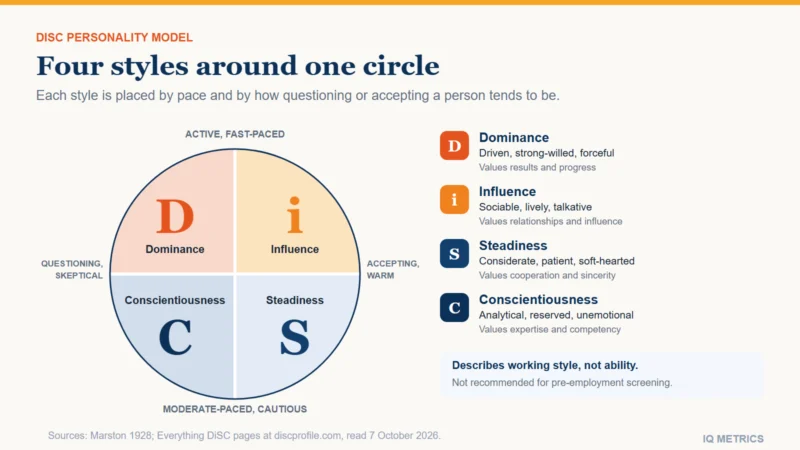 Mind & Everyday Life
DISC Personality Model
DISC sorts workplace behavior into four styles: Dominance, Influence, Steadiness and Conscientiousness. It began with a 1928 book by William Moulton Marston and became a family of training questionnaires. Here is how the model works, what the evidence says, and why it is not a hiring test.
 Understanding IQ
Grit vs IQ
Grit is weakly to moderately linked to school achievement and overlaps almost completely with conscientiousness. See what the original grit studies, two large meta-analyses, the marshmallow test and a retracted test-motivation paper really show about grit vs IQ.
 Mind & Everyday Life
IQ vs EQ
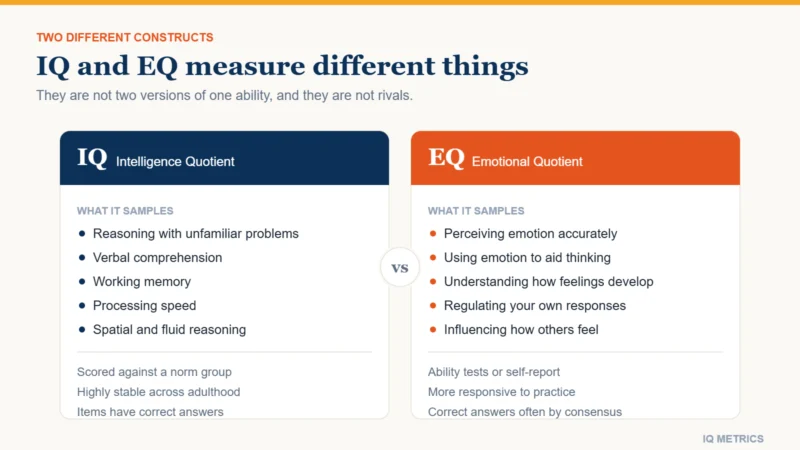
IQ measures reasoning; EQ measures how well you read and manage emotion. They are different constructs, measured in different ways, with different amounts of evidence behind them. Here is what each one actually predicts, which is easier to change, and where the popular claim that EQ matters more comes from.