





Are Smart People Lonely? What the Research Says About IQ, Friends and Loneliness
Are smart people lonely? No study shows a high IQ causes loneliness. One survey found friends added less to life satisfaction for the extremely intelligent, while older adults with lower ability became slightly lonelier. Here is the evidence on loneliness, gifted children and why the idea feels true.

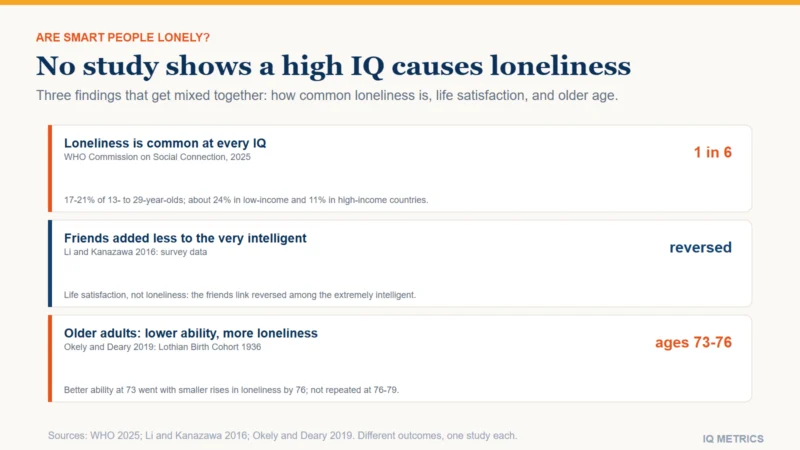
Are smart people lonely? No study shows that a high IQ makes people lonely, and the best-known findings point in different directions. In one survey analysis, more frequent socializing with friends went with higher life satisfaction overall but with lower life satisfaction among the extremely intelligent, which measures satisfaction, not loneliness. In a Scottish cohort of older adults, better cognitive ability at 73 went with smaller increases in loneliness by 76. And loneliness is common at every level: the World Health Organization estimates that 1 in 6 people worldwide is affected. This guide separates what the research shows from the “lonely genius” story, looks at gifted children and the effect of being labelled, and explains why the idea feels true.
- How common: 1 in 6 people worldwide; 17% to 21% of 13- to 29-year-olds; about 24% in low-income countries against about 11% in high-income countries (WHO, 2025).
- Friends and satisfaction: time with friends added less, and for the extremely intelligent went the other way, in a 2016 analysis of life satisfaction by Li and Kanazawa.
- Older age: better cognitive ability at 73 went with smaller rises in loneliness by 76 in the Lothian Birth Cohort 1936, a result not repeated between 76 and 79.
- Gifted label: in a 35-year English study, children labelled gifted had more emotional problems than equally able children who were not labelled.
- Emotional skills: understanding and managing emotions, not IQ, were linked with loneliness in 196 adolescents.
- Rarity: by our arithmetic about 1 in 740 people score 145 or higher, so there are fewer peers at the same level.
This is part of our series on IQ and wellbeing, alongside IQ and happiness, high IQ and mental health, depression and IQ and anxiety and IQ. Withdrawal from others as a feature of a serious mental illness is a separate topic, covered in schizophrenia and IQ.
What do researchers mean by loneliness?
The WHO Commission on Social Connection describes loneliness as the painful feeling that arises from a gap between the social connections a person wants and the ones they have, and separates it from social isolation, which is a lack of contact with others. The two can come apart: someone with few contacts may be content, and someone surrounded by people can feel unseen. That matters for the IQ question. A person with unusual interests may have fewer people who share them without being lonely, and a person with a full calendar may still be.
How common is loneliness?
| Group | Reported feeling lonely |
|---|---|
| People worldwide | 1 in 6 |
| Aged 13 to 29 | 17% to 21%, highest among teenagers |
| Low-income countries | About 24% |
| High-income countries | About 11% |
These are survey estimates, and loneliness is reported by the person, so figures depend on how it was asked. What they show clearly is that loneliness is widespread and tracks age and national income, not obviously intelligence. The Commission also links loneliness to an estimated 871,000 deaths a year, about 100 an hour (WHO news release, 30 June 2025); treat that as WHO’s estimate.
The best-known study: IQ, friends and life satisfaction
The strongest source for the “smart people are lonelier” idea is a 2016 paper in the British Journal of Psychology by Norman Li and Satoshi Kanazawa. They proposed the “savanna theory of happiness”: because the human brain evolved in ancestral conditions, situations that raised happiness then may still raise it now, and general intelligence, which evolved to solve novel problems, may weaken that pull. They tested it on two things that differ between ancestral and modern life, population density and how often people socialize with friends. As predicted, life satisfaction was lower with higher population density and higher with more frequent socializing with friends. Both associations interacted with intelligence, and for friends the main association was reversed among the extremely intelligent: more intelligent individuals reported lower life satisfaction with more frequent socialization with friends.
Read it carefully. The outcome was life satisfaction, not loneliness, and the finding concerns how much time with friends adds to satisfaction, which is not the same as having friends or feeling alone. It is one team’s hypothesis tested on survey data, so it is correlational, and the reversal was reported for the extremely intelligent only. It is a hint that frequent socializing may do less for some very intelligent people. It would be a stretch to say it shows smart people are lonely (our reading).
What older-age data show: the Lothian Birth Cohort
Okely and Deary (2019) used three triennial waves, at ages 73, 76 and 79, of the Lothian Birth Cohort 1936 to test whether loneliness and cognitive ability predict each other. Better processing speed, visuospatial ability or crystallized ability at 73 went with less positive changes in loneliness between 73 and 76, but that was not replicated between 76 and 79. Loneliness at 73 and 76 did not predict later change in cognitive abilities. The authors read it as a slightly higher risk of becoming lonely among people with lower cognitive abilities at 73. That is the reverse of the lonely-genius idea, though it concerns older adults and was not consistent across waves. For how scores change with age, see IQ and age.
Gifted children: lonely, or labelled?
Joan Freeman’s study began in England in 1974 with 70 children labelled gifted. Each was matched on age, sex and socio-economic level with two comparison children from the same class: one with an identical gift who was not labelled, and one chosen at random. Tests and interviews with the pupils, their teachers and their parents continued for 35 years. The labelled children had significantly more emotional problems than either the unlabelled but identically gifted children or the random controls. For the whole sample, hard work, emotional support and a positive personal outlook mattered most, and, in general, the higher a person’s intelligence the better their chances in life.
That points to the label, and the expectations around it, as one source of difficulty rather than ability itself. Not every study is reassuring. In a small 2011 experiment, 22 mathematically gifted adolescents and 24 average adolescents played the Ultimatum Game, a two-player bargaining game. The gifted proposers made strategic but socially impaired offers and the gifted responders accepted less often, so they earned less, and the authors concluded that mathematically gifted adolescents have deficiencies in social valuation and mentalization. That is one task in one small group chosen for mathematical talent, and it does not measure loneliness.
Martin, Burns and Schonlau (2010) made a point that applies to the whole debate: most reviews of mental health in gifted youth include studies that do not directly compare gifted with nongifted young people, so claims about the gifted need population cohorts with comparison groups. For how giftedness is identified, see gifted cutoff scores and signs of a gifted child.
Where would your own score land?
Take the IIF-certified assessment and get your score with the scale it was measured on, the percentile it corresponds to and the confidence range around it — the three figures most online tests leave out.
Find your IQ score now! →Why the idea feels true
- Fewer peers at your level. With a standard deviation of 15, about 2.3% score 130 or higher, roughly 23 in a school of 1,000, and about 1 in 740 score 145 or higher, roughly one student (our arithmetic from the normal curve; try the IQ percentile calculator). If sharing a level of reasoning or a set of interests helps friendships form, there are fewer matches. That is a hypothesis; none of the studies above tested it.
- Survey headlines. High-IQ-society surveys report high rates of diagnosed anxiety and depression (see anxiety and IQ), and the authors of a European replication say who joins may explain it. Those stories travel even though they measured diagnoses, not loneliness.
- Memorable cases. Isolated geniuses are easy to recall, in fiction and in biography. Ordinary highly intelligent people with busy social lives are not, which is an availability effect, not data (our suggestion).
What loneliness studies do link to: emotional skills
If any ability is linked to loneliness in the research we found, it is emotional rather than cognitive. Wols, Scholte and Qualter (2015) tested 196 adolescents aged 11 to 13 in England twice, ten months apart, on the youth version of the Mayer-Salovey-Caruso Emotional Intelligence Test and a scale of peer-related loneliness. Understanding and managing emotions were linked prospectively with loneliness in both boys and girls, and perceiving and using emotions in boys only. Emotional intelligence tests are not IQ tests; we compare the two in IQ vs EQ. The study is small, and links of this kind do not show which causes which.
If you are feeling lonely
Neither a high nor a low IQ decides whether you feel connected. Loneliness is a gap between the connection you want and the connection you have, and that gap can be narrowed from either side. If it is persistent, or your mood is low, talk to your doctor or a local mental-health service; an IQ test will not help with that. If you have always felt out of step with the people around you, interest-based groups where others share your pace may help. That last point is our suggestion, not a research finding.
Quick answers
- Are smart people lonely? Not on the evidence we found. No study shows a high IQ causes loneliness.
- Do smart people have fewer friends? One study found frequent socializing with friends went with lower life satisfaction among the extremely intelligent. We found no study that settles the question of number of friends.
- Are gifted children lonelier? One 35-year study found the gifted label, not ability, went with more emotional problems.
- Does loneliness lower IQ? In the Lothian cohort, loneliness did not predict later change in cognitive abilities between 73 and 79.
- How common is loneliness? About 1 in 6 people worldwide, according to WHO.
Sources
- World Health Organization (2025): Social connection linked to improved health and reduced risk of early death, news release on the report of the WHO Commission on Social Connection, 30 June 2025.
- Li, N.P. and Kanazawa, S. (2016): Country roads, take me home... to my friends: how intelligence, population density, and friendship affect modern happiness, British Journal of Psychology, 107(4), 675-697.
- Okely, J.A. and Deary, I.J. (2019): Longitudinal associations between loneliness and cognitive ability in the Lothian Birth Cohort 1936, Journals of Gerontology: Series B, 74(8), 1376-1386.
- Freeman, J. (2014): A 35-year comparison of children labelled as gifted, unlabelled as gifted and average-ability, Revista Educacao Especial, 27(50), 563-580.
- Yun, K., Chung, D., Jang, B., Kim, J.H. and Jeong, J. (2011): Mathematically gifted adolescents have deficiencies in social valuation and mentalization, PLoS ONE, 6(4), e18224.
- Martin, L.T., Burns, R.M. and Schonlau, M. (2010): Mental disorders among gifted and nongifted youth: a selected review of the epidemiologic literature, Gifted Child Quarterly, 54(1), 31-41.
- Wols, A., Scholte, R.H.J. and Qualter, P. (2015): Prospective associations between loneliness and emotional intelligence, Journal of Adolescence, 39, 40-48.
Keep reading
All articles →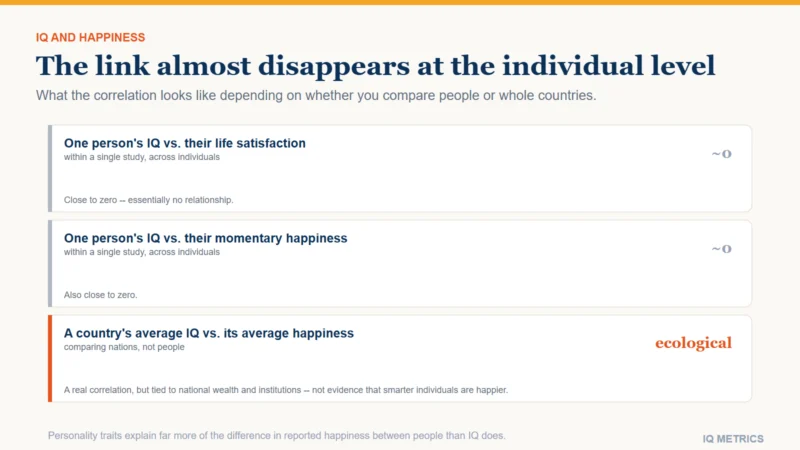 Research & Evidence
IQ and Happiness
IQ and happiness are almost unrelated at the individual level, though smarter countries do report higher average happiness. What the research actually finds, why national comparisons mislead, and what predicts happiness better than IQ.
 Understanding IQ
High IQ and Mental Health
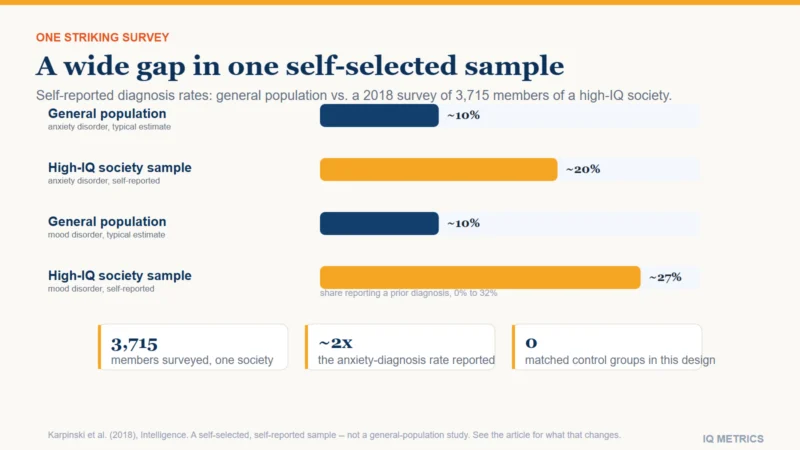
A widely cited 2018 study found sharply higher rates of anxiety and depression among members of a high-IQ society. Why that finding is far from the whole story, what a century of gifted research actually shows, and what seems to matter more than IQ itself.
 Mind & Everyday Life
Anxiety and IQ
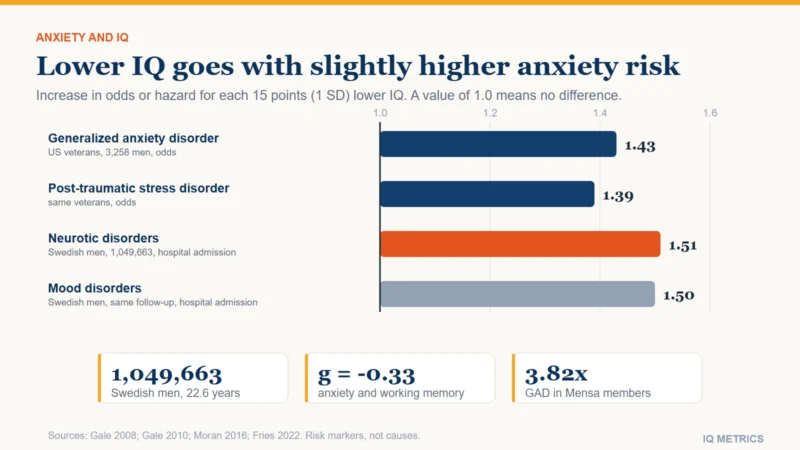
Does anxiety lower IQ, or do smart people worry more? Large cohorts link a lower IQ to more anxiety disorders, Mensa surveys report the reverse, and anxiety weakens working memory on test day. Here is what each study measured and where selection bias may explain the gap.