





Anxiety and IQ: Are Anxious People Smarter? What the Research Shows
Does anxiety lower IQ, or do smart people worry more? Large cohorts link a lower IQ to more anxiety disorders, Mensa surveys report the reverse, and anxiety weakens working memory on test day. Here is what each study measured and where selection bias may explain the gap.

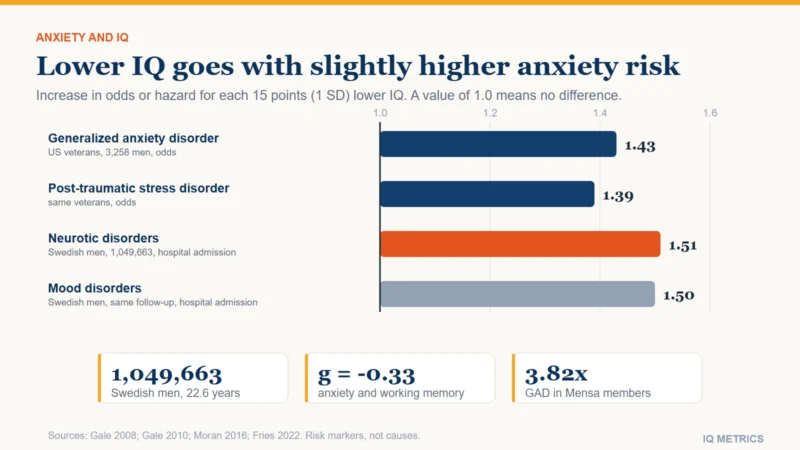
Anxiety and IQ are linked in two ways that look contradictory but are not. In studies that follow thousands of people for years, a lower IQ in youth goes with a higher risk of anxiety disorders later, roughly 1.4 to 1.5 times the risk (odds or hazard, depending on the study) for every 15 points lower. In smaller studies, people who worry and ruminate more tend to have stronger verbal skills. Neither pattern shows that anxiety makes anyone less, or more, intelligent. What is better established is a short-term effect: anxiety goes with poorer working-memory performance, which can pull down a score on the day. This guide goes through the main studies, explains why the Mensa surveys that report high anxiety among high-IQ people need careful reading, and separates anxiety disorders from test anxiety.
- Lower IQ, higher risk: among 3,258 US veterans, each 15 points lower in early adulthood went with 1.43 times the odds of generalized anxiety disorder in midlife. Among 1,049,663 Swedish men, hospital admission for a neurotic disorder rose 1.51 times per standard deviation lower.
- Not specific to anxiety: the Swedish slope was almost the same for mood disorders (1.50) and higher for schizophrenia (1.60), so it looks like a general mental-health association.
- Worry and words: in one study of 126 undergraduates, higher verbal intelligence was a unique positive predictor of worry and rumination.
- On test day: a 2016 meta-analysis of 177 samples (22,061 people) found anxiety goes with poorer working-memory performance, an effect size of -0.33.
- Mensa surveys: members of high-IQ societies report high rates of anxiety, but the authors of a European replication say who joins the society may explain it.
This is the anxiety companion to our guides to depression and IQ and bipolar disorder and IQ. Obsessive-compulsive disorder has its own page, OCD and IQ. Test nerves, the anxiety that can lower a score on the day, are covered in test anxiety and IQ scores.
What do we mean by anxiety and IQ?
Three different things get called anxiety, and they behave differently in the research. Everyday worry and nervousness is normal and passes. An anxiety disorder, such as generalized anxiety disorder (GAD), is a diagnosed condition in which fear or worry is persistent, hard to control and interferes with daily life. Test anxiety is nervousness about being evaluated. Studies of anxiety and IQ use all three, which is one reason their answers differ.
IQ is not one thing either. A full-scale score blends reasoning, vocabulary, memory and speed, and a single ability such as working memory can behave differently from the total. Where a study measured only verbal ability or only working memory, this guide says so.
Does a lower IQ raise the risk of anxiety disorders?
In prospective studies, which measure IQ first and ask about mental health years later, the answer is yes, modestly. Three studies carry most of the weight.
- Vietnam Experience Study (US): cognitive ability was measured at enlistment, at a mean age of 20.4, and psychiatric disorders by structured interview at a mean age of 38.3, in 3,258 male veterans. For a 1-SD (15-point) lower score the unadjusted odds ratio was 1.43 for generalized anxiety disorder, 1.39 for post-traumatic stress disorder, 1.32 for major depression and 1.20 for alcohol abuse or dependence. Most associations stayed significant after adjusting for confounders.
- Swedish conscripts: 1,049,663 men took intelligence tests on conscription and were followed for 22.6 years on average. For each standard deviation lower, the hazard of a hospital admission was 1.51 for neurotic disorders, 1.50 for mood disorders and 1.60 for schizophrenia.
- Dunedin birth cohort (New Zealand): in 1,037 people followed to age 32, a lower IQ at ages 7, 9 and 11 predicted more adult depression and more adult anxiety, and more comorbidity.
| Study | Who | Outcome | Increase per 1 SD lower IQ |
|---|---|---|---|
| Vietnam Experience Study | 3,258 US male veterans | Generalized anxiety disorder, midlife interview | Odds 1.43 (95% CI 1.27 to 1.64) |
| Vietnam Experience Study | Same veterans | Post-traumatic stress disorder | Odds 1.39 (1.18 to 1.67) |
| Swedish conscripts | 1,049,663 men | Hospital admission, neurotic disorders | Hazard 1.51 (1.48 to 1.54) |
| Swedish conscripts | Same men | Hospital admission, mood disorders | Hazard 1.50 (1.47 to 1.51) |
To see what 1.43 means, here is our own arithmetic: if the odds rise by that factor with each 15 points, a 30-point gap (an IQ of 70 against 100) would roughly double them (1.43 x 1.43 = 2.0), assuming each step is the same. That is an extrapolation, not a result from the paper. It is also a difference in risk, not a prediction for any one person: people with anxiety disorders are found across the whole IQ range.
The studies cannot say why the two are linked. Candidate explanations include shared early causes such as adversity in childhood (see toxic stress and IQ), fewer coping resources or more stressful life events for people with fewer cognitive resources, and differences in who gets diagnosed; the Dunedin authors framed it as lower “cognitive reserve”. The Swedish design counts hospital admissions, so it captures the more severe end of anxiety.
Are anxious people smarter? The Mensa surveys
The opposite claim, that high intelligence goes with anxiety, comes mainly from surveys of high-IQ society members. In 2018 Karpinski and colleagues surveyed 3,715 American Mensa members, people at or above the 98th percentile, and reported much higher rates of diagnosed or suspected mood and anxiety disorders than national figures. We summarize the numbers in high IQ and mental health.
A preregistered replication in 2022 asked 615 Mensa members in Austria, Germany, Hungary, Switzerland and the United Kingdom. Generalized anxiety was 3.82 times as common as in the general population (risk ratio), depression 4.38 times and autism spectrum disorders 2.25 times. Asthma, allergies and autoimmune disease, which the first survey had reported as elevated, were not. The authors add that the effect may come from sample selectiveness, meaning who joins a high-IQ society, rather than from high IQ itself.
That is the key to reconciling the two bodies of evidence. A population cohort samples everyone and shows a gentle slope across the whole IQ range: lower scores, slightly more anxiety. A society survey looks only at the top 2%, only at people who chose to take a test and join, and relies on self-reported diagnoses, including suspected ones. Neither design shows that a higher IQ causes anxiety.
Do worriers have stronger verbal skills?
One small study points that way. Penney, Miedema and Mazmanian (2015) measured generalized anxiety, depression and social anxiety, plus worry, rumination and post-event processing (replaying a social encounter afterwards), in 126 undergraduates, alongside verbal and nonverbal intelligence, and they controlled for test anxiety and momentary negative mood, which earlier work often ignored. Verbal intelligence was a unique positive predictor of how severe worry and rumination were. Nonverbal intelligence was a unique negative predictor of post-event processing. The links between verbal intelligence and generalized anxiety or depression symptoms became non-significant once the overlap between measures was removed.
The authors discuss possible explanations, such as stronger verbal skills allowing people to examine past and future situations in more depth. Treat that as a hypothesis. This is one correlational study of 126 students, it cannot show which way the link runs, and it does not mean worriers are smarter overall.
Where would your own score land?
Take the IIF-certified assessment and get your score with the scale it was measured on, the percentile it corresponds to and the confidence range around it — the three figures most online tests leave out.
Find your IQ score now! →Anxiety and working memory: the clearest effect on a test
The best-replicated finding concerns working memory, the mental workspace used to hold information while you use it. A 2016 meta-analysis by Moran pooled 177 samples and 22,061 people and found that self-reported anxiety is reliably related to poorer working-memory performance, with an effect size of g = -0.334. It held across the type of task:
- Complex span tasks (such as operation span): g = -0.342, from 30 samples and 3,196 people.
- Simple span tasks (such as digit span): g = -0.318, from 127 samples and 17,547 people.
- Dynamic span tasks (such as n-back): g = -0.437, from 20 samples and 1,318 people.
The review’s proposed mechanism is that anxiety competes with the task for working-memory resources. On an IQ-style scale of 15 points per standard deviation, -0.33 is about 5 points (our conversion; these are working-memory task scores, not full-scale IQ). Working memory feeds into many IQ subtests, which is why it matters here; see memory and IQ, the digit span test and executive function vs IQ.
These data fit the idea that anxiety can depress a score on the day without changing the ability underneath, which is why every score comes with a margin of error: see the IQ score margin of error explained.
What the studies cannot tell us
- Direction. A lower IQ might raise the risk of anxiety, anxiety might lower test scores, or something earlier might do both. The cohorts measured IQ first, which fixes the order of events but does not remove shared causes.
- Who was studied. The veterans and conscripts were men, Dunedin is one New Zealand city, and the Mensa samples chose themselves.
- How anxiety was measured. Structured interviews and hospital records in the cohorts, self-report questionnaires in most working-memory studies, and diagnosed or suspected conditions reported by members in the Mensa surveys.
- Size. The associations are modest. Nobody’s anxiety can be read from an IQ score, and an IQ score cannot be read from anxiety.
If anxiety affects how you do on an IQ test
- Treat one score as one reading. A score taken in a very anxious state may understate what you can do; our guide to test anxiety and IQ scores covers what helps.
- Know the format first. Familiarity removes one source of nerves; how to prepare for an IQ test explains what to expect.
- Check how accurate any online result is. IQ test accuracy sets out what a single sitting can and cannot show.
- Separate the score from your mental health. An IQ result is not a diagnosis in either direction. Persistent anxiety that interferes with daily life is worth raising with a doctor or mental-health professional whatever your score.
When you are ready for a baseline, you can take our IQ test at a time when you feel settled, not rushed.
Quick answers
- Does anxiety lower IQ? Not on the evidence reviewed here. Anxiety goes with poorer working-memory performance and can lower a score on the day, but no study here shows it lowering underlying intelligence.
- Do smart people have more anxiety? In surveys of high-IQ society members, yes; in population cohorts, lower IQ goes with more anxiety. The designs answer different questions.
- Is a high IQ a risk factor for anxiety? Not established. Selection into the society may explain the survey results.
- Is a low IQ a risk factor? It is a modest risk marker: about 1.4 to 1.5 times per 15 points in the large cohorts above.
- Does worrying mean you are intelligent? Worry tracked verbal ability in one small student sample. That is not evidence that worriers are smarter.
- Can an IQ test detect anxiety? No. It measures cognitive performance, not mood or diagnosis.
Sources
- Gale, C.R. et al. (2008): Cognitive ability in early adulthood and risk of 5 specific psychiatric disorders in middle age: the Vietnam Experience Study, Archives of General Psychiatry, 65(12), 1410-1418.
- Gale, C.R. et al. (2010): Intelligence in early adulthood and subsequent hospitalization for mental disorders, Epidemiology, 21(1), 70-77.
- Koenen, K.C. et al. (2009): Childhood IQ and adult mental disorders: a test of the cognitive reserve hypothesis, American Journal of Psychiatry, 166(1), 50-57.
- Moran, T.P. (2016): Anxiety and working memory capacity: a meta-analysis and narrative review, Psychological Bulletin, 142(8), 831-864.
- Karpinski, R.I. et al. (2018): High intelligence: a risk factor for psychological and physiological overexcitabilities, Intelligence, 66, 8-23.
- Fries, J., Baudson, T.G., Kovacs, K. and Pietschnig, J. (2022): Bright, but allergic and neurotic? A critical investigation of the “overexcitable genius” hypothesis, Frontiers in Psychology, 13, 1051910.
- Penney, A.M., Miedema, V.C. and Mazmanian, D. (2015): Intelligence and emotional disorders: is the worrying and ruminating mind a more intelligent mind?, Personality and Individual Differences, 74, 90-93.
Keep reading
All articles →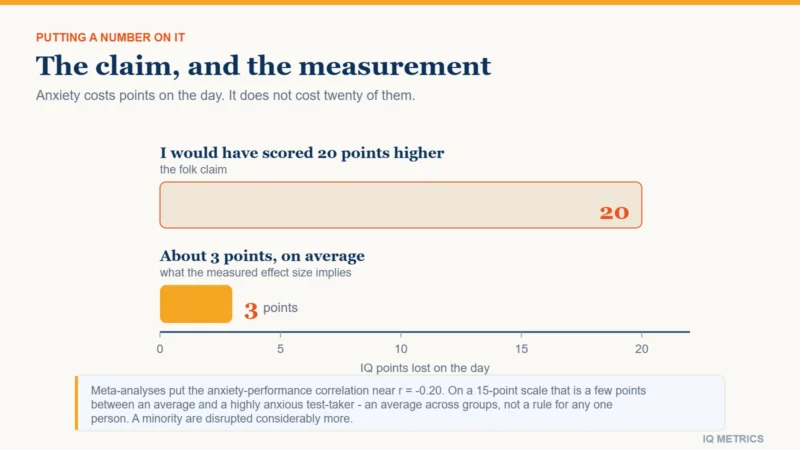 Mind & Everyday Life
Test Anxiety and IQ Scores
Almost everyone who has had a disappointing result has wondered whether nerves cost them fifteen or twenty points. The evidence says no. Test anxiety and cognitive performance correlate at roughly r = -0.20, which works out to a few points on a 15-point scale. Here is the number, and what it changes.
 Mind & Everyday Life
Depression and IQ
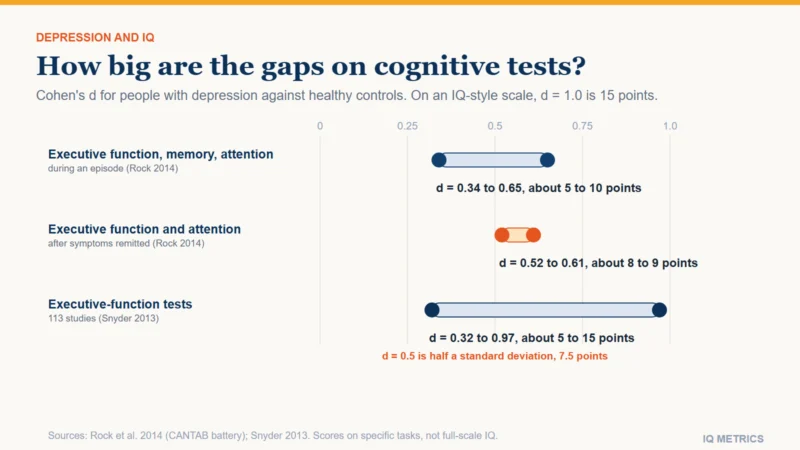
Does depression lower IQ? It lowers performance on attention, memory, speed and planning tasks while an episode lasts, and some executive and attention differences remain after recovery. A permanent loss of intelligence is not shown, and two large cohorts suggest the arrow also runs the other way.
 Mind & Everyday Life
OCD and IQ
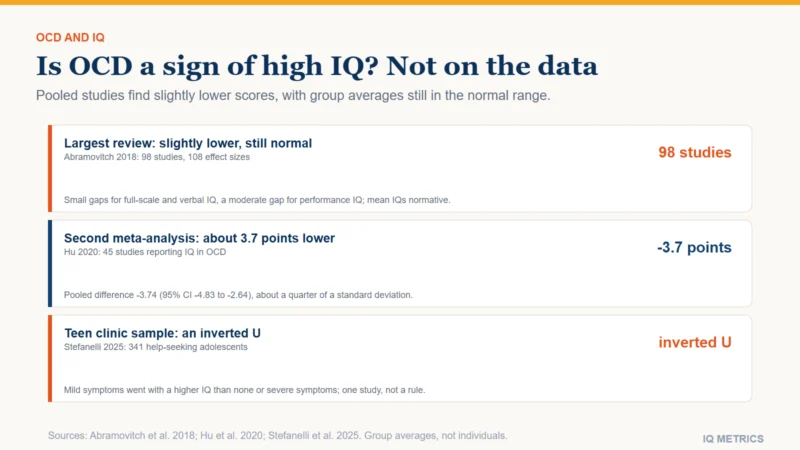
Is OCD a sign of high intelligence? A 2018 meta-analysis of 98 studies found people with obsessive-compulsive disorder score slightly lower than comparison groups, though still in the normal range. Here is what slows the scores, and where the high-IQ idea may come from.