





The Marshmallow Test: What It Predicted, What Replications Found and the IQ Link
What does the marshmallow test really predict? The original studies linked waiting to teenage success, but a larger replication found the link half as strong and two thirds smaller after controls, and a 2024 follow-up found no reliable adult prediction. Here is the evidence, the IQ link and the trust factor.

The marshmallow test measures how long a young child will wait for a bigger treat. In the original Stanford studies, children who waited longer did better as teenagers, which made the test famous as a predictor of success. A larger replication found the link was about half as strong, and two thirds of that disappeared once family background and early cognitive ability were counted; a 2024 follow-up to age 26 found that the test did not reliably predict adult outcomes. Waiting also depends on trust, culture and strategy, not only willpower, and the marshmallow test is not an IQ test. This guide explains how the test works, what each study found, what it says about IQ and about delay discounting, and what the evidence supports for parents.
- The original claim: 4-year-olds who delayed gratification longer in certain laboratory situations became more cognitively and socially competent adolescents (Mischel, Shoda and Rodriguez, 1989).
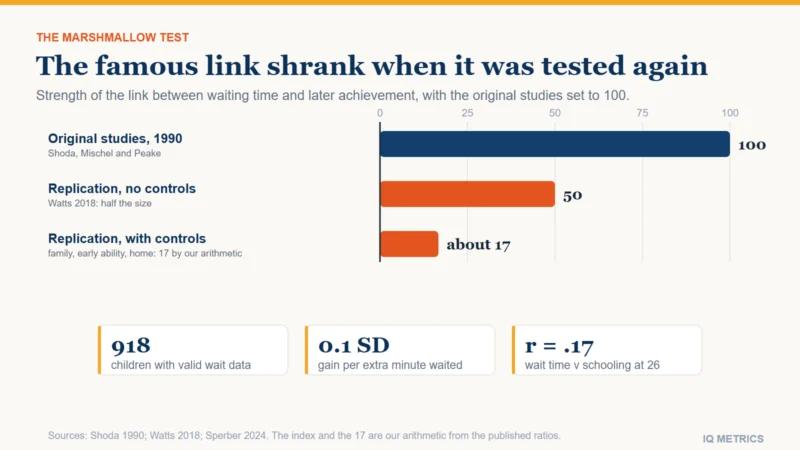
- The replication: among 918 US children with valid wait data, an extra minute waited at age 4 predicted about one tenth of a standard deviation more achievement at 15, half the size of the original link, and one third of that after controls (Watts, Duncan and Quan, 2018).
- Adult outcomes: in 702 people tested at 54 months and surveyed at 26, wait time correlated .17 with educational attainment, but almost all adjusted associations were nonsignificant (Sperber and colleagues, 2024).
- Trust: 28 four-year-olds waited significantly longer after seeing a reliable environment than an unreliable one (Kidd, Palmeri and Aslin, 2013).
- Culture: rural Cameroonian Nso children (76) waited better than German middle-class children (125) (Lamm and colleagues, 2018).
- IQ: across 24 studies, higher intelligence went with less steep delay discounting, with a correlation of about -0.23 (Shamosh and Gray, 2008).
Self-control and its link with ability are also covered in grit vs IQ, which summarizes the replication in one paragraph, and in executive function vs IQ. This page goes deeper into the test itself.
What is the marshmallow test?
A child sits in a room with one treat, often a marshmallow, and is told that if they wait until the adult comes back they will get a second one; if they would rather not wait, they can eat the first. The adult leaves, and researchers record how many seconds the child holds out. The measure is called delay of gratification.
The first studies were run around 1970, four decades before Casey and colleagues re-tested participants, with preschool children from a university community at Stanford. They were designed to find out what children do with their attention while they wait; Mischel and Ebbesen’s 1970 paper is titled “Attention in delay of gratification”. Mischel, Shoda and Rodriguez’s 1989 review in Science concluded that specific cognitive and attentional processes allow effective self-regulation early in development, meaning that how long a child waits depends on what the child does while waiting as well as on willpower.
What did the original studies find?
The headline came from follow-ups. The 1989 review reported that 4-year-old children who delayed gratification longer in certain laboratory situations developed into more cognitively and socially competent adolescents, achieving higher scholastic performance and coping better with frustration and stress. Shoda, Mischel and Peake (1990) compared versions of the task to find when waiting would predict later outcomes, and reported coherent patterns of statistically significant correlations, in the versions they judged diagnostic, between seconds of delay in preschool and cognitive and academic competence in adolescence. The samples were small, with tens of children per analysis, and all came from a university community.
In 2011, Casey and colleagues re-tested nearly 60 of those preschoolers in their mid-forties. Those who had been less able to wait, and who consistently showed low self-control in their twenties and thirties, did worse at holding back a response to happy faces, an “alluring” cue, and imaging in 26 participants showed different recruitment of frontostriatal circuits. The authors concluded that resistance to temptation, as the delay task measures it, is a relatively stable individual difference.
What the 2018 replication found
Watts, Duncan and Quan replicated and extended the 1990 study on a larger and more varied sample, concentrating on children whose mothers had not completed college. The table sets out what they found.
| Measure | Finding |
|---|---|
| Sample | 918 US children with valid delay data; main analyses on 552 whose mothers had not completed college |
| Raw link to achievement at 15 | An extra minute waited at age 4 predicted about 0.1 standard deviations more achievement, half the size reported in the original studies |
| With controls | Reduced by two thirds after controls for family background, early cognitive ability and the home environment |
| What mattered most | Being able to wait at least 20 seconds |
| Behavior at 15 | Associations much smaller and rarely statistically significant |
Notice that the control list includes early cognitive ability. A child who can wait longer may also have stronger early reasoning, language and attention, and a home that supports achievement in other ways. Once those are counted, little of the link remains. In index terms, shown in the chart above and based on our arithmetic from the published ratios, if the original link is 100 the replication’s raw link is 50 and its controlled link is about 17.
Does the marshmallow test predict adult life?
Sperber, Vandell, Duncan and Watts (2024) followed a sample forward to adulthood. In 702 participants who completed the marshmallow test at 54 months and survey measures at age 26, a preregistered analysis found that performance was not strongly predictive of adult achievement, health or behavior. There were modest bivariate associations with educational attainment (r = .17) and body mass index (r = -.17), but almost all of the regression-adjusted coefficients were nonsignificant, and no clear pattern of moderation by socioeconomic status or sex appeared. The authors concluded that the test does not reliably predict adult outcomes.
For scale, a correlation of .17 means wait time accounts for under 3% of the variation in schooling (.17 squared is .029, our arithmetic). That is a real association, but nowhere near the fate-in-a-treat story the test acquired in popular retellings.
Is waiting self-control, or trust? What changes how long children wait
Kidd, Palmeri and Aslin (2013) tested 28 children, mean age 4 years 6 months, on the marshmallow task after placing them in an environment shown to be either unreliable or reliable. Children in the reliable condition waited significantly longer. The authors read the result as showing that wait times reflect a reasoned belief about whether waiting will pay off, not only self-control. A child who has learned that promises are broken is behaving sensibly by eating the first treat. The sample was small, so treat it as a strong hint rather than a settled rule.
Culture matters too. Lamm and colleagues (2018) compared 125 German middle-class preschoolers with 76 rural Cameroonian Nso preschoolers on the marshmallow test. The 4-year-old Nso children waited better, and wait performance was related to culture-specific maternal socialization goals and interaction behavior. In a later study of 207 children from Germany and Kenya, Koomen, Grueneisen and Herrmann (2020) found that children delayed gratification substantially better when their reward depended on both members of a pair waiting.
The common thread is that wait time is a behavior in a context. It carries information about the child, the setting and what the child expects from adults.
Where would your own score land?
Take the IIF-certified assessment and get your score with the scale it was measured on, the percentile it corresponds to and the confidence range around it — the three figures most online tests leave out.
Find your IQ score now! →The marshmallow test and IQ
The marshmallow test is not an IQ test, but the two overlap. Three findings bear on how much:
- In the original follow-ups, longer delay went with higher academic and cognitive competence in adolescence. In the 2018 replication, much of that association disappeared once early cognitive ability was among the controls.
- A 2008 meta-analysis by Shamosh and Gray pooled 24 studies of intelligence and delay discounting, the choice between a smaller reward now and a larger one later. Higher intelligence went with less steep discounting, a weighted mean correlation of about -0.23, a small-to-moderate effect.
- In the Dunedin cohort, childhood self-control and IQ correlated .44, as we describe in grit vs IQ.
Taken together, more patient children tend to score somewhat higher on IQ-type tests and more intelligent children tend to be somewhat more patient, but the overlap is partial and the causal order is unknown. A high IQ does not guarantee waiting well, and waiting well does not guarantee a high IQ. For how well ability predicts later outcomes in general, see does IQ predict school success, and for the wider contrast between talent and effort see talent vs practice and growth mindset and intelligence.
Delay discounting in mental health research
The adult version of the same idea, delay discounting, has been studied across psychiatric conditions. A 2019 meta-analysis by Amlung and colleagues of 43 studies found steeper discounting, a stronger pull toward smaller, sooner rewards, in schizophrenia (Hedges g = 0.46, 12 studies), bipolar disorder (0.68, 4 studies), borderline personality disorder (0.60), major depression (0.37), bulimia nervosa (0.41) and binge-eating disorder (0.34), and shallower discounting in anorexia nervosa (-0.30). The authors found modest evidence of publication bias. See schizophrenia and IQ and bipolar disorder and IQ for how those conditions relate to IQ. A money-choice task for adults is a different measure from a child waiting for a marshmallow, and the figures should not be carried across.
What should parents take from it?
- Do not use a marshmallow test at home to predict a child’s future. The best evidence says one wait time carries little long-term information once family circumstances are counted.
- Trust and context shape waiting. Children waited longer where the setting had proved reliable (Kidd 2013, a small study), which is one reason to keep promises about small things.
- Strategies, not just willpower. The 1989 review points to attention and thinking processes children can use while they wait.
- A wait time is not a score. IQ-type tests sample reasoning, memory and speed; see IQ testing for children for what a child’s result does and does not show.
Quick answers
- Was the marshmallow test debunked? Not exactly. A larger replication found a weaker link than the original, and a 2024 follow-up found no reliable prediction of adult outcomes, so it is weaker than its reputation.
- What age is the marshmallow test for? The studies here used children about 4 years old; the US follow-up tested them at 54 months.
- What does the marshmallow test predict? A modest association with later achievement that shrinks sharply after controlling for family background and early cognitive ability.
- Does it measure IQ? No, though patience and intelligence overlap partly: about -0.23 across 24 studies of delay discounting.
- Who created it? Walter Mischel and colleagues at Stanford, in studies from around 1970 onward.
Sources
- Mischel, W. and Ebbesen, E.B. (1970): Attention in delay of gratification, Journal of Personality and Social Psychology, 16(2), 329-337.
- Mischel, W., Shoda, Y. and Rodriguez, M.I. (1989): Delay of gratification in children, Science, 244(4907), 933-938.
- Shoda, Y., Mischel, W. and Peake, P.K. (1990): Predicting adolescent cognitive and self-regulatory competencies from preschool delay of gratification: identifying diagnostic conditions, Developmental Psychology, 26(6), 978-986.
- Casey, B.J. et al. (2011): Behavioral and neural correlates of delay of gratification 40 years later, PNAS, 108(36), 14998-15003.
- Watts, T.W., Duncan, G.J. and Quan, H. (2018): Revisiting the marshmallow test: a conceptual replication investigating links between early delay of gratification and later outcomes, Psychological Science, 29(7), 1159-1177.
- Sperber, J.F., Vandell, D.L., Duncan, G.J. and Watts, T.W. (2024): Delay of gratification and adult outcomes: the marshmallow test does not reliably predict adult functioning, Child Development, 95(6), 2015-2029.
- Kidd, C., Palmeri, H. and Aslin, R.N. (2013): Rational snacking: young children’s decision-making on the marshmallow task is moderated by beliefs about environmental reliability, Cognition, 126(1), 109-114.
- Lamm, B. et al. (2018): Waiting for the second treat: developing culture-specific modes of self-regulation, Child Development, 89(3), e261-e277.
- Koomen, R., Grueneisen, S. and Herrmann, E. (2020): Children delay gratification for cooperative ends, Psychological Science, 31(2), 139-148.
- Shamosh, N.A. and Gray, J.R. (2008): Delay discounting and intelligence: a meta-analysis, Intelligence, 36(4), 289-305.
- Amlung, M. et al. (2019): Delay discounting as a transdiagnostic process in psychiatric disorders: a meta-analysis, JAMA Psychiatry, 76(11), 1176-1186.
Keep reading
All articles →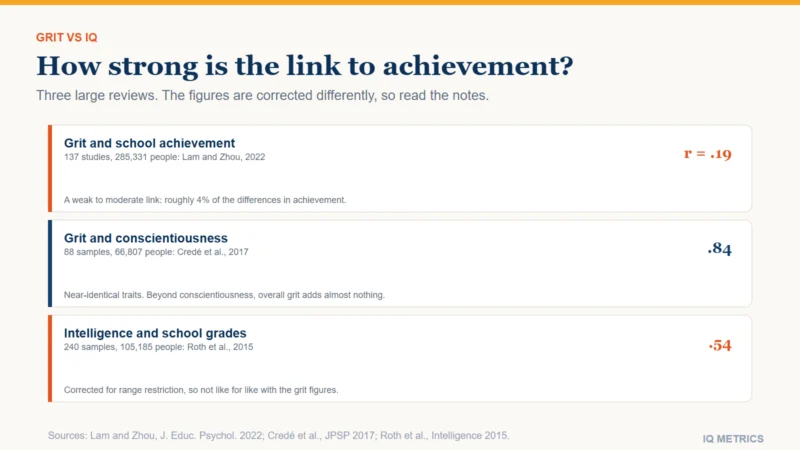 Understanding IQ
Grit vs IQ
Grit is weakly to moderately linked to school achievement and overlaps almost completely with conscientiousness. See what the original grit studies, two large meta-analyses, the marshmallow test and a retracted test-motivation paper really show about grit vs IQ.
 Understanding IQ
Executive Function vs IQ
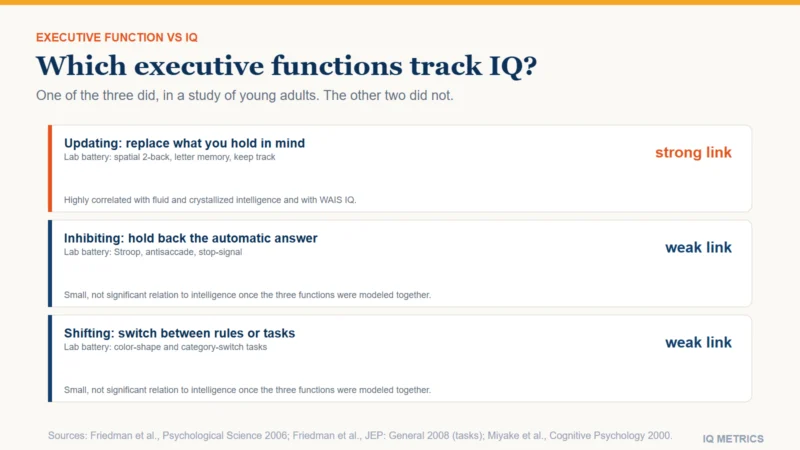
Executive function and IQ overlap but are not the same thing. Of the three executive functions, only updating working memory was highly correlated with intelligence in one study of young adults. See the three functions, a twin study, how reliable the tasks are and why training claims fall short.
 Research & Evidence
Does IQ Predict School Success?
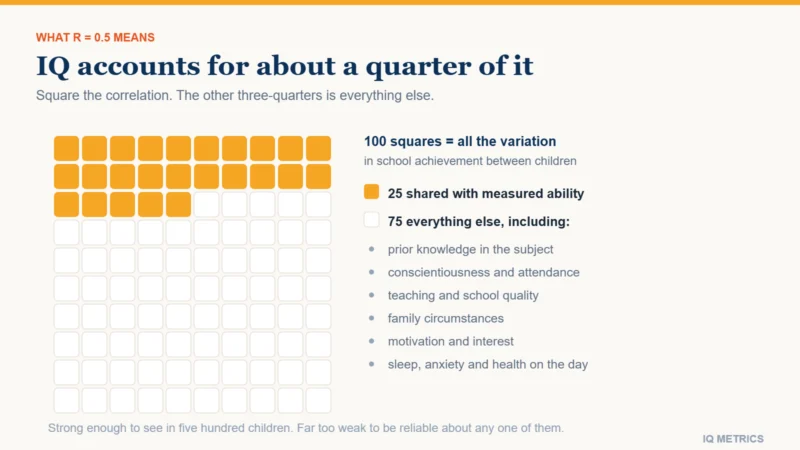
IQ predicts school achievement better than any other single measure psychologists have found, and still leaves roughly three-quarters of the variation unexplained. Both halves of that sentence get ignored by somebody. Here are the actual correlations, what they mean for one child, and what accounts for the rest.