





Introverts and IQ: Do Introverts Have a Higher IQ?
Do introverts have a higher IQ? Not in the data. Two large meta-analyses find openness is the Big Five trait most tied to IQ (rho = .20), while overall extraversion is negligible. Here are the numbers, what they mean in IQ points, and where the introvert charts come from.

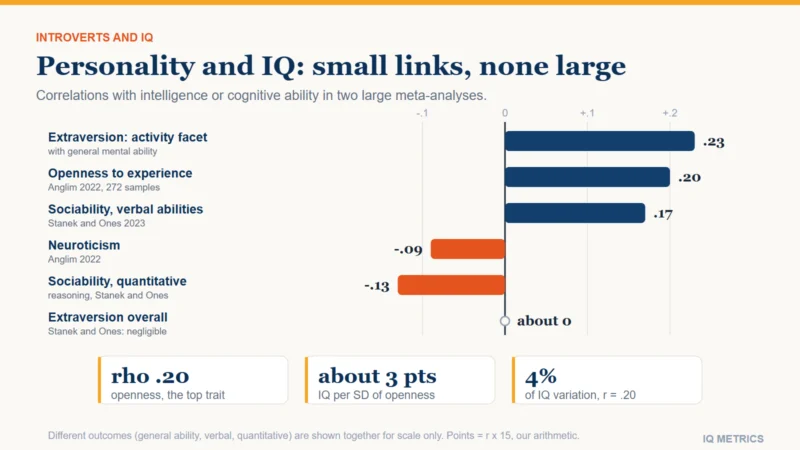
Introverts and IQ are barely linked. In the two largest meta-analyses of personality and cognitive ability, the Big Five trait most tied to intelligence is openness to experience (rho = .20 across 272 samples), not introversion. Overall extraversion is negligibly related to cognitive ability, and only narrow facets show small links, some positive and some negative. So “do introverts have a higher IQ?” has a short answer: no, not in any way that would let you guess a person's score from how sociable they are. This guide walks through the numbers, shows why the two meta-analyses differ on some of them, translates the correlations into IQ points and explains where the “introverts are smarter” charts come from.
- Openness is the main personality correlate of IQ: rho = .20; neuroticism is weaker and negative (rho = −.09) (Anglim and colleagues, 2022; N = 162,636).
- Extraversion overall: negligibly related to cognitive abilities (Stanek and Ones, 2023).
- Facets differ: activity correlated .23 with general mental ability, while sociability correlated −.13 with quantitative reasoning and +.17 with verbal abilities.
- In IQ points: a correlation of .20 means about 3 points per standard deviation of the trait (our arithmetic).
- Internet type charts: the INTJ and INTP rankings we checked cite no sample or test.
For the trait model behind these terms, start with our guide to the Big Five personality traits and the page on IQ versus personality. Handwriting analysis, which also claims to read personality, is tested in handwriting and IQ.
What does introversion mean in personality research?
In the Big Five model, introversion is the low end of extraversion, a trait that is a spectrum, not a type. Extraversion has two aspects, assertiveness and enthusiasm, and five commonly studied facets: activity, dominance, positive emotionality, sensation seeking and sociability. Most people score somewhere in the middle, and the word “introvert” is a convenient label for the lower part of that range. It is also different from shyness or social anxiety, which involve fear of judgement; our guide to anxiety and IQ covers that side.
This matters because a claim about introverts and IQ is really a claim about several facets that can point in different directions. A person can be low on sociability and high on activity, or high on assertiveness and low on sensation seeking. A single “introvert” bucket averages those differences away.
What do the big meta-analyses find about personality and IQ?
Anglim, Dunlop, Wee, Horwood, Wood and Marty (2022, Psychological Bulletin) pooled 272 samples with 162,636 people and examined the Big Five and the HEXACO model at the domain, facet and item level. Openness had the strongest link with intelligence (rho = .20), followed by neuroticism in the opposite direction (rho = −.09). At the facet level, traits related to intellectual engagement and unconventionality correlated more strongly with intelligence than other openness facets, and sociability and orderliness were negatively correlated with intelligence. Gregariousness and excitement seeking had stronger negative correlations with crystallized than fluid intelligence.
Stanek and Ones (2023, PNAS) went further. They combined 60,690 relations between 79 personality and 97 cognitive-ability constructs, drawn from 3,543 meta-analyses with data from millions of people. Their conclusion on extraversion is blunt: global extraversion is negligibly related to cognitive abilities. Beneath it, the activity facet correlated .23 with general mental ability (95% interval .22 to .24); sociability correlated −.13 with quantitative reasoning (interval −.15 to −.11) and, on average, .17 with verbal abilities; and sensation seeking was a small positive correlate of comprehension knowledge (.12). They note that earlier meta-analyses had reported mostly null effects for extraversion and abilities, and that their larger dataset revealed relations that were previously unacknowledged.
| Trait or facet | Correlation | With what | Source |
|---|---|---|---|
| Openness to experience | .20 | Intelligence | Anglim et al., 2022 |
| Extraversion: activity | .23 | General mental ability | Stanek and Ones, 2023 |
| Extraversion: sociability | .17 | Verbal abilities (mean) | Stanek and Ones, 2023 |
| Neuroticism | −.09 | Intelligence | Anglim et al., 2022 |
| Extraversion: sociability | −.13 | Quantitative reasoning | Stanek and Ones, 2023 |
| Extraversion overall | negligible | Cognitive abilities | Stanek and Ones, 2023 |
Why do the two meta-analyses not agree on every number?
They do not, and the reason is technical but worth knowing. A 2026 review in Current Opinion in Psychology (Anglim) compared the two. It states that Stanek and Ones used a sample-size-weighted estimator, which gave excessive weight to a few large-sample studies and produced estimates that do not generalize. Reanalysing their dataset with an estimator that accounts for variation between studies (REML) gave results more consistent with the 2022 meta-analysis. In plain terms: when a handful of very large studies dominate, a pooled figure can reflect those studies more than the field. That is a dispute about method, and the safe reading is that facet-level correlations are small and uncertain, while the headline, openness first and extraversion weak, is common to both.
What do these correlations mean in IQ points?
A correlation is hard to picture, so here is a translation, and it is our arithmetic, not the authors'. IQ has a standard deviation of 15 points. A correlation of r means that a person who is one standard deviation higher on a trait is, on average, r times 15 points higher on IQ. For openness at .20 that is about 3 points. For the activity facet at .23 it is about 3.5 points. For a correlation of .10 it is 1.5 points. A correlation of .20 explains about 4% of the variation in IQ (.20 squared), which leaves the other 96% to everything else.
Three points is smaller than the margin of error on a single test, which is commonly 2 to 3 points of standard error and a 95% band of around 5 points either side (see our note on an IQ score as a range, or what a score such as an IQ of 115 can and cannot tell you). So even where a personality trait carries a real signal, it cannot tell you whether a particular quiet or talkative person scored 105 or 120.
Where would your own score land?
Take the IIF-certified assessment and get your score with the scale it was measured on, the percentile it corresponds to and the confidence range around it — the three figures most online tests leave out.
Find your IQ score now! →Where does the introverts-are-smarter idea come from?
Searches for the highest-IQ personality type lead to charts that rank INTJ and INTP near the top at 125 to 130 or more. Our news desk looked for the data behind them and found sources that disagree with each other and that name no sample, test or date; it also notes that the publisher of the Myers-Briggs instrument says it does not measure ability. Peer-reviewed work points to a small link between IQ and the Intuition letter, which tracks openness, not the Introversion letter. The full write-up is which MBTI type has the highest IQ.
The same piece cites a 2012 meta-analysis of 41 studies (Freund and Kasten) in which people's estimates of their own intelligence tracked tested IQ at only about r = .33, so self-reported IQ is a weak foundation for any ranking. Our reading is that three things feed the belief: the stereotype that quiet people are thinking deeply, the fact that people who post about being introverted or gifted online are not a random sample, and the real but modest openness link. None of them shows that introversion itself raises IQ.
Are smart people more likely to be alone?
The reverse question is different: does high intelligence push people toward solitude? The evidence we reviewed in are smart people lonely found no study showing that a high IQ makes people lonely, and the best-known findings point in different directions. Related reading: IQ and happiness and high IQ and mental health. The broader point is the same as above: personality and ability overlap a little, and neither predicts the other well for one person.
Intelligence as maximal and typical performance
An older, influential review by Ackerman and Heggestad (1997, Psychological Bulletin) helps explain why the two fields overlap only partly. They distinguished intelligence as maximal performance, what a person can do at their best on a test, from intelligence as typical performance, what a person habitually does, and argued that the second gives a basis for relating intelligence to personality. Reviewing intelligence, personality and interests together, they identified four trait complexes: social, clerical or conventional, science or math, and intellectual or cultural. Traits cluster across the two domains, which is why correlations are real, and modest. For the practical differences between kinds of measurement, see our guide on IQ versus EQ.
Personality can also steer who gets which experiences, and that matters for how associations are read. Our post on music lessons and IQ shows a clear case: personality in children, and openness in their parents, predicted who took lessons for longer. And grit versus IQ shows a popular trait that overlaps almost completely with conscientiousness and is nearly unrelated to cognitive ability.
Quick answers about introverts and IQ
- Do introverts have a higher IQ? No. Overall extraversion is negligibly related to cognitive ability.
- Which personality trait is most related to IQ? Openness to experience, at about rho = .20.
- Is INTJ the smartest type? No dataset we found supports that; the charts cite no sample.
- Are any extraversion traits linked to IQ? Narrow facets are: activity positively (.23) and sociability both positively (verbal) and negatively (quantitative), all small.
- Does your personality change your IQ test result? Not by much; the associations are worth a few points at most.
Sources
- Anglim, J., Dunlop, P.D., Wee, S., Horwood, S., Wood, J.K. and Marty, A. (2022): Personality and intelligence: a meta-analysis, Psychological Bulletin, 148(5-6), 301-336.
- Stanek, K.C. and Ones, D.S. (2023): Meta-analytic relations between personality and cognitive ability, Proceedings of the National Academy of Sciences, 120(23).
- Anglim, J. (2026): Personality and cognitive ability: a critical review and meta-analytic synthesis, Current Opinion in Psychology, 67, 102171.
- Ackerman, P.L. and Heggestad, E.D. (1997): Intelligence, personality, and interests: evidence for overlapping traits, Psychological Bulletin, 121(2), 219-245.
Keep reading
All articles →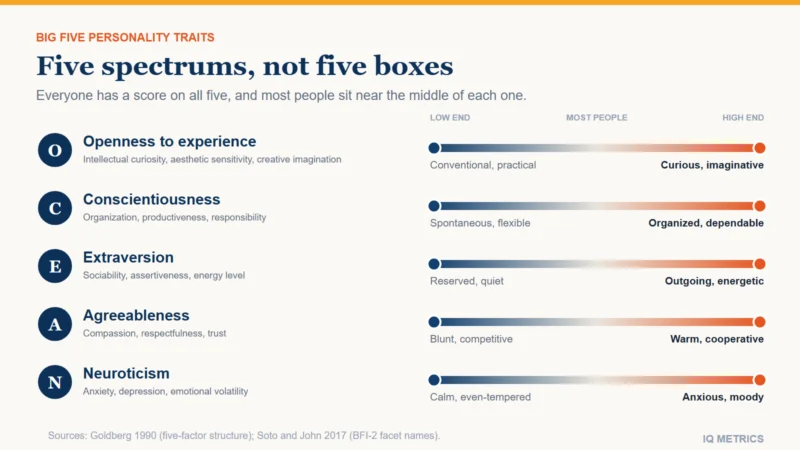 Mind & Everyday Life
Big Five Personality Traits
The Big Five personality traits are openness, conscientiousness, extraversion, agreeableness and neuroticism: five spectrums that came out of decades of research on the words people use to describe each other. Here is what each trait means, how it is measured, what it predicts and how it changes.
 Mind & Everyday Life
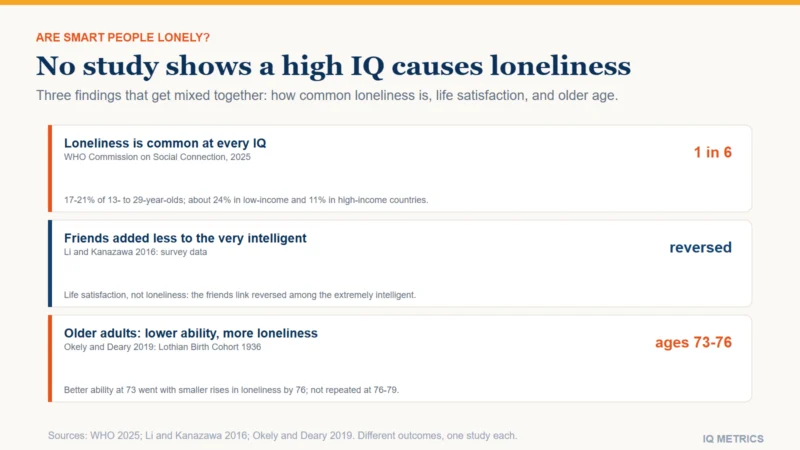
Are Smart People Lonely?
Are smart people lonely? No study shows a high IQ causes loneliness. One survey found friends added less to life satisfaction for the extremely intelligent, while older adults with lower ability became slightly lonelier. Here is the evidence on loneliness, gifted children and why the idea feels true.
 Research & Evidence
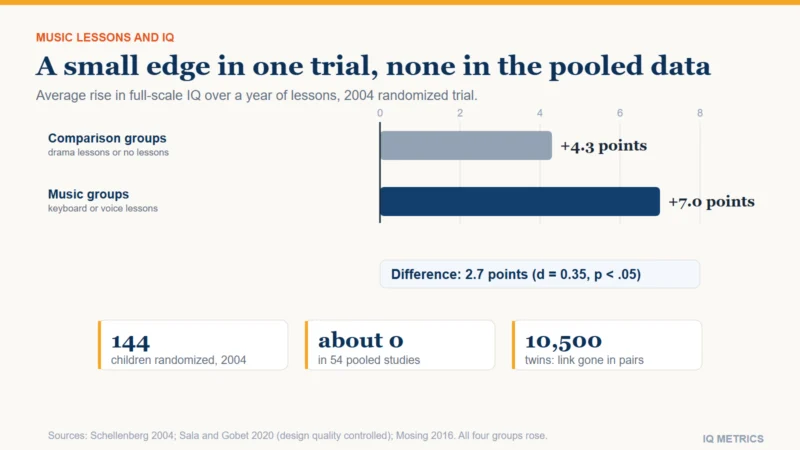
Music Lessons and IQ
Do music lessons raise IQ? One 2004 trial of 144 children found a 2.7-point edge, but a meta-analysis of 54 studies finds no overall effect once study quality is controlled, and a study of more than 10,500 twins finds the link vanishes within pairs. Here is the evidence.