





What Does an IQ of 65 Mean? Percentile, Category and Mental Age
An IQ of 65 is the 1st percentile: about 1 person in 102 scores it or lower. It sits inside the ICD-10 mild range, is labelled Extremely Low on Wechsler tests and has a likely true score of about 60 to 73. See its mental age, what it means for daily life and how courts treat it.

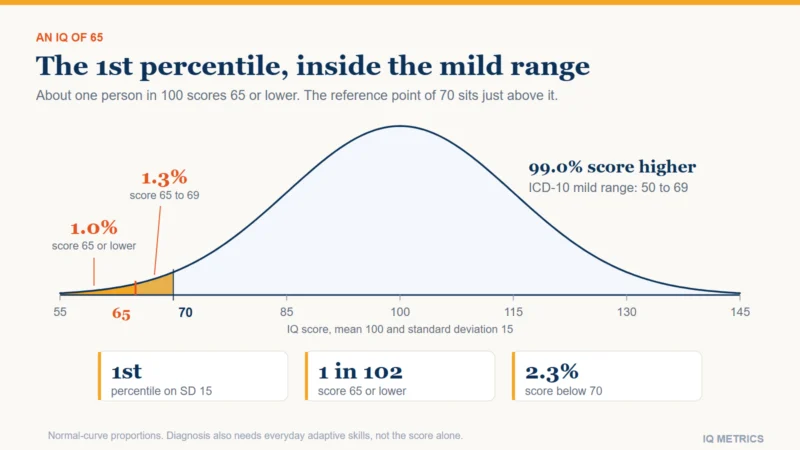
An IQ of 65 is the 1st percentile: about 1 person in 102 scores 65 or lower. It sits inside the mild range of intellectual disability in the WHO’s ICD-10 (IQ 50 to 69), and under the DSM-5-TR it points to a diagnosis only when everyday skills are affected too. Test charts label a 65 Extremely Low (Wechsler) or Mildly impaired or delayed (Stanford-Binet 5), and what it means for a person depends far more on adaptive skills and support than on the number. This guide covers where 65 falls on the bell curve, what each test and classification calls it, the mental age it implies for a child and for an adult, how accurate one 65 is, what the older diagnostic manuals said about daily life at this level, and what courts and benefit rules do with it.
- Percentile: the 1st on a standard deviation (SD) 15 scale, 1 in 102. On SD 16 it is the 1.4th and on Cattell’s SD 24 the 7.2nd.
- Label: Extremely Low on the Wechsler tests, Mildly impaired or delayed on the Stanford-Binet 5, F70 mild in ICD-10.
- Disability: a 65 usually meets the score criterion, because it is more than two standard deviations below the mean. The diagnosis still needs deficits in adaptive functioning that began in the developmental period.
- Accuracy: an observed 65 is best read as a true score of roughly 60 to 73, so it can sit on either side of the reference point of 70.
Where does an IQ of 65 sit on the bell curve?
On a scale with a mean of 100 and a standard deviation of 15, a score of 65 is 35 points, or 2.33 standard deviations, below the mean. About 1.0% of people score 65 or lower and 99.0% score higher: roughly one person in every 100. The curve is symmetric, so 65 is exactly as far below 100 as 135 is above it and exactly as common (see what an IQ of 135 means). The IQ percentile calculator places any score on the same curve, and the IQ bell curve explains the shape.
| Score band | Share of people | WISC-V label |
|---|---|---|
| Below 55 | 0.13% | Extremely Low |
| 55 to 64 | 0.8% | Extremely Low |
| 65 to 69 | 1.3% | Extremely Low |
| 70 to 79 | 6.8% | Very Low |
| 80 to 89 | 16.1% | Low Average |
| 90 to 109 | 49.5% | Average |
Together the scores below 70 hold 2.3% of people, about 1 in 44, and our guides to an IQ of 70 and an IQ of 75 cover the scores just above. The scale matters: the same printed 65 is rarer or commoner depending on the test, as the table shows.
| Scale | Standard deviation | z score for 65 | Share scoring 65 or lower | Wechsler score with the same rarity |
|---|---|---|---|---|
| Wechsler tests, Stanford-Binet 5 | 15 | -2.33 | 1.0% | 65 |
| Stanford-Binet Form L-M (older edition) | 16 | -2.19 | 1.4% | 67 |
| Cattell scales | 24 | -1.46 | 7.2% | 78 |
So a Cattell 65 is roughly a 78 on the Wechsler scale and an L-M 65 roughly a 67. Quote the scale before comparing; the IQ score converter moves a score between scales, and standard deviation 15 versus 16 explains why they differ.
What category is an IQ of 65?
Every test and classification draws the band differently, so “what category is an IQ of 65?” has several answers. On the Wechsler adult and children’s tests the band below 70 is Extremely Low. The Stanford-Binet 5 splits it further, calling 55 to 69 mildly impaired or delayed. The World Health Organization’s ICD-10 puts 50 to 69 in the mild class of mental retardation (the term ICD-10 uses), and, unusually, adds a mental-age equivalent for adults of 9 to under 12 years.
| Test or system | Band that contains 65 |
|---|---|
| WAIS-IV (Wechsler, adults) | 69 and below: Extremely Low |
| WISC-V (Wechsler, children) | 69 and below: Extremely Low |
| Stanford-Binet 5 | 55 to 69: Mildly impaired or delayed |
| Woodcock-Johnson (WJ IV chart) | 69 and below: Very Low |
| ICD-10 (WHO) | F70 mild: IQ 50 to 69, adult mental age 9 to under 12 years |
| DSM-5-TR | No IQ bands: severity is graded by adaptive functioning |
The DSM-5-TR, the American diagnostic manual, dropped IQ bands entirely: it grades severity as mild, moderate, severe or profound by how well a person manages everyday conceptual, social and practical demands. ICD-11 keeps the score logic but sets it as about two to three standard deviations below the mean, which on SD 15 is roughly 55 to 70, so a 65 sits in the middle of that stretch.
Is an IQ of 65 an intellectual disability?
Usually it meets one of three requirements, not all. A diagnosis of intellectual developmental disorder under the DSM-5-TR needs deficits in intellectual functions confirmed by clinical assessment and an individually administered, standardised test, deficits in adaptive functioning, and onset during the developmental period. The manual puts the intellectual criterion at about two standard deviations below the mean, roughly 65 to 75 once error is counted, so a 65 sits at the low end of that window, beyond the two-standard-deviation line. The American Association on Intellectual and Developmental Disabilities uses the same logic and requires onset before age 22.
What the score cannot decide is the rest. On the normal curve about 2.3% of people score 70 or lower, yet the American Psychiatric Association puts the prevalence of intellectual disability at about 1%, and about 85% of those people are in the mild range. The gap is the adaptive-functioning requirement: two people with a 65 can reach different conclusions if one manages money, travel and work with little help and the other does not. What an IQ of 70 means sets out the three-part test in full, and low IQ versus learning disability explains why a low score and a specific learning disability are different things.
What is the mental age of someone with an IQ of 65?
The question comes from the original IQ formula: mental age divided by chronological age, multiplied by 100. On that ratio scale a 10-year-old who performed like an average child of 6 years 6 months scored 65, and for children it still gives a rough picture of where test performance sits (see IQ and mental age for the chart from IQ 30 to 100).
| Child's age | Mental age |
|---|---|
| 6 years | 3 years 11 months |
| 8 years | 5 years 2 months |
| 10 years | 6 years 6 months |
| 12 years | 7 years 10 months |
| 14 years | 9 years 1 months |
For adults the idea breaks down, because raw test performance stops climbing in the late teens. The figure that circulates online, a mental age of 10 years 5 months, comes from multiplying 0.65 by an assumed adult ceiling of 16, and ICD-10’s own “9 to under 12 years” for the whole mild class is the same kind of convention. Both describe test items, not a person: an adult who scores 65 has adult experience, adult relationships and often practical skills that no test item measures. Deviation IQ versus ratio IQ explains why modern tests stopped using mental age.
How accurate is a single score of 65?
Every score carries measurement error. For full-scale IQ on the major Wechsler tests the standard error is about 3 points, so a 95% interval is roughly 6 points either side, and a reported 65 is best read as a true score somewhere around 59 to 71. Kelley’s formula, which pulls an observed score toward 100, points the same way: the table applies it to an observed 65.
| Test reliability | Expected true score | Likely range (95%) |
|---|---|---|
| 0.90 (a short or unsupervised test) | 68 | 60 to 77 |
| 0.95 (a good group-administered test) | 67 | 60 to 73 |
| 0.98 (a full individually administered battery) | 66 | 62 to 70 |
On the middle row the range runs from 60 to 73, which crosses the 70 line. That is why the same person can be labelled differently on two sittings, and why courts and clinicians look at more than one number. Old norms matter too: scores inflate by roughly three points a decade as norms age (why IQ norms expire), so a 65 on an outdated edition can be lower on a current one. An IQ score is a range, not a number works through the arithmetic, and how to read an IQ test report shows where the interval appears.
Where would your own score land?
Take the IIF-certified assessment and get your score with the scale it was measured on, the percentile it corresponds to and the confidence range around it — the three figures most online tests leave out.
Find your IQ score now! →What does an IQ of 65 mean in daily life?
Less than the number suggests, and the range between people is wide. The American Psychiatric Association’s older manual, the DSM-IV-TR (2000), described what it called mild mental retardation (IQ about 50 to 70) as typically reaching academic skills of about the sixth-grade level by the late teens, and, as adults, social and vocational skills adequate for minimum self-support, with some supervision and guidance under unusual stress. That is the source of the question “what grade level is an IQ of 65?”, and it is a description of typical groups from a manual that no longer exists, not a ceiling for any one person.
Current sources lean the other way. A 2015 National Academies report describes people with mild intellectual disability as able to learn practical life skills that let them function in ordinary life with minimal support, and the AAIDD adds that with the right personalised supports over time, life functioning generally improves. In practice a 65 means that new skills usually take more explicit teaching, more practice and more repetition, that complex, high-stakes tasks such as contracts, large financial decisions and unfamiliar paperwork are where support helps most, and that jobs follow fit rather than a number. Average IQ by occupation shows how overlapping the groups are at the population level.
Where does an IQ of 65 matter in law and benefits?
Because 70 appears in legal and administrative definitions in the United States, scores near it carry real consequences. A 65 is below the line itself, so the argument is usually about the other criteria:
- Social Security: the adult listing for intellectual disorder (12.05) includes a full-scale IQ of 70 or below, alongside marked or extreme limits in mental functioning and evidence the disorder began before age 22. Our guide to low IQ and disability benefits goes through it.
- Atkins v. Virginia (2002), Hall v. Florida (2014) and Moore v. Texas (2017): the Supreme Court barred executing people with intellectual disability, held that a score above 70 cannot end the inquiry when it falls within the test’s margin of error, and required courts to follow current medical standards. At 65 the score itself is rarely the contested part; adaptive functioning and age of onset are.
- Special education (IDEA): the law names no IQ number. It asks for significantly subaverage general intellectual functioning together with deficits in adaptive behaviour, appearing during the developmental period and affecting educational performance.
These are legal and administrative points, not clinical advice. The measurement point carries over: a score is a range, and other evidence decides.
If you or your child scored 65
- Ask which test, which edition and which scale. The same 65 means different things on SD 15, 16 and 24, and an old edition may be inflated.
- Ask for the confidence interval and the index scores. A full-scale 65 can average a verbal score in the 70s with a lower processing-speed score; full-scale IQ versus index scores explains why the profile matters more than the total.
- Rule out other causes. Check hearing, vision, language background, sleep and health before treating the number as a finding, and see ADHD, autism and dyslexia for conditions that can depress a score without lowering ability.
- Ask about adaptive behaviour. It should be measured with a standardised tool and compared with others of the same age and background, not inferred from the IQ.
- Use the result to plan. For a child, skills in this range respond well to early, explicit teaching; for an adult, the most useful result is a clear map of which tasks need support and which do not. Professional IQ tests describes the instruments psychologists use.
Quick answers
- Is an IQ of 65 bad or low? It is far below average: the 1st percentile. Whether it is a problem depends on everyday functioning and on how well support fits.
- What category is an IQ of 65? Extremely Low on the Wechsler tests; mildly impaired or delayed on the Stanford-Binet 5; F70 mild in ICD-10.
- What is the mental age of an IQ of 65? For a child, 65% of their age: 6 years 6 months for a 10-year-old. For adults the idea does not apply, though the usual convention gives 10 years 5 months.
- Is an IQ of 65 a disability? Usually it meets the score criterion; the diagnosis also needs adaptive deficits that began in development.
- How common is an IQ of 65? About 1.0% score 65 or lower, 1 person in 102; about 0.2% score exactly 65 when scores are rounded to whole numbers.
- Can an IQ of 65 change? A retest moves by several points through error and practice. Real change in everyday skills comes mainly from teaching and support; see can you improve your IQ.
The bottom line
An IQ of 65 is the 1st percentile, about 1 person in 102, in the Extremely Low band and inside the ICD-10 mild range, with a likely true score of roughly 60 to 73. By itself it is neither a diagnosis nor a ceiling: what it means depends on the test, the person’s everyday skills and the support around them. Compare it with an IQ of 70 and an IQ of 75. For a genetic condition where scores sit far lower on average, see Down syndrome and IQ, and for one where they usually stay in the normal range, Turner syndrome and IQ. To see where a score sits on the curve, start with the IQ Metrics IQ test.
Sources
- World Health Organization, ICD-10 (via the NHS ICD-10 browser): F70 to F79, the IQ ranges and adult mental-age equivalents for mild, moderate and severe classes.
- American Psychiatric Association: Diagnostic and Statistical Manual of Mental Disorders, fifth edition, text revision (DSM-5-TR), criteria for intellectual developmental disorder; and the fourth edition, text revision (DSM-IV-TR, 2000), description of mild mental retardation.
- Hall v. Florida, 572 U.S. 701 (2014), and Moore v. Texas, 581 U.S. 1 (2017): US Supreme Court opinions; Atkins v. Virginia, 536 U.S. 304 (2002).
- Percentile, band and Kelley figures are computed from the normal distribution. The classification tables, benefit rules and DSM details follow our own guides to an IQ of 70 and an IQ of 75.
Keep reading
All articles →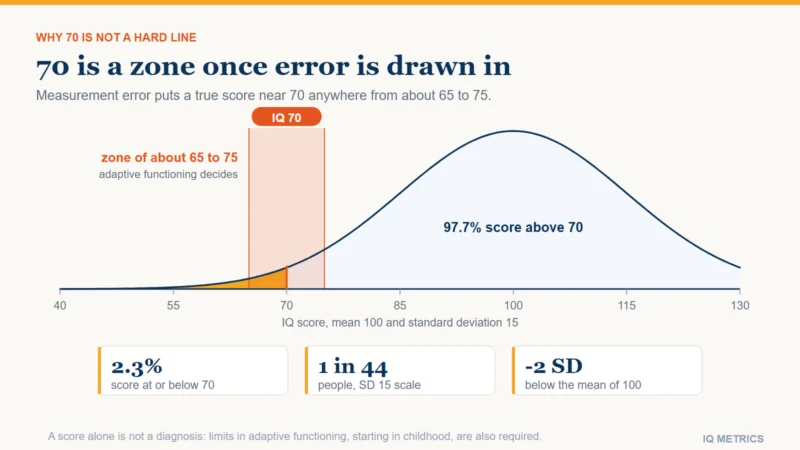 Scores & Scales
What an IQ of 70 Means
An IQ of 70 sits two standard deviations below the mean, at about the 2nd percentile. It is the score most often linked with intellectual disability, but a diagnosis never rests on the number alone: measurement error turns the line into a zone, and adaptive functioning decides who is inside it.
 Scores & Scales
What Does an IQ of 75 Mean?
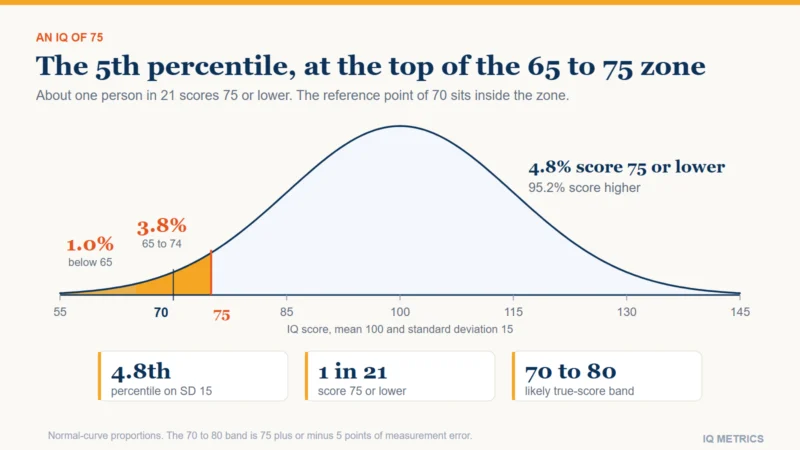
An IQ of 75 is the 5th percentile: about 1 person in 21 scores it or lower. It sits at the top edge of the 65 to 75 zone around the intellectual-disability reference point and is labelled Borderline or Very Low. See what courts say, its mental age for a child and how accurate one 75 is.
 Understanding IQ
Low IQ vs Learning Disability
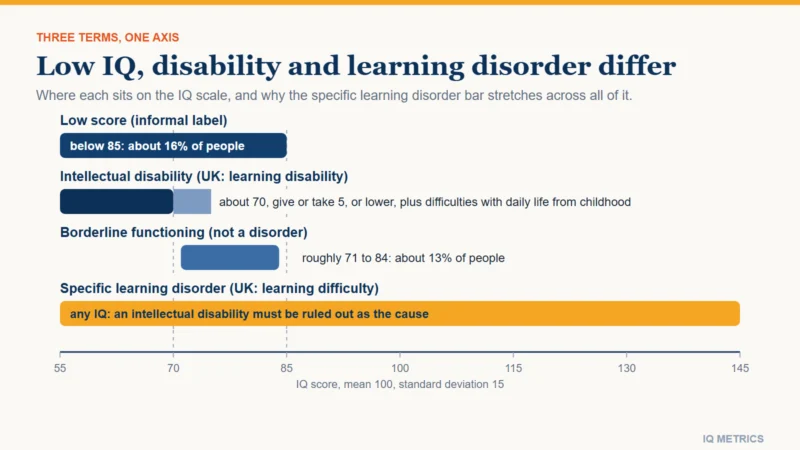
A low IQ, an intellectual disability and a specific learning disability are three different things, and the UK uses "learning disability" for the second. What each requires, how each is assessed, the US and UK terms, and what to do if you are worried.