





Down Syndrome and IQ: What the Typical Range Really Means
Most people with Down syndrome score in the mild to moderate range of intellectual disability, with an average IQ of around 50 and a typical range of about 30 to 70. The number hides a wide spread, a consistent profile of strengths, and test limits that matter more here than almost anywhere else.

Most people with Down syndrome score in the mild to moderate range of intellectual disability. Research reviews put the average IQ at around 50, with a typical range of roughly 30 to 70. The American Academy of Pediatrics describes the intellectual impairment as sometimes mild (IQ 50 to 70), usually moderate (IQ 35 to 50) and occasionally severe (IQ 20 to 35).
Those figures describe a group, and the people in it vary enormously. IQ tests are also less precise at this end of the scale than anywhere else. This article covers the typical Down syndrome IQ range and why it is so wide, whether someone with Down syndrome can score higher, the pattern of strengths behind the number, and what an IQ score cannot tell a family.
What is the average IQ of a person with Down syndrome?
A 2015 review of cognition across the lifespan (Grieco and colleagues, American Journal of Medical Genetics) gives a typical IQ of about 30 to 70 and a mean of about 50, with individual scores reaching from the profound range up to the borderline range. An IQ of 50 is more than three standard deviations below the general-population mean of 100.
The American Academy of Pediatrics’ 2022 clinical guidance breaks the same picture into bands:
- Mild (IQ about 50 to 70): sometimes.
- Moderate (IQ about 35 to 50): the most common.
- Severe (IQ about 20 to 35): occasionally.
Two cautions apply. Current diagnostic manuals grade the severity of intellectual disability by adaptive functioning, not by IQ bands, so these ranges describe test scores rather than a diagnosis (what an IQ of 70 means explains how that works). And Down syndrome is common enough for the averages to be well studied: the CDC estimates it occurs in about 1 in every 640 babies in the United States, roughly 5,700 a year.
Why the Down syndrome IQ range is so wide
Several things spread scores out, and they interact:
- The type of Down syndrome. About 96% of people have standard trisomy 21, with an extra copy of chromosome 21 in every cell. About 3 to 4% have translocation Down syndrome, and 1 to 2% have mosaic Down syndrome, in which only some cells carry the extra chromosome.
- Health. Hearing loss, sleep apnea, vision problems and thyroid disease are all common, and each can pull test performance down.
- Co-occurring conditions. Some people with Down syndrome are also autistic, which changes both the profile and how testing goes.
- Individual differences. As in any group, people differ in temperament, interests, schooling and support.
Can someone with Down syndrome have an average IQ?
Scores in the average range are not part of the typical picture. The research literature describes scores reaching up into the borderline range, just below average, but it gives no reliable figure for how often that happens.
Higher scores are reported more often in mosaic Down syndrome. In a 1991 study that matched 30 people with mosaicism to 30 people with trisomy 21, the mosaic group’s average IQ was significantly higher, with stronger verbal and visual-perceptual skills (Fishler and Koch). A 2015 review found that most, but not all, studies agree, that the samples are small, and that a higher share of cells carrying the extra chromosome tends to go with lower scores (Papavassiliou and colleagues).
The ranges overlap, though. Some children with trisomy 21 outscore some children with mosaicism, and people who are only mildly affected by mosaicism may never be diagnosed at all, which can make the average gap look bigger than it really is. The American Academy of Pediatrics sums it up carefully: people with mosaicism may be more mildly affected, but this is not always the case.
The profile behind the number
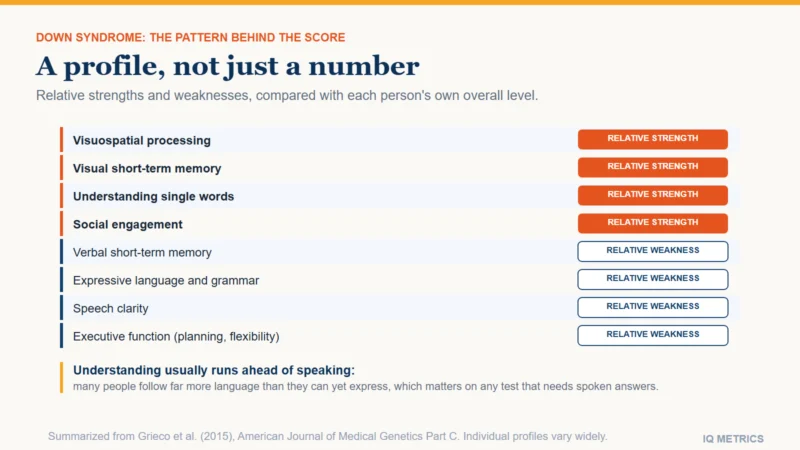
A full-scale IQ blends very different abilities into one figure, and in Down syndrome the pattern underneath is unusually consistent. The Grieco review describes:
- Relative strengths: visuospatial processing, visual short-term memory, nonverbal learning and memory, understanding of single words, and social engagement.
- Relative weaknesses: verbal short-term memory, expressive language and grammar, speech clarity, and executive functions such as planning and flexible thinking, which tend to become more affected with age.
In the review’s words, expressive language is delayed relative to comprehension. Many people understand far more than they can say, which matters on any test item that needs a spoken answer. It is also why the index scores in a report usually say more than the full-scale total, and why working memory and reasoning are worth reading separately.
Where would your own score land?
Take the IIF-certified assessment and get your score with the scale it was measured on, the percentile it corresponds to and the confidence range around it — the three figures most online tests leave out.
Find your IQ score now! →Why IQ scores can fall during childhood
Parents are sometimes told that a child’s IQ dropped between two assessments. Grieco and colleagues explain what is usually happening: although standardized scores appear to fall, raw scores show the child is still gaining skills, at a slower rate than same-age peers. An IQ compares a child with others of the same age, so steady progress that is slower than typical produces a lower standard score. It is not a loss of skills. IQ testing for children covers why childhood scores move in general.
How IQ tests work at the low end of the scale
Most intelligence tests, including the Wechsler scales and the Stanford-Binet, do not report IQ scores below 40. When many test-takers hit that floor, the test stops telling them apart: in one longitudinal study using the Stanford-Binet with people who have Down syndrome, more than a third scored at the floor. It is the mirror image of the ceiling effect at the top of the scale.
Researchers have built workarounds. A method published in 2014 turns raw scores into deviations from general-population norms, so scores below 40 can still be distinguished (Sansone and colleagues, first used with fragile X syndrome and autism). A 2026 study of 276 people with Down syndrome aged 6 to 61 found floor effects on both the KBIT-2 and the Stanford-Binet 5, and that the level of intellectual disability a person was assigned depended partly on which test was used (Schworer and colleagues). The practical lesson is that one score from one test is an estimate, and the choice of test matters. Professional IQ tests describes the main instruments.
Health problems that can lower a score
The American Academy of Pediatrics’ 2022 health supervision guidance lists conditions that are common in Down syndrome and that can affect performance on any test:
- Hearing loss: about 75% of people.
- Obstructive sleep apnea: 50 to 79%.
- Eye problems: 60 to 80%.
- Thyroid disease: 24 to 50%.
Undetected hearing loss or poor sleep can make a test look like a measure of ability when it is partly a measure of hearing or tiredness. Hearing loss changes cognitive test scores, and sleep and IQ covers the second effect. Checking both before a cognitive assessment is simply good practice.
IQ in adulthood and later life
Lifespans have lengthened dramatically. The CDC reports that in 1960 people with Down syndrome lived to about 10 years old on average, and the American Academy of Pediatrics now puts life expectancy at around 60. Longer lives bring a new cognitive question, because Down syndrome carries a high risk of Alzheimer’s disease.
By age 40, most people with Down syndrome have the amyloid plaques and tau tangles linked to Alzheimer’s, according to the National Institute on Aging. In a 2020 Lancet study of 388 adults, the median age at dementia diagnosis was 53.7 (Fortea and colleagues). That is one reason a record of each adult’s own thinking and daily-living skills is so valuable: later changes can be measured against the person’s own baseline rather than against population norms that were never built for them.
What an IQ score does not tell families
Everyday functioning often runs ahead of test results. The American Academy of Pediatrics notes that people with Down syndrome often function more effectively in social situations than cognitive assessment results would predict, unless autism is also present. A study using the Vineland adaptive behavior scales found communication to be a relative weakness next to daily living and social skills (Dykens, Hodapp and Evans, 2006).
Work is part of adult life for many. In a 2016 survey of 511 US adults with Down syndrome, 56.6% had paid jobs, although only 3% worked full time, and the participants chose to take part, so the figure is not a national rate (Kumin and Schoenbrodt). Early intervention improves developmental outcomes, according to the National Institutes of Health, but it has not been shown to raise IQ scores permanently: the short-term gains in early studies tended to fade.
An IQ score is one input to planning, useful for describing how someone learns best right now. It does not set a ceiling on reading, work, relationships or independence. For how other conditions interact with testing, see ADHD, autism and dyslexia in IQ testing and fetal alcohol spectrum disorder and IQ.
Keep reading
All articles →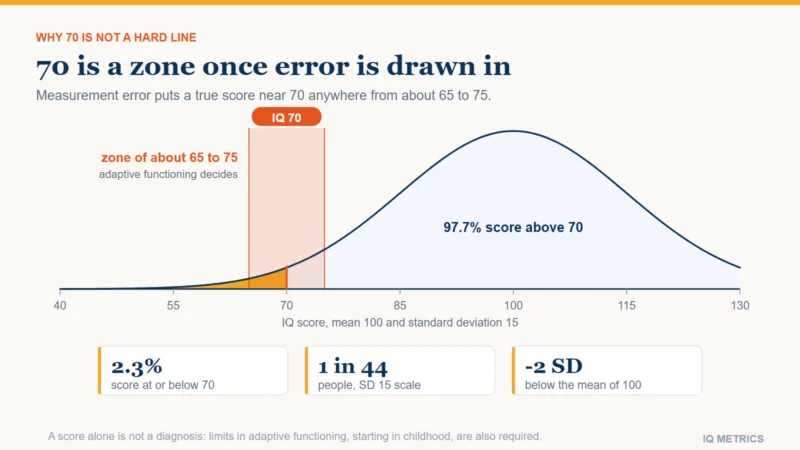 Scores & Scales
What an IQ of 70 Means
An IQ of 70 sits two standard deviations below the mean, at about the 2nd percentile. It is the score most often linked with intellectual disability, but a diagnosis never rests on the number alone: measurement error turns the line into a zone, and adaptive functioning decides who is inside it.
 Research & Evidence
Fetal Alcohol Spectrum Disorder and IQ
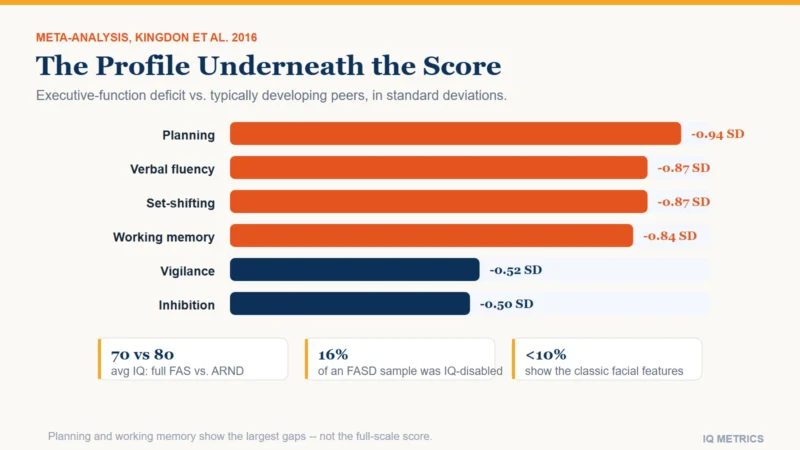
A clinical study of 473 people diagnosed with fetal alcohol syndrome or its milder forms found that only 16 percent had an IQ in the intellectually disabled range. That statistic is not the reassurance it sounds like -- it is the reason the condition is so often missed. Here is what a normal-looking score can still be hiding.
 Taking a Test
IQ Testing for Children
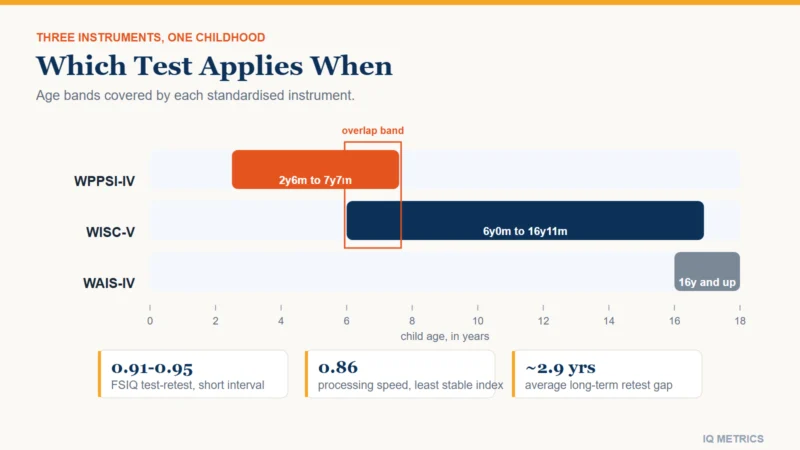
Children are not tested on the same instrument as adults, and the test itself changes twice before age eighteen. Here is which one applies when, how reliable an early score really is, and what a parent should and should not conclude from a single number.