





Turner Syndrome and IQ: What the Research Shows About 45,X
Most girls and women with Turner syndrome have an IQ in the normal range, with verbal skills above non-verbal, visuospatial and maths skills. See why published averages differ, how mosaic and ring X karyotypes change the picture and what a referral clinic found.

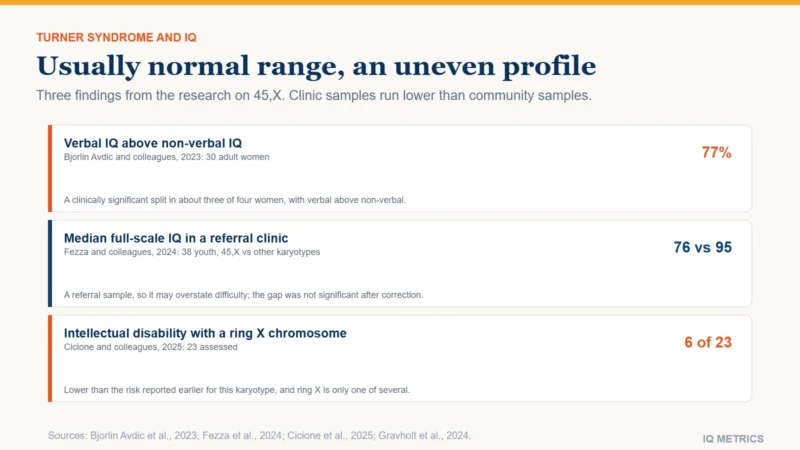
Most girls and women with Turner syndrome (45,X) have an IQ in the normal range, but the profile is uneven: verbal skills tend to sit above non-verbal, visuospatial and number skills, and intellectual disability is uncommon outside rarer karyotypes such as a ring X chromosome. Published averages differ because clinic samples run lower than community ones, so no single figure fits everyone. This guide covers Turner syndrome and IQ: what the studies found, why their numbers disagree, how mosaic and ring X karyotypes differ, the maths and attention pattern, whether the parent the X came from matters, what hormone therapy adds, and how it compares with other genetic conditions such as Klinefelter and Down syndrome.
- How common: the 2024 international guideline gives about 50 per 100,000 females, roughly 1 in 2,000.
- IQ: usually in the normal range. A classic 1997 study of 80 females with a single X called intelligence “usually normal”; a 2024 referral clinic found a median full-scale IQ of 76 with 45,X and 95 with other karyotypes, a gap that did not survive correction for multiple comparisons.
- Profile: verbal IQ above performance IQ. In 30 adult women, 77% showed a clinically significant split.
- Learning and attention: in the clinic sample, 18% had a mathematics learning disorder and 26% ADHD, 26% anxiety and 16% autism; screening of 30 adults found far lower attention and autism rates.
- Higher-risk group: with a ring X chromosome, 6 of 23 had an intellectual developmental disorder.
What is Turner syndrome?
Turner syndrome is a chromosome condition in females in which all or part of one X chromosome is missing. It is usually described by karyotype: classic 45,X, mosaic forms such as 45,X/46,XX in which some cells have two X chromosomes, and structural changes such as an isochromosome Xq, a deletion or a ring X. It brings short stature and early loss of ovarian function, and it can affect the heart, kidneys, hearing and thyroid, which is why the 2024 international guideline runs to about 100 printed pages. Alongside diagnosis, growth, puberty, fertility and co-morbidities, its topics include neurocognition and neuropsychology.
What is the average IQ in Turner syndrome?
In most studies the group average falls in the normal range, with performance below verbal. The table sets out six studies, and the differences between them are the lesson.
| Study | Who was tested | What they found |
|---|---|---|
| Skuse and colleagues, 1997 | 80 females with a single X chromosome | Intelligence was “usually normal”; the 25 with a paternally inherited X had better verbal and executive skills than the 55 with a maternal X |
| Downey and colleagues, 1991 | 23 adult women, compared with 23 women of short stature without Turner syndrome | No difference in verbal IQ; lower performance IQ and full-scale IQ, mainly from spatial and mathematical items |
| Gawlik and colleagues, 2002 | 29 girls tested on a Wechsler scale | Normal full-scale and verbal IQ; lower non-verbal subtest scores; no link to karyotype |
| Bjorlin Avdic and colleagues, 2023 | 30 adult women in Sweden | A verbal above non-verbal split in 77%; ADHD thresholds reached by 2 and autism thresholds by 1 |
| Fezza and colleagues, 2024 | 38 assessed youth in one referral clinic (of 114 patients) | Median full-scale IQ 76 with 45,X and 95 with other karyotypes; verbal above performance in both groups |
| Cicione and colleagues, 2025 | 104 people with 45,X, mosaic 45,X or a ring X chromosome | Intellectual developmental disorder in 6 of 23 (26%) with a ring X; a higher risk than in the other two groups |
Three points stand out. First, the verbal-performance split is the most consistent result. The 2024 guideline says the features of the childhood profile, persistent visual-spatial differences, arithmetic difficulty and executive-function differences, continue in adolescence and sit behind a lasting gap between verbal and performance IQ. Second, the full-scale total is pulled down only by the performance side: in the older adult study the verbal scores matched the comparison group, and the gaps appeared on the spatial and mathematical items. Third, the spread is wide. In the 2024 clinic, the middle half of children with other karyotypes scored between 75 and 103, and the middle half with 45,X between 51 and 88.
Why do published averages disagree?
Because of who gets tested. The 2024 clinic sample is a referral sample: only 38 of 114 patients had a neuropsychological assessment, at a median age of 11.3, and children are often sent for assessment because of concerns about learning or behaviour. That selection pushes the average down and the problem rates up, exactly as in the Klinefelter literature (see Klinefelter syndrome and IQ). The same study found the 45,X versus other-karyotype gap in full-scale IQ (76 versus 95, p = 0.027), but it did not meet the stricter threshold set to allow for many comparisons, so it is a signal, not a settled difference. Community samples such as the 1997 and 2002 studies report normal verbal and full-scale scores.
The same gap shows in other rates. In the clinic, 26% had ADHD and 26% an anxiety disorder, 18% a specific mathematics learning disorder and 16% autism spectrum disorder. In the Swedish adult sample, screening reached ADHD thresholds in 2 of 30 (7%) and autism thresholds in 1 (3%), and a Bayesian analysis found no association between the IQ split and either. Neither figure is a prevalence for all women with Turner syndrome; both depend on how the group was found. The full-scale IQ versus index scores explainer shows why a total can hide this kind of unevenness.
Does mosaic Turner syndrome affect IQ differently?
Generally less. In a 2023 multicentre chart review of 631 patients from three paediatric centres, neuropsychological or mental-health concerns were documented for 48.2%, and a mosaic karyotype was associated with a lower risk of both. The picture is the reverse for a ring X chromosome. The 2024 guideline notes that with a ring X and functional loss of the XIST gene a more severe cognitive phenotype may be seen, and a 2025 cohort of 104 people found an intellectual developmental disorder in 6 of 23 (26%) with a ring X, a higher risk than in the 45,X and mosaic groups but lower than earlier reports had suggested. Karyotype is a risk factor, not a verdict: the 2002 study found no relation between karyotype and IQ in 29 girls, and the 2024 clinic found a gap that did not survive correction.
Why do maths and spatial skills stand out?
The weak spot is spatial and numerical reasoning, not language. In 2008 Murphy and Mazzocco compared 18 girls with Turner syndrome with 89 comparison girls matched on full-scale IQ. The Turner group did not differ on untimed arithmetic calculation or on accuracy in checking sums, but they had limited mastery of counting skills and took longer to verify answers, and they differed from the matched girls on visual-spatial skills, working memory and reading. That is the signature of an uneven profile rather than a lower overall level: with IQ held equal, the specific difficulties remain. Dyscalculia and IQ covers how number difficulties and IQ relate more generally, and spatial IQ tests show what the visual-spatial side measures.
On a current Wechsler scale this shows up in the index scores. The WISC-V no longer reports verbal and performance IQ; it reports a Verbal Comprehension Index, a Visual Spatial Index, a Fluid Reasoning Index, a Working Memory Index and a Processing Speed Index, so a visuospatial difficulty would show as a lower Visual Spatial Index than Verbal Comprehension Index. WISC-V index scores explained walks through them, and verbal versus non-verbal IQ scores covers the older split.
Does the parent the X chromosome came from matter?
It may. In 1997 Skuse and colleagues studied 80 females with a single X chromosome, 55 with the X from the mother (45,X[m]) and 25 with the X from the father (45,X[p]). Those with the paternal X were significantly better adjusted, with superior verbal and higher-order executive-function skills, which the authors linked to a gene or genes for social cognition that is imprinted and not expressed from the maternal X. Their reading was that the same locus could help explain why 46,XY males, whose single X is always maternal, are more vulnerable to language and social-cognition conditions such as autism. It is an influential finding and an old one; treat it as a hypothesis the field has kept testing, not as a rule for any one person.
Where would your own score land?
Take the IIF-certified assessment and get your score with the scale it was measured on, the percentile it corresponds to and the confidence range around it — the three figures most online tests leave out.
Find your IQ score now! →Does hormone therapy change IQ?
Possibly at the margin. The 2024 guideline summarises the evidence that women with Turner syndrome who received hormone replacement therapy performed better than those who did not on measures of overall IQ, expressive vocabulary and visuospatial processing, while stressing that this does not remove the characteristic neurocognitive profile in some women. Hormone therapy is given for pubertal development, bone and heart health, not for intelligence, so the cognitive findings are a secondary note rather than a reason to start or stop it; that decision belongs with the treating team.
How does it compare with other genetic conditions?
Turner syndrome sits at the milder end. Most people with it score in the normal range with a clear verbal-performance pattern, while some other chromosome conditions shift the whole distribution lower:
| Condition | Typical IQ picture | Guide |
|---|---|---|
| Turner syndrome (45,X) | Usually the normal range; verbal above non-verbal; higher risk with a ring X chromosome | This guide |
| Klinefelter syndrome (47,XXY) | Normal range, average about 93; intellectual disability rare | Klinefelter syndrome and IQ |
| Down syndrome | Average about 50, typical range about 30 to 70 | Down syndrome and IQ |
| Williams syndrome | Mild to moderate disability; mean full-scale IQ 61 in 62 adults | Williams syndrome and IQ |
| Fragile X syndrome | Males moderate to severe; females vary far more | Fragile X and IQ |
For the idea of what a score means at the low end of the scale, see what an IQ of 65 means, and for how the label relates to everyday skills, low IQ versus learning disability.
What to do if a child or woman has Turner syndrome
- Ask for a neuropsychological assessment at key transitions. The guidelines recommend screening for neuropsychological concerns at key stages of development, and a Wechsler index profile tells you more than a total.
- Look at the profile, not the total. A verbal strength can lift a full-scale score over the average line while spatial, number and working-memory skills still need support.
- Plan for maths early. Counting, estimation and spatial tasks benefit from explicit, concrete teaching before gaps compound.
- Screen for attention and anxiety. Both are reported more often in clinic samples, and both can lower a test score without lowering ability; see ADHD, autism and dyslexia and IQ test scores.
- Use scores to plan, not to predict. The spread inside every group is wide, and a single figure says little about school, work or life. For what a score can and cannot tell you, see how to read an IQ test report.
Quick answers
- Does Turner syndrome affect IQ? Often a little, mostly on the non-verbal side. Overall intelligence is usually in the normal range.
- What is the average IQ in Turner syndrome? It depends on who was studied. Community samples report normal verbal and full-scale scores; a referral clinic reported medians of 76 for 45,X and 95 for other karyotypes.
- Is Turner syndrome an intellectual disability? Not usually. Risk is higher with a ring X chromosome (6 of 23 in one cohort).
- Does mosaic Turner syndrome have a different IQ? Mosaic karyotypes carry a lower risk of neuropsychological concerns in a 631-patient review.
- Can a girl with Turner syndrome have a high IQ? Yes. Scores cover the normal range, and in the clinic sample the middle half of children with other karyotypes scored 75 to 103.
- Is Turner syndrome the same as Klinefelter syndrome? No. Turner syndrome is a missing X chromosome in a female; Klinefelter is an extra X in a male. Both show an uneven profile with a typically normal-range IQ.
The bottom line
Turner syndrome and IQ: the typical person scores in the normal range, with verbal skills above non-verbal, visuospatial and number skills, and the totals reported in the literature depend heavily on who was tested. A ring X chromosome carries a higher risk of intellectual disability, mosaic karyotypes a lower risk of concerns, and hormone therapy may help at the margin. The score that matters most is the profile: a full-scale IQ can look average while one index sits much lower, which is why an assessment should report all of them. For where a score sits on the standard scale, try the IQ Metrics IQ test and the IQ percentile calculator.
Sources
- Gravholt, C.H. et al. (2024): Clinical practice guidelines for the care of girls and women with Turner syndrome, European Journal of Endocrinology, 190, G53-G151.
- Skuse, D.H. et al. (1997): Evidence from Turner’s syndrome of an imprinted X-linked locus affecting cognitive function, Nature, 387, 705-708.
- Fezza, J.I. et al. (2024): Spectrum of neuropsychological challenges in Turner syndrome, Frontiers in Endocrinology, 15, 1461103.
- Cicione, M.E. et al. (2025): Revisiting the neuropsychological and clinical profile of mosaic Turner syndrome with a ring X chromosome, American Journal of Medical Genetics Part C.
- Kremen, J. et al. (2023): Neuropsychological and mental health concerns in a multicenter clinical sample of youth with Turner syndrome, American Journal of Medical Genetics Part A.
- Bjorlin Avdic, H. et al. (2023): Cognitive profile in adult women with Turner syndrome: IQ split and associations with ADHD and ASD, Cognitive Neuropsychiatry, 28(3), 207-225.
- Downey, J. et al. (1991): Cognitive ability and everyday functioning in women with Turner syndrome, Journal of Learning Disabilities, 24(1), 32-39. And Murphy, M.M. and Mazzocco, M.M.M. (2008): Mathematics learning disabilities in girls with fragile X or Turner syndrome during late elementary school, Journal of Learning Disabilities, 41(1), 29-46.
- Gawlik, A. et al. (2002), PMID 12818125: a Polish-language study of intellectual functioning in 29 girls with Turner syndrome (abstract read). The fragile X, Williams, Down and Klinefelter figures in the comparison table follow our own guides.
Keep reading
All articles →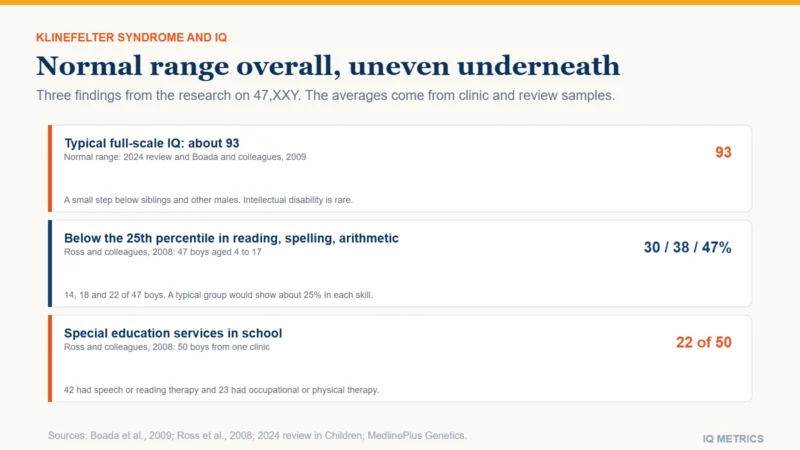 Understanding IQ
Klinefelter Syndrome and IQ
Most people with Klinefelter syndrome (47,XXY) have an IQ in the normal range, averaging about 93, with intellectual disability rare. See the verbal versus performance pattern, what a 50-boy cohort found on reading, attention, motor skills and handedness, and why published averages can mislead.
 Understanding IQ
Fragile X and IQ
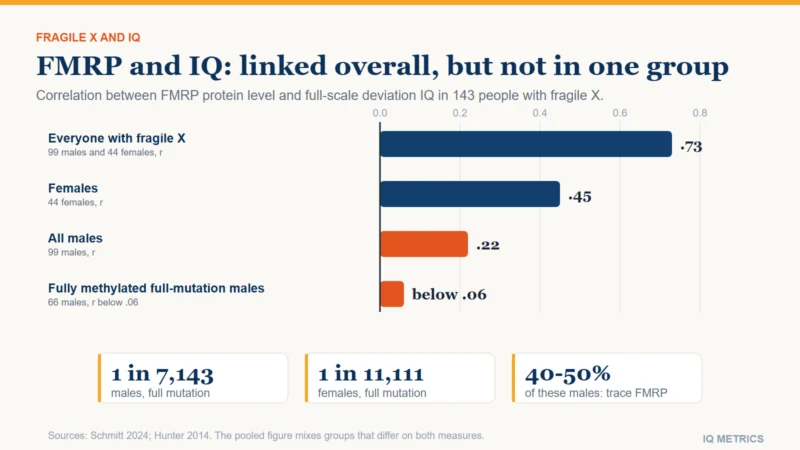
Fragile X and IQ: fully methylated full-mutation males are described as moderate to severe intellectual disability, while females vary widely. A 2024 study of 143 people found a near-normal IQ curve shifted down, and FMRP protein level mattered except in fully methylated males.
 Understanding IQ
Dyscalculia and IQ
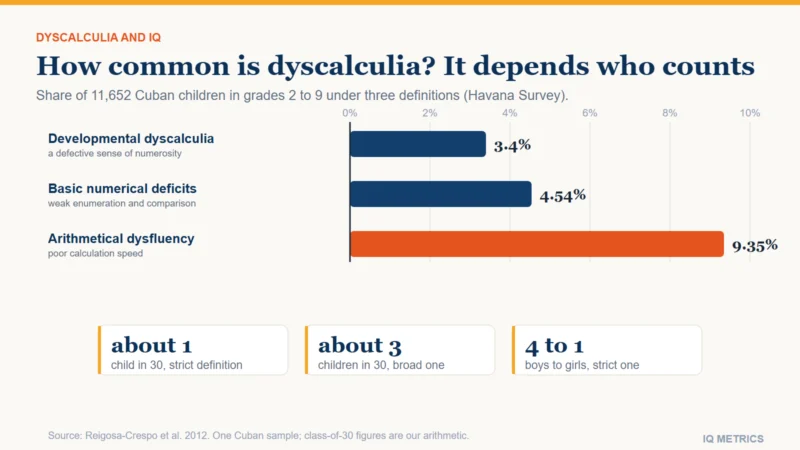
Can you have dyscalculia and a high IQ? Yes: it is a specific difficulty with numbers, not a low-IQ condition. Estimates of how common it is run from 3.4% to over 9% depending on the definition. Here is what the studies say, how it is assessed and how it differs from maths anxiety.