





Klinefelter Syndrome and IQ: What the Research Shows About 47,XXY
Most people with Klinefelter syndrome (47,XXY) have an IQ in the normal range, averaging about 93, with intellectual disability rare. See the verbal versus performance pattern, what a 50-boy cohort found on reading, attention, motor skills and handedness, and why published averages can mislead.

Most people with Klinefelter syndrome (47,XXY) have an IQ in the normal range. A 2024 review puts the typical full-scale score at about 93, a small step below siblings and other males, and intellectual disability is rare. The larger effects are on language, reading, writing and arithmetic, attention and movement, so a normal total can sit on top of an uneven profile. This guide covers Klinefelter syndrome and IQ: the average score, the verbal versus performance pattern (and the third of boys who show the reverse), what a 50-boy clinic cohort found about learning, attention, motor skills and left-handedness, why published averages may mislead, whether testosterone or the parent of origin changes IQ, and how the profile compares with other genetic conditions such as Down syndrome.
- How common: about 1 in 650 male newborns, and MedlinePlus says researchers believe up to 65% of people with Klinefelter syndrome are never diagnosed.
- IQ: usually in the normal range, around 93 in a 2024 literature review. Boada and colleagues (2009) write that “a small, but significant downward shift in mean overall IQ” has been reported, while general abilities are not typically in the intellectual disability range.
- Profile: performance IQ is typically higher than verbal IQ, but in a 2022 study of 55 boys one third showed the opposite pattern.
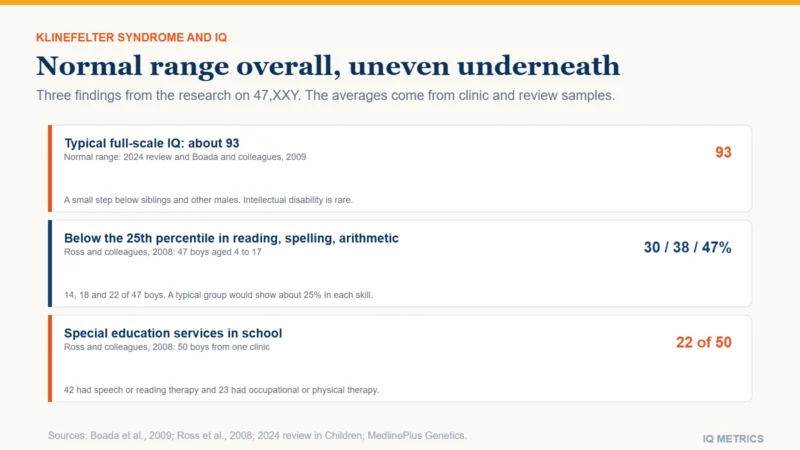
- Learning: in a clinic cohort of 50 boys aged 4 to 17, 30% scored below the 25th percentile in reading, 38% in spelling and 47% in arithmetic, and 22 were receiving special education services.
What is Klinefelter syndrome?
Klinefelter syndrome is a sex-chromosome condition in which a male has an extra X chromosome in his cells: 47,XXY instead of 46,XY. MedlinePlus Genetics puts it at about 1 in 650 male newborns, which makes it the most common sex-chromosome disorder. It arises by chance, from a failure of paired X chromosomes to separate when an egg or sperm forms (or, in mosaic cases, after fertilisation). In one clinic study that traced the origin of the extra X in 47 boys, it came from the mother in 30 and from the father in 17 (Ross and colleagues, 2008). The wider idea that intelligence travels on the X chromosome and so comes from the mother is examined in our guide to whether intelligence is inherited from the mother or father. A small share of people are mosaic (46,XY/47,XXY), and conditions with more extra sex chromosomes, such as 48,XXYY, 48,XXXY and 49,XXXXY, have more severe features, so this article is about 47,XXY.
Features vary. They can include small testes with reduced testosterone, tall stature, and an increased risk of speech, language and learning differences, and in some cases they are so mild that the condition is not diagnosed until puberty or adulthood. This site publishes tests and explains scores; it has no clinical standing, and nothing here is a diagnosis or medical advice.
What is the average IQ in Klinefelter syndrome?
Typically within the normal range. A 2024 literature review in Children states that people with Klinefelter syndrome typically reach normal full-scale IQ scores, averaging around 93, though significantly lower than healthy controls. Boada and colleagues (2009) reviewed the cognitive literature and report a small but significant downward shift in mean overall IQ, while general cognitive abilities are not typically in the intellectual disability range. Ross and colleagues (2008), summarising earlier studies, say the same: global intelligence is generally within normal limits but tends to be lower than that of siblings or control males.
A 93 is the 32nd percentile on the standard scale (our normal-curve arithmetic): inside the Average band, seven points below the population mean of 100, a gap about as large as the 95% margin of error on one score (compare an IQ of 90 and an IQ of 95). MedlinePlus says people with Klinefelter syndrome very rarely have intellectual disabilities (the score zone around 70 to 75 is explained in what an IQ of 75 means). An average hides a wide spread, and individual scores run across the range: the 2024 review includes a case report of an 11-year-old with mosaic Klinefelter syndrome whose WISC-IV full-scale IQ was 115. One case proves only that the range is wide.
Verbal IQ, performance IQ and the boys who show the opposite pattern
The textbook pattern is a performance IQ that sits above the verbal IQ, usually put down to the language difficulties that emerge early in the condition. The research is less tidy than the textbook. Boada and colleagues note that results on verbal versus nonverbal and spatial abilities have been mixed, differing with the age and the way the cohort was recruited. In 2022 Samango-Sprouse and colleagues split 55 boys with 47,XXY by their WISC results and found that one third had higher verbal than perceptual scores, which they described as a previously unreported alternative profile; expressive and receptive vocabulary were similar in both groups.
For a family or a clinician the lesson is practical. A full-scale number averages very different abilities, and in this condition the gap between the parts is often the useful finding. Full-scale IQ versus index scores and verbal versus non-verbal IQ scores explain how to read a report that splits them, and WISC-V index scores explained shows the children’s version.
Language, reading and maths: where the difficulty shows
MedlinePlus says people with Klinefelter syndrome tend to understand speech better than they produce it, and that they have an increased risk of learning disabilities, most commonly problems with reading (dyslexia) and written expression. Ross and colleagues tested 50 boys aged 4.1 to 17.8 who had been referred to a paediatric endocrinology clinic, all with a karyotype confirming the diagnosis (47 with 47,XXY, 1 mosaic and 2 with 48,XXYY). Vocabulary and the understanding of meaningful language were relatively spared, while higher-level language was impaired. Average reading and spelling scores fell in the average range and arithmetic in the low average range, but the spread is what stands out:
| Skill | Boys below the 25th percentile | Expected in a typical group |
|---|---|---|
| Reading | 14 of 47 (30%) | 25% |
| Spelling | 18 of 47 (38%) | 25% |
| Arithmetic | 22 of 47 (47%) | 25% |
Twenty-two of the 50 boys were receiving special education services in school, 26 were in regular classes and 2 had not yet started school; 42 had received speech or reading therapy and 23 occupational or physical therapy. The sample came from a clinic, so it may over-represent boys whose difficulties had been noticed. For the wider picture of reading problems and test scores, see dyslexia and IQ.
Attention, movement and left-handedness
The same study found deficits in the ability to sustain attention without impulsivity in the younger boys, and motor difficulties, especially in strength and running speed. Handedness differed from the general population too: the authors report non-right-handedness in 37% of the boys against 14% in the general population (P = 0.002), and they link the cognitive results to atypical brain lateralisation. None of this is a verdict on ability. Left-handedness in the general population does not predict a higher or lower IQ (see are left-handed people smarter?), and attention is separate from reasoning, as ADHD and IQ and executive function versus IQ explain.
Does IQ change with age in Klinefelter syndrome?
In the Ross cohort scores were only modestly lowered in the younger boys, while older boys had, on average, verbal and nonverbal reasoning cluster scores more than one standard deviation below the mean of the general population (below 85). That compares different boys at different ages, not the same boys followed over time, and the sample was clinic-referred, so it cannot show a decline. The 2024 review describes the language problems as emerging early and intensifying with academic demands, and a related pattern is documented in Down syndrome, where standard scores can fall while skills keep growing, only more slowly than same-age peers (explained in Down syndrome and IQ). A repeat assessment that tracks each child against his own earlier results is more informative than a single score.
Where would your own score land?
Take the IIF-certified assessment and get your score with the scale it was measured on, the percentile it corresponds to and the confidence range around it — the three figures most online tests leave out.
Find your IQ score now! →Do testosterone treatment or the parent of origin change IQ?
In the Ross study neither the genetic factors examined (the parent the extra X came from, the androgen receptor CAG repeat length and X-inactivation) nor previous testosterone treatment accounted for variation in the cognitive results, although the treated group was small and timing and duration varied, so the authors say its effect could not be fully addressed. A summary in the 2024 review reports that parental education, prenatal diagnosis and testosterone treatment together explained 43% of the variance in verbal IQ and 45% in performance IQ among people with 47,XXY, with higher parental education, prenatal diagnosis and testosterone treatment going with better outcomes. Those are observational findings and cannot separate treatment from everything else that differs when a diagnosis comes early, so they are not evidence that treatment raises IQ.
Why published averages may mislead
If up to 65% of people with Klinefelter syndrome are never diagnosed, the people in studies are not a random sample. Clinic cohorts such as Ross’s include boys referred because of learning or developmental concerns, which can pull averages down, while screening and population studies may find fewer difficulties. Boada and colleagues make the same point when they say results differ with the age and the ascertainment method of the group studied. The honest summary is that the group average sits slightly below the general average, that individuals vary widely, and that the exact figure depends on who was counted.
How does the Klinefelter IQ profile compare with other genetic conditions?
| Condition | What the studies report | Read more |
|---|---|---|
| Klinefelter syndrome (47,XXY) | Normal range, average about 93; intellectual disability rare | This guide |
| Down syndrome | Average about 50, typical range about 30 to 70 | Down syndrome and IQ |
| Williams syndrome | Mild to moderate disability; mean full-scale IQ 61 in 62 adults | Williams syndrome and IQ |
| Fragile X syndrome | Males moderate to severe; females vary far more | Fragile X and IQ |
The contrast shows why a syndrome name is a poor predictor of a score. Klinefelter syndrome affects the profile (language, reading, attention, movement) far more than the overall level. For how conditions interact with testing, see ADHD, autism and dyslexia in IQ testing and autism and IQ, and for how children are tested, IQ testing for children.
What to do after a diagnosis or a surprising score
- Ask for a full assessment, not a single number. Index scores, language testing and academic testing show where help is needed; professional IQ tests describes the instruments.
- Check language and reading early. Speech-language and reading evaluations are common in this group, and most boys in the Ross cohort had already received therapy.
- Look at attention and movement as well. They are separate from IQ and can be assessed and supported separately.
- Track progress against the child’s own earlier results. Standard scores compare a child with same-age peers; they say little about whether skills are growing.
- Talk to a clinician. Medical questions such as hormone treatment belong with a paediatrician or endocrinologist.
Quick answers
- Does Klinefelter syndrome cause low IQ? It is associated with a small average downward shift, to around 93 in one 2024 review, which is inside the normal range.
- Is Klinefelter syndrome an intellectual disability? No. MedlinePlus says people with the syndrome very rarely have intellectual disabilities, although learning disabilities, mainly in reading and writing, are more common.
- Can someone with Klinefelter syndrome have a high IQ? Yes. The average hides a wide range, and published cases include a full-scale IQ of 115.
- Is verbal IQ lower than performance IQ? Often, but not always: one third of 55 boys in a 2022 study showed the reverse.
- Does testosterone treatment raise IQ? The studies cited here do not show that. They are small and observational.
- How common is Klinefelter syndrome? About 1 in 650 male newborns, and up to 65% of cases are never diagnosed.
The bottom line
Klinefelter syndrome and IQ: the typical full-scale score is in the normal range, around 93, a small step below siblings and other males, with intellectual disability rare. The effects that matter most are on language, reading, writing, arithmetic, attention and movement, the verbal-versus-performance pattern is less fixed than the textbook says, and published averages depend on who was studied because most cases are never diagnosed. An IQ score is one input to planning. It describes how someone learns right now; it does not set a ceiling on school, work or relationships. To see how a score of your own compares, start with the IQ Metrics IQ test.
Sources
- Boada, R., Janusz, J., Hutaff-Lee, C. and Tartaglia, N. (2009): The cognitive phenotype in Klinefelter syndrome: a review of the literature including genetic and hormonal factors, Developmental Disabilities Research Reviews, 15(4), 284-294.
- Ross, J.L. et al. (2008): Cognitive and motor development during childhood in boys with Klinefelter syndrome, American Journal of Medical Genetics Part A, 146A, 708-719.
- Samango-Sprouse, C.A. et al. (2022): Novel neurocognitive profile in a minority of boys with 47,XXY (Klinefelter syndrome), Journal of Developmental and Behavioral Pediatrics.
- 2024 literature review and case report: Klinefelter syndrome: a genetic disorder leading to neuroendocrine modifications and psychopathological vulnerabilities in children, Children, 11(5), 509.
- MedlinePlus Genetics: Klinefelter syndrome (frequency, diagnosis, learning and language).
- Percentile figures are computed from the normal distribution. The comparison table follows our own guides to Down syndrome, Williams syndrome and fragile X.
Keep reading
All articles →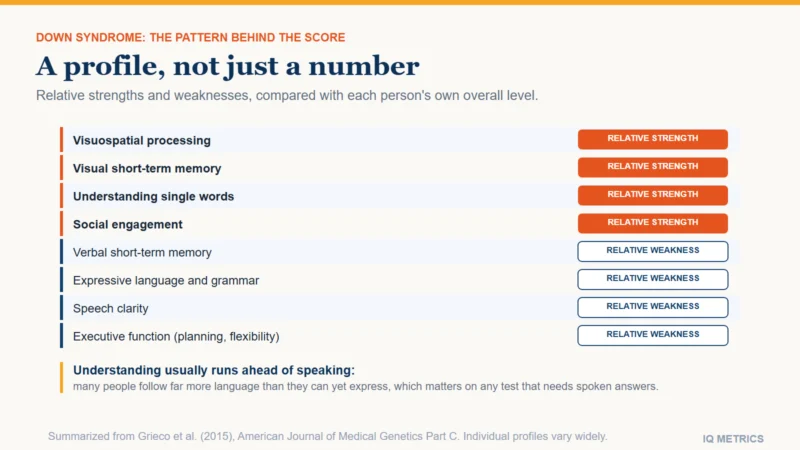 Understanding IQ
Down Syndrome and IQ
Most people with Down syndrome score in the mild to moderate range of intellectual disability, with an average IQ of around 50 and a typical range of about 30 to 70. The number hides a wide spread, a consistent profile of strengths, and test limits that matter more here than almost anywhere else.
 Understanding IQ
Williams Syndrome and IQ
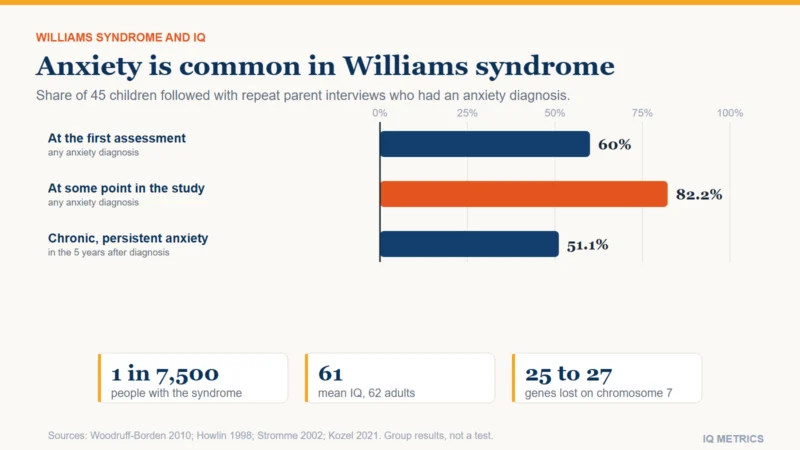
Williams syndrome and IQ: mean full-scale IQ was 61 in 62 adults, and 292 children averaged in the borderline range on the KBIT-2, stable from age 4 to 17. Language is a relative strength and visuospatial construction an extreme weakness. Here is what the studies show.
 Understanding IQ
Dyslexia and IQ
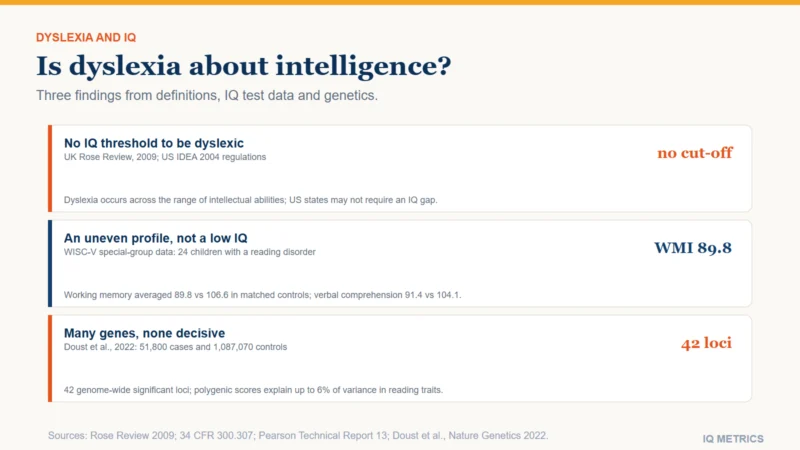
Dyslexia is a reading and spelling difficulty that occurs at every level of IQ, and the IQ-gap rule was dropped as a US requirement in 2004 and from the IDA definition in 2025. See what IQ tests show for readers with dyslexia, and what the genetics and myths add.