





Fragile X and IQ: What IQ Scores Look Like in Males and Females
Fragile X and IQ: fully methylated full-mutation males are described as moderate to severe intellectual disability, while females vary widely. A 2024 study of 143 people found a near-normal IQ curve shifted down, and FMRP protein level mattered except in fully methylated males.

Fragile X and IQ: males with a fully methylated full mutation are described as having a moderate to severe intellectual disability, while females vary far more, and about half fall in the borderline to intellectual disability range in one review. In a 2024 study of 143 people with fragile X syndrome (99 males, 44 females), IQ scores formed a near-normal bell curve shifted downward, not a single low cluster. Sex, mosaicism and how much of the FMRP protein the body still makes all move a person along that curve. This guide covers how common fragile X is, what the studies report for males and females, why scores differ so much, whether IQ declines with age, and what the premutation does and does not do. It is general information, not medical advice.
- Common: the full mutation occurs in about 1 in 7,143 males and 1 in 11,111 females, from a pooled estimate with wide uncertainty.
- Males: described as moderate to severe intellectual disability in the fully methylated full-mutation group, with scores spread out in a near-normal curve.
- Females: milder and more variable; in one review about half were borderline or in the intellectual disability range and the rest average.
- Mosaics: people with a mix of cell types had better intellectual functioning than matched people with the full mutation only.
- Premutation carriers: no global change in general intelligence, memory or executive function in adults under 50.
Fragile X sits next to several conditions we have covered. Down syndrome is the other well-known genetic syndrome in this area (Down syndrome and IQ), and a companion guide covers the chromosome 7 condition (Williams syndrome and IQ). Fragile X also overlaps with autism, epilepsy and anxiety.
What is fragile X syndrome, and how common is it?
Fragile X syndrome is caused by a change in the FMR1 gene on the X chromosome. A stretch of DNA made of repeating CGG units grows; when it passes 200 repeats (the “full mutation”), the gene is silenced and the body stops making fragile X messenger ribonucleoprotein, or FMRP. A review in Nature Reviews Disease Primers calls it the leading inherited form of intellectual disability and autism spectrum disorder, with hyperactivity, impulsivity, anxiety, poor language development and seizures among the features. Repeat counts of roughly 55 to 199 are called a premutation.
Hunter and colleagues (2014) pooled 68 observations in a systematic review and meta-analysis. They estimated the full mutation at 1.4 per 10,000 males (95% CI 0.1 to 3.1) and 0.9 per 10,000 females (0.0 to 2.9), which they express as 1 in 7,143 and 1 in 11,111. The premutation was far more common: 11.7 per 10,000 males (1 in 855) and 34.4 per 10,000 females (1 in 291). The authors note that the full-mutation estimates are lower than in earlier reviews, and the wide intervals show how uncertain they remain. Because the gene is on the X chromosome, a male has one copy and a female has two, which is one reason the sexes differ (see is intelligence inherited from the mother or father for the wider picture of X-linked genes and IQ).
What IQ do males with fragile X have?
The most recent large look at IQ in fragile X is Schmitt and colleagues (2024), who tested 143 people aged 8 to 50 (99 males and 44 females). The paper describes fully methylated full-mutation males, the classic form, as marked by moderate to severe intellectual disability. What it adds is a picture of the spread. Using an abbreviated deviation IQ, the distribution of scores in the full male sample, and separately in the 66 fully methylated full-mutation males, was near-normal on skewness, kurtosis and a Shapiro-Wilk test: shifted below the general-population average, but shaped like an ordinary bell curve. The authors propose that fragile X has its own “standard curve” with its own mean and spread, and illustrate it with a male whose IQ of 45 would sit 1 standard deviation above the fragile X mean on that curve.
Two cautions come with such low scores. First, many standard tests have a floor, and the authors point to floor effects on standardized IQ measures as a limit on earlier research. The deviation-based score they used can fall below that floor: among fully methylated full-mutation males in the original samples, values ranged from -20 to 47 (our reading: these numbers describe relative standing, not a literal IQ on a standard test). Second, a single number says little about what a person can do day to day; see low IQ versus learning disability and what an IQ of 70 means for how scores and support needs relate.
What about females with fragile X?
Females have a second X chromosome, and in each cell one X is switched off at random, so some cells use the working copy of FMR1 and some the silenced one. That variation in FMR1 and FMRP expression is why the presentation in females is more variable and often milder, as Schmitt and colleagues explain. Keysor and Mazzocco’s developmental review (2002) found that approximately half of females with the syndrome had cognitive abilities in the borderline to intellectual disability range. The rest had average intellectual functioning but could still show relative deficits in math achievement, attention and executive function. Baker and colleagues (2019) compared 90 males and 36 females and found males had poorer intellectual functioning on all domains (p < 0.0001).
Why scores vary: mosaicism and the FMRP protein
Two molecular details explain a good part of the spread. Mosaicism means a person has a mix of cells, some with a full mutation and some with a smaller premutation-sized repeat (or different methylation). In Baker’s international cohort of 126 people aged 1 to 43, those with this mix had better intellectual functioning and fewer maladaptive behaviors than age- and sex-matched people with the full mutation only. Autism features were similar between the groups once intellectual functioning was taken into account.
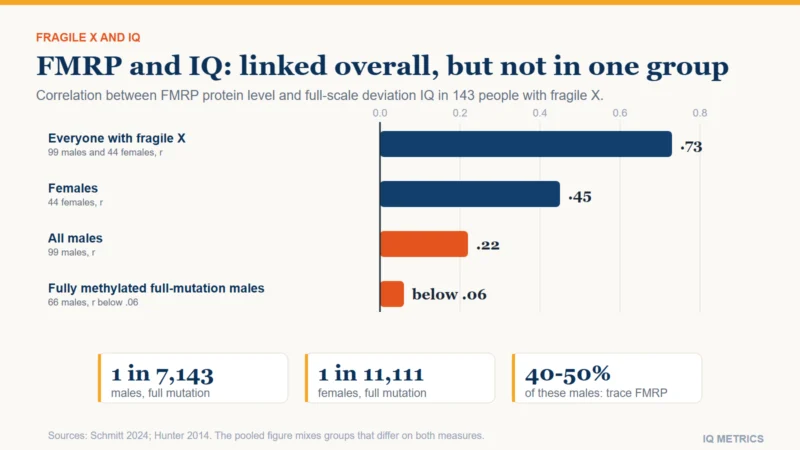
FMRP level matters too. In the Schmitt sample, higher FMRP went with higher full-scale deviation IQ across everyone (r = .73), in females (r = .45) and in males (r = .22). But among the 66 fully methylated full-mutation males there was no relationship (all r below .06). Earlier work by the same group found that 40% to 50% of such males still express trace levels of FMRP, and they suggest that at very low levels other genetic, epigenetic and environmental factors may matter more, while saying that has not been directly tested. The pooled r = .73 is much larger than either sex alone, which is what you would expect if males and females differ on both FMRP and IQ (our reading), so do not read it as the strength of the link inside any one group.
| Study | Sample | Main finding |
|---|---|---|
| Schmitt et al., 2024 | 143 people aged 8 to 50 (99 males, 44 females) | IQ near-normally distributed but shifted down; FMRP linked to IQ except in fully methylated males |
| Baker et al., 2019 | 126 people aged 1 to 43 (90 males, 36 females) | Males lower than females; mosaics higher than full mutation only |
| Keysor and Mazzocco, 2002 | Review of females with the full mutation | About half borderline to intellectual disability range |
| Wright-Talamante et al., 1996 | 35 males and 16 females (chart review) | IQ decline in 28% of males and 36% of females |
| Hunter et al., 2008 | 138 males and 506 females aged 18 to 50 | No global neuropsychological effect of the premutation |
Where would your own score land?
Take the IIF-certified assessment and get your score with the scale it was measured on, the percentile it corresponds to and the confidence range around it — the three figures most online tests leave out.
Find your IQ score now! →Does IQ decline with age in fragile X?
An often-quoted older study may be the source. Wright-Talamante and colleagues (1996) reviewed hospital records of 35 males with fragile X and 16 females with the full mutation, plus 9 male and 9 female controls, who had repeated IQ tests between 7 months and 13 years apart. A significant decline appeared in 10 of the 35 males (28%), 6 of the 16 females (36%), none of the 9 control males and 1 of the 9 control females. After taking starting IQ into account, the decline was greater in males with fragile X than in control males. The authors list limitations, including the use of the same IQ test over time, and the sample was small and retrospective.
Be careful with the word “decline”. An IQ is a comparison with same-age norms, so a person who keeps learning but more slowly than same-age peers can see the score fall without losing any skill (our reading; the abstract does not say which happened). We did not review later longitudinal work, so treat the question as open.
Premutation carriers: is IQ affected?
Hunter and colleagues (2008) tested 138 males and 506 females aged 18 to 50, from the general population and from families with a history of fragile X, on measures of general intelligence, memory and executive functioning. Among males, no association with repeat length was found for any factor. Among females, the only significant link was with self-reported attention problems, which were higher in premutation carriers. The authors concluded there is no global neuropsychological impact of carrying a premutation allele among adults under 50. The premutation is tied to other conditions, such as a tremor and ataxia syndrome mostly in older males and primary ovarian insufficiency in females, but those are not IQ effects.
How IQ is measured in fragile X, and what to keep in mind
- Test choice matters. Young children are assessed with age-appropriate developmental or intelligence tests (see WPPSI-IV and the brief KBIT-2), and tests with high floors cannot separate low scores well.
- Look at the profile, not only the total. Processing speed, working memory, cognitive flexibility and inhibitory control are described as especially affected.
- Other conditions travel with it. Anxiety, hyperactivity (compare ADHD and IQ) and seizures can all affect how a child performs on test day.
- Context for support decisions. For how scores are used in disability rules, see our report on low IQ and disability benefits; to place a number on a bell curve, use the IQ percentile calculator. An online test such as the IQ Metrics test is not a clinical assessment.
Quick answers
- What is the IQ of someone with fragile X? There is no single IQ. Fully methylated full-mutation males are described as moderate to severe intellectual disability, with a spread of scores; females vary more.
- Is fragile X an intellectual disability? It is the leading inherited cause of intellectual disability, but not every person with the gene change has one, especially among females and mosaics.
- Do girls with fragile X have lower IQ? On average they score higher than males, and about half were borderline or in the intellectual disability range in one review.
- Does the fragile X premutation lower IQ? Not globally, in adults under 50.
- Does IQ get worse with age? An older chart review reported declines in about 3 in 10, with important limits; it may reflect slower gains than peers.
Sources
- Hunter, J. et al. (2014): Epidemiology of fragile X syndrome: a systematic review and meta-analysis, American Journal of Medical Genetics Part A, 164A(7), 1648-1658.
- Hagerman, R.J. et al. (2017): Fragile X syndrome, Nature Reviews Disease Primers, 3, 17065.
- Schmitt, L.M., Nelson, M., Shaffer, R.C. and Erickson, C.A. (2024): A near normal distribution of IQ in fragile X syndrome, Scientific Reports, 14, 23058.
- Baker, E.K. et al. (2019): Intellectual functioning and behavioural features associated with mosaicism in fragile X syndrome, Journal of Neurodevelopmental Disorders, 11, 41.
- Keysor, C.S. and Mazzocco, M.M. (2002): A developmental approach to understanding fragile X syndrome in females, Microscopy Research and Technique, 57(3), 179-186.
- Wright-Talamante, C. et al. (1996): A controlled study of longitudinal IQ changes in females and males with fragile X syndrome, American Journal of Medical Genetics, 64(2), 350-355.
- Hunter, J.E. et al. (2008): No evidence for a difference in neuropsychological profile among carriers and noncarriers of the FMR1 premutation in adults under the age of 50, American Journal of Human Genetics, 83(6), 692-702.
Keep reading
All articles →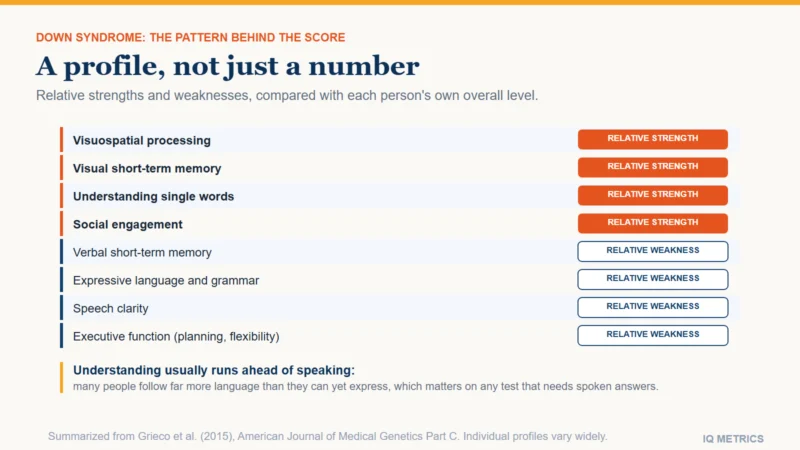 Understanding IQ
Down Syndrome and IQ
Most people with Down syndrome score in the mild to moderate range of intellectual disability, with an average IQ of around 50 and a typical range of about 30 to 70. The number hides a wide spread, a consistent profile of strengths, and test limits that matter more here than almost anywhere else.
 Understanding IQ
Williams Syndrome and IQ
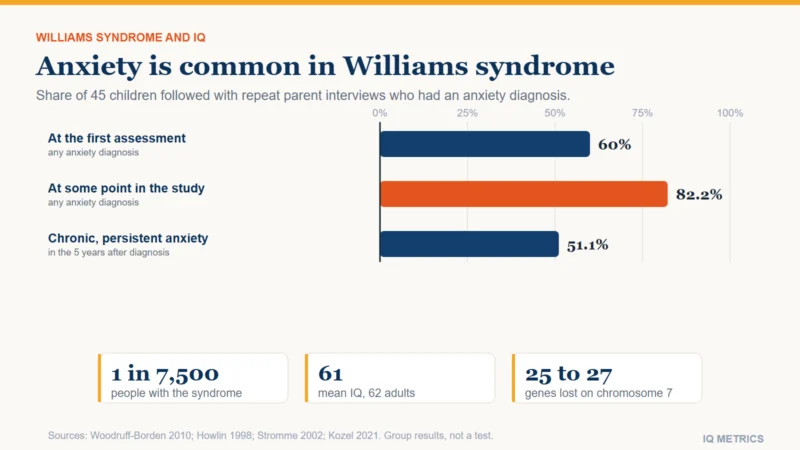
Williams syndrome and IQ: mean full-scale IQ was 61 in 62 adults, and 292 children averaged in the borderline range on the KBIT-2, stable from age 4 to 17. Language is a relative strength and visuospatial construction an extreme weakness. Here is what the studies show.
 Understanding IQ
Autism and IQ
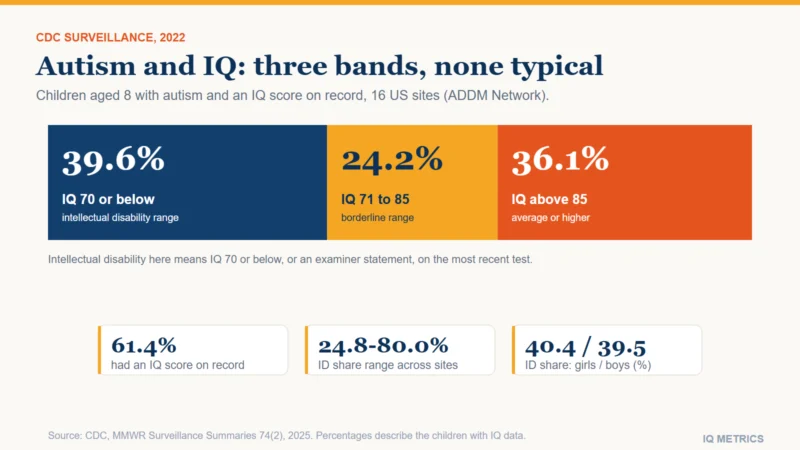
About 40% of 8-year-olds with autism and an IQ score on record had an IQ of 70 or below, and 36% scored above 85. See the CDC figures and their caveats, the Raven's gap of 30 percentile points, and what an IQ number cannot tell you.