How smart were dinosaurs? Every dinosaur brain measured
We put every dinosaur brain from the latest study on one scale, from Troodon to Stegosaurus, and laid out the dispute over how many neurons T. rex really had.

By Leon Falkner, Data & Research Analyst · Reviewed by Aarav Vardhan, Editor-in-Chief · Published 2 November 2026 · 8 min read
About this study
- Report type
- Data study from published fossil measurements
- Data
- 115 rows, 68 names; 31 dinosaurs on one scale
- Compared with
- Living birds, reptiles and mammals (our animal data set) and a human brain
- Years
- Studies published 2007-2025; count of named genera on 2 November 2026
- Licence
- CC BY 4.0 (our dataset and charts)
- Version
- 2026.11
- Sources
- 13
The smartest dinosaurs were small feathered hunters, not the giants. Measured one way for 31 dinosaurs, Troodon had a brain about 6.5 times bigger than a living reptile of its weight, close to living birds; T. rex 1.2-2.2 times; Stegosaurus, Diplodocus and Apatosaurus under a third. Estimates of T. rex’s forebrain neurons run from 0.25 billion (built like a crocodile’s) to 3.3 billion (like a bird’s). IQ Metrics Research, November 2026.
01 Key findings
- Troodon, Bambiraptor and Ornithomimus had the biggest brains for their size, about 6.5, 6.2 and 6.1 times the brain of a living reptile of the same weight. All three are small feathered theropods, the group that led to birds.Caspar et al. 2024; IQ Metrics calculation
- T. rex sits in the middle (1.2-2.2 times a reptile’s brain), above the plant-eating giants: Stegosaurus 0.2-0.3 and Apatosaurus 0.1, the lowest of the 31.Caspar et al. 2024; IQ Metrics calculation
- Was T. rex as smart as a baboon? The two latest studies disagree tenfold. A 2023 study gave it 2.2 to 3.3 billion forebrain neurons, like a baboon; a 2024 reply by 11 scientists put it at 0.25 to 0.36 billion and called a crocodile-like brain more plausible.Herculano-Houzel 2023; Caspar et al. 2024
- Its brain weighed 97 to 179 grams on the 2024 estimate, 6% to 12% of a human brain (1,508 g in the brains counted for neurons); even the 2023 study’s largest guess, 343 g, is under a quarter.Caspar et al. 2024; Herculano-Houzel 2023; Azevedo et al. 2009
- A macaw’s forebrain has more neurons than the 2024 study’s highest T. rex estimate: 1.9 billion against 1.7 billion, in a bird about a kilogram in weight.Olkowicz et al. 2016; Caspar et al. 2024
- Only 45 of 1,851 named dinosaur genera (2.4%) have ever had their brain measured. Everything known about dinosaur intelligence rests on a few dozen skulls.Paleobiology Database; IQ Metrics count
02 Statistics to quote
Troodon’s brain against a living reptile of the same weight: the highest of 31 dinosaurs.
IQ Metrics, from Caspar et al. 2024Published estimates of the neurons in T. rex’s forebrain (2023 and 2024 studies).
Herculano-Houzel 2023; Caspar et al. 2024Weight of a T. rex brain on the 2024 estimate: 6% to 12% of a human brain.
Caspar et al. 2024Forebrain neurons in a blue-and-yellow macaw: more than the 2024 study’s highest estimate for T. rex (1.7 bn).
Olkowicz et al. 2016; Caspar et al. 2024Named dinosaur genera with a published brain measurement (2.4%).
IQ Metrics, from the Paleobiology DatabaseStegosaurus: its brain against a reptile of its weight, among the smallest of any dinosaur.
IQ Metrics, from Caspar et al. 202403 What was the smartest dinosaur?
On brain size for body size, Troodon (now often called Stenonychosaurus): its brain was about 6.5 times the size a living reptile of its weight would have. Bambiraptor, a cousin of Velociraptor, came second (6.2) and the ostrich-like Ornithomimus third (6.1). We put all 31 dinosaurs in the 2024 study [1] on one scale, the reptile encephalization quotient [4] [5], so every number is measured the same way.
Brain size for body size: 31 dinosaurs on one scale
How many times bigger each brain was than the brain of a typical living reptile of the same weight (1 = the same; the reptile encephalization quotient of Hurlburt 1996). Every brain and body mass is from one study (Caspar et al. 2024), so the dinosaurs compare; where it gives a range, the bar is the middle of it (the table below has the ranges). Bigger for its body is not proof of smarter.
Source: Brain and body masses: Caspar et al. 2024, Table 1 [1]; equation as given in [4] [5]; calculation by IQ Metrics
Data table
| label | value |
|---|---|
| Troodon | 6.5 |
| Bambiraptor | 6.2 |
| Ornithomimus | 6.1 |
| Archaeopteryx | 3.9 |
| Khaan | 2.3 |
| Citipati | 2.2 |
| T. rex | 1.7 |
| Hypacrosaurus | 1.5 |
| Protoceratops | 1.3 |
| Carcharodontosaurus | 1.3 |
| Iguanodon | 1.3 |
| Edmontosaurus | 1.2 |
| Shuvuuia | 1.2 |
| Psittacosaurus | 1.2 |
| Tarbosaurus | 1.1 |
| Sinraptor | 1 |
| Carnotaurus | 0.9 |
| Giganotosaurus | 0.9 |
| Majungasaurus | 0.8 |
| Acrocanthosaurus | 0.7 |
| Allosaurus | 0.7 |
| Triceratops | 0.6 |
| Euoplocephalus | 0.6 |
| Thescelosaurus | 0.6 |
| Giraffatitan | 0.5 |
| Kentrosaurus | 0.5 |
| Buriolestes | 0.5 |
| Amargasaurus | 0.3 |
| Diplodocus | 0.3 |
| Stegosaurus | 0.2 |
| Apatosaurus | 0.1 |
Embed this chart
Paste this HTML into your page: it carries the numbers and the credit link to this figure.
The leaders are all small feathered theropods, the group that led to birds; the 2024 study found their brains no different in relative size from living birds’ [1]. The giants sit at the other end: Stegosaurus 0.2-0.3 and Apatosaurus 0.1. Brain size for body size is a rough guide, not a test score: see what brain size says about intelligence in people.
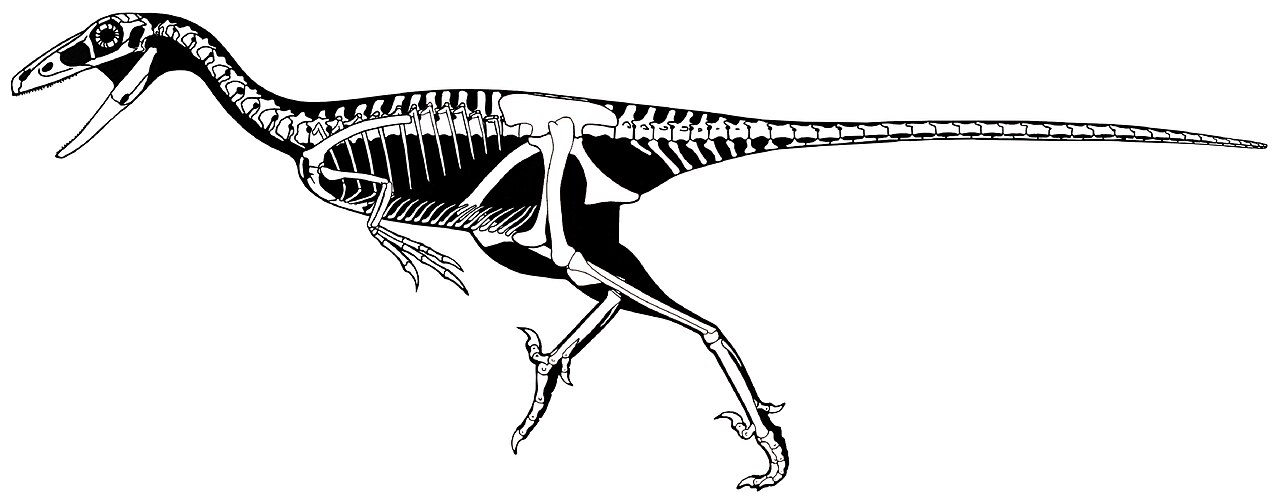
Troodon (Stenonychosaurus): the biggest brain for its body of the 31.
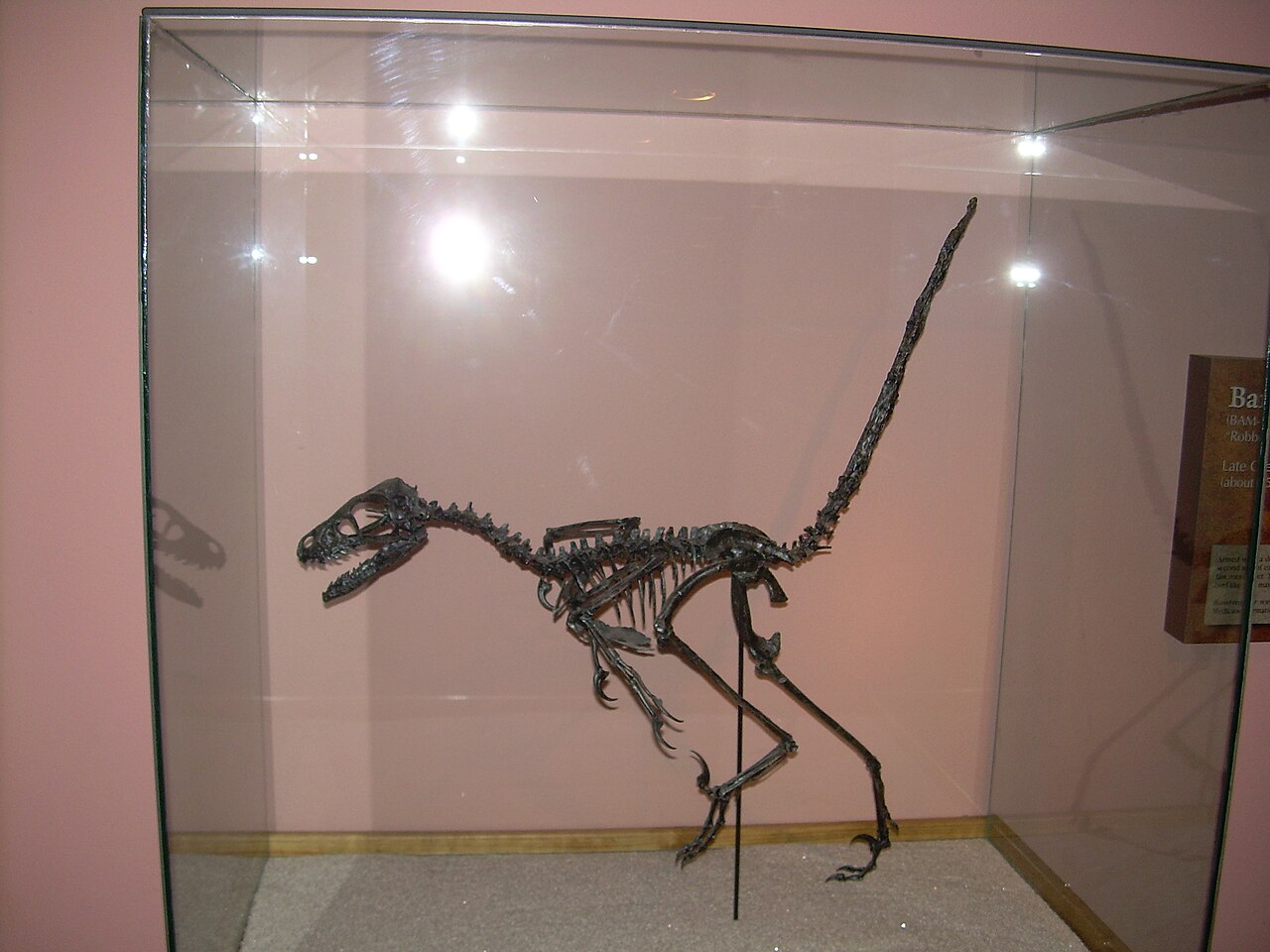
Bambiraptor, a small cousin of Velociraptor: second.
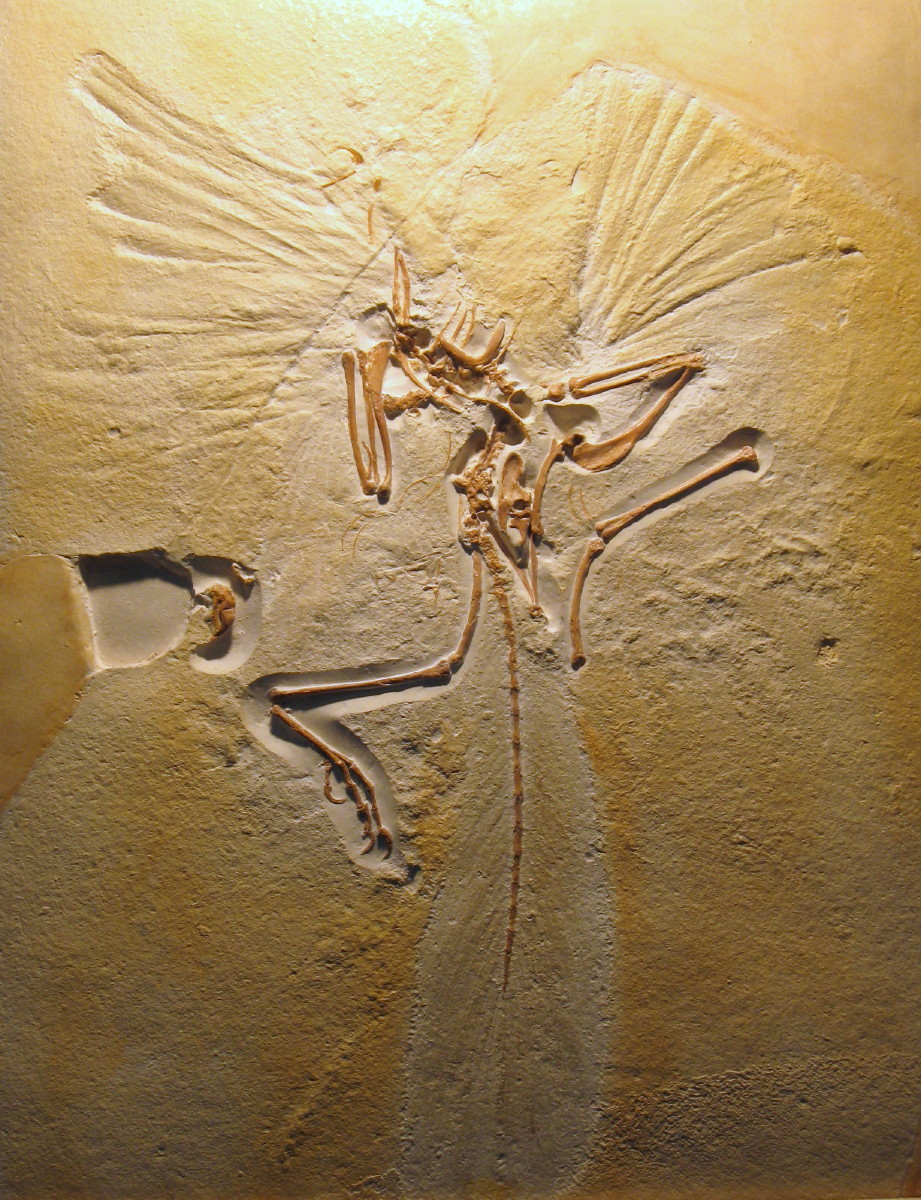
Archaeopteryx, the early bird: its brain cavity was scanned at 1.52 mL.
Photo: H. Raab (User:Vesta), CC BY-SA 3.0, via Wikimedia Commons
Grouped by kind of dinosaur, the pattern is plain: every small feathered dinosaur sits above a typical reptile, most by a long way; the big meat-eaters cluster around it; the long-necked plant-eaters all sit below it.
Brain size for body size, by kind of dinosaur
Each dot is one of the 31 dinosaurs, at its brain size against a living reptile of the same weight (the middle of its range). Boxes: the middle half of each group; whiskers: lowest and highest. The dashed line is a typical living reptile (1x).
Dotted line: A typical living reptile.
Source: Caspar et al. 2024, Table 1 [1]; equation [4]; calculation by IQ Metrics
Data table
| kind of dinosaur | n | low | q1 | median | q3 | high |
|---|---|---|---|---|---|---|
| Small feathered dinosaurs | 7 | 1.2 | 2.2 | 3.9 | 6.2 | 6.5 |
| Big meat-eaters | 9 | 0.7 | 0.8 | 0.9 | 1.1 | 1.7 |
| Long-necked plant-eaters | 5 | 0.1 | 0.3 | 0.3 | 0.5 | 0.5 |
| Other plant-eaters | 10 | 0.2 | 0.6 | 0.9 | 1.2 | 1.5 |
Embed this chart
Paste this HTML into your page: it carries the numbers and the credit link to this figure.
04 How big was a T. rex brain?
About 97 to 179 grams, on the 2024 estimate [1]. The cavity in a T. rex skull holds 314 to 414 millilitres, but in crocodiles, the closest living relatives with a similar skull, the brain fills only part of it, so the study took 31% to 42%. The 2023 study took half or all of the cavity, 202 or 343 grams [2]. A human brain weighs several times more: the brains counted for neurons averaged 1,508 grams [12].
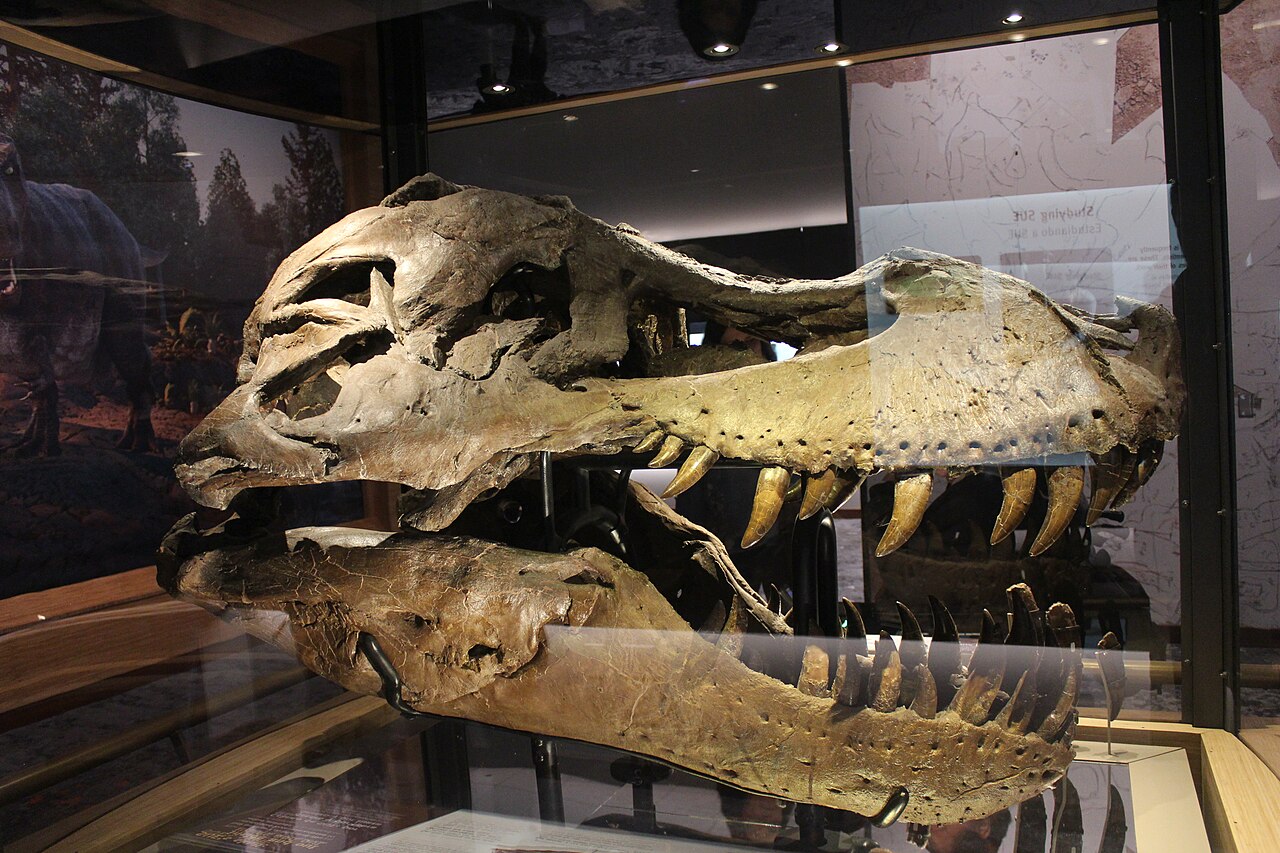
The skull of Sue (FMNH PR 2081) at the Field Museum. Its brain cavity, 414 mL, is the largest in the 2024 study.
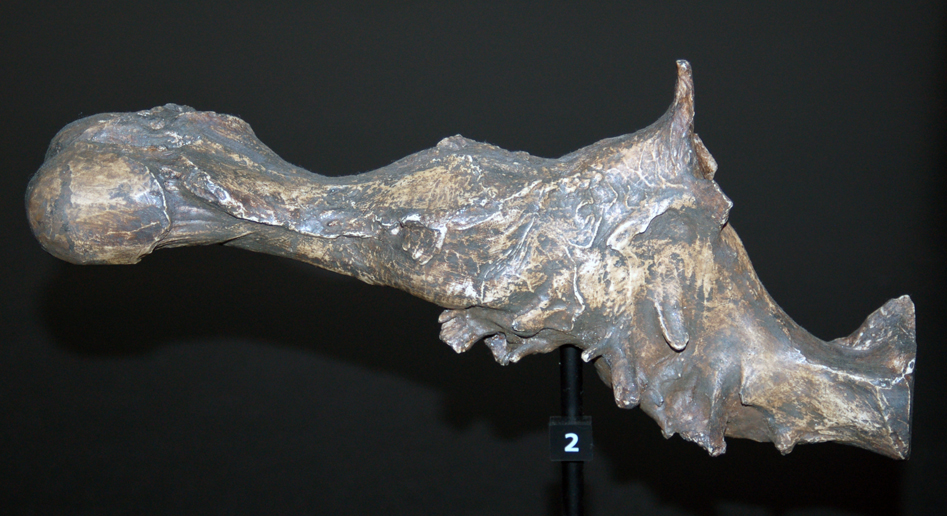
Cast of a T. rex braincase, the bone around the brain (Australian Museum, Sydney). Brain sizes are estimated from the space inside it.
Photo: Matt Martyniuk (Dinoguy2), CC BY-SA 4.0, via Wikimedia Commons
How heavy was a T. rex brain? Grams, against yours and living animals
Dinosaur brains are estimated from the cavity in the skull (the endocast). The 2023 study took half or all of the cavity as brain; the 2024 study took 31% to 42%, as in crocodiles, whose brains do not fill the cavity. Living animals: brains weighed after death.
Source: Caspar et al. 2024 [1]; Herculano-Houzel 2023 [2] [3]; living animals [13] [12] [10] [11]
Data table
| label | value |
|---|---|
| A human brain (the brains counted by Azevedo et al.) | 1508 |
| T. rex, 2023 estimate (the whole brain cavity) | 343 |
| T. rex, 2023 estimate (half the cavity) | 202 |
| T. rex, 2024 estimate, highest | 178.8 |
| T. rex, 2024 estimate, lowest | 97.2 |
| Iguanodon (2024, highest) | 149.9 |
| Triceratops (2024, highest) | 96.1 |
| Ostrich (living bird) | 40.2 |
| Troodon | 38.6 |
| Stegosaurus (2024, highest) | 27 |
| Common raven (living bird) | 14.1 |
| Nile crocodile (living reptile) | 5.8 |
Embed this chart
Paste this HTML into your page: it carries the numbers and the credit link to this figure.
05 Was T. rex as smart as a baboon?
Probably not. In 2023 a neuroscientist estimated that T. rex had 2.2 to 3.3 billion neurons in its forebrain, “baboon-like” numbers, and suggested it could have used tools [2]. In 2024, 11 palaeontologists and neuroscientists re-measured the skulls and found 0.25 to 0.36 billion if the brain was packed like a crocodile’s, or 1.1 to 1.7 billion if like a bird’s; they called the crocodile-like case “more plausible” [1].
How many brain cells did T. rex have? Every published estimate against living animals
Billions of neurons in the forebrain (the pallium, where birds and mammals do most of their thinking). T. rex rows are estimates: "bird-like" assumes its brain was packed like a bird's, "reptile-like" like a crocodile's. The other rows are living animals whose neurons were counted.
Source: Herculano-Houzel 2023 [2] [3]; Caspar et al. 2024, Table 2 [1]; living animals [10] [11] [13]
Data table
| label | value |
|---|---|
| T. rex, 2023 study, bird-like (343 g brain) | 3.3 |
| Yellow baboon (counted; cerebral cortex) | 2.9 |
| T. rex, 2023 study, bird-like (202 g brain) | 2.2 |
| Blue-and-yellow macaw (counted) | 1.9 |
| T. rex, 2024 study, bird-like, highest | 1.7 |
| Common raven (counted) | 1.2 |
| T. rex, 2024 study, bird-like, lowest | 1.1 |
| Common ostrich (counted) | 0.5 |
| T. rex, 2023 study, reptile-like (343 g brain) | 0.5 |
| Emu (counted) | 0.4 |
| T. rex, 2024 study, reptile-like, highest | 0.4 |
| T. rex, 2024 study, reptile-like, lowest | 0.2 |
Embed this chart
Paste this HTML into your page: it carries the numbers and the credit link to this figure.
The 2024 team also checked the 2023 study’s predictions against bones. It predicted that T. rex matured at 4 to 5 years and lived 42 to 49 years; growth tissue shows maturity at 15 years at the earliest, and the oldest T. rex counted so far lived up to 33 [1]. And neuron counts are not intelligence on their own: a giraffe (1.7 billion) out-counts tool-using capuchin monkeys (1.1 billion) [1].
The new measurements lowered almost every estimate, not just T. rex’s. With the same bird-like assumption in both studies, 16 of the 19 dinosaurs in both fell; Allosaurus fell most (69%) and T. rex fell 48%, from 3.3 to 1.7 billion [2] [1].
The 2024 re-measurement: bird-like neuron estimates, 2023 vs 2024 (millions)
The 19 dinosaurs in both studies, each with its highest bird-like estimate (the same assumption in both, so the change comes from the new brain and body measurements). 16 fell; 3 rose a little.
Source: Herculano-Houzel 2023 [2] [3]; Caspar et al. 2024, Table 2 [1]
Data table
| dinosaur | 2023 study | 2024 study |
|---|---|---|
| T. rex | 3289 | 1722 |
| Acrocanthosaurus | 2116 | 707 |
| Giraffatitan | 2075 | 1374 |
| Allosaurus | 1921 | 604 |
| Edmontosaurus | 1764 | 1342 |
| Iguanodon | 1538 | 1520 |
| Ornithomimus | 1179 | 691 |
| Triceratops | 1017 | 1105 |
| Diplodocus | 851 | 611 |
| Troodon | 664 | 575 |
| Euoplocephalus | 664 | 533 |
| Protoceratops | 498 | 258 |
| Kentrosaurus | 444 | 385 |
| Citipati | 424 | 385 |
| Stegosaurus | 423 | 444 |
| Bambiraptor | 296 | 278 |
| Khaan | 209 | 199 |
| Archaeopteryx | 62 | 56 |
| Shuvuuia | 35 | 56 |
Embed this chart
Paste this HTML into your page: it carries the numbers and the credit link to this figure.
06 Why do the estimates differ so much?
Because no one knows how tightly dinosaur brains were packed. Birds pack far more neurons into a gram of brain than reptiles do [10] [11]. The same brain weight therefore gives two answers, 4 to 7 times apart, for every dinosaur in the 2023 study [2].
One brain, two answers: neurons if reptile-like vs bird-like (millions)
The 2023 study's two estimates for each dinosaur: the same brain mass, packed like a reptile's brain or like a bird's. The bird-like number is 4 to 7 times higher, so the open question is how dinosaur brains were built, not how big they were.
Millions of neurons in the forebrain (telencephalon)
Source: Herculano-Houzel 2023, Table 1 [2] [3] (values checked against the reprint in [1] Table 2)
Data table
| dinosaur | If reptile-like | If bird-like |
|---|---|---|
| T. rex | 446 | 3289 |
| Acrocanthosaurus | 311 | 2116 |
| Giraffatitan | 306 | 2075 |
| Allosaurus | 288 | 1921 |
| Edmontosaurus | 268 | 1764 |
| Iguanodon | 240 | 1538 |
| Ornithomimus | 194 | 1179 |
| Alioramus | 173 | 1028 |
| Triceratops | 172 | 1017 |
| Diplodocus | 148 | 851 |
| Euoplocephalus | 121 | 664 |
| Troodon | 121 | 664 |
| Protoceratops | 96 | 498 |
| Zanabazar | 90 | 460 |
| Kentrosaurus | 88 | 444 |
| Camptosaurus | 85 | 430 |
| Citipati | 84 | 424 |
| Stegosaurus | 84 | 423 |
| Bambiraptor | 63 | 296 |
| Conchoraptor | 49 | 220 |
| Khaan | 47 | 209 |
| Tsaagan | 25 | 94 |
| Shuvuuia | 11 | 35 |
Embed this chart
Paste this HTML into your page: it carries the numbers and the credit link to this figure.
07 Are birds smarter than dinosaurs were?
Birds are dinosaurs: the only line that survived. A blue-and-yellow macaw has 1.9 billion forebrain neurons and a raven 1.2 billion [10], against 0.25 to 1.7 billion for T. rex on the 2024 estimate. On a chart of brain against body weight, the small feathered dinosaurs sit among living birds and the giants among living reptiles. For the living record holders, see which animals have the most neurons and how smart crows are.
Dinosaurs between reptiles and birds: brain weight against body weight
Each dot is one animal, on log scales (each step is 10 times the last). Living birds sit above living reptiles of the same weight; the small feathered dinosaurs sit with the birds, the giants with the reptiles. Dinosaur brains are the middle of the 2024 estimates.
Brain weight (g, log scale)
Body weight (kg, log scale)
Source: Dinosaurs: Caspar et al. 2024 [1]; living animals: our data set [13] (from [10] [11] and the papers it lists)
Data table
| animal | body_kg | brain_g | group |
|---|---|---|---|
| Troodon | 47.4 | 38.6 | feathered |
| Bambiraptor | 8.1 | 14 | feathered |
| Ornithomimus | 83.5 | 49.9 | feathered |
| Archaeopteryx | 0.3 | 1.5 | feathered |
| Khaan | 21.9 | 8.8 | feathered |
| Citipati | 124 | 22.1 | feathered |
| T. rex | 6792.9 | 138 | dino |
| Hypacrosaurus | 3689.2 | 100.7 | dino |
| Protoceratops | 82.7 | 10.9 | dino |
| Carcharodontosaurus | 3269.1 | 81.8 | dino |
| Iguanodon | 8268.3 | 130.3 | dino |
| Edmontosaurus | 6610.1 | 109.5 | dino |
| Shuvuuia | 3 | 1.5 | feathered |
| Psittacosaurus | 28.6 | 5.2 | dino |
| Tarbosaurus | 2345.1 | 58.1 | dino |
| Sinraptor | 1122.3 | 34.7 | dino |
| Carnotaurus | 1641.8 | 39.5 | dino |
| Giganotosaurus | 6136.8 | 82.1 | dino |
| Majungasaurus | 1614.2 | 32.6 | dino |
| Acrocanthosaurus | 3455 | 44.8 | dino |
| Allosaurus | 2541.8 | 36 | dino |
| Triceratops | 13274.6 | 83.5 | dino |
| Euoplocephalus | 2329.6 | 30.2 | dino |
| Thescelosaurus | 338.5 | 10.1 | dino |
| Giraffatitan | 34003.1 | 113.2 | dino |
| Kentrosaurus | 1596.9 | 19.2 | dino |
| Buriolestes | 6.4 | 0.9 | dino |
| Amargasaurus | 10194.6 | 30.7 | dino |
| Diplodocus | 14813.1 | 36.5 | dino |
| Stegosaurus | 6953.9 | 23.4 | dino |
| Apatosaurus | 41268.7 | 37.4 | dino |
| Long-finned pilot whale | 800 | 3608.2 | mammal |
| African elephant | 3824.5 | 4618.6 | mammal |
| Giraffe | 470 | 528 | mammal |
| Greater kudu | 218 | 308.5 | mammal |
| Blesbok | 60 | 155.1 | mammal |
| Lion | 180 | 198.9 | mammal |
| Dog | 19.7 | 86.5 | mammal |
| Striped hyena | 40 | 99.2 | mammal |
| Raccoon | 6.2 | 34.2 | mammal |
| Springbok | 25 | 102.1 | mammal |
| Capybara | 47.5 | 74.7 | mammal |
| Pig | 100 | 57.8 | mammal |
| Tree shrew | 0.2 | 2.8 | mammal |
| Brown bear | 350 | 315 | mammal |
| Cat | 4.5 | 34.9 | mammal |
| Rock hyrax | 2.5 | 16.9 | mammal |
| Banded mongoose | 1.5 | 14.3 | mammal |
| Agouti | 2.8 | 17.6 | mammal |
| Western tree hyrax | 1.1 | 12.8 | mammal |
| Grey squirrel | 0.5 | 5.5 | mammal |
| Rabbit | 4.6 | 9.1 | mammal |
| Prairie dog | 1.5 | 5.3 | mammal |
| Guinea pig | 0.3 | 3.7 | mammal |
| Ferret | 0.8 | 5.4 | mammal |
| Four-toed elephant shrew | 0.1 | 2.4 | mammal |
| Rat | 0.3 | 1.7 | mammal |
| Eastern mole | 0.1 | 1.1 | mammal |
| Spiny rat | 0.2 | 2.1 | mammal |
| Eastern rock elephant shrew | 0 | 1 | mammal |
| Hottentot golden mole | 0.1 | 0.8 | mammal |
| Star-nosed mole | 0 | 0.8 | mammal |
| Golden hamster | 0.2 | 1 | mammal |
| Hairy-tailed mole | 0 | 0.8 | mammal |
| Northern short-tailed shrew | 0 | 0.3 | mammal |
| House mouse | 0 | 0.4 | mammal |
| Smoky shrew | 0 | 0.2 | mammal |
| Naked mole-rat | 0 | 0.4 | mammal |
| Human | 58.5 | 1508 | mammal |
| Chimpanzee | 34.8 | 344 | mammal |
| Squirrel monkey | 0.7 | 30.2 | mammal |
| Yellow baboon | 8 | 151.2 | mammal |
| Bonnet macaque | 8 | 61.5 | mammal |
| Capuchin monkey | 3.3 | 52.2 | mammal |
| Northern greater galago | 0.9 | 10.2 | mammal |
| Long-tailed macaque | 5.7 | 46.2 | mammal |
| Common marmoset | 0.4 | 7.8 | mammal |
| Owl monkey | 0.9 | 15.7 | mammal |
| Gray mouse lemur | 0.1 | 1.8 | mammal |
| Eurasian eagle-owl | 2.3 | 15.8 | bird |
First 80 of 243 rows; the Data button gives all of them.
Embed this chart
Paste this HTML into your page: it carries the numbers and the credit link to this figure.
08 Did Stegosaurus have a second brain?
No. Stegosaurus had one of the smallest brains for its size (20-27 grams, 0.2-0.3 of a reptile’s brain for its weight) [1]. The “second brain” is a wide space in the spinal canal over the hips. It has been popularly called a second brain, but it probably held a glycogen body, as in birds today, with the nerves to the legs [6] [7] [8]. More brain myths are checked in our brain statistics fact check.
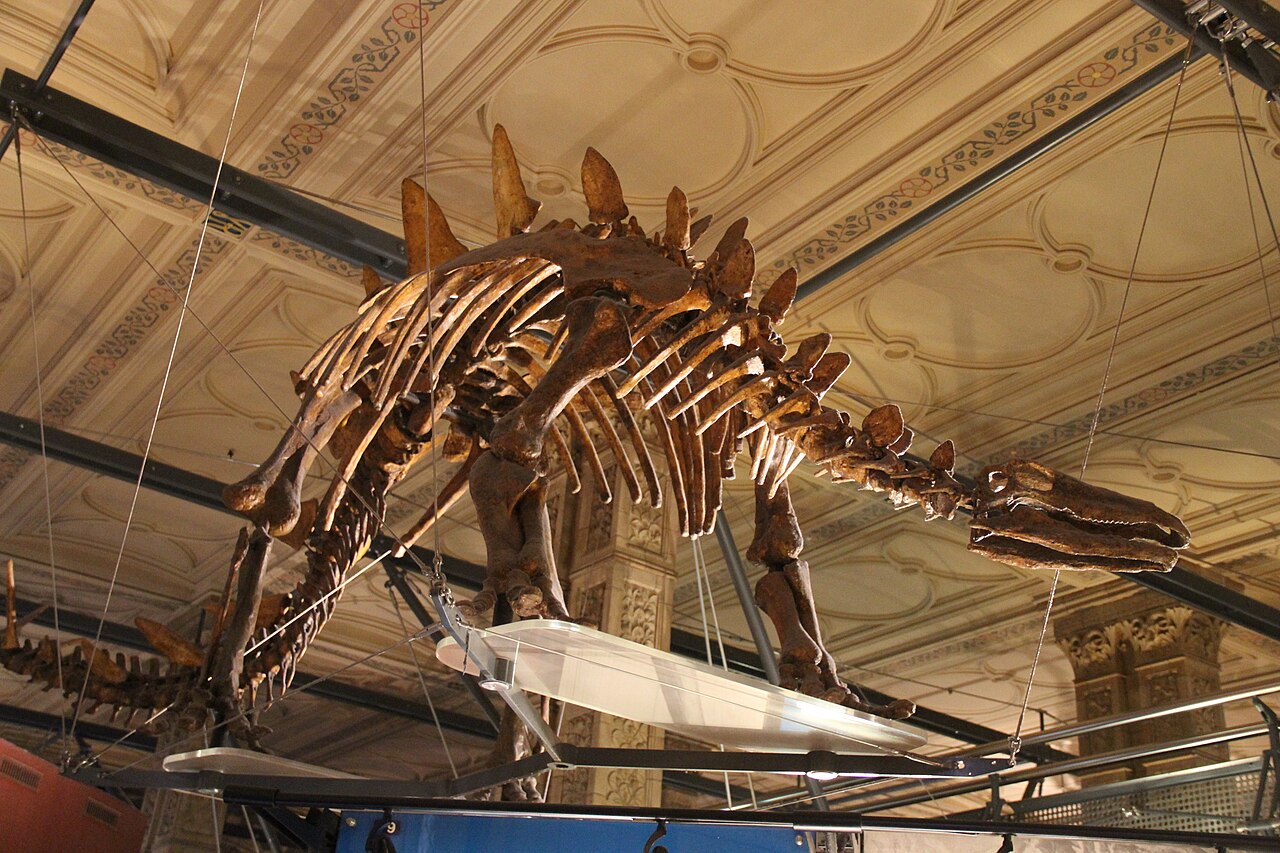
Stegosaurus: a body of about 7 tonnes and a brain of 20-27 grams.
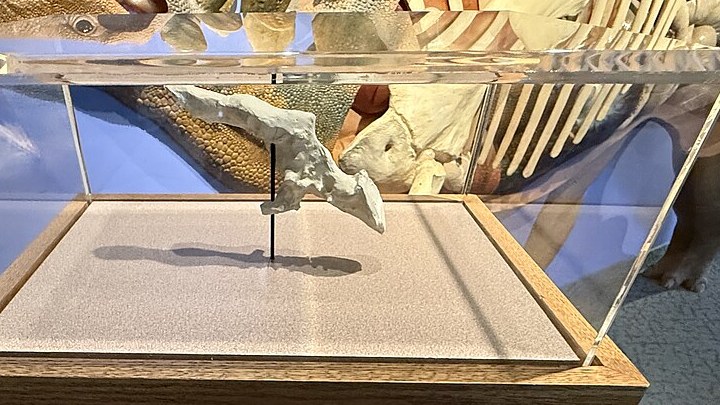
Its brain: a cast of the brain cavity (Academy of Natural Sciences of Philadelphia).
Photo: Laura Blanchard, CC BY-SA 4.0, cropped, via Wikimedia Commons
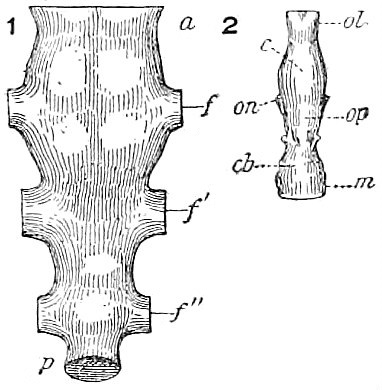
Casts drawn in 1903: the canal in the hip bones (1), later called a second brain, and the brain cavity (2) of the same animal.
The New International Encyclopaedia, vol. 6 (1903), p. 100; public domain, via Wikimedia Commons
09 How many dinosaurs have had their brain measured?
Very few. The Paleobiology Database lists 1,851 accepted genera of non-bird dinosaurs (2,434 species) [9]. In the studies we read, 45 genera have a published brain or brain-cavity measurement: 2.4%. Brains need a well-kept braincase, which few fossils have.
From every named dinosaur to the few with a brain we can compare
Genera of non-bird dinosaurs: accepted in the Paleobiology Database on 2 November 2026; with a published brain or brain-cavity measurement in the studies we read (a lower bound); measured in the 2024 study we use for the ranking; and with neuron estimates in both the 2023 and the 2024 study.
Source: Paleobiology Database [9]; [1] [3] [4] [5]; count by IQ Metrics
Data table
| stage | count | pct_of_first | pct_of_previous |
|---|---|---|---|
| Named dinosaur genera | 1851 | 100 | 100 |
| With a published brain measurement | 45 | 2.4 | 2.4 |
| Measured in the 2024 study (our ranking) | 30 | 1.6 | 66.7 |
| With neuron estimates in both studies | 18 | 1 | 60 |
Embed this chart
Paste this HTML into your page: it carries the numbers and the credit link to this figure.
The 45 dinosaurs with a measured brain, by group
One square per genus. Hover a square for its name.
45 generaone square = one genus
Source: Our dataset (CSV below), from [1] [3] [4] [5]
Data table
| genus | group | label | detail |
|---|---|---|---|
| Bambiraptor | Small feathered theropods | Bambiraptor | Small feathered theropods |
| Citipati | Small feathered theropods | Citipati | Small feathered theropods |
| Conchoraptor | Small feathered theropods | Conchoraptor | Small feathered theropods |
| Khaan | Small feathered theropods | Khaan | Small feathered theropods |
| Ornithomimus | Small feathered theropods | Ornithomimus | Small feathered theropods |
| Shuvuuia | Small feathered theropods | Shuvuuia | Small feathered theropods |
| Stenonychosaurus | Small feathered theropods | Stenonychosaurus | Small feathered theropods |
| Troodontid (unnamed) | Small feathered theropods | Troodontid (unnamed) | Small feathered theropods |
| Tsaagan | Small feathered theropods | Tsaagan | Small feathered theropods |
| Zanabazar | Small feathered theropods | Zanabazar | Small feathered theropods |
| Alioramus | Tyrannosaurs | Alioramus | Tyrannosaurs |
| Gorgosaurus | Tyrannosaurs | Gorgosaurus | Tyrannosaurs |
| Tarbosaurus | Tyrannosaurs | Tarbosaurus | Tyrannosaurs |
| Tyrannosaurus | Tyrannosaurs | Tyrannosaurus | Tyrannosaurs |
| Acrocanthosaurus | Other theropods | Acrocanthosaurus | Other theropods |
| Allosaurus | Other theropods | Allosaurus | Other theropods |
| Baryonyx | Other theropods | Baryonyx | Other theropods |
| Carcharodontosaurus | Other theropods | Carcharodontosaurus | Other theropods |
| Carnotaurus | Other theropods | Carnotaurus | Other theropods |
| Erlikosaurus | Other theropods | Erlikosaurus | Other theropods |
| Giganotosaurus | Other theropods | Giganotosaurus | Other theropods |
| Majungasaurus | Other theropods | Majungasaurus | Other theropods |
| Murusraptor | Other theropods | Murusraptor | Other theropods |
| Sinraptor | Other theropods | Sinraptor | Other theropods |
| Amargasaurus | Sauropods and kin | Amargasaurus | Sauropods and kin |
| Apatosaurus | Sauropods and kin | Apatosaurus | Sauropods and kin |
| Buriolestes | Sauropods and kin | Buriolestes | Sauropods and kin |
| Diplodocus | Sauropods and kin | Diplodocus | Sauropods and kin |
| Giraffatitan | Sauropods and kin | Giraffatitan | Sauropods and kin |
| Nigersaurus | Sauropods and kin | Nigersaurus | Sauropods and kin |
| Amurosaurus | Ornithopods and hadrosaurs | Amurosaurus | Ornithopods and hadrosaurs |
| Camptosaurus | Ornithopods and hadrosaurs | Camptosaurus | Ornithopods and hadrosaurs |
| Edmontosaurus | Ornithopods and hadrosaurs | Edmontosaurus | Ornithopods and hadrosaurs |
| Hypacrosaurus | Ornithopods and hadrosaurs | Hypacrosaurus | Ornithopods and hadrosaurs |
| Iguanodon | Ornithopods and hadrosaurs | Iguanodon | Ornithopods and hadrosaurs |
| Lurdusaurus | Ornithopods and hadrosaurs | Lurdusaurus | Ornithopods and hadrosaurs |
| Mantellisaurus | Ornithopods and hadrosaurs | Mantellisaurus | Ornithopods and hadrosaurs |
| Proa | Ornithopods and hadrosaurs | Proa | Ornithopods and hadrosaurs |
| Thescelosaurus | Ornithopods and hadrosaurs | Thescelosaurus | Ornithopods and hadrosaurs |
| Protoceratops | Horned dinosaurs | Protoceratops | Horned dinosaurs |
| Psittacosaurus | Horned dinosaurs | Psittacosaurus | Horned dinosaurs |
| Triceratops | Horned dinosaurs | Triceratops | Horned dinosaurs |
| Euoplocephalus | Stegosaurs and ankylosaurs | Euoplocephalus | Stegosaurs and ankylosaurs |
| Kentrosaurus | Stegosaurs and ankylosaurs | Kentrosaurus | Stegosaurs and ankylosaurs |
| Stegosaurus | Stegosaurs and ankylosaurs | Stegosaurus | Stegosaurs and ankylosaurs |
Embed this chart
Paste this HTML into your page: it carries the numbers and the credit link to this figure.
Brain size is a rough guide. Reasoning can be measured.
Our IQ test measures how you reason with patterns and places your result against adults, with a percentile.
Take the IQ test10 Every dinosaur in our comparison
Every dinosaur on the consistent scale (31 species)
Ma = million years ago (the middle of the species' range in the Paleobiology Database). Body and brain: Caspar et al. 2024. "x reptile" = brain size for body size against a typical living reptile. Neurons in millions, as the 2024 study's reptile-like and bird-like estimates.
| Troodon (Stenonychosaurus) | Feathered theropod | 75 | 47 | 39 | 6.5 | 134 | 575 |
| Bambiraptor | Feathered theropod | 78 | 8.1 | 14 | 6.2 | 69 | 278 |
| Ornithomimus | Feathered theropod | 75 | 84 | 50 | 6.1 | 159 | 691 |
| Archaeopteryx | Early bird | 147 | 0.3 | 1.5 | 3.9 | 16 | 56 |
| Khaan | Feathered theropod | 78 | 22 | 8.8 | 2.3 | 51 | 199 |
| Citipati | Feathered theropod | 78 | 124 | 22 | 2.2 | 93 | 385 |
| T. rex | Tyrannosaur | 75 | 8,070 | 97-179 | 1.2-2.2 | 246-365 | 1,114-1,722 |
| Hypacrosaurus | Ornithopod | 75 | 3,689 | 86-116 | 1.3-1.8 | 226-276 | 1,016-1,264 |
| Protoceratops | Horned | 79 | 83 | 9.3-13 | 1.1-1.6 | 53-64 | 207-258 |
| Carcharodontosaurus | Theropod | 118 | 3,269 | 69-94 | 1.1-1.5 | 198-241 | 876-1,088 |
| Iguanodon | Ornithopod | 132 | 8,268 | 111-150 | 1.1-1.4 | 268-327 | 1,223-1,520 |
| Edmontosaurus | Ornithopod | 75 | 6,610 | 93-126 | 1.0-1.4 | 239-292 | 1,079-1,342 |
| Shuvuuia | Feathered theropod | 78 | 3.0 | 1.5 | 1.2 | 16 | 56 |
| Psittacosaurus | Horned | 123 | 29 | 4.4-6.0 | 1.0-1.3 | 32-40 | 122-151 |
| Tarbosaurus | Tyrannosaur | 78 | 2,345 | 49-67 | 1.0-1.3 | 158-193 | 685-852 |
| Sinraptor | Theropod | 158 | 1,122 | 29-40 | 0.9-1.2 | 113-137 | 473-588 |
| Carnotaurus | Theropod | 69 | 1,642 | 34-45 | 0.8-1.1 | 123-150 | 520-646 |
| Giganotosaurus | Theropod | 110 | 6,137 | 70-94 | 0.8-1.1 | 198-242 | 878-1,092 |
| Majungasaurus | Theropod | 69 | 1,614 | 28-38 | 0.7-0.9 | 108-132 | 453-563 |
| Acrocanthosaurus | Theropod | 108 | 3,455 | 38-52 | 0.6-0.8 | 133-162 | 569-707 |
| Allosaurus | Theropod | 149 | 2,542 | 31-41 | 0.6-0.8 | 115-141 | 486-604 |
| Triceratops | Horned | 75 | 13,275 | 71-96 | 0.5-0.7 | 200-243 | 889-1,105 |
| Euoplocephalus | Armoured | 78 | 2,330 | 26-35 | 0.5-0.7 | 103-126 | 429-533 |
| Thescelosaurus | Ornithopod | 75 | 339 | 8.6-12 | 0.5-0.7 | 50-61 | 195-243 |
| Giraffatitan (Brachiosaurus) | Sauropod | 152 | 34,003 | 96-130 | 0.4-0.6 | 244-298 | 1,105-1,374 |
| Kentrosaurus | Armoured | 152 | 1,597 | 16-22 | 0.4-0.5 | 76-93 | 310-385 |
| Buriolestes | Sauropod | 232 | 6.4 | 0.8-1.0 | 0.4-0.5 | 10-12 | 34-42 |
| Amargasaurus | Sauropod | 124 | 10,195 | 26-35 | 0.2-0.3 | 104-127 | 433-539 |
| Diplodocus | Sauropod | 150 | 14,813 | 31-42 | 0.2-0.3 | 116-142 | 491-611 |
| Stegosaurus | Armoured | 149 | 6,954 | 20-27 | 0.2-0.3 | 87-106 | 357-444 |
| Apatosaurus | Sauropod | 150 | 41,269 | 32-43 | 0.1 | 118-144 | 500-621 |
Source: Caspar et al. 2024, Tables 1-2 [1]; ages [9]; equation [4]; calculation by IQ Metrics
11 How we built the dataset
- 01
- 02
Use one source for the ranking
Brain and body masses from one study, the 2024 one, so the 31 dinosaurs are measured the same way (brain = 31%-42% of the cavity for most, 100% for the bird-like ones, as that study did).
- 03
One equation for all
Brain size against a living reptile of the same weight: brain (g) divided by 0.0155 x body (g) to the power 0.553 (Hurlburt 1996, as given in [4]).
- 04
Keep both neuron answers
Each neuron estimate is shown as published, reptile-like and bird-like; we do not choose between them.
- 05
Count what is missing
Named genera from the Paleobiology Database, queried on 2 November 2026 [9].
Read every number with these in mind
- A brain is never fossilised; every dinosaur brain weight is an estimate from the cavity in the skull.
- Brain size for body size is not intelligence, and neither is a neuron count. Both are clues.
- Body weights of dinosaurs are estimates too; heavier estimates make a brain look smaller for its body.
- The 2023 study’s values are read from its preprint (version 3); the published article is not open to read. The values we use match the ones the 2024 study reprints from the published article.
- Our count of measured dinosaurs is a lower bound: unpublished theses may hold a few more.
Sources
- The Anatomical Record 2024;307(12):3685-3716. Tables 1-3 (version of record). Caspar, K. R., Gutierrez-Ibanez, C., Bertrand, O. C., Carr, T., Colbourne, J. A. D., Erb, A., George, H., Holtz, T. R., Naish, D., Wylie, D. R. & Hurlburt, G. R. How smart was T. rex? Testing claims of exceptional cognition in dinosaurs and the application of neuron count estimates in palaeontological research. The Anatomical Record 307(12), 3685-3716. 2024. doi.org/10.1002/ar.25459Facts cited
- Journal of Comparative Neurology 2023;531:962-974. Herculano-Houzel, S. Theropod dinosaurs had primate-like numbers of telencephalic neurons. Journal of Comparative Neurology 531(9), 962-974. 2023. doi.org/10.1002/cne.25453Facts cited
- bioRxiv, preprint v3 (3 Dec 2022). Table 1. Herculano-Houzel, S. Theropod dinosaurs had primate-like numbers of telencephalic neurons. bioRxiv preprint v3, posted 3 Dec 2022 (Table 1, pp. 27-29). 2022. www.biorxiv.org/content/10.1101/2022.06.20.496834v3.full.pdfFacts cited
- Journal of Anatomy 2023. Table 3 and the REQ equation. Barker, C. T., Naish, D., Trend, J., Michels, L. V., Witmer, L., Ridgley, R., Rankin, K., Clarkin, C. E., Schneider, P. & Gostling, N. J. Modified skulls but conservative brains? The palaeoneurology and endocranial anatomy of baryonychine dinosaurs (Theropoda: Spinosauridae). Journal of Anatomy 242(6), 1124-1144. 2023. doi.org/10.1111/joa.13837Facts cited
- Biological Reviews 2011;86:117-155. Section II.8. Sander, P. M., Christian, A., Clauss, M., Fechner, R., Gee, C. T., Griebeler, E.-M., et al. Biology of the sauropod dinosaurs: the evolution of gigantism. Biological Reviews 86(1), 117-155. 2011. doi.org/10.1111/j.1469-185X.2010.00137.xFacts cited
- The Anatomical Record 2025. Discussion. Atterholt, J., Wedel, M. J., Tykoski, R., Fiorillo, A. R., Holwerda, F., Nalley, T. K., Lepore, T. & Yasmer, J. Neural canal ridges: a novel osteological correlate of postcranial neuroanatomy in dinosaurs. The Anatomical Record 308(5), 1349-1368. 2025. doi.org/10.1002/ar.25558Facts cited
- The Anatomical Record 2023. Discussion. Atterholt, J. & Wedel, M. J. A computed tomography-based survey of paramedullary diverticula in extant Aves. The Anatomical Record 306(1), 29-50. 2023. doi.org/10.1002/ar.24923Facts cited
- Paleobiology Database, data service 1.2, queried 2 Nov 2026. Paleobiology Database, data service v1.2 (taxa/single and taxa/list), queried 2 Nov 2026. 2026. paleobiodb.org/data1.2Data CC BY 4.0
- Proc Natl Acad Sci USA 2016;113(26):7255-7260. Tables S1, S3, S4. Olkowicz S, Kocourek M, Lučan RK, et al: Birds have primate-like numbers of neurons in the forebrain. 2016. doi.org/10.1073/pnas.1517131113Facts cited
- Proc Natl Acad Sci USA 2022;119(11):e2121624119. Dataset S1. Kverková K, Marhounová L, Polonyiová A, et al: The evolution of brain neuron numbers in amniotes. 2022. doi.org/10.1073/pnas.2121624119Facts cited
- J Comp Neurol 2009;513(5):532-541. Azevedo FAC, Carvalho LRB, Grinberg LT, et al: Equal numbers of neuronal and nonneuronal cells make the human brain an isometrically scaled-up primate brain. 2009. doi.org/10.1002/cne.21974Facts cited
- IQ Metrics Research. Smartest animals: neuron counts and test results for 100+ species (our data set of living animals: brain mass, body mass, neurons). 2026. iqmetrics.org/research/smartest-animalsCC BY 4.0
Version history
- 2026.112 November 2026First release.
Leon Falkner, Data & Research Analyst. Leon owns the arithmetic on IQ Metrics: the percentile tables, the score converter and the figures in everyone else's drafts. On the research desk Leon pulls the data, builds each index and writes the method. More about Leon.
Questions
What was the smartest dinosaur?
On brain size for body size, Troodon (Stenonychosaurus): about 6.5 times the brain of a living reptile of its weight, close to living birds. Bambiraptor and Ornithomimus were next.
How big was a T. rex brain?
About 97 to 179 grams on the 2024 estimate, roughly a tenth of a human brain. Larger estimates (up to 343 g) assume the brain filled the whole cavity in the skull.
Was T. rex smart?
Probably as smart as a large reptile, or a little more. A 2023 study suggested baboon-like neuron numbers; a 2024 study put the likely count at 0.25 to 0.36 billion forebrain neurons, closer to a crocodile's pattern.
How smart was Velociraptor?
No Velociraptor brain has been measured in the studies we read. Its close relative Bambiraptor had a brain about 6.2 times that of a reptile its weight, among the highest of any dinosaur.
Did Stegosaurus have two brains?
No. The space in its spinal canal over the hips probably held a glycogen body, as in birds. Its one brain weighed about 20 to 27 grams.
Share it, cite it, download it
You may reuse everything on this page under CC BY 4.0: in articles, reports, lessons and posts. The one condition is credit to IQ Metrics with a link to this page.
Cite this study
Version 2026.11. Citing the version lets readers find the exact numbers.
Archived copy with a DOI: 10.5281/zenodo.23909530 (report PDF and data on Zenodo).
Falkner, L. (2026). How smart were dinosaurs? Every dinosaur brain measured (Version 2026.11) [Data set]. IQ Metrics Research. https://iqmetrics.org/research/how-smart-were-dinosaurs/ (DOI: 10.5281/zenodo.23909530)
Falkner, Leon. "How smart were dinosaurs? Every dinosaur brain measured." IQ Metrics Research, 2 Nov. 2026, iqmetrics.org/research/how-smart-were-dinosaurs/. DOI: 10.5281/zenodo.23909530.
Falkner, Leon. "How smart were dinosaurs? Every dinosaur brain measured." IQ Metrics Research. November 2, 2026. https://iqmetrics.org/research/how-smart-were-dinosaurs/. DOI: 10.5281/zenodo.23909530.
@misc{iqmetrics2026howsmartweredinosaurs, author = {Falkner, Leon}, title = {How smart were dinosaurs? Every dinosaur brain measured}, institution = {IQ Metrics}, year = {2026}, version = {2026.11}, doi = {10.5281/zenodo.23909530}, url = {https://iqmetrics.org/research/how-smart-were-dinosaurs/} }
Source: Leon Falkner, "How smart were dinosaurs? Every dinosaur brain measured." IQ Metrics Research, version 2026.11, https://iqmetrics.org/research/how-smart-were-dinosaurs/ (DOI 10.5281/zenodo.23909530)
Embed the key numbers
Paste this into an article or post. It lists the main numbers and credits the source.
Get the data
One row per dinosaur, specimen and source (115 rows): species, group, age, brain-cavity volume, the share of it taken as brain, brain and body mass, our reptile encephalization quotient (for the 2024 study’s dinosaurs), the published quotient where a paper gives one, the reptile-like and bird-like neuron estimates, and where each number is in its paper.
| Column | What it holds |
|---|---|
species, common_name, group, specimen | The dinosaur and the fossil measured |
age_ma, period | Middle of the species' age range in the Paleobiology Database (million years ago) |
endocast_ml, brain_share_assumed, brain_g_min, brain_g_max | Brain-cavity volume, the share taken as brain, brain mass |
body_kg | Body mass as estimated in that source |
req_iqmetrics_min, req_iqmetrics_max | Our reptile quotient: brain / (0.0155 x body g ^ 0.553); 2024-study rows only |
neurons_if_reptile_like_*, neurons_if_bird_like_* | Forebrain (telencephalon) neurons as published, both assumptions |
neuron_source, brain_source, body_source, where | Source ids and the table or page of each number |
For journalists, researchers and teachers
Everything on this page may be quoted, charted and republished with credit. No embargo, no permission needed, no sign-up. If you need a number that is not here, ask.
Summary you can paste
Plain news style. Edit freely; keep the credit.
IQ Metrics Research collected every published dinosaur brain measurement (115 rows, 68 names) and put the 31 dinosaurs of a 2024 study on one scale of brain size for body size. Troodon had about 6.5 times the brain of a living reptile of its weight, Bambiraptor 6.2 and Ornithomimus 6.1; T. rex 1.2-2.2; Stegosaurus 0.2-0.3 and Apatosaurus 0.1. Published estimates of the neurons in T. rex's forebrain run from 0.25 to 3.3 billion. Only 45 of 1,851 named dinosaur genera have a measured brain. Source: IQ Metrics Research, https://iqmetrics.org/research/how-smart-were-dinosaurs/
Angles for a story
- The smartest dinosaur was the size of a large dog (Figure 1).
- T. rex’s brain: a tenth of yours (Figure 3).
- Baboon or crocodile? The T. rex neuron dispute in one chart (Figure 4).
- The 2024 re-measurement cut 16 of 19 estimates (Figure 5).
- A macaw out-counts T. rex (Figure 7).
- Only 45 of 1,851 named dinosaurs have had their brain measured (Figure 8).
Quotes you can use
Attributable as written, with the name and title. For a different angle or a quote on a specific figure, ask through the contact page.
The smartest dinosaurs, by brain size, were the small feathered ones. The giants we all know had reptile-sized brains for their bodies.
Leon Falkner, Data & Research Analyst, IQ Metrics ResearchWhether T. rex had a third of a billion neurons or three billion depends on one thing nobody can see: how tightly its brain was packed.
Leon Falkner, Data & Research Analyst, IQ Metrics ResearchA macaw today has more forebrain neurons than the best recent estimate for T. rex. The cleverest dinosaurs are still flying around us.
Leon Falkner, Data & Research Analyst, IQ Metrics Research
Files
- CSV of every dinosaur brain, with specimen, brain and body mass, our reptile quotient, neuron estimates and sources (CC BY 4.0)
- Every figure as a print-ready PNG: use the Image button under each figure
- Embed code and data table under every figure
- Share images for social media in three sizes, with the credit line built in
- Citations in APA, MLA, Chicago, BibTeX and plain text
Terms, contact and corrections
Credit: “IQ Metrics Research, How Smart Were Dinosaurs? (2026)” with a link to this page. On air or in print, “IQ Metrics” and the page address are enough.
What it covers: every dinosaur brain or brain-cavity measurement in the studies we read (2007-2025), the 2023 and 2024 neuron estimates, and a count of named genera from the Paleobiology Database.
Contact: the research team, through the contact page. Corrections are made on this page with a dated note in the version history.