




Crow IQ: How Smart Are Crows and Ravens, Really?
A crow has no IQ, but tests show what corvids can do: bend wire, plan hours ahead, count their own calls. The 7-year-old comparison traces to one 2014 study of six crows, who were at chance on two of six puzzles.

A crow has no IQ. An IQ is a score defined by comparing a person with a norm group of people the same age, and no norm group exists for any bird. What science can say is what crows and ravens do: bend wire into hooks, plan for a need that will only arise hours later, produce a set number of calls on cue, and pass some cause-and-effect puzzles at about the level of a 5-to-7-year-old child. On other puzzles the same crows perform no better than chance. That mixed record is more interesting than any single number.
- No crow IQ exists. IQ needs human norms; any figure attached to a crow or raven in a meme or listicle has no source.
- What is measured instead: tool making, planning ahead, analogical reasoning, counting one’s own calls and remembering human faces, each tested with a task built for the species, usually on a handful of birds.
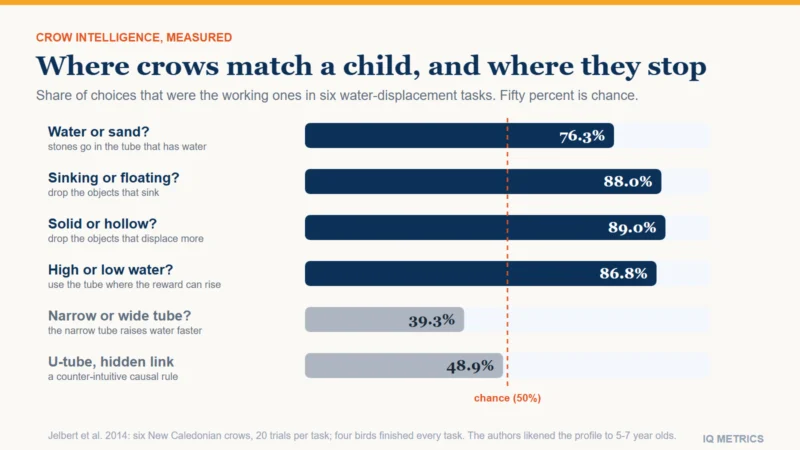
- The “7-year-old” line traces to a 2014 study of six New Caledonian crows on water-displacement puzzles, compared with children aged 5 to 7 on that task alone.
- Where crows stop: the same birds were at chance on two of the six puzzles.
This article covers why “crow IQ” is not a real number, the landmark experiments and their limits, the true origin of the 7-year-old comparison, how a crow brain compares with a primate brain, whether ravens are smarter than crows, and the other kind of Raven that turns up when you search for “raven IQ”.
Can a crow's IQ be measured?
Not in the way a person’s can. A modern IQ is a deviation score with a mean of 100 and a standard deviation of 15, so a result only means something next to the people of the same age it was normed on (see the IQ bell curve). There is no such reference group for crows, and no test written in words or pictures for humans would be fair to a bird with different senses, motivations and bodies. The same problem applies to dog IQ, where researchers use tasks that fit the species instead.
What comparative psychologists do is give animals a physical task and compare pass rates, trial counts and errors. The result is a profile of what a species can do, with its own caveats about training, motivation and sample size. Some researchers have asked whether animals show a general factor of intelligence like human g. A meta-analysis of 555 correlations between cognitive tasks in animals found a mean of just 0.185 (95% confidence interval 0.087 to 0.287) and described the support for general intelligence as relatively weak. Studies of wild birds point in different directions: New Zealand robins tested on six tasks produced a first component explaining a little over 34% of the variance, below the 40% or so typical of human tests, while Australian magpies on four tasks produced 64.6%, though critics say four tasks are far from comprehensive. As far as we could find, no crow or raven has been tested for a general factor at all.
What do crows and ravens actually do?
These seven results are the ones most often cited, each from a peer-reviewed study. Species matter: crows, ravens and rooks are all corvids, but each finding belongs to the species tested, and the sample sizes are small.
| Experiment | Species | What the birds did |
|---|---|---|
| Tool making (Weir, Chappell and Kacelnik, 2002) | New Caledonian crow | A crow called Betty bent a straight wire into a hook in 9 of 10 valid trials. Her male companion never did. One bird, and the authors note the skill probably has a developmental history. |
| Metatool use (Taylor et al., 2007) | New Caledonian crow | Seven crows faced a puzzle in which a short tool had to be used to get a longer one. Six tried it and four succeeded on the first trial. |
| Water displacement (Bird and Emery, 2009) | Rook | All four rooks tested dropped stones into a water-filled tube to raise a floating reward within reach. |
| Analogical reasoning (Smirnova et al., 2015) | Hooded crow | Two birds passed relational matching-to-sample after training on identity matching. Critics question whether this is analogy in the human sense. |
| Planning ahead (Kabadayi and Osvath, 2017) | Raven | Five hand-raised ravens chose and kept a tool, or a token to trade for one, for a task that arrived 15 minutes or 17 hours later. |
| Counting own calls (Liao, Brecht, Veit and Nieder, 2024) | Carrion crow | Three crows produced one to four calls to match arbitrary cues. Errors grew with the number, which the authors read as an approximate number sense, a precursor of counting. |
| Remembering faces (Marzluff et al., 2010) | American crow | Wild crows trapped by a person in a mask kept responding to that mask for at least 2.7 years. |
Two cautions apply to every row. First, most of these birds were trained or habituated for the task, and each result has critics who propose leaner explanations, such as trial-and-error learning. Second, a result such as the 2017 raven study is usually described as matching great apes on one kind of planning; it is not evidence of an all-round ape-level mind. Researchers describe the pattern as “divergent brain evolution with convergent mental evolution”, the phrase Nathan Emery and Nicola Clayton used in their 2004 Science review of the field.
Where does the "as smart as a 7-year-old" claim come from?
It traces to a 2014 paper in PLOS ONE by Sarah Jelbert and colleagues. Six wild-caught New Caledonian crows, pre-trained to drop stones, were given “Aesop’s fable” puzzles, in which objects must be dropped into a tube to raise a floating reward. Across 20 trials per task the birds chose the tube with water over the tube with sand 76.3% of the time, objects that sink over objects that float 88.0%, solid over hollow objects 89.0%, and the tube with the higher water level 86.8%. They did not favour the narrow tube that raises water faster (39.3%), and on the U-tube task, where a hidden connection makes the obvious choice the wrong one, they performed at chance (48.9%). Only four of the six birds completed every task. The authors said the birds’ grasp of causal properties rivalled that of 5-to-7-year-old children on similar tasks. Press coverage later compressed that into “as smart as a 7-year-old”.
A companion study by Lucy Cheke, Elsa Loissel and Nicola Clayton (2012) gave the same tasks to children aged 4 to 10, in five two-minute trials. Most children aged seven and over learned to pass even the counter-intuitive U-tube version, while few younger children did. So the line is a fair summary of one narrow task, and even that is contested: critics note that the crows sometimes dropped non-functional objects early on, and a later meta-analysis argued that Aesop’s fable tasks cannot separate trial-and-error learning from causal reasoning. It is not a statement about general intelligence. A crow that matches a six-year-old at water displacement has not matched one at language, arithmetic or reading. The age-based comparison also mirrors how human testing works, which is what IQ test questions for kids explains.
How does a crow brain compare with a primate brain?
Bird brains are small but densely packed. A 2016 study in PNAS by Seweryn Olkowicz and colleagues counted neurons in 73 birds from 28 species and found that parrot and songbird brains hold about twice as many neurons as primate brains of the same mass. A raven’s 14-gram brain contains about 2.2 billion neurons, more than a billion of them in the pallium, the forebrain region associated with flexible behaviour. That is more than a capuchin monkey has in its pallium, and a blue-and-yellow macaw, with a walnut-sized brain, has more pallial neurons than a rhesus monkey. Two limits are worth stating. The study sampled ravens and rooks but no crow species, so “crows have primate-like neuron counts” goes a step beyond the data. And a raven’s brain, at about 14.5 cubic centimetres, is roughly a twenty-fifth the volume of a chimpanzee’s.
That is why “bird brain” is a poor insult, and why raw brain size is a weak predictor of ability across species. The same caution holds within humans: brain size and IQ correlate only modestly, and popular brain myths about intelligence show how often a tidy claim about brains outruns the evidence.
Crow vs raven: which is smarter?
Nobody has run one identical test battery on both species and ranked them, so the honest answer is that they are comparable on the tasks that exist. The famous tool-making results come from New Caledonian crows, which use tools routinely in the wild, while the long-range planning results come from ravens. Each species looks best on the task it was given. The physical differences are clearer:
| Measure | Common raven | American crow |
|---|---|---|
| Length | 56 to 69 cm | 41 to 53 cm |
| Wingspan | 116 to 118 cm | 86 to 99 cm |
| Weight | 689 g to 1.63 kg | 311 to 623 g |
| Oldest wild bird on record | 22 years 6 months | 18 years 4 months |
| Brain volume (measured in a comparable species) | raven: 14.5 cm³ | New Caledonian crow: 7.3 cm³ |
The raven is the largest songbird in the world, and it has the bigger brain. That does not make it the cleverer bird on any given test, only the larger one.
Where would your own score land?
Take the IIF-certified assessment and get your score with the scale it was measured on, the percentile it corresponds to and the confidence range around it — the three figures most online tests leave out.
Find your IQ score now! →Are crows smarter than dogs, chimpanzees or children?
There is no single fair answer, because the skills differ. Dogs are exceptional at following human pointing and gestures, a skill shaped by thousands of years of domestication; crows are exceptional at making and adapting tools, which dogs are not known to do. No head-to-head test of the two exists, and the dog IQ article covers the dog side.
Corvids have been compared with apes on published ape data rather than in the same room. In a self-control task in which an animal must resist reaching straight for visible food, ravens scored 100% (five birds), jackdaws 97% and New Caledonian crows 92%, against 100% for chimpanzees, 99.1% for orangutans, 95% for bonobos and 94.4% for gorillas. In a 2020 study, hand-raised ravens (eight started, seven finished) sat a 15-task battery adapted from the one used with apes: similar on quantities, theory of mind and social learning, slightly lower on causality and communication, and lower on spatial memory. The authors warned against generalising, and the original battery compared apes with 2.5-year-old children, which is a different yardstick from the 7-year-old headline. Verbal versus non-verbal IQ scores shows why a task-based, non-verbal measure is the closest thing to a fair test for any species.
Not the bird: Raven's Progressive Matrices
Searching for “raven IQ” also returns a different Raven. Raven’s Progressive Matrices is a non-verbal reasoning test devised in the 1930s by the British psychologist John C. Raven, in which the test taker picks the piece that completes a pattern. It has nothing to do with the bird, and it is one of the most widely used measures of abstract reasoning in people. Its scoring is covered in Raven's Progressive Matrices scores explained, and the pattern-completion format is the one children meet in the kids IQ tests.
Quick answers
What is the IQ of a crow?
There is none. IQ is a human-normed score. Experiments give task results, such as 76.3% correct at choosing water over sand, not a single number.
Are crows as smart as a 7-year-old?
On one narrow set of water-displacement puzzles, comparable to 5-to-7-year-olds, according to the study that started the claim. On two of six puzzles the same crows were at chance, and the comparison says nothing about language or schooling.
Can crows count?
Approximately. In a 2024 Science study three crows produced one to four calls to match a numeral or a sound cue. That shows control over the number of their own calls, not exact counting or arithmetic.
Do crows remember faces?
Yes. Wild American crows kept responding to the face of a person who trapped them for at least 2.7 years in the 2010 experiment. Claims of far longer grudges come from press coverage rather than that peer-reviewed figure.
Do crows hold funerals?
Not in the sense of mourning. Crows gather around dead crows, and research from the University of Washington found they use the scene to learn what is dangerous.
What is the smartest bird?
Corvids and parrots top the comparative studies and have the densest forebrain neuron counts, but no ranking exists across all species and tasks.
The bottom line
Crows and ravens are impressive, but the question “what is a crow’s IQ” has no answer, because IQ is a comparison with human norms. The real picture is a profile: expert tool users, planners and face-readers that match a young child on some causal puzzles and fail others. The same lesson holds for people, where what an IQ of 135 means depends entirely on the group that the score is measured against.
Sources
- Jelbert et al. (2014), PLOS ONE: using the Aesop’s fable paradigm to investigate causal understanding of water displacement by New Caledonian crows.
- Cheke, Loissel and Clayton (2012), PLOS ONE: how do children solve Aesop’s fable?
- Weir, Chappell and Kacelnik (2002), Science: shaping of hooks in New Caledonian crows.
- Kabadayi and Osvath (2017), Science: ravens parallel great apes in flexible planning for tool-use and bartering.
- Liao, Brecht, Veit and Nieder (2024), Science: crows “count” the number of self-generated vocalizations.
- Smirnova, Zorina, Obozova and Wasserman (2015), Current Biology: crows spontaneously exhibit analogical reasoning.
- Olkowicz et al. (2016), PNAS: birds have primate-like numbers of neurons in the forebrain.
- Emery and Clayton (2004), Science: the mentality of crows: convergent evolution of intelligence in corvids and apes.
- Swift and Marzluff (2015), Animal Behaviour: wild American crows gather around their dead to learn about danger.
Keep reading
All articles →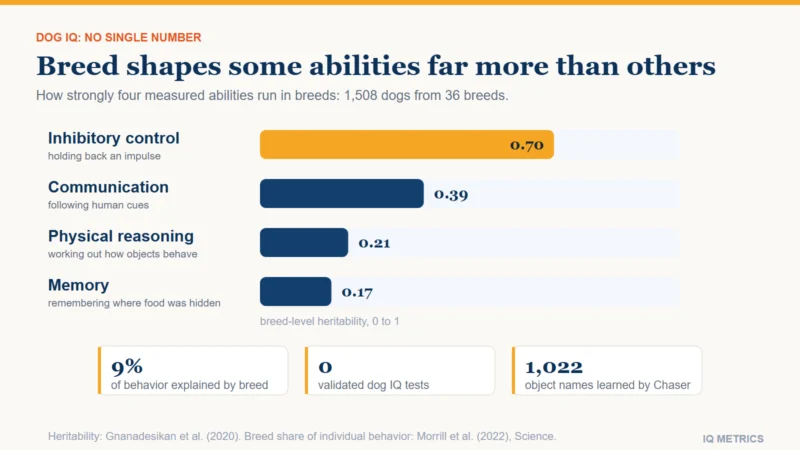 Understanding IQ
Dog IQ
Dogs do not have an IQ: no validated test gives them one. Researchers can measure trainability, memory, self-control and a small general factor, and those results say more about how dogs think than any breed ranking, at-home dog IQ test or "as smart as a toddler" comparison ever could.
 Understanding IQ
Brain Myths About Intelligence
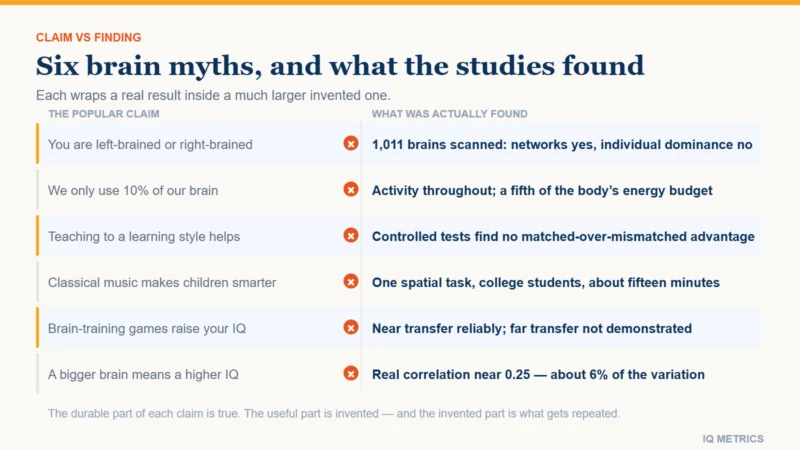
You are not left-brained or right-brained, you do not use ten per cent of your brain, and matching a lesson to your learning style does not help you learn. Six claims about intelligence that almost everyone repeats, what the studies that tested them found, and the smaller true fact hiding inside each one.
 Scores & Scales
Verbal vs Non-Verbal IQ Scores
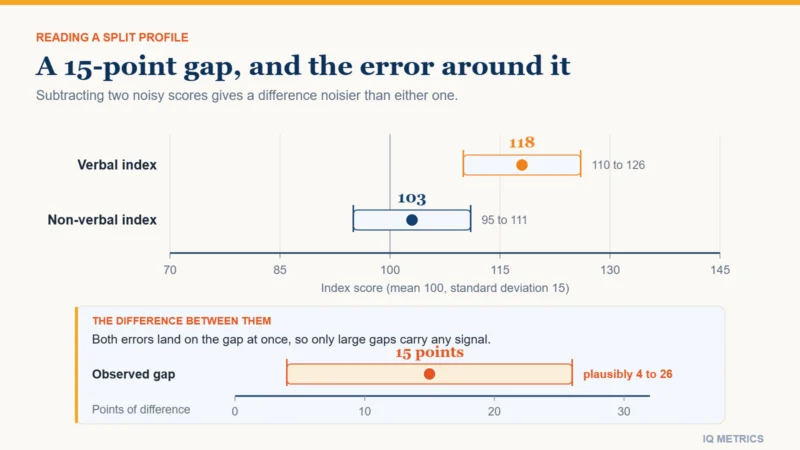
Two people can hold the same IQ number and have completely different profiles, and a split between the verbal and non-verbal indexes is far commoner than most test-takers expect. Here is what base-rate tables and compounding measurement error say about how large a gap has to be before it means anything.