





What Is a Borderline IQ? The 70 to 84 Range and What It Does Not Mean
A borderline IQ is a score of about 71 to 84, which 13.2% of people have on the standard scale. It is not an intellectual disability: ICD-10-CM codes it separately (R41.83), DSM-5-TR gives no IQ range, and the AAIDD asks for limits in everyday skills before age 22.

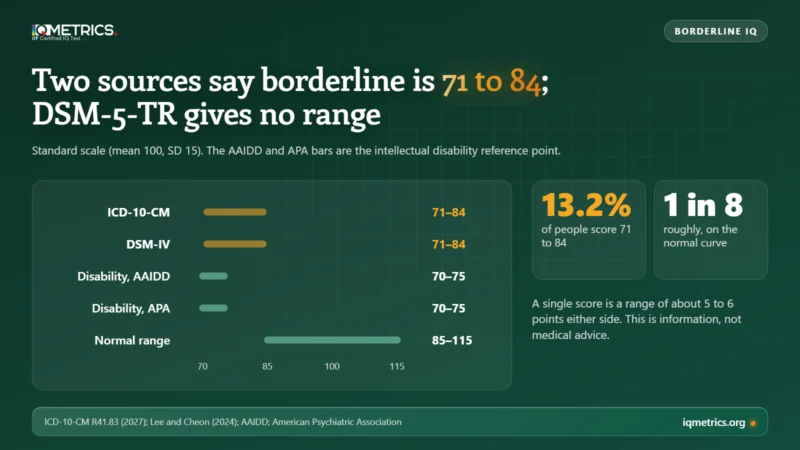
A borderline IQ is a score of about 71 to 84 on the standard scale (average 100, standard deviation 15). About 13% of people, roughly 1 in 8, score in that range. It is not an intellectual disability. ICD-10-CM codes borderline intellectual functioning as R41.83, separate from the intellectual disability codes, and DSM-5-TR lists it as something that may be a focus of clinical attention.
Below: where ICD-10-CM, DSM, the American Psychiatric Association and the AAIDD each put the line. Then what the range does and does not mean, and why one score is not a diagnosis. The new part is the side-by-side table. The same words, “borderline” and “IQ 70 to 84”, are drawn differently by each source.
Key takeaways
- Range: ICD-10-CM and the older DSM-IV both say IQ 71 to 84. On the normal curve that is 13.2% of people, about 1 in 8.
- DSM-5 and DSM-5-TR dropped the IQ range. They ask for careful assessment of intellectual and adaptive functioning instead.
- Not an intellectual disability: ICD-10-CM lists the two as separate codes, and the AAIDD requires limits in everyday skills that began before age 22.
- Reference point for intellectual disability: a full-scale IQ of around 70 to 75, read with everyday functioning and clinical judgement.
- A single score is a range of about 5 to 6 points either side, so a score near 70 or 85 cannot settle which side a person is on.
What is a borderline IQ?
A borderline IQ is a score just above the range used for intellectual disability and just below the normal range of 85 to 115. Clinicians call it borderline intellectual functioning.
It is a description, not a diagnosis of disorder. Wieland and Zitman (2016) put it plainly: according to DSM and ICD, borderline intellectual functioning is not a disorder. They call it a frequently unrecognised condition, which is one reason it helps to know exactly what the range covers.
What does an IQ of 70 to 84 mean?
IQ 70 to 84 means one to two standard deviations below the average of 100. The standard deviation (SD) is how spread out scores are, and it is 15 points on most modern tests.
Two SDs below average is 70 and one SD below is 85, so the band holds the stretch between them. Counting each score from 71 to 84, 13.2% of people fall inside it. Counting the continuous curve from 70 to 85 gives 13.6%. Our IQ percentile calculator places any score on the same curve.
In a class of 30, about 4 pupils fall in this band. The scores around it are covered in our guides to an IQ of 75 and an IQ of 80.
Where do ICD-10-CM, DSM and the AAIDD draw the line?
They draw it in different places, and some do not draw it at all. The table sets each source’s wording side by side.
| Source | What it covers | Where the line sits |
|---|---|---|
| ICD-10-CM, US edition (R41.83) | Borderline intellectual functioning | Applicable to “IQ level 71 to 84” |
| ICD-10-CM, intellectual disabilities (F70 to F79) | Mild to profound intellectual disability | Excludes borderline intellectual functioning, “IQ above 70 to 84” |
| DSM-IV | Borderline intellectual functioning | “An IQ in the 71-84 range” |
| DSM-5-TR (R41.83) | Borderline intellectual functioning | No IQ range; careful assessment of intellectual and adaptive functions |
| American Psychiatric Association | Intellectual disability | A full-scale IQ of around 70 to 75 indicates a significant limitation; no specific score is required |
| AAIDD | Intellectual disability | An IQ of around 70 or as high as 75, plus limits in adaptive behavior, before age 22 |
Two things stand out. ICD-10-CM and the old DSM-IV agree on 71 to 84. The ICD-10-CM text is the 2027 edition, in force from 1 October 2026. DSM-5 and DSM-5-TR removed the numbers. Lee and Cheon (2024) report that DSM-5 “no longer provided a specific FSIQ range”. Wieland and Zitman (2016) call this one of the least highlighted changes in DSM-5.
The DSM-5-TR says the category “may be used when an individual’s borderline intellectual functioning is the focus of clinical attention or has an impact on the individual’s treatment or prognosis”. We read it as quoted in Lee and Cheon’s Table 1, because the manual itself is sold, not posted.
Is a borderline IQ an intellectual disability?
No. Intellectual disability needs more than a score: the AAIDD defines it as significant limitations in both intellectual functioning and adaptive behavior that begin before age 22.
Adaptive behavior means everyday conceptual, social and practical skills, such as managing money, following rules or looking after yourself. The American Psychiatric Association adds that a specific IQ score is no longer required for diagnosis and that clinical judgement is needed. ICD-10-CM goes further and marks the two as mutually exclusive: a person is coded either as borderline intellectual functioning or as intellectual disability, never both.
The overlap sits at 70 to 75. A score of 72 can fall on either side of the reference point once the margin of error is counted. That is why the everyday-skills part of the assessment decides. Our guide to low IQ versus learning disability explains how a learning disability is a different thing again.
Is a borderline IQ a disability?
A borderline IQ is not an intellectual disability diagnosis, and DSM and ICD do not treat it as a disorder. That does not mean it has no effect on school, work or daily life.
Support and legal protection are set by the rules of each country, school system and programme. They usually look at how a person functions, not at a score alone. If you or your child needs help, ask a school psychologist, a clinical psychologist or a doctor for a full assessment. It should cover everyday skills as well as an IQ score. The AAIDD stresses that only a comprehensive evaluation lets a clinician decide, and that strengths sit alongside limits. This page is information, not medical advice.
Where would your own score land?
Take the IIF-certified assessment and get your score with the scale it was measured on, the percentile it corresponds to and the confidence range around it — the three figures most online tests leave out.
Find your IQ score now! →How many people have a borderline IQ?
On the normal curve, about 13% of people score 71 to 84, so roughly 1 in 8. That is a count of scores, not of diagnoses.
Lee and Cheon (2024) note that the full-scale IQ alone could place 13.6% of people in the range. They add that when everyday functioning is also considered, the share meeting the criteria is likely to be lower. Our IQ test range guide and average IQ guide show where the band sits among the others.
How accurate is a borderline score?
Not very, at the level of single points. A full-scale score has a standard error of measurement of about 2 to 3 points, so a 95% interval is roughly 5 to 6 points either side.
A reported 78 fits a true standing of about 72 to 84, and a reported 84 fits about 78 to 90. Two sittings can give different labels, and the same score can get a different word on different charts. Our explainer on the margin of error in an IQ score shows how to read a range. Our IQ of 80 guide lays out the chart labels for this stretch.
What should you do with a borderline score?
Treat it as one piece of information and ask what it is based on. Check which test and which scale produced it, who gave it, and whether adaptive skills were assessed too.
A score from an online quiz is not a clinical result. If you want to see how a score compares with the bands above, take the IQ test as an estimate. Talk to a qualified professional about any decision that matters.
Quick answers
- What is a borderline IQ? A score of about 71 to 84 on the standard scale, the stretch between the normal range and the intellectual disability reference point.
- What is borderline intellectual functioning? The clinical name for it: ICD-10-CM code R41.83 and a DSM-5-TR category that may be a focus of clinical attention.
- Is IQ 70 to 84 an intellectual disability? No. Intellectual disability also needs limits in everyday skills that began before age 22.
- Is a borderline IQ a disability? Not as a diagnosis. Support depends on local rules and on how a person functions, so ask a qualified professional.
- How many people have a borderline IQ? About 13.2% of people score 71 to 84 on SD 15, roughly 1 in 8.
The bottom line
A borderline IQ is a score of about 71 to 84, which 13.2% of people have, and it is a description rather than a diagnosis of disability. ICD-10-CM and the old DSM-IV give the range, DSM-5-TR and the AAIDD do not, and every source asks for more than one score.
Sources
- ICD-10-CM R41.83, Borderline intellectual functioning: applicable to IQ level 71 to 84, with the exclusion note shared with F70 to F79 (tabular list, US 2027 edition).
- Lee and Cheon (2024), Journal of the Korean Academy of Child and Adolescent Psychiatry: DSM-IV and DSM-5-TR wording, and the 13.6% share.
- Wieland and Zitman (2016), BJPsych Bulletin: borderline intellectual functioning in DSM and ICD.
- AAIDD, definition of intellectual disability and American Psychiatric Association, what is intellectual disability.
- Shares of people are our arithmetic from the normal curve with a mean of 100 and an SD of 15.
Keep reading
All articles →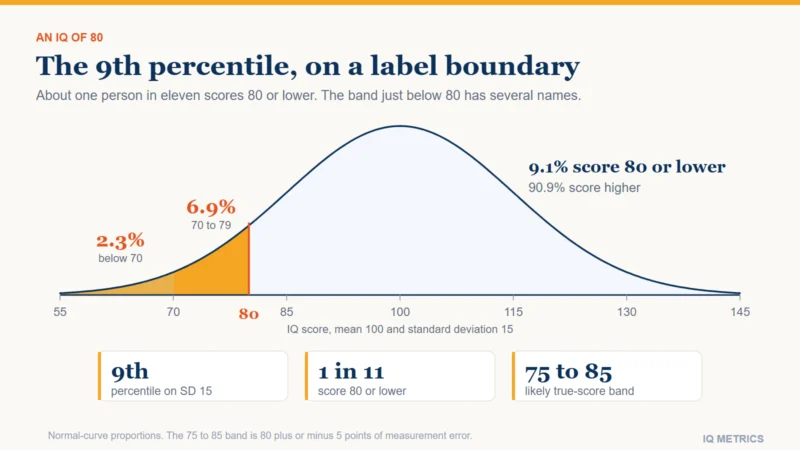 Scores & Scales
What Does an IQ of 80 Mean?
An IQ of 80 is the 9th percentile on the standard scale: about 1 person in 11 scores 80 or lower. Major test charts call it the bottom of the Low Average band, and the band just below it is called borderline on some. See what 80 means, how accurate it is and what it predicts.
 Scores & Scales
What Does an IQ of 75 Mean?
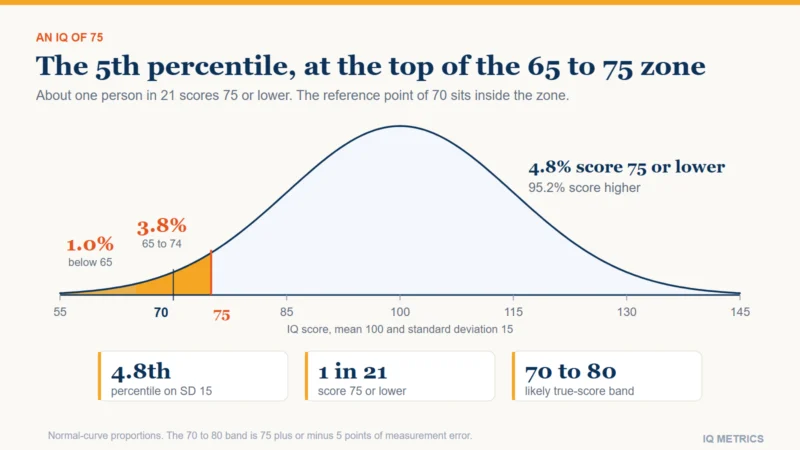
An IQ of 75 is the 5th percentile: about 1 person in 21 scores it or lower. It sits at the top edge of the 65 to 75 zone around the intellectual-disability reference point and is labelled Borderline or Very Low. See what courts say, its mental age for a child and how accurate one 75 is.
 Understanding IQ
Low IQ vs Learning Disability
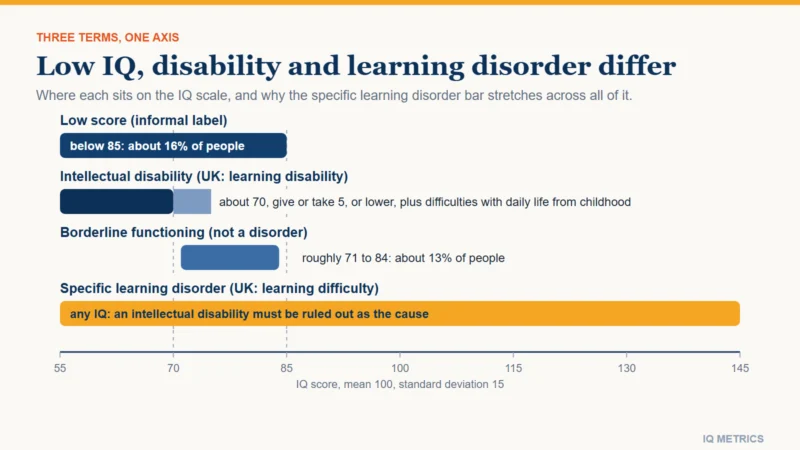
A low IQ, an intellectual disability and a specific learning disability are three different things, and the UK uses "learning disability" for the second. What each requires, how each is assessed, the US and UK terms, and what to do if you are worried.