





Which IQ Resource Do You Need? Tests, Calculators, Guides and Data in One Place
Which IQ resource answers your question? A map of every IQ test, calculator, score guide, research study, celebrity profile and brain game on IQ Metrics, matched to the question each one answers, with 29 studies, 350+ profiles and 8 games counted from the live site.

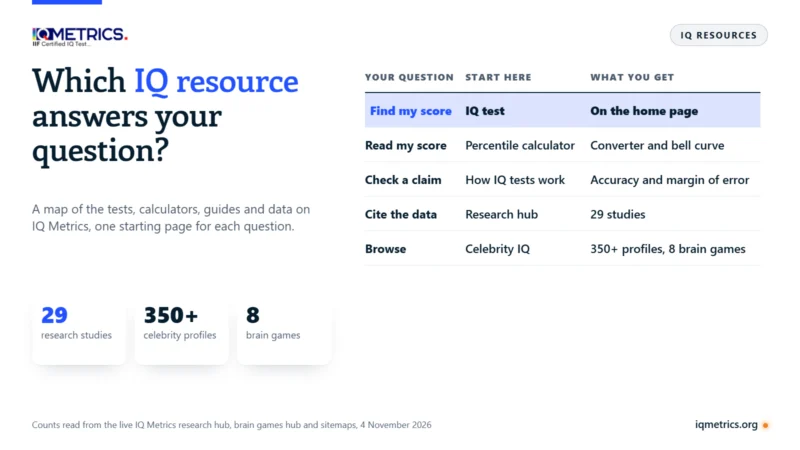
The IQ resource you need depends on your question: a test to get a score, a calculator to read it, a guide to check it or a study to cite it. IQ Metrics has all four. It also has 29 research studies, more than 350 celebrity profiles and 8 brain games.
Below: the six kinds of IQ resource, a table of which page answers which question, and the outside sources we trust. The new part is the map. Every count in it was read from the live site on 4 November 2026.
Key takeaways
- Get a score: take the IQ test on the home page, or pick another test type from the IQ tests hub.
- Read a score: the percentile calculator, the score converter and the bell curve turn a number into a position.
- Check a claim: the guides on how IQ tests work, how accurate they are and what the margin of error is.
- Cite data: 29 research studies with methods and downloadable data.
- Browse: more than 350 celebrity IQ profiles and 8 brain games.
Which IQ resource should you start with?
Start with the page that answers your question, not the one that sounds closest. The table matches common questions to our pages.
| Your question | Start here | What you get |
|---|---|---|
| How do I find my IQ? | IQ test (home page) | The test itself; take it, then read the score with the tools below |
| Which kind of test fits me? | All IQ tests | Test types, kids tests and work or school tests in one place |
| Where does my score sit? | IQ percentile calculator | A score turned into a percentile |
| What is this score on another scale? | IQ score converter | A score moved between SD 15, SD 16 and SD 24 scales |
| Is my score normal, high or low? | What is a normal IQ? and IQ test range | The bands and how many people sit in each |
| What does one exact score mean? | What does an IQ of 131 mean? | A worked score, with the same guide for many other numbers |
| Can I trust an online test? | Are online IQ tests accurate? and how IQ tests work | What a score can and cannot tell you |
| What do the clinical tests report? | WISC-V scores and WAIS scores | Score ranges for the tests psychologists use |
| What do the studies show? | Research hub | 29 studies with sources, methods and data |
| How smart are famous people? | Celebrity IQ | More than 350 profiles, grouped by field |
| Do brain games help? | Brain games | 8 short games, each with a guide |
Where can you take an IQ test?
The IQ test on the IQ Metrics home page is the main one, and the other test types sit one click away. The IQ tests hub lists them all.
The menu groups them in three sets. Six test types cover one ability or a mix: verbal, spatial, numerical, culture-fair, timed and classical. The kids IQ test has versions for ages 4 to 7, 8 to 12 and 13 to 17, and our guide to IQ test questions for kids shows what children are asked.
Six work and school tests are built for practice and aptitude: the aptitude test, logical reasoning, critical thinking, situational judgement, the Wonderlic practice test and the CogAT practice test.
Which IQ calculators and tools are there?
Seven tools turn a score into something you can read, and the IQ tools hub lists them. Each one answers a different question about the same number.
- IQ percentile calculator: what share of people score below you.
- IQ bell curve: where a score sits on the curve.
- IQ score converter: the same standing on SD 15, 16 or 24 scales.
- Compare two IQ scores: two scores set side by side.
- How IQ changes with age: what age does to a score.
- Update an old IQ score: bringing an old result up to date.
- Regression to the mean and parent versus child IQ: why scores drift toward 100.
The full list is on the IQ tools page. If you only use one, use the converter, because the same number means different things on different scales.
Where can you learn how IQ tests work and how accurate they are?
Start with our guide to how IQ tests work, then read the pages on accuracy and error. They explain what a score is made of before you trust it.
The how IQ tests work guide covers the questions and scoring. The accuracy guide covers online tests, and what makes an IQ test reliable covers the statistics behind it. Every score also has a margin of error, which our news explainer on the margin of error in an IQ score sets out. To read a real report, see how to read an IQ test report, and for the background, the history of IQ testing.
Where can you look up what a score means?
Look it up by the number, the range or the test. Our score pages cover all three.
By number, the guides run from an IQ of 75 and 80 up to 131, 136 and 200. By range, see what a normal IQ is, the borderline IQ range, IQ classifications and the genius IQ level. For cut-offs, see Mensa score requirements and gifted cut-off scores.
By test, we explain scores for the Stanford-Binet (see also the Stanford-Binet 5 score ranges), the Woodcock-Johnson and the WPPSI-IV. To compare countries, see average IQ by country, with the caveat that those figures rest on very different samples.
Where can you find IQ research and data?
The research hub holds 29 studies and reports, and each one publishes its sources, its method and a data file under an open licence.
Three show the range. The world’s shortest IQ test study pools 91 samples from 26 countries, and finds that 35% solve the bat-and-ball problem. The smartest countries index ranks 86 countries on PISA 2025 results, and is not an IQ ranking. The Mensa statistics study counts members country by country. How we build every study is set out on the research methods page.
Where can you find famous people and brain games?
The celebrity hub profiles more than 350 people, and the brain games hub holds 8 games. Both sit under the same menu as the tests.
The celebrity IQ profiles are grouped by field, from actors and athletes to scientists and historical figures. The brain games each work one skill, such as reaction time, memory or logic, and take two to five minutes.
Where would your own score land?
Take the IIF-certified assessment and get your score with the scale it was measured on, the percentile it corresponds to and the confidence range around it — the three figures most online tests leave out.
Find your IQ score now! →Which IQ test resources are for students, parents and job seekers?
Each group has its own short path. These are the pages we point people to most often.
- Students: the CogAT practice test and how to prepare for an IQ test
- Parents: the kids IQ test, signs of a gifted child and gifted cut-off scores
- Job seekers: the aptitude test, the Wonderlic practice test and IQ tests for job interviews
- Employers: IQ Metrics for business and our study of which employers use aptitude tests
- Anyone curious: can you improve your IQ and IQ versus personality
How do you use these IQ resources together?
Use them in four steps: take a test, read the score, check how much to trust it, then look for evidence. Each step has a page above.
First, take the IQ test or a practice test. Second, put the number in the percentile calculator and the converter. Third, read the accuracy and margin-of-error pages, so you know a score is a range of about 5 or 6 points either side. Fourth, open a research study if you want the data behind a claim.
Can an online IQ resource replace a clinical test?
No. An online test places you against that site’s own sample, and a clinical report comes from a trained examiner using a test with published norms.
Mensa makes the same split. American Mensa says it does not accept unsupervised testing, including tests given over the internet. Use our tools to understand a score and to get an estimate, and ask a qualified psychologist for any decision that matters.
Which outside sources can you trust for IQ?
The ones that publish the rules themselves: the test publishers, the diagnostic bodies and the societies that set entry scores. We link to these when we state a rule or a number.
- Mensa International and American Mensa for entry rules and qualifying scores.
- AAIDD and the American Psychiatric Association for how intellectual disability is defined.
- Riverside Insights and Pearson for the score scales of the tests they publish.
- The research pages above, which name the primary source for every figure.
Quick answers
- What is the best IQ resource to start with? The IQ test on the home page if you want a score, the percentile calculator if you already have one.
- What IQ tools and calculators are there? A percentile calculator, a bell curve, a score converter, a score comparison, and tools for age and change over time.
- Where can I find IQ test resources for children? The kids IQ test for ages 4 to 17 and our guide to IQ test questions for kids.
- Where is the research? The research hub, with 29 studies and open data.
- How many celebrity IQ profiles are there? More than 350, and new ones go live regularly.
The bottom line
Pick the IQ resource by the question: the home page test for a score, the calculators to read it, the guides to check it and the 29 research studies to cite it. Every page here links onward, and every outside link goes to the body that wrote the rule.
Sources
- Counts of studies, brain games and profiles were read from the live research hub, brain games hub and sitemaps of iqmetrics.org on 4 November 2026.
- Outside sources are the pages named above: Mensa International, American Mensa, AAIDD, the American Psychiatric Association, Riverside Insights and Pearson.
Keep reading
All articles → Taking a Test
Are IQ Tests Reliable Measures of Intelligence?
It is crucial to understand that while IQ tests are not exhaustive measures of intelligence, they are reliable tools for assessing certain cognitive abilities.
 Scores & Scales
IQ Classifications
IQ classification sorts scores into named bands, and the names depend on the test: Average is 90 to 109 on the Wechsler scales, but 130 and above is Very Superior on one test and Extremely High on another. See the labels side by side, where they came from and what they do not mean.
 Scores & Scales
How to Read an IQ Test Report
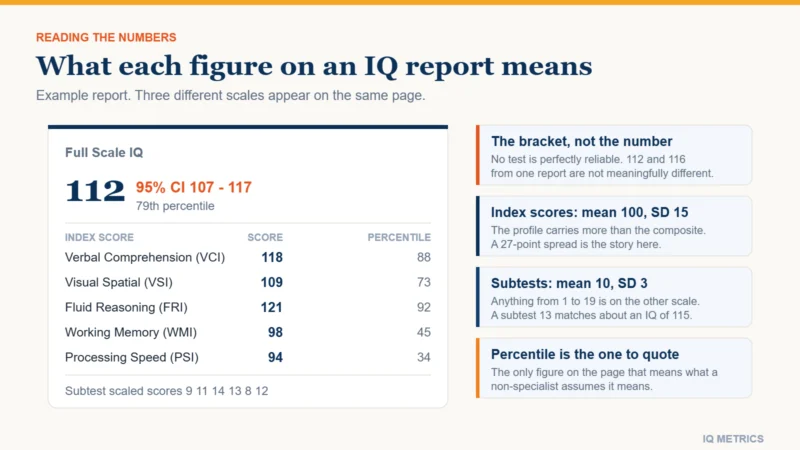
An IQ report puts numbers on at least three different scales and almost never explains which of them matters. Here is what FSIQ, the index scores, the subtest scaled scores, the percentile rank and that bracketed range each mean, and when the headline number should not be read at all.