



What was Johannes Kepler’s IQ?
A “straight A” student at Tübingen, then the elliptical orbit of Mars in Astronomia nova (1609).
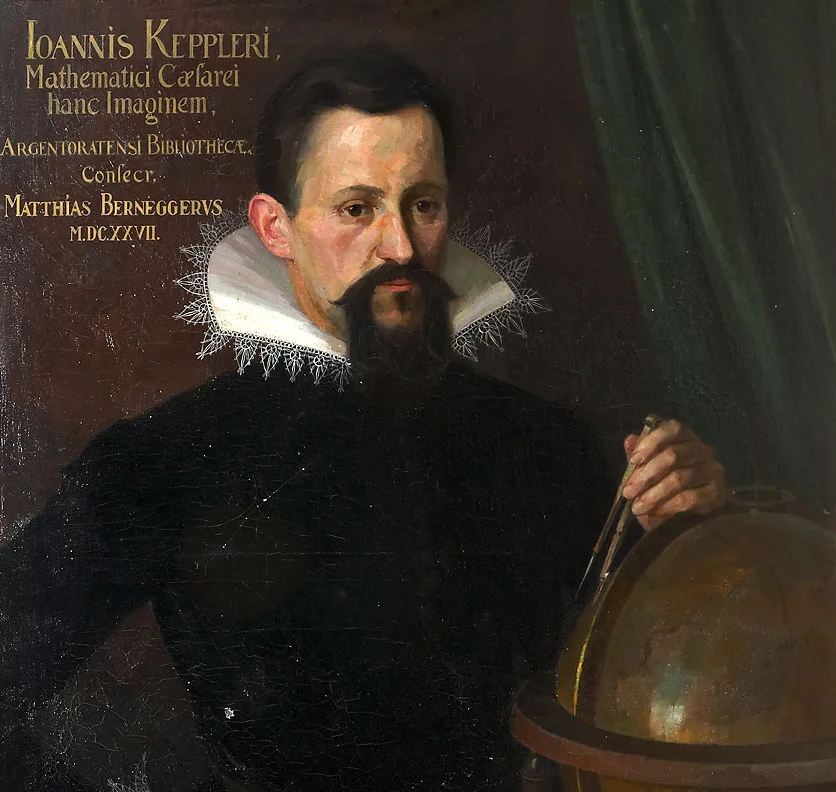
Johannes Kepler’s IQ was never measured: he died in 1630, long before IQ tests existed, so no test result exists. The only figures are retrospective estimates by Catharine Cox (1926) from records of his early life, 140 for his childhood and 160 for his youth, on a scale where the average person is 100. The documented record is a master’s degree from Tübingen in 1591 and the post of imperial mathematician from 1601.
Johannes Kepler’s estimated IQ
- Catharine Cox’s 1926 ratings from biographical records (Table 29 and the case study on pages 475–477 of Genetic Studies of Genius, volume II): 140 for his childhood to age 17 (reliability of the data .53) and 160 for his youth to age 26 (reliability .75). Her corrected figure for the youth rating is 175, an adjustment of the 160, not a second measurement.
- Quarterly grades at the University of Tübingen that show a “straight A” student, a baccalaureate examination passed on September 25, 1588, and a master’s degree on August 11, 1591, according to the Dictionary of Scientific Biography.
- Appointment on April 11, 1594 as teacher and provincial mathematician at Graz, the Mysterium Cosmographicum (1596), and work with Tycho Brahe from early 1600 until Tycho’s death on October 24, 1601.
- Appointment as imperial mathematician within two days of Tycho’s death, and later works that fall outside the years Cox rated: Astronomia nova (1609), Harmonices Mundi (1619) and the Rudolphine Tables (1627).
This is an inference from records, not a test result. Cox’s data on Kepler’s childhood are thin (reliability .53), and she called her correction “a crude approximation.” The floor of 150 allows for the weaker childhood rating of 140. The top, 175, is her corrected figure for the youth rating, and no test could confirm a number that high.
- Born
- December 27, 1571, Weil der Stadt
- Died
- November 15, 1630, Regensburg
- Education
- University of Tübingen: baccalaureate 1588, master’s degree August 11, 1591
- Posts
- Teacher and provincial mathematician, Graz, from 1594; imperial mathematician from 1601
- Known for
- Kepler’s laws of planetary motion; Astronomia nova (1609), Harmonices Mundi (1619), Rudolphine Tables (1627)
- Cox (1926) ratings
- 140 for childhood to age 17; 160 for youth to age 26; corrected figure 175
- Circulating figure
- 175, from a 2014 article that names no source
What an IQ of 150–175 actually means
Set the claim aside for a moment. If someone genuinely scored in this range, here is what that would represent.
Average is 100 by construction, and about two-thirds of people fall between 85 and 115. Take the test to place your own score on this scale.
| Score range | Classification | Share of people | What it indicates |
|---|---|---|---|
| 85 – 114 | Average | ~68% | The range most people fall into. |
| 115 – 129 | Above average | ~13.6% | Roughly one person in seven. |
| 130 – 144 | Gifted | ~2% | The threshold most high-IQ societies use. |
| Above 144 | Highly gifted | ~0.1% | Figures above this range are extrapolated from the curve rather than measured. |
Percentages are approximate and describe a normal distribution. The same number means different things on tests with different standard deviations.
Thirty questions gives you a measured position on this exact scale — your score, your percentile and the ability breakdown behind it.
Find out in 30 minutes →Who Johannes Kepler was
Johannes Kepler was born on December 27, 1571 in Weil der Stadt and died on November 15, 1630 in Regensburg, according to the Dictionary of Scientific Biography, MacTutor and Wikidata. The Dictionary says he entered the Adelberg monastery school in 1584 and enrolled two years later at Maulbronn, a preparatory school for the University of Tübingen.
He formally matriculated at Tübingen in October 1587, passed the baccalaureate examination there on September 25, 1588, and took up residence in the Tübinger Stift, the seminary for scholarship students, in 1589.
How smart was Johannes Kepler? The record from his student years points to a very able young scholar. The Dictionary of Scientific Biography says his quarterly grades at Tübingen, still preserved, show a “straight A” student, and that when he applied to renew his scholarship the university senate noted a “superior and magnificent mind.”
He received his master’s degree on August 11, 1591. Cox’s case notes add that he won second place in the master’s examination at 19, that his schooling had been interrupted between ages 7 and 11 by farm and tavern work and poor health, and that Michael Maestlin, the Tübingen professor of mathematics, taught him the Copernican system.
On April 11, 1594, at 22, Kepler arrived in Graz to teach and to serve as provincial mathematician, a post Tübingen filled at the request of the local authorities. His first book, the Mysterium Cosmographicum, appeared in 1596, and he sent a copy to Tycho Brahe, who was looking for a mathematical assistant.
Kepler set out for Bohemia in January 1600 and reached Tycho’s observatory at Benatky early in February. Tycho died on October 24, 1601, and within two days Kepler was appointed to his post of imperial mathematician, having worked with him for less than ten months. He held the title under Emperor Rudolf II and his two successors, Matthias and Ferdinand II.
The works that made his name came after the period Cox rated, which ends at 26. Astronomia nova, printed at Heidelberg and published in the summer of 1609, when Kepler was 37, showed that Mars moves in an ellipse with the Sun at one focus and sweeps out equal areas in equal times, according to MacTutor.
Harmonices Mundi (Linz, 1619) contains the third law, which relates a planet’s period to its distance from the Sun, and the Rudolphine Tables, printed at Ulm in 1627, stayed accurate for decades. The age-at-breakthrough table dates his best-known work at age 47. The Dictionary of Scientific Biography adds that Newton’s early notebooks show he learned Kepler’s first and third laws from a 1661 textbook. For how the site places their estimated IQs, see other scientists we have checked.
 By Elora Mercer, Celebrity Research WriterFigures checked by Leon Falkner, Data & Research Analyst
Reviewed by Aarav Vardhan, Editor-in-Chief · Last reviewed November 2026

Johannes Kepler: the documented record
The estimate above rests on this record. Every entry here is a matter of public fact, which is more than can be said for the number itself.
- 1571Born December 27 in Weil der Stadt.
- 1591Receives his master’s degree from Tübingen on August 11.
- 1594Arrives in Graz on April 11 as teacher and provincial mathematician.
- 1596Publishes the Mysterium Cosmographicum.
- 1601Tycho Brahe, with whom Kepler has worked since early 1600, dies October 24; within two days Kepler is appointed imperial mathematician.
- 1609Astronomia nova is published, printed at Heidelberg.
- 1619Harmonices Mundi is published at Linz.
- 1627The Rudolphine Tables are completed at Ulm in September.
- 1630Dies November 15 in Regensburg.
- 1926Catharine Cox publishes her ratings of Kepler: 140 to age 17, 160 to age 26.
Where the 175 figure came from
Following a claim back to its first appearance is the part almost nobody does — and it is what most people are actually asking.
No IQ test result has been published for Johannes Kepler, so any Kepler IQ score is an estimate made after the fact. He died on November 15, 1630. The Binet–Simon intelligence test appeared in 1905, and William Stern coined the abbreviation “IQ” in 1912. The estimates that exist trace to one book, Catharine Cox’s The Early Mental Traits of Three Hundred Geniuses (Stanford University Press, 1926), volume II of the series Genetic Studies of Genius.
Searches for Johannes Kepler IQ, and for “Kepler IQ Cox 1926,” lead to one place: Table 29 and the case study on pages 475–477 of Cox’s volume. Her raters read the biographical record for each of 301 subjects and gave two IQ ratings, each the average of three independent estimates: one for the record to age 17 and one for the record to age 26.
Kepler received 140 (reliability of the data .53) and 160 (.75). She then adjusted the ratings for thin records, and the table in The IQs of 301 geniuses lists 175 as the corrected figure for his youth. Cox called that correction “a crude approximation” and said it marks a point below which the true figure probably did not fall.
Where does the 175 come from? It matches the corrected figure Cox derived from her youth rating of 160. A June 19, 2014 news article on a commercial IQ-testing site, “Historic figures with amazing IQs,” also says experts estimate Kepler’s IQ at about 175 and adds that this would equate to 153 today.
It names no expert, test or study and does not mention Cox, so the link to her table is a match of numbers that the page does not show. The direction matters: the ratings Cox recorded from the evidence, 140 and 160, are lower than the 175 that circulates, which is her statistical adjustment.
Was Kepler a genius? His documented record is that of an exceptional astronomer and mathematician: straight-A university grades, three laws of planetary motion and the post of imperial mathematician. “Genius” has no fixed IQ cut-off; see what genius-level IQ means. His estimated IQ, 150–175, overlaps Galileo Galilei (150–185), another of Cox’s subjects, and sits below Isaac Newton (170–190) and Blaise Pascal (180–195), whom the same method rates higher.
Cox’s ratings are ratio IQs, mental age divided by chronological age. Read on the usual modern scale (mean 100, SD 15), 150 is about 1 in 2,330 people and 175 about 1 in 3.5 million, beyond what a test can separate reliably (see the test ceiling).
How we read a number →Kepler died in 1630, so no school, university or adult test exists. The Dictionary of Scientific Biography, MacTutor and Cox’s case study describe grades, examinations, posts and works, and none gives an IQ from a test.
Gives Kepler’s ratings of 140 (to age 17, reliability .53) and 160 (to age 26, reliability .75), his case notes on schooling and the Tübingen master’s examination, and the 28 subjects rated 140 in childhood, whose youth ratings average 150. Describes the correction as a crude approximation.
Gives the baccalaureate on September 25, 1588, the master’s degree on August 11, 1591, the straight-A grades and the senate’s “superior and magnificent mind,” the arrival in Graz on April 11, 1594, Tycho Brahe’s death on October 24, 1601, the Astronomia nova (summer 1609), the Rudolphine Tables (September 1627) and Newton’s early reading of Kepler’s laws.
Confirms the birth and death dates, the Mysterium Cosmographicum (1596), Tycho’s search for an assistant, the first two laws in Astronomia nova (1609), the third law in Harmonices Mundi (Linz, 1619) and the lasting accuracy of the Rudolphine Tables.
Used for orientation: born December 27, 1571 in Weil der Stadt, entered the Tübinger Stift in September 1589, arrived in Graz in April 1594 aged 22, and was imperial mathematician to Rudolf II, Matthias and Ferdinand II.
Wikidata describes Q8963 as a German mathematician and astronomer (1571–1630). The Wikipedia article dates the Binet–Simon test to 1905 and William Stern’s abbreviation “IQ” to 1912.
Says experts estimate Kepler’s IQ at about 175, equal to 153 today. Names no expert, test or study, gives no date of measurement, and does not mention Cox.
The full table of Cox’s ratings lists Kepler with childhood 140, youth 160, reliability .75 and corrected 175. It describes the corrected figures as her adjustment of the youth estimate.
Its table of historical geniuses dates Kepler’s best-known work, taken from Wikidata, at age 47.
The sources behind our estimate
The figures that circulate for Johannes Kepler, what we were able to confirm, and where the two diverge.
A June 19, 2014 news article on a commercial IQ-testing site, “Historic figures with amazing IQs,” says experts estimate Kepler’s IQ at about 175, or 153 after a Flynn-effect adjustment. It names no expert, test or study.
The 175 comes with no test, no date of measurement and no named source. It equals the corrected figure Cox published for Kepler’s youth, but the article does not mention her, so the match is a coincidence of numbers, not a citation. Cox’s own recorded ratings are 140 (to age 17) and 160 (to age 26). The Dictionary of Scientific Biography, MacTutor and Wikipedia give grades, examinations, posts and works, and no IQ.
Cox’s recorded ratings, 140 and 160, sit below the 175 that circulates, and 175 is her statistical correction of the 160. It is therefore the top of this site’s 150–175 range, not its middle. The 153 on the same page is a second, unexplained step down from 175, so the circulating numbers differ by more than twenty points without any new evidence.
Want a number that does hold up? Every figure on this page is somebody’s claim. Take the 30-question test and get a percentile you can check rather than a figure you have to trust.
Johannes Kepler — frequently asked
What was Johannes Kepler’s IQ?
Johannes Kepler’s IQ was never measured, so it is unknown. Catharine Cox’s 1926 study estimated it from biographical records at 140 for his childhood and 160 for his youth, on a scale where the average person is 100. This site’s estimated range for Kepler is 150–175.
What is Johannes Kepler’s IQ score?
Johannes Kepler never took an IQ test, so no IQ score exists for him. He died in 1630, and the first intelligence scale, by Alfred Binet and Théodore Simon, appeared in 1905. The figures 140, 160 and 175 are retrospective estimates from his record: Catharine Cox’s 1926 ratings and her corrected figure.
How smart was Johannes Kepler?
Kepler’s record is that of an exceptional scholar. The Dictionary of Scientific Biography says his preserved Tübingen grades show a “straight A” student, and he took a master’s degree on August 11, 1591. He later showed that Mars moves in an ellipse (Astronomia nova, 1609), but no test score measures how smart he was.
Was Johannes Kepler a genius?
The record supports the word in its everyday sense: he gave three laws of planetary motion and served as imperial mathematician from 1601. But “genius” has no fixed IQ cut-off, and no test score backs it. Cox’s 1926 rating of 160 for his youth is an estimate from records, not a result.
Where does the 175 for Kepler come from?
The 175 equals the corrected figure for Kepler’s youth that Catharine Cox derived in 1926 from her rating of 160. A 2014 article on a commercial testing site also gives about 175 but names no source, so its origin is not shown. Cox called her correction a crude approximation.
How does Johannes Kepler’s estimated IQ compare with Isaac Newton’s?
This site estimates 150–175 for Kepler and 170–190 for Isaac Newton. Both ranges rest on Cox’s 1926 ratings of biographical records, not on tests, and they overlap only from 170 to 175, so Newton’s range sits higher. Neither man took an IQ test.
What did Johannes Kepler discover?
Kepler showed that planets move in ellipses with the Sun at one focus and sweep out equal areas in equal times, laws published in Astronomia nova (1609), and a third law linking a planet’s orbital period to its distance from the Sun, published in Harmonices Mundi (1619), according to MacTutor.
How does my IQ compare with Johannes Kepler?
You can find out in about fifteen minutes. The IQ Metrics assessment is 30 questions, scored on the same 100-mean scale used throughout this page, so your result and the estimate above are at least expressed in the same units — one measured, one inferred. Once you have a number, the leaderboard shows where it would sit, and how we score and norm it explains the benchmarking.
Where does this estimate come from?
From the documented record rather than a test — the method is named above and set out in full under how we read a number. Compare it against the other scientists profiles, starting with Albert Einstein.
- Take the 30-question IQ test — get a measured score and percentile of your own
- Average IQ by country — how the scale behaves across populations
- How IQ Metrics scores its assessment — the method behind our own number
- More on how IQ testing works — reliability, error and what a score can and cannot say
- More scientists profiles — same field, same method
More scientists
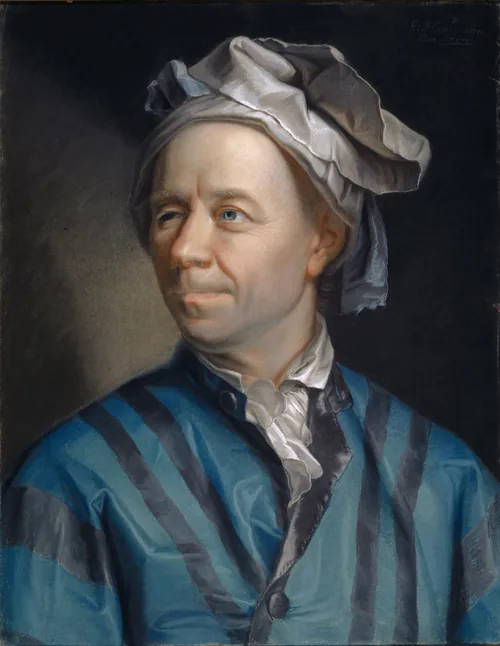
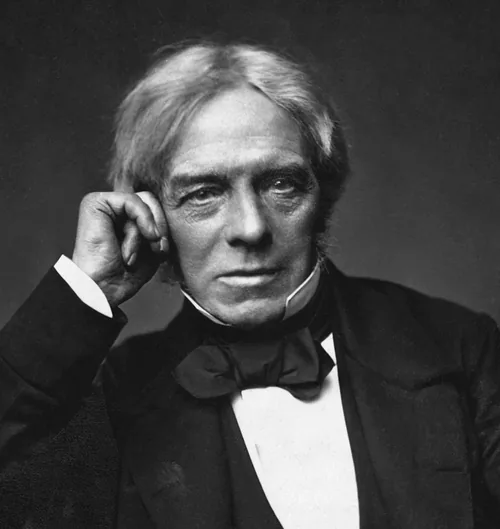
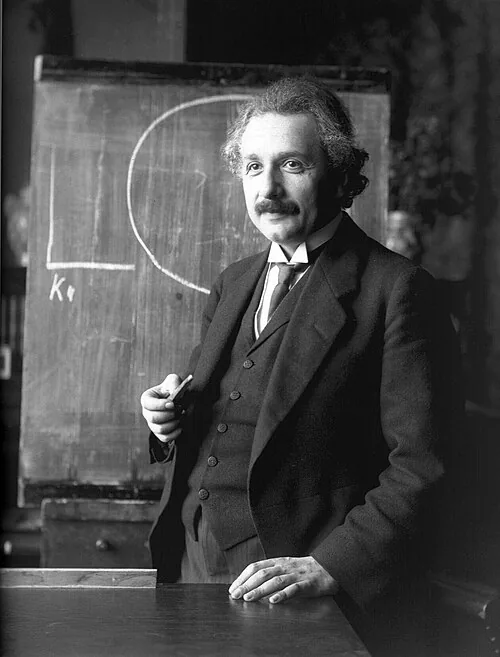
Portrait of Leonhard Euler by Jakob Emanuel Handmann (1753; Kunstmuseum Basel), public domain (the painter died in 1781). · Photograph, about the 1850s, photographer not recorded (Commons file); public domain. Background removed for the portrait above. · Portrait by Ferdinand Schmutzer (1921), public domain. Background removed for the portrait above.


An estimate is an inference.
Yours can be measured.
Thirty questions, scored against general-population benchmarks. Your score, your percentile, your ability breakdown and a printable IIF certificate.
Find your IQ score now! →