





Medicare Memory Test 3 Words: How the Recall and Clock Drawing Work
The Medicare memory test with 3 words is usually the Mini-Cog: recall three words, draw a clock, score 0 to 5. Medicare names no single test. See how it is scored, every possible total, what below 3 means and how it differs from the MoCA and SLUMS.

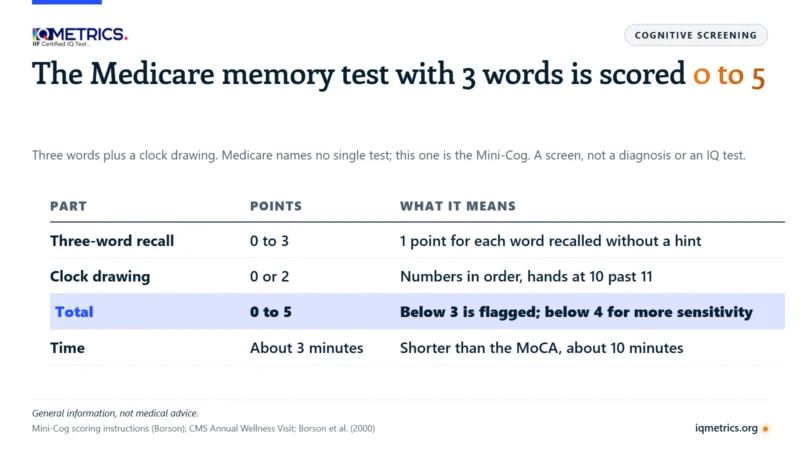
The Medicare memory test 3 words people mention is usually the Mini-Cog. You hear three words, draw a clock, then recall the words, for a total of 0 to 5 points, and a total below 3 is flagged. Medicare does not require that test. The CMS asks clinicians to check for cognitive impairment at each annual wellness visit, by observation or a brief test. It is a screen, not a diagnosis and not an IQ test.
Below: how each part is scored, a table of every possible score, what happens after a low one, and how it differs from the MoCA and SLUMS. New here: with an abnormal clock, only a perfect 3-word recall reaches 3, and with a normal clock, only recalling no words falls below 3. This page is general information, not medical advice.
Key takeaways
- Medicare names no single test. CMS says to assess by direct observation or reports from the patient, family, friends and caregivers, and to consider brief cognitive tests.
- The common version is the Mini-Cog: 0 to 3 points for recalled words plus 0 or 2 for the clock, total 0 to 5 (Borson).
- A total below 3 is the validated screen-positive cut point. The authors suggest below 4 when you want to catch more cases.
- It is a screen. In 1,119 older adults it flagged 76% of people with dementia and cleared 89% of those without (Borson et al., 2003).
- A low score means a closer look, not a diagnosis. Talk to your clinician.
What is the Medicare memory test 3 words clinicians use?
It is usually the Mini-Cog, a three-minute screen built from three-word recall and a clock drawing. Medicare does not name it, though.
The CMS annual wellness visit page tells clinicians to check for cognitive impairment at the first visit, and its payment page says the same for later visits. It says to assess cognitive function by direct observation or by reports from the patient, family, friends, caregivers and others, and to consider brief cognitive tests. The CMS page does not name a required test. So the “Medicare cognitive test” you hear about is one option a clinician may choose.
The Mini-Cog has three steps. The clinician says three memory test words and asks you to repeat them. You then draw a clock, adding the numbers and setting the hands to 10 past 11, according to the authors’ instructions. Last, you recall the three words without hints. The authors report an administration time of 3 minutes, against 7 for the Mini-Mental State Exam (Borson et al., 2000).
What do the three words and the clock drawing score?
The words score 0 to 3 and the clock drawing scores 0 or 2, so the total runs from 0 to 5.
| Part | Points | What earns them |
|---|---|---|
| Three-word recall | 0 to 3 | 1 point for each word recalled without a hint |
| Clock drawing | 0 or 2 | Numbers in the right order and about the right place, none missing or doubled, hands pointing to the 11 and 2. Hand length is not scored |
| Total | 0 to 5 | Recall points plus clock points |
The clock is all or nothing: it scores 0 or 2, never 1. Each word you recall without a hint adds 1.
The form tells the clinician to repeat the clock instructions as needed, because the clock step is not a memory test. A clock drawing test dementia screen like this one is therefore scored on the drawing alone.
What score is a pass on the Medicare memory test?
Strictly there is no pass. A total of 3 or more clears the standard cut point, and below 3 is a positive screen. The authors say many people with real impairment still score higher, so they suggest a cut point of below 4 when greater sensitivity is wanted.
Because the clock counts for 2 and each word for 1, only a few combinations land on each side of the line. We worked out every total from the authors’ rules:
| Words recalled | Normal clock (+2) | Abnormal clock (+0) |
|---|---|---|
| 0 words | 2: below 3 | 0: below 3 |
| 1 word | 3: below 4 | 1: below 3 |
| 2 words | 4: at or above 4 | 2: below 3 |
| 3 words | 5: at or above 4 | 3: below 4 |
Read it this way. With an abnormal clock, only recalling all three words reaches 3, and even that sits below the more sensitive cut of 4. With a normal clock, only recalling no words falls below 3.
How well does it work? In 1,119 older adults in Pennsylvania, the Mini-Cog flagged 76% of those with dementia and cleared 89% of those without (Borson et al., 2003). Sensitivity is the share of people with dementia the test flags, and specificity is the share without dementia it clears. The Mini-Mental State Exam scored 79% and 88% in the same data. A 2015 review of 149 studies put the Mini-Cog at 0.91 and 0.86 (Tsoi et al., JAMA Internal Medicine).
Is it an IQ test or a dementia screen?
It is a dementia screen. It gives raw points out of 5, compares them with a cut point and not with other people your age, and has no IQ conversion.
A screen answers one question: does this person need a closer look? An IQ test answers a different one: how does this person’s ability compare with a norm group? Our guide can an IQ test detect dementia explains why the two should not be mixed up.
Screening healthy people is also debated. The US Preventive Services Task Force (JAMA, 2020) found the evidence insufficient to judge the benefits and harms of screening older adults who have no signs or symptoms. That is one reason a clinician’s judgment and your own concerns matter as much as any score.
What happens if you fail it?
A low score leads to a closer look, not to a diagnosis. The CMS says that if a clinician detects impairment, Medicare covers a separate visit for a more detailed cognitive assessment and care plan (CPT code 99483).
According to CMS, that fuller evaluation may help diagnose dementia and may identify treatable causes or related conditions, such as depression or anxiety. Other things can also lower a result. The words are read aloud, so unaddressed hearing loss can matter, as our hearing loss and cognitive test scores article explains.
Our SLUMS guide covers a follow-up in which some low scorers improved once a cause was treated. CMS also lists a safety evaluation for home and motor vehicle operation in that fuller assessment; our guide to the average reaction time for drivers shows how far a car travels while a driver reacts. If you or a relative are worried about memory, speak to a clinician.
Where would your own score land?
Take the IIF-certified assessment and get your score with the scale it was measured on, the percentile it corresponds to and the confidence range around it — the three figures most online tests leave out.
Find your IQ score now! →How does it differ from the MoCA and SLUMS?
The Mini-Cog is the shortest of the three and the only one scored out of 5. It takes about 3 minutes, while the MoCA takes about 10 and both it and SLUMS are scored out of 30.
| Screen | Score range | Normal or cut-off |
|---|---|---|
| Mini-Cog | 0 to 5 | Below 3 flagged; below 4 for more sensitivity |
| MoCA | 0 to 30 | 26 to 30 normal, per the publisher |
| SLUMS | 0 to 30 | 27 to 30 normal with a high school education, 25 to 30 with less |
See the MoCA score guide for what each band means and why newer studies question the cut-off of 26. Tsoi and colleagues (2015) found the MoCA the best alternative for mild cognitive impairment, while the Mini-Cog was among the best for dementia.
Can you practise for the 3-word recall test?
You can, but it defeats the purpose. A screen only helps if your result shows how you remember on the day.
The Mini-Cog authors publish six alternative word lists and recommend a different list for repeated testing, so memorising one list does not carry over. We do not print the lists or a practice sheet: the form is the authors’ copyrighted work, and a practice sheet would weaken the screen for the people who need it.
To see how short-term recall feels, try our memory game or sequence memory test. They are games, not medical tests. For the wider link between memory and ability, read memory and IQ, or take the IQ test for a score built for people of every age band.
Quick answers
- What is the Medicare cognitive test? There is no single one. CMS lets clinicians use observation or a brief test such as the Mini-Cog.
- What is the Medicare memory test 3 words? Usually the Mini-Cog: hear three words, draw a clock, recall the words. Score 0 to 5.
- What score is normal? 3 or more clears the standard cut point; the authors suggest below 4 when greater sensitivity is wanted.
- Is it an IQ test? No. It is a dementia screen with no IQ score.
- What if you score low? A closer evaluation, which Medicare covers as a separate visit. It is not a diagnosis.
- Can you practise? It defeats the purpose. The authors publish six word lists and recommend switching lists on repeat tests.
The bottom line
The 3-word memory test at a Medicare visit is a quick screen, not a required test, not a diagnosis and not an IQ test. A score of 3 or more clears the standard line, and below 3 means a closer look. More in our cognitive-screening series: MoCA scores and the SLUMS test. This page is general information, not medical advice.
Sources
- Centers for Medicare & Medicaid Services. Annual Wellness Visit.
- Centers for Medicare & Medicaid Services. Cognitive Assessment & Care Plan Services.
- Borson S. Mini-Cog: instructions for administration and scoring (version 01.19.16).
- Borson S, Scanlan JM, Chen P, Ganguli M (2003). The Mini-Cog as a screen for dementia: validation in a population-based sample. Journal of the American Geriatrics Society 51, 1451-1454.
- Borson S, Scanlan J, Brush M, Vitaliano P, Dokmak A (2000). The mini-cog: a cognitive ’vital signs’ measure for dementia screening in multi-lingual elderly. International Journal of Geriatric Psychiatry 15, 1021-1027.
- Tsoi KK, Chan JY, Hirai HW, Wong SY, Kwok TC (2015). Cognitive tests to detect dementia: a systematic review and meta-analysis. JAMA Internal Medicine 175, 1450-1458.
- US Preventive Services Task Force (2020). Screening for cognitive impairment in older adults: recommendation statement. JAMA 323, 757-763.
Keep reading
All articles →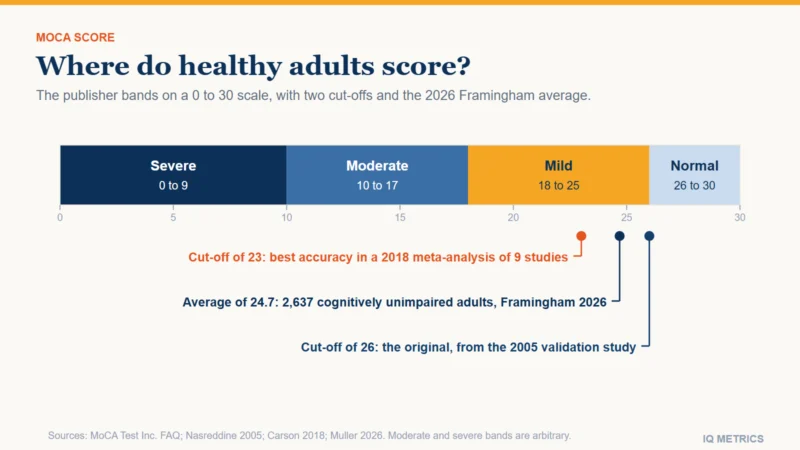 Scores & Scales
MoCA Score
A MoCA score is a number out of 30 from a 10-minute screen for mild cognitive impairment. See the four publisher score bands, why the 26 cut-off flags many healthy adults, what changes the score, what to do with a result and why a MoCA is not an IQ.
 Scores & Scales
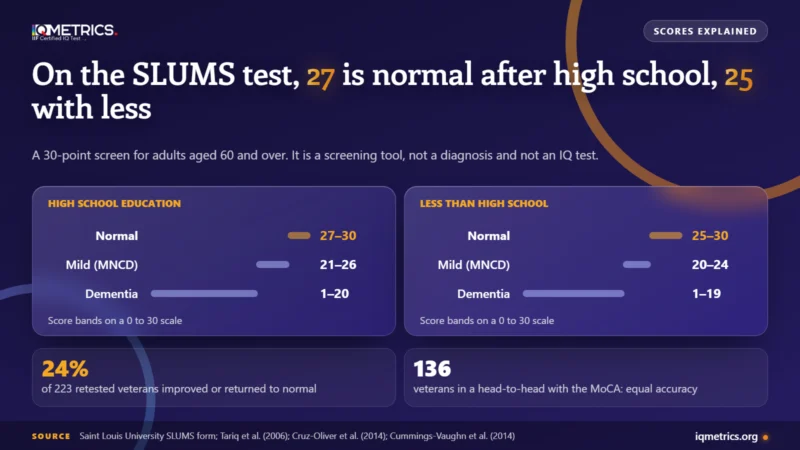
SLUMS Cognitive Test
SLUMS cognitive test scoring: 27 to 30 is normal with a high school education and 25 to 30 with less. Every cut-off, the eight sections, how SLUMS compares with the MoCA, and why 24% of retested veterans improved. A screening tool, not an IQ test.
 Taking a Test
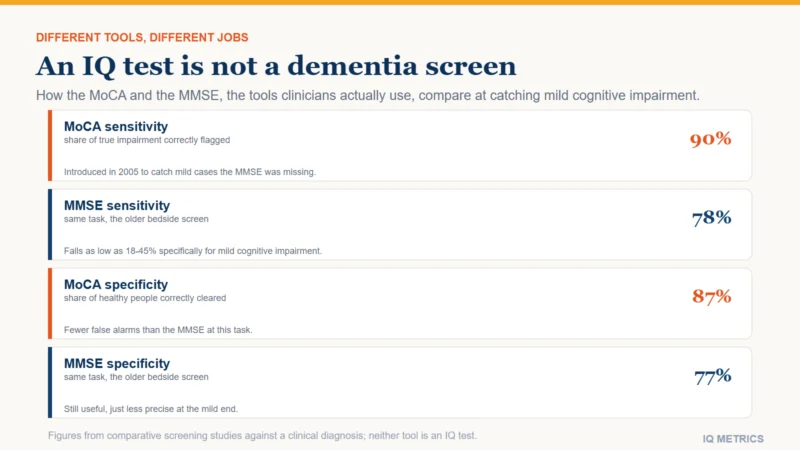
Can an IQ Test Detect Dementia?
A standard IQ test cannot diagnose dementia; it has no personal baseline and was not built to screen for decline. How the MMSE and the more sensitive MoCA compare, why a normal score can hide early decline, and what actually helps catch it.