





What Is the SLUMS Cognitive Test? Scoring, Cut-offs by Education and How It Compares With MoCA
SLUMS cognitive test scoring: 27 to 30 is normal with a high school education and 25 to 30 with less. Every cut-off, the eight sections, how SLUMS compares with the MoCA, and why 24% of retested veterans improved. A screening tool, not an IQ test.

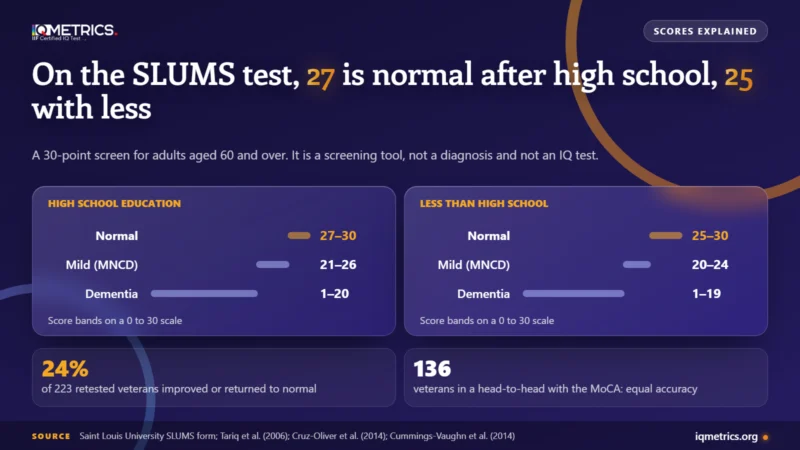
The SLUMS cognitive test is a 30-point screen for mild cognitive impairment and dementia from Saint Louis University. Scoring depends on education. With a high school education, 27 to 30 is normal, 21 to 26 is mild neurocognitive disorder and 1 to 20 is dementia. With less, 25 to 30 is normal, 20 to 24 is mild and 1 to 19 is dementia. It is a screening tool, not a diagnosis and not an IQ test.
Below: every cut-off, what the eight sections measure, how SLUMS compares with the MoCA and the MMSE, and a finding most guides skip. In a 7.5-year follow-up of 223 veterans, 53 (24%) improved or returned to normal, and a reversible cause was found for 36 of those 53 (Cruz-Oliver and colleagues, 2014). A low score is not always a one-way road.
Key takeaways
- The SLUMS test has 30 points. The “normal” line is 27 with a high school education and 25 without, a 2-point difference.
- The bands are normal, mild neurocognitive disorder (the SLUMS name for mild cognitive impairment) and dementia, with separate cut-offs for each education group.
- In a head-to-head study of 136 veterans, SLUMS and MoCA were statistically equivalent at spotting mild impairment and dementia (Cummings-Vaughn and colleagues, 2014).
- SLUMS is for adults aged 60 and over and should be given no more than once a year, according to Saint Louis University.
- It is a screening tool. A low score is a reason to see a clinician, not a diagnosis, and it has no link to an IQ score.
What is the SLUMS cognitive test?
SLUMS stands for Saint Louis University Mental Status. It is a short question-and-answer screen of orientation, memory, attention and executive function, scored out of 30.
Tariq and colleagues tested it against the MMSE in 702 patients at the St. Louis Veterans Affairs medical center, whose mean age was 75.3 (American Journal of Geriatric Psychiatry, 2006).
Saint Louis University says the exam is designed for adults aged 60 and over. It should not be used for people whose cognition is affected by conditions such as traumatic brain injury, developmental disabilities or schizophrenia. Health care and social service professionals give it, and the university advises no more than once a year, because repeating it sooner can inflate the score.
What is a normal SLUMS test score?
It depends on education. With a high school education, 27 to 30 is normal. With less than high school, 25 to 30 is normal.
| Result | High school education | Less than high school |
|---|---|---|
| Normal | 27 to 30 | 25 to 30 |
| Mild neurocognitive disorder | 21 to 26 | 20 to 24 |
| Dementia | 1 to 20 | 1 to 19 |
The split exists because education changes how people do on memory and thinking tasks. Tariq and colleagues reported results for both education groups, and the SLUMS did better than the MMSE at flagging mild neurocognitive disorder in each. A single SLUMS test score is also not fixed: vision problems and some medicines can lower it, as the section on reversible causes shows.
What do the SLUMS exam questions cover?
Eight sections add up to 30 points. We describe them in general terms and do not print the items, because publishing them would weaken the test for the people who need to take it.
| Section | Points | What it samples |
|---|---|---|
| Orientation: day, year and state | 3 | Orientation and attention |
| A short money calculation | 3 | Number calculation |
| Naming animals in one minute | 3 | Verbal fluency under a time limit |
| Recalling five objects after a delay | 5 | Delayed memory |
| Repeating numbers backward | 2 | Working memory |
| Drawing a clock | 4 | Visual-spatial skill and planning |
| Judging shapes | 2 | Visual-spatial skill |
| Recalling a short story | 8 | Memory and executive function |
The animal-naming section gives 0 points for 0 to 4 animals, 1 for 5 to 9, 2 for 10 to 14 and 3 for 15 or more. You can try the same skill with our verbal fluency test. The reverse-numbers section is close to the digit span test, and our sequence memory test exercises recall in a game format.
SLUMS vs MoCA: how do they compare?
In a direct comparison they performed about the same. Cummings-Vaughn and colleagues tested 136 veterans aged 60 and over and found the areas under the ROC curve, a standard accuracy measure, were equivalent (Journal of the American Geriatrics Society, 2014).
| Condition detected | SLUMS | MoCA |
|---|---|---|
| Mild cognitive impairment | 0.74 | 0.77 |
| Dementia | 0.98 | 0.96 |
| Mild impairment or dementia | 0.82 | 0.83 |
The tests differ in design. Here is how SLUMS, the MoCA and the Mini-Mental State Examination (MMSE) line up.
| Feature | SLUMS | MoCA | MMSE |
|---|---|---|---|
| Points | 30 | 30 | 30 |
| Origin | Saint Louis University team, paper in 2006 | Nasreddine and colleagues, Montreal, 2005 | Folstein, Folstein and McHugh, 1975 |
| Aimed at | Mild neurocognitive disorder and dementia | Mild cognitive impairment | Cognitive impairment overall; weaker for mild cases |
| Education | Two sets of cut-offs | One point added for 12 or fewer years of education | Scores shift with age, education and culture |
| Test sample | 702 patients, mean age 75.3 | 94 with mild impairment, 93 with mild Alzheimer’s, 90 healthy | Reviewed over 26 years of studies in 1992 |
Two more findings help. In the MoCA’s own 2005 validation, the MoCA caught 90% of people with mild impairment against 18% for the MMSE at the same cut-off of 26. And in 170 community-dwelling adults aged 60 and over, SLUMS scores ran lower than MMSE scores and were less bunched toward the top, and tracked the Trail Making Test more closely (Feliciano and colleagues, 2013). For the MoCA’s bands and why its cut-off of 26 flags many healthy adults, see our MoCA score guide.
Where would your own score land?
Take the IIF-certified assessment and get your score with the scale it was measured on, the percentile it corresponds to and the confidence range around it — the three figures most online tests leave out.
Find your IQ score now! →Can a low SLUMS score get better?
Sometimes, yes. In a follow-up of people first tested in 2003, 53 of 223 (24%) improved or returned to normal 7.5 years later.
A reversible cause was found for 36 of those 53 (68%). The two interventions that set improvers apart were correcting vision loss and stopping anticholinergic medicines. Over the same period 33 people (15%) slid to mild decline and 20 (9%) to severe decline, so the trend is not all upward. It is why a low score should lead to an assessment, not a conclusion. Other things that move cognitive test results include hearing, as in our news piece on hearing loss and cognitive test scores.
Is the SLUMS test an IQ test?
No. The SLUMS gives raw points out of 30 to find memory and thinking problems in older adults. It does not rank a person against others, and there is no conversion to an IQ.
IQ tests compare a person with a norm group of the same age. Screens like the SLUMS and MoCA ask whether performance has fallen below what is expected for a healthy older adult. Our guide to whether an IQ test can detect dementia covers that difference. For a related thinking-speed task, see normal times by age in our guide to trail making test scores. For a score on the IQ scale, take the IQ test.
This page is information, not medical advice. If you are worried about your memory or someone else’s, speak to a doctor.
Quick answers
- What is the SLUMS cognitive test? A 30-point screen of memory, attention and executive function for adults aged 60 and over, from Saint Louis University.
- What is a normal SLUMS test score? 27 to 30 with a high school education, 25 to 30 with less.
- What are the SLUMS exam questions? Eight sections: orientation, a money sum, animal naming, five-object recall, numbers backward, a clock, shapes and a story.
- SLUMS vs MoCA: which is better? In one head-to-head study of 136 veterans they were equivalent. The MoCA adjusts for education by adding a point, SLUMS by using separate cut-offs.
- Is SLUMS an IQ test? No. It is a screening tool, not a diagnosis and not an IQ test.
The bottom line
The SLUMS is a 30-point screen with cut-offs that change with education: 27 and above is normal after high school, 25 and above otherwise. It performs like the MoCA in the one direct comparison we found, and a low score can improve when a reversible cause is treated. It is a prompt to see a clinician, not a verdict.
Sources
- Saint Louis University School of Medicine. SLU Mental Status Exam and its scoring form (read 6 November 2026).
- Tariq SH, Tumosa N, Chibnall JT, Perry MH, Morley JE (2006). Comparison of the Saint Louis University mental status examination and the mini-mental state examination for detecting dementia and mild neurocognitive disorder. American Journal of Geriatric Psychiatry 14(11), 900-910.
- Cummings-Vaughn LA, Chavakula NN, Malmstrom TK, Tumosa N, Morley JE, Cruz-Oliver DM (2014). Veterans Affairs Saint Louis University Mental Status examination compared with the Montreal Cognitive Assessment and the Short Test of Mental Status. Journal of the American Geriatrics Society 62(7), 1341-1346.
- Feliciano L, Horning SM, Klebe KJ, Anderson SL, Cornwell RE, Davis HP (2013). Utility of the SLUMS as a cognitive screening tool among a nonveteran sample of older adults. American Journal of Geriatric Psychiatry 21(7), 623-630.
- Cruz-Oliver DM, Malmstrom TK, Roegner M, Tumosa N, Grossberg GT (2014). Cognitive deficit reversal as shown by changes in the Veterans Affairs Saint Louis University Mental Status (SLUMS) examination scores 7.5 years later. Journal of the American Medical Directors Association 15(9).
- Nasreddine ZS, et al. (2005). The Montreal Cognitive Assessment, MoCA: a brief screening tool for mild cognitive impairment. Journal of the American Geriatrics Society 53(4), 695-699.
- Tombaugh TN, McIntyre NJ (1992). The mini-mental state examination: a comprehensive review. Journal of the American Geriatrics Society; Folstein MF, Folstein SE, McHugh PR (1975). Mini-mental state. Journal of Psychiatric Research 12(3), 189-198.
Keep reading
All articles →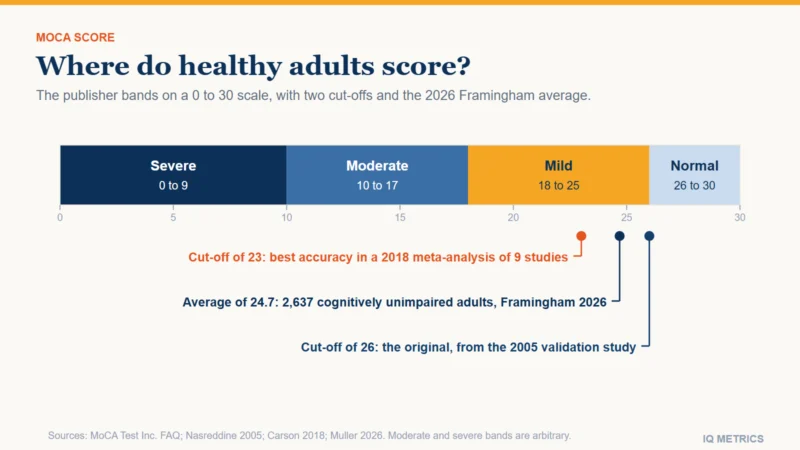 Scores & Scales
MoCA Score
A MoCA score is a number out of 30 from a 10-minute screen for mild cognitive impairment. See the four publisher score bands, why the 26 cut-off flags many healthy adults, what changes the score, what to do with a result and why a MoCA is not an IQ.
 Taking a Test
Can an IQ Test Detect Dementia?
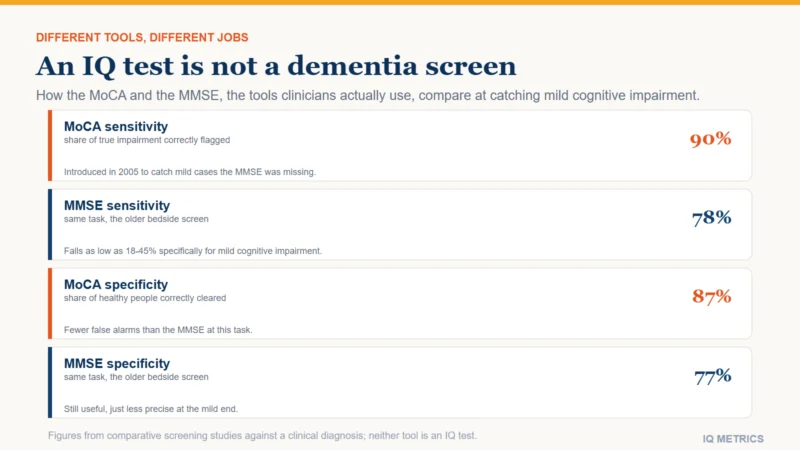
A standard IQ test cannot diagnose dementia; it has no personal baseline and was not built to screen for decline. How the MMSE and the more sensitive MoCA compare, why a normal score can hide early decline, and what actually helps catch it.
 Understanding IQ
Memory and IQ
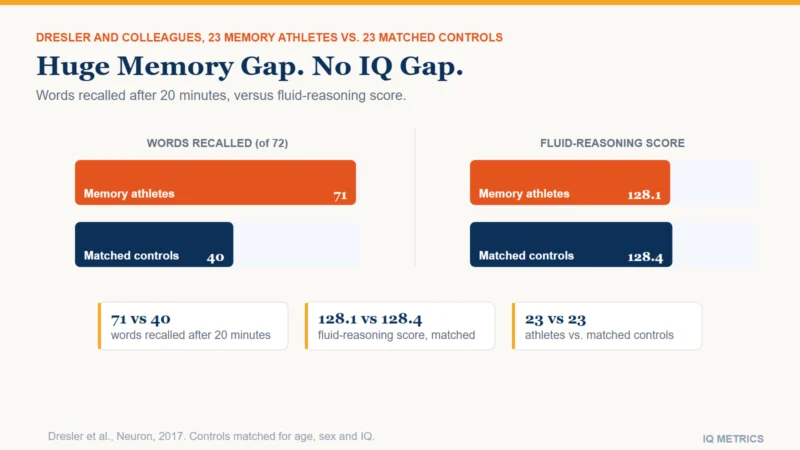
The world's best memory athletes can memorize 71 shuffled words in twenty minutes. Their IQ scores are not measurably different from a matched control group who could only manage 40. If a spectacular memory is not the same thing as a high IQ, what actually is the difference?