





Average Reaction Time for Drivers: 0.75 or 1.5 Seconds?
The average reaction time for drivers is about 0.75 seconds if the signal is expected and about 1.5 seconds for a surprise. See the distance covered at 30, 50 and 70 mph, why road designers assume 2.5 seconds, and what age and IQ change.

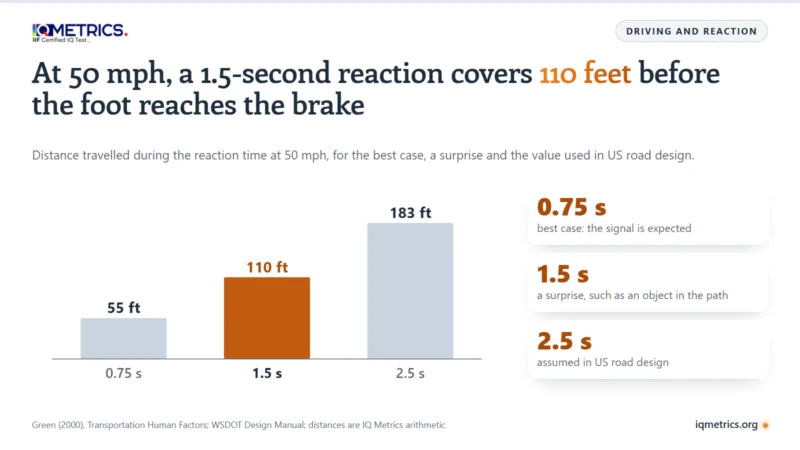
The average reaction time for drivers paying close attention is about 0.75 seconds, but only when they know when and where the signal will come (Green, 2000). A lead car’s brake lights take about 1.25 seconds, and a true surprise about 1.5 seconds. At 50 mph, 1.5 seconds is 110 feet (34 meters) of road before the foot reaches the brake.
Below: why two numbers exist, how far a car travels at 30, 50 and 70 mph, what age changes, and how to measure your own reaction. New here: US road designers assume 2.5 seconds, more than three times the best case. At 50 mph that gap is 128 feet (39 meters), and it is our own arithmetic from two cited values.
Key takeaways
- Expectation sets the number. A driver who knows when and where the signal will come needs about 0.70 to 0.75 seconds. A surprise needs about 1.5 seconds (Green, 2000).
- Reaction time here means detecting the signal and moving the foot from the accelerator to the brake pedal. Braking itself comes after.
- At 50 mph, the reaction distance is 55 feet at 0.75 seconds, 110 feet at 1.5 seconds and 183 feet at the 2.5 seconds used in US road design.
- Experts disagree on the exact values: a 2000 commentary found 1.0 to 1.3 seconds in fairly urgent real-road cases (Summala, 2000).
- Faster reactions go with a higher IQ only weakly, at about -.3 in simple lab tests.
What is the average reaction time for drivers paying close attention?
About 0.70 to 0.75 seconds, if the driver is fully aware of when and where the signal will appear. That is the best-case figure from Marc Green’s 2000 review of driver perception-brake times.
Paying attention alone is not enough. When the signal is unexpected but common, such as a lead car’s brake lights, Green puts the time at about 1.25 seconds. For a surprise, such as an object suddenly moving into the road, the time is roughly 1.5 seconds.
So the answer to the quiz question depends on the situation. If you only know the “3/4 second” rule, you know the best case.
Why do two numbers exist, 0.75 and 1.5 seconds?
Because expectation changes the time by a factor of 2, Green found. The same driver is quick when the signal is expected and slow when it is a surprise.
In perception reaction time driving studies, engineers measure the delay between a signal and the foot reaching the brake. It includes noticing the signal, deciding and moving the foot. It does not include the braking itself.
| Situation | Time | Source |
|---|---|---|
| Fully aware of when and where the signal will come | 0.70 to 0.75 s | Green, 2000 |
| Unexpected but common signal, such as a lead car’s brake lights | About 1.25 s | Green, 2000 |
| Surprise event, such as an object suddenly in the path | Roughly 1.5 s | Green, 2000 |
| Fairly urgent real-road case, unalerted drivers, about 4 s from collision | 1.0 to 1.3 s average | Summala, 2000 |
| Value used in US road design | 2.5 s | WSDOT Design Manual |
Not everyone agrees on the middle values. Summala (2000), writing in the same journal issue, argued that Green’s figures mix situations of different urgency. He cited road data in which unalerted drivers braked with an average delay of 1.0 to 1.3 seconds when a collision was about 4 seconds away.
The 2.5 seconds is a different thing: a design value. The Washington State DOT Design Manual says its perception and reaction distance is the distance travelled in 2.5 seconds at the design speed.
How far do you travel during the reaction time at 30, 50 and 70 mph?
At 50 mph a car covers 55 feet (17 meters) in 0.75 seconds and 110 feet (34 meters) in 1.5 seconds. Distance is speed times time, so stopping distance and reaction time grow together.
| Speed | 0.75 s (expected) | 1.5 s (surprise) | 2.5 s (US road design) |
|---|---|---|---|
| 30 mph (48 km/h) | 10 m (33 ft) | 20 m (66 ft) | 34 m (110 ft) |
| 50 mph (80 km/h) | 17 m (55 ft) | 34 m (110 ft) | 56 m (183 ft) |
| 70 mph (113 km/h) | 23 m (77 ft) | 47 m (154 ft) | 78 m (257 ft) |
Reaction distance is only the first part. Then the car has to slow down. The same WSDOT manual calculates design stopping distance with a constant deceleration of 11.2 feet per second squared. Adding our braking arithmetic (speed squared divided by twice that rate) to the 2.5-second reaction gives:
| Speed | Reaction (2.5 s) | Braking | Total |
|---|---|---|---|
| 30 mph (48 km/h) | 34 m (110 ft) | 26 m (86 ft) | 60 m (196 ft) |
| 50 mph (80 km/h) | 56 m (183 ft) | 73 m (240 ft) | 129 m (423 ft) |
| 70 mph (113 km/h) | 78 m (257 ft) | 143 m (471 ft) | 222 m (727 ft) |
At 50 mph that is about 423 feet in all. Real stopping depends on the road, the tires and the driver, so treat these as examples, not a safety rule.
In the UK, Rule 126 of the Highway Code says to allow at least a two-second gap behind the vehicle in front on high-speed roads, and at least double on wet roads. Two seconds is only half a second more than the surprise reaction time of 1.5 seconds.
Does driver reaction time change with age?
A little, in simple lab tests; and Green notes that age, gender, cognitive load and urgency all modulate the driving times. Reaction time while driving by age is harder to pin down than a button press.
Our reaction time by age article reports that simple reaction time in one calibrated study rose from 218 milliseconds at ages 18 to 24 to 239 at ages 59 to 65, about 0.55 milliseconds a year. That gap of 21 milliseconds is tiny next to the 750 milliseconds that separate an expected signal from a surprise.
A simple click is not a brake. Driving adds perception, a decision and a foot movement. How reaction speed changes across life is one part of the story told in can your IQ change over time.
Do faster reactions mean a higher IQ?
Only weakly. Our reaction time by age article puts the link between reaction time and IQ at about -.3, in simple lab tests. A correlation of -.3 means reaction time accounts for roughly 9% of the differences in IQ.
We did not find a driving study that reports an IQ link, so we make no claim that fast drivers score higher. The nearest related idea is processing speed, covered in processing speed and IQ. For attention under conflict, see the Stroop test explained.
Where would your own score land?
Take the IIF-certified assessment and get your score with the scale it was measured on, the percentile it corresponds to and the confidence range around it — the three figures most online tests leave out.
Find your IQ score now! →How can you measure your own reaction time?
Use a simple click test. Our reaction time test guide explains how to take one and what the milliseconds mean. It measures a simple response, so it is not a driving test and does not predict how you brake.
To practise attention under conflict, try the Stroop test game or the sequence memory test. More games are on our brain games page. If you are worried about your thinking while driving, talk to a clinician: the CMS list for a detailed cognitive assessment includes a safety evaluation for motor vehicle operation. Our Medicare memory test guide explains the quick screen that often comes first.
What do we still not know about driver reaction time?
- The values come from reviews and commentary, and they disagree at the middle: 1.25 seconds against 1.0 to 1.3.
- The 2.5 seconds is a design value, not a measured average for any one driver.
- Our distance tables are arithmetic from the cited times, not measurements of cars on a road.
- We found no study here that links driver reaction time to IQ.
If you want a number for your thinking skills, take the IQ test. It is built and normed for people, not for driving.
Quick answers
- What is the average reaction time for drivers? About 0.75 seconds if the signal is expected, about 1.25 for a lead car’s brake lights and about 1.5 for a surprise.
- Why 0.75 or 1.5? Expectation. It changes the time by a factor of 2 (Green, 2000).
- How far is that at 50 mph? 55 feet at 0.75 seconds, 110 feet at 1.5 seconds and 183 feet at 2.5 seconds.
- Does reaction time slow with age? Slightly in simple lab tests, about 0.55 milliseconds a year.
- Do faster reactions mean a higher IQ? Only weakly, about -.3 in simple tests.
The bottom line
The average driver needs about 0.75 seconds in the best case and about 1.5 seconds for a surprise, and road designers assume 2.5. Pick the number that matches the situation. These figures describe averages, so any one driver may differ.
Sources
- Green M (2000). “How long does it take to stop?” Methodological analysis of driver perception-brake times. Transportation Human Factors 2(3), 195-216.
- Summala H (2000). Brake reaction times and driver behavior analysis. Transportation Human Factors 2(3), 217-226.
- Washington State Department of Transportation. Design Manual M 22-01, chapter 1260, Sight distance.
- UK Government. The Highway Code: general rules, techniques and advice for all drivers and riders (rules 103 to 158).
- Centers for Medicare & Medicaid Services. Cognitive Assessment & Care Plan Services.
Keep reading
All articles →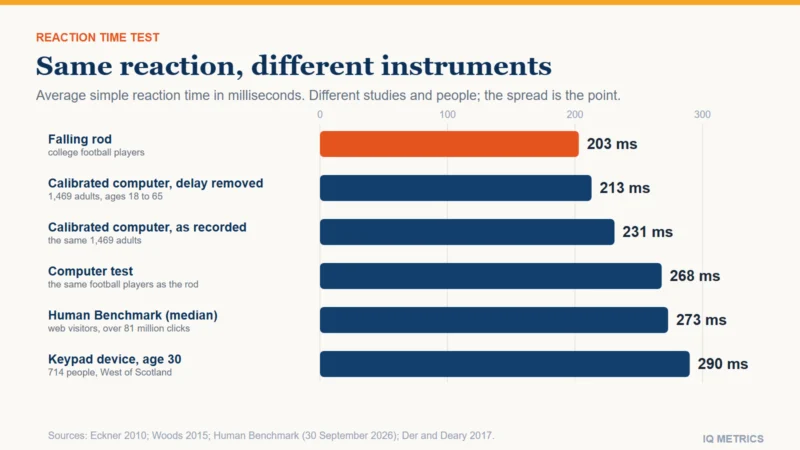 Understanding IQ
Reaction Time Test
A reaction time test depends on the equipment: 203 ms with a falling rod, 231 ms on a calibrated computer, 273 ms online. See the ruler drop conversion table, why online scores run slow, driving and sprint reaction times, and what really changes your speed.
 Understanding IQ
Processing Speed and IQ
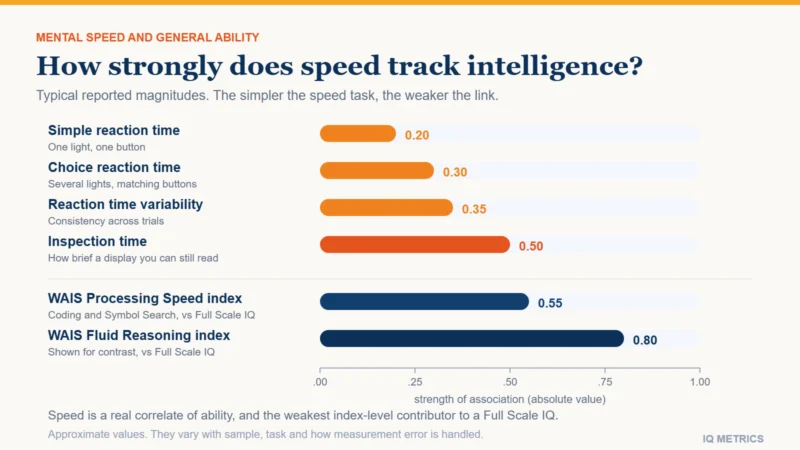
Fast thinkers are assumed to be smart thinkers, and there is a real finding underneath the stereotype: people who score higher on IQ tests do respond faster on tasks with no reasoning content at all. But the link is weaker than the folklore, and on a professional battery the speed index is the least g-loaded.
 Understanding IQ
Memory and IQ
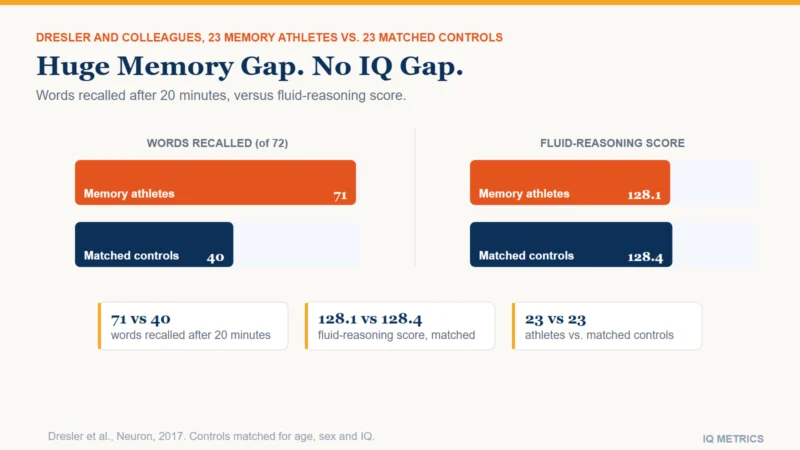
The world's best memory athletes can memorize 71 shuffled words in twenty minutes. Their IQ scores are not measurably different from a matched control group who could only manage 40. If a spectacular memory is not the same thing as a high IQ, what actually is the difference?