





Intelligence Test Sample: 10 IQ Questions for Adults With Answers
An intelligence test sample shows what real IQ questions look like. Try 10 original questions for adults, from pattern grids to digit memory, check the answer and the rule for each, and see the real item counts and time limits of Raven's, the WAIS-IV and the Mensa Norway test, plus what practice adds.

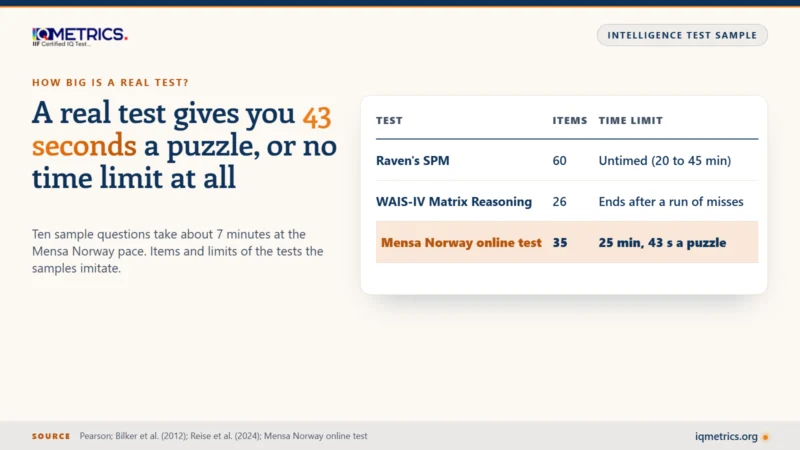
An intelligence test sample looks like this: a grid with one cell missing, a number series, a word pair to match or a short logic puzzle, each with one right answer. Below are 10 original IQ test questions for adults, with answers and the ability each one trains. Real tests are longer: Raven’s Standard Progressive Matrices has 60 items, and the Mensa Norway test has 35 puzzles in 25 minutes.
Below: the 10 questions, the rule behind each answer, the item counts and time limits of the real tests they imitate, and what practice can and cannot do. New here: Mensa Norway’s limit works out at about 43 seconds a puzzle, so this sample suggests 7 minutes for all 10. We wrote every question ourselves. None comes from a published test.
Key takeaways
- Real IQ questions fall into a few families: pattern grids, number series, word relations, spatial puzzles, logic and memory.
- Raven’s Standard Progressive Matrices has 60 items and no time limit. The WAIS-IV Matrix Reasoning subtest has 26 items. Mensa Norway’s online test has 35 puzzles in 25 minutes.
- At Mensa Norway’s pace you get about 43 seconds a puzzle (25 minutes for 35 puzzles; our arithmetic).
- Retesting raises scores by about a quarter of a standard deviation, roughly 4 IQ points, mostly through familiarity (Hausknecht et al., 2007).
- Ten questions cannot give you an IQ. An IQ needs a norm group of people your age.
What does an intelligence test sample look like?
An intelligence test sample shows the kinds of question a test asks, not the test itself. Most adult items test reasoning with new material, so no school knowledge is needed.
Six families cover most of what you will meet. Pattern grids, called matrices, ask which piece completes a design. Number series ask what comes next. Word questions ask how two things relate or what they share. Spatial questions ask you to picture a shape from another side. Logic questions ask what must follow from two statements. Memory questions ask you to hold digits in mind and reorder them. Our guide to the types of questions on an IQ test explains why each one is included.
All 10 questions below were written from scratch. They follow the format of real items but are not copied from any published test, and they are not scored against norms.
What are 10 sample IQ test questions for adults?
This sample IQ test for adults takes about 7 minutes. Work in order, set a timer and keep the answer table below covered. Questions 1 and 2 imitate the visual items in Raven’s matrices, in the WAIS-IV Matrix Reasoning subtest and in the Mensa Norway test. Question 3 is a number version of the same grid.
Pattern questions (fluid reasoning)
| Column 1 | Column 2 | Column 3 |
|---|---|---|
| ● | ●● | ●●● |
| ●● | ●●● | ● |
| ●●● | ● | ? |
Question 1. Options: A) one dot, B) two dots, C) three dots, D) four dots.
| Column 1 | Column 2 | Column 3 |
|---|---|---|
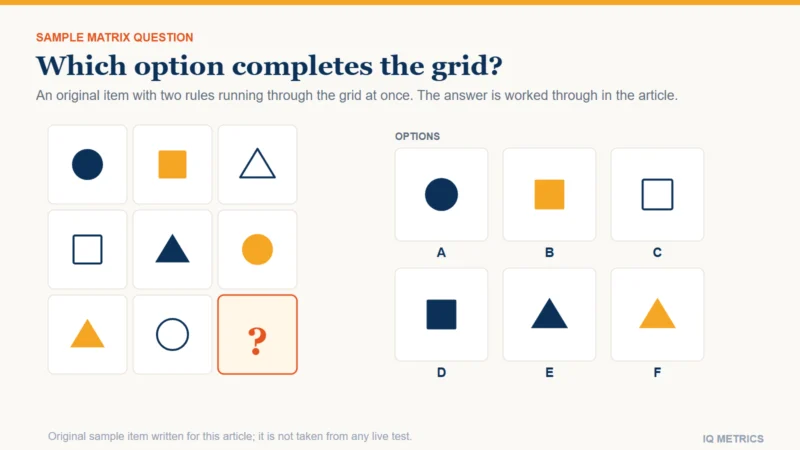
| ● | ■ | ▲ |
| □ | △ | ○ |
| ▲ | ● | ? |
Question 2. Options: A) filled square, B) hollow square, C) filled circle, D) filled triangle, E) hollow triangle.
| Column 1 | Column 2 | Column 3 |
|---|---|---|
| 2 | 6 | 18 |
| 3 | 9 | 27 |
| 4 | 12 | ? |
Question 3. Options: A) 16, B) 24, C) 36, D) 48.
Number questions (quantitative reasoning)
Question 4. What number comes next? 3, 7, 15, 31, ? Options: A) 47, B) 55, C) 63, D) 65.
Question 5. What number comes next? 2, 3, 5, 8, 12, 17, ? Options: A) 22, B) 23, C) 24, D) 25.
Word questions (verbal reasoning)
Question 6. A thermometer is to temperature as a barometer is to what? Options: A) wind, B) pressure, C) humidity, D) rainfall.
Question 7. In what way are a river and a road alike? Write one short answer. The Wechsler Similarities subtest asks the same kind of question.
Space, logic and memory questions
Question 8. A solid 3 by 3 by 3 cube is painted red on all six faces, then cut into 27 equal small cubes. How many small cubes have exactly two red faces? Options: A) 6, B) 8, C) 12, D) 24.
Question 9. All the nurses on a ward are trained in CPR. Some people trained in CPR are volunteers. Which statement is certain? A) Some nurses are volunteers. B) No nurse is a volunteer. C) Neither A nor B is certain.
Question 10. Read these digits once, cover them, then say them backward: 5, 8, 2, 9, 4.
What are the answers and the rule behind each?
Here are the IQ test sample questions with answers. Each line gives the rule, so you can check your reasoning and not only your pick.
| Question | Answer | Rule | Ability measured |
|---|---|---|---|
| 1 | B) two dots | Each row and each column holds one, two and three dots once. | Fluid reasoning |
| 2 | A) filled square | Shapes move one place along each row, and the fill alternates by row: filled, hollow, filled. | Fluid reasoning |
| 3 | C) 36 | Each row is multiplied by 3 as it goes across: 4, 12, 36. | Quantitative reasoning |
| 4 | C) 63 | Double the number and add 1: 3, 7, 15, 31, 63. | Quantitative reasoning |
| 5 | B) 23 | The gaps grow by 1: +1, +2, +3, +4, +5, then +6. | Quantitative reasoning |
| 6 | B) pressure | A barometer measures air pressure as a thermometer measures temperature. | Verbal reasoning |
| 7 | Both are routes | Name the shared category, such as a route that carries travellers or goods from place to place, not a surface detail such as both being long. | Verbal concept formation |
| 8 | C) 12 | One small cube sits on each of the cube’s 12 edges. The 8 corners show three red faces, the 6 face centres one, and the middle cube none. | Spatial visualisation |
| 9 | C) Neither is certain | The CPR-trained volunteers might not be nurses, so “some nurses are volunteers” does not follow. | Deductive reasoning |
| 10 | 4, 9, 2, 8, 5 | Reverse the order of the digits. | Working memory |
Intelligence test questions and answers like these train the format. They do not measure you, because a measurement needs a norm group. Real matrix tests also make items harder as they go; Mensa Norway says its puzzles “get progressively difficult”. Our guides cover more worked examples of analogy questions, syllogism questions and number sequences. Question 10 is a short version of the digit span test.
How many questions and how much time does a real intelligence test give?
It depends on the test: from 26 items for one Wechsler subtest to 60 for Raven’s Standard Progressive Matrices, and from no time limit to 25 minutes.
| Test | Items | Time limit | Source |
|---|---|---|---|
| Raven’s Standard Progressive Matrices (SPM) | 60 items | Untimed; Pearson lists 20 to 45 minutes | Bilker et al. (2012); Pearson |
| Raven’s Advanced Progressive Matrices (APM) | Not stated on the Pearson page | Untimed; Pearson lists 40 to 60 minutes | Pearson |
| WAIS-IV Matrix Reasoning subtest | 26 items | No whole-test limit stated; Wechsler subtests stop after a run of misses | Reise et al. (2024); Pearson WAIS-5 FAQ |
| Mensa Norway online test | 35 puzzles | 25 minutes | Mensa Norway |
Mensa Norway calls its test an indication of general cognitive abilities and “not a substitute for professional intelligence tests”. Its puzzles are visual patterns. You get no bonus for finishing early and no penalty for a wrong guess, so it pays to answer every one.
The pace is easy to work out. Mensa Norway gives 25 minutes for 35 puzzles. That is 1,500 seconds divided by 35, or about 43 seconds a puzzle. Ten questions at that pace take about 7 minutes, which is why this sample suggests 7.
Pearson’s 20 to 45 minutes for the 60 Raven’s SPM items works out to 20 to 45 seconds an item, but that is a typical completion time and not a limit. For other tests, see how long an IQ test takes, test by test: our guide How long does an IQ test take? has the table, and our timed IQ test page lets you feel a strict limit.
Where would your own score land?
Take the IIF-certified assessment and get your score with the scale it was measured on, the percentile it corresponds to and the confidence range around it — the three figures most online tests leave out.
Find your IQ score now! →Can practice raise your score on an intelligence test?
A little, and mostly through familiarity. On average a second sitting scores about a quarter of a standard deviation higher, roughly 4 IQ points on a scale with a standard deviation of 15.
Hausknecht and colleagues pooled 50 studies of cognitive ability tests, with 107 samples and 134,436 participants. They found an adjusted overall gain of .26 standard deviations on retesting, larger when practice came with coaching and when the same form was reused (Journal of Applied Psychology, 2007). We turned .26 into points: 0.26 x 15 is about 3.9.
The gain fades quickly. In a study that tested people seven times on a figural matrices test, the largest gain was linked to the second session, and smaller gains lasted up to the fourth (Jendryczko, Scharfen and Holling, Journal of Intelligence, 2019). Practice teaches you the instructions, the item formats and the pace. It does not prove a higher underlying ability, which is why a repeat score is a weaker estimate. Our report on the practice effect on cognitive ability tests explains how employers handle it.
What can 10 questions tell you about your intelligence?
Not your IQ. An IQ score compares you with a norm group of people your age, and ten questions have no norm group. A fair use of this sample is to see which question type slows you down.
Count your correct answers by family: pattern, number, word, space and logic, memory. If you missed both grid questions, practise pattern items first. For a real score, take the IQ Metrics IQ test, then place the result with our IQ percentile calculator. For younger readers, try the IQ test questions for kids, which cover three item types by age. Question 10 tests working memory, one of the executive functions that researchers have tied to success in soccer: see our guide to soccer IQ.
Quick answers
- What does an intelligence test sample look like? Pattern grids, number series, word relations, spatial puzzles, logic and digit memory, each with one right answer.
- How many questions are on a real IQ test? It varies: 60 on Raven’s SPM, 26 in the WAIS-IV Matrix Reasoning subtest and 35 on Mensa Norway’s online test.
- How much time do you get? Raven’s SPM is untimed, and Mensa Norway gives 25 minutes for 35 puzzles.
- Can a sample give you an IQ? No. A score needs a norm group, and ten questions have none.
- Does practice help? By about 4 points on a second sitting, mostly through familiarity.
The bottom line
An intelligence test sample teaches the format, not your level. Use these 10 questions to meet the six question families, to see how little time a puzzle gets, and to find your slow spot. Then read the real item counts before you trust any online score, and take the IQ test when you want a number on a named scale.
Sources
- Mensa Norway. IQ test made by Mensa Norway (35 puzzles, 25-minute limit), read 10 November 2026.
- Pearson. Raven’s Standard Progressive Matrices product page and Raven’s Advanced Progressive Matrices product page (completion times), read 10 November 2026.
- Pearson. WAIS-5 product page and FAQ (discontinue rules), read 10 November 2026.
- Bilker WB, Hansen JA, Brensinger CM, Richard J, Gur RE, Gur RC (2012). Development of abbreviated nine-item forms of the Raven’s Standard Progressive Matrices test. Assessment 19, 354-369.
- Reise SP, Wong E, Block J, Widaman KF, Gullett JM, Bauer RM, Drane DL, Loring DW (2024). Computerized adaptive test strategies for the Matrix Reasoning subtest of the WAIS-IV. Journal of the International Neuropsychological Society.
- Hausknecht JP, Halpert JA, Di Paolo NT, Moriarty Gerrard MO (2007). Retesting in selection: a meta-analysis of coaching and practice effects for tests of cognitive ability. Journal of Applied Psychology 92, 373-385.
- Jendryczko D, Scharfen J, Holling H (2019). The impact of situational test anxiety on retest effects in cognitive ability testing: a structural equation modeling approach. Journal of Intelligence 7, 22.
Keep reading
All articles → Taking a Test
What Are The Type of Questions Asked On IQ Test?
IQ tests ask a small set of question types: pattern and matrix reasoning, verbal reasoning, number series, spatial puzzles, working memory and speed tasks. See what each looks like, how many questions a test has and which tests are multiple choice.
 Taking a Test
IQ Test Questions for Kids
Original IQ test questions for kids with answers, by age: sample items for 4-7, 8-12 and 13-17, a matrix puzzle worked through, how a child's score is set, how stable it is, and what practice really does.
 Taking a Test
How Long Does an IQ Test Take?
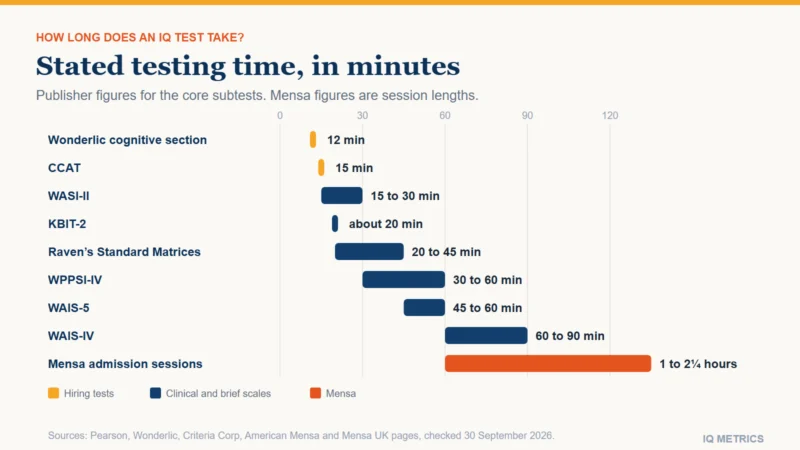
An official IQ test usually takes 45 to 90 minutes of testing: 45 for the WAIS-5, 60 to 90 for the WAIS-IV, 12 for the Wonderlic. See the time for every major test, how many questions to expect, why two people take different amounts of time and what a full evaluation adds.