





Is an IQ of 129 Good? What One Point Below 130 Really Means
An IQ of 129 is the 97.3rd percentile, about 1 in 38, on SD 15. One point under 130 is smaller than the error in one score: a true 129 reads 130 or more about 4 sittings in 10. See the scales, the Mensa lines and the arithmetic behind that claim.

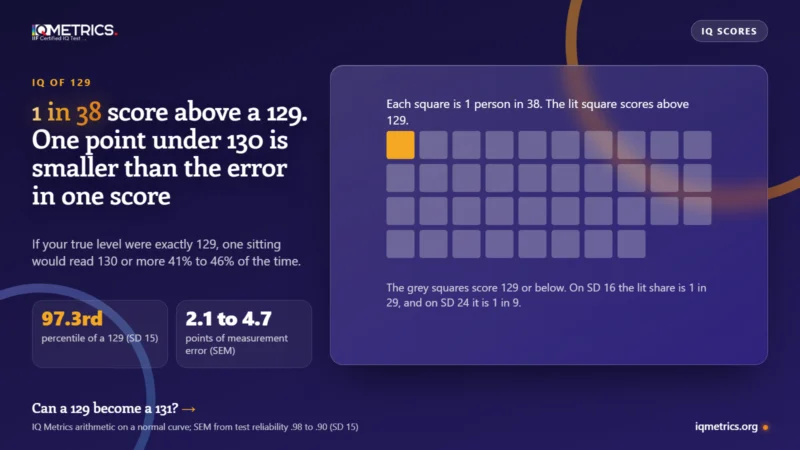
Yes. An IQ of 129 is the 97.3rd percentile on a scale with a mean of 100 and a standard deviation (SD) of 15: about 2.7 in 100 people score higher, or 1 in 38. It is one point under the usual 130 line, and that is less than the error in a single score. If 129 were your true level, about 4 in 10 sittings would read 130 or more.
New here: the line between 129 and 130 is thinner than the test can see. With a standard error of 2.1 to 4.7 points, a 129 carries a 95% band of about 125 to 133 at best and 120 to 138 at worst. Even at best, two sittings by the same person differ by 2 points or more about 6 times in 10. Below: the percentile, the scales, Mensa, and the arithmetic of one point.
Key takeaways
- An IQ of 129 is the 97.3rd percentile on SD 15 (1 in 38), the 96.5th on SD 16 (1 in 29) and the 88.7th on SD 24 (1 in 9).
- One IQ point near 129 is worth 0.4 of a percentile point. The 129 and 130 lines are 1 point apart on a scale where one score can move 2 to 5 points by chance.
- If your true level were exactly 129, one sitting would read 130 or more 41% to 46% of the time, depending on how reliable the test is (our arithmetic).
- No test on American Mensa’s list has a line below 130. A 129 is 1 point short on a Wechsler test, 3 short on a CogAT and 19 short on the Cattell.
- Retesting helps on average: a gain of .26 standard deviations is 3.9 points on SD 15 (Hausknecht and others, 2007, as read on our Mensa preparation page).
Is an IQ of 129 good?
Yes. A 129 is higher than about 97 in 100 people in the norm group, which puts it in roughly the top 3%. So is 129 a good IQ? Yes, by the usual standards. Whether it is good enough depends on the line you face, and the nearest line most people ask about is 130.
A norm group is the large sample of people a test was scored against. The test sets its mean to 100. So a 129 says you stand 29 points above that mean, or 1.93 standard deviations. It does not say how you would score on a different test with a different norm group.
What percentile is an IQ of 129?
An IQ of 129 is the 97.3rd percentile on SD 15. About 2.7% of people score higher, or 1 in 38. The 129 IQ percentile is our own arithmetic on a normal curve, and it holds only if the test’s norm group is close to normal. Our IQ percentile calculator gives the same answer for any score.
| Scale | Where 129 sits | Percentile of a 129 | About 1 in | Same standing on SD 15 |
|---|---|---|---|---|
| SD 15 (Wechsler) | 1.93 SDs above average | 97.3rd | 1 in 38 | 129.0 |
| SD 16 (older Stanford-Binet, CogAT) | 1.81 SDs above | 96.5th | 1 in 29 | 127.2 |
| SD 24 (Cattell) | 1.21 SDs above | 88.7th | 1 in 9 | 118.1 |
The scale changes what 129 means. A 129 on SD 24 is a much weaker result than a 129 on SD 15. Our report on SD 15 vs 16 explains why the scales differ.
Is an IQ of 129 different from 130?
Not by much. In an IQ of 129 vs 130 comparison, a 130 is the 97.7th percentile, or 1 in 44, against 97.3rd and 1 in 38 for a 129. That is 0.4 of a percentile point, about 4 people in every 1,000.
The 130 line is a convenient round number. It marks two standard deviations above the mean, which is the 97.72nd percentile on SD 15. Nothing changes in a person between 129 and 130. If you want to know whether 130 means genius, our guide to an IQ of 130 goes through the claims.
Can the same person score 129 and 131?
Yes, easily. Every test has a standard error of measurement (SEM), which says how far one sitting can land from your average over many sittings. The formula is the SD times the square root of one minus the test’s reliability, as our IQ test accuracy page sets out.
We did not read a test manual for this post, so we show the arithmetic for three reliabilities. A reliability of .90 gives an SEM of 4.7 points on SD 15, which is the example our accuracy page uses. Our report on the IQ margin of error puts well-normed adult tests at 2 to 3 points, which matches a reliability near .98.
| Test reliability | SEM (points) | 95% band around 129 | Percentile range of that band | One sitting reads 130 or more | Two sittings differ by 2 or more |
|---|---|---|---|---|---|
| 0.98 | 2.1 | 124.8 to 133.2 | 95.1th to 98.6th | 41% | 62% |
| 0.95 | 3.4 | 122.4 to 135.6 | 93.3th to 99.1th | 44% | 75% |
| 0.90 | 4.7 | 119.7 to 138.3 | 90.5th to 99.5th | 46% | 82% |
The table assumes the score is the true level plus a random error, that the errors are normal, and that nothing changes between sittings. Real retests also gain from practice, which makes the second score higher on average. So treat the figures as the size of the noise, not as a forecast for your own result.
Read it like this. If your true level were exactly 129, about 4 sittings in 10 would still print 130 or more. A person who scored 131 once and 129 another time has shown nothing unusual.
Does an IQ of 129 qualify for Mensa?
No. Mensa asks for the 98th percentile on a supervised test. On SD 15 that is 130.8, so a 129 is 1.8 points short. American Mensa’s qualifying-scores page, which we read on 14 November 2026, lists no test with a line below 130.
| Test | Qualifying score | Points a 129 is short |
|---|---|---|
| Wechsler adult and children scales (Full Scale IQ) | 130 | 1 |
| Stanford-Binet 5 | 130 | 1 |
| Stanford-Binet (older form) | 132 | 3 |
| Cognitive Abilities Test (CogAT) | 132 | 3 |
| Cattell | 148 | 19 |
So the answer is no on every test, but the margin differs. The Cattell scale uses an SD of 24, which is why its line is 148 and not 130. Our Mensa IQ requirements guide and our news explainer on the Mensa IQ requirement give the full tables. American Mensa lets you sit a test or battery again after eight weeks, and our Mensa test preparation guide covers what a retest can change.
Where would your own score land?
Take the IIF-certified assessment and get your score with the scale it was measured on, the percentile it corresponds to and the confidence range around it — the three figures most online tests leave out.
Find your IQ score now! →What does an IQ of 129 say about you?
The 129 IQ meaning is narrow. It says how you did on one set of puzzles, on one day, against one norm group. It is a strong result. It does not set a limit on what you can learn or do, and it is not a diagnosis.
Societies above Mensa set their own, higher lines. Our guide to high-IQ societies lists them, and our report on how rare a high IQ score is shows what each percentile means.
How does an IQ of 129 compare with 127, 128 and 131?
A 129 is 1 point above a 128 (the 96.9th percentile) and 2 above a 127 (the 96.4th). It is 2 points under a 131 (the 98.1st). Our posts on an IQ of 127, an IQ of 128 and an IQ of 131 give each neighbour its own table.
What does a 129 on an online test mean?
Treat it as a rough guide. Online tests use their own norm groups, and many do not state their SD. A 129 from a website is not a 129 from a supervised test with a trained examiner. For a score of your own, take the IQ test, then place it with the percentile calculator.
Quick answers
- Is 129 IQ good? Yes. It is the 97.3rd percentile on SD 15, higher than about 97 in 100 people.
- What does an IQ of 129 mean? You scored 29 points above the average of 100, or 1.93 standard deviations. About 1 in 38 people score higher.
- Is 129 enough for Mensa? No. American Mensa’s lowest IQ lines are 130, and the exact 98th percentile is 130.8 on SD 15.
- Is IQ 129 genius? There is no agreed genius line. A 129 is a high score, one point under the usual 130 marker.
- Can a 129 become a 131? Yes. Measurement error alone moves one sitting by several points, and practice adds a few more on a retest.
Sources
- American Mensa. Qualifying test scores (page read 14 November 2026).
- IQ Metrics. IQ test accuracy: reliability, SEM and limits (the SEM formula and the reliability .90 example).
- IQ Metrics. An IQ score is a range, not a number: the margin of error (2 September 2026).
- Hausknecht JP, Halpert JA, Di Paolo NT, Moriarty Gerrard MO (2007). Retesting in selection: a meta-analysis of coaching and practice effects for tests of cognitive ability. Journal of Applied Psychology 92(2), 373-385 (the .26 figure as read on our Mensa preparation page).
- The percentiles, the 1-in-N figures, the 130.8 cut-off and the whole error table are our arithmetic on a normal curve with mean 100; they are not published test norms or manual values.
Keep reading
All articles →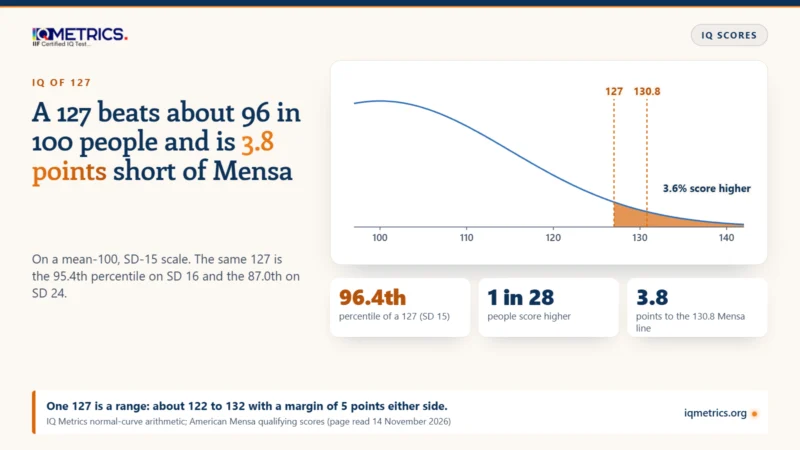 Scores & Scales
What Does an IQ of 127 Mean?
An IQ of 127 is the 96.4th percentile on SD 15, about 1 in 28 people, and 3 points short of the 130 Mensa line. See 127 on each scale, how many people in a class reach it, which gifted-programme rule it misses, and how far one score can move.
 Scores & Scales
What Does an IQ of 128 Mean?
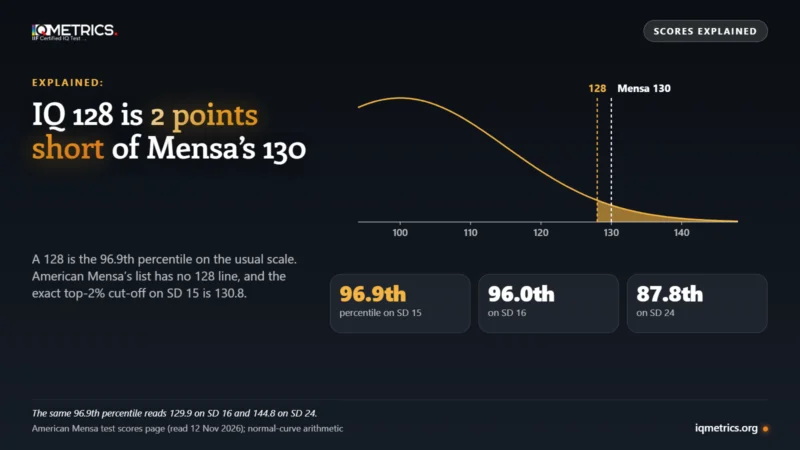
An IQ of 128 is the 96.9th percentile on SD 15, about 1 in 32 people, and 2 points under the usual 130 Mensa line. See what 128 means on SD 16 and SD 24, why no test on American Mensa's list takes it, how far one sitting can move the score, and which famous people sit near it.
 Scores & Scales
Is 130 IQ a Genius Score?
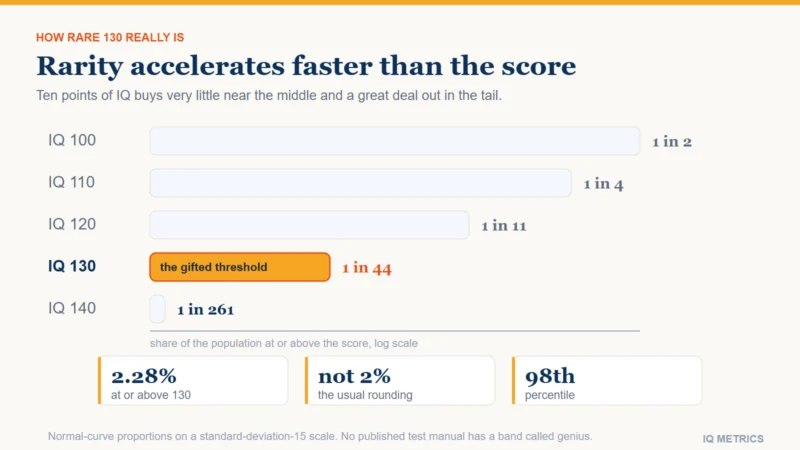
A score of 130 is the conventional threshold for gifted identification and for high-IQ society membership, and it is reached by about one person in 44. It is not, however, a "genius" score, because no published test defines such a band. The word is a popular import, and the difference is worth understanding.