





What Does an IQ of 131 Mean? IQ Test 131, Percentile and Mensa
An IQ of 131 is the 98.1st percentile on SD 15 (about 1 in 52) but the 97.4th on SD 16 (about 1 in 38). Mensa lists 131 as the exact line for two tests and 132 for eight more, so the same score can qualify on one test and miss by a point on the next.

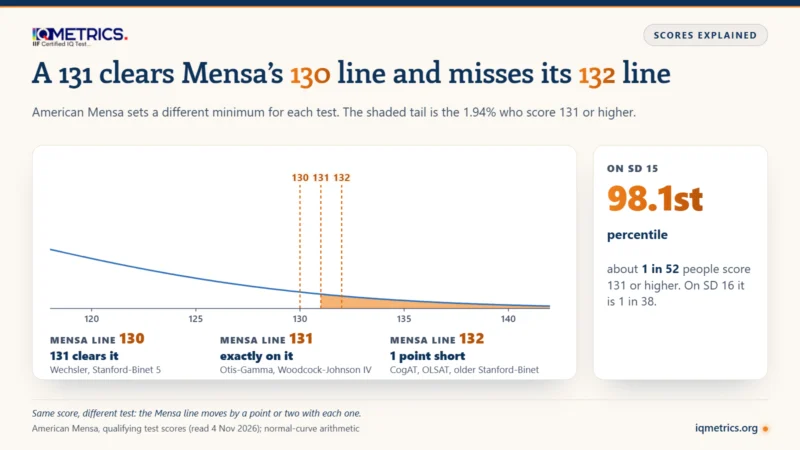
IQ test 131 means the 98.1st percentile on a scale with an average of 100 and a standard deviation (SD) of 15. About 1 in 52 people score 131 or higher. On an SD 16 scale the same number is the 97.4th percentile, about 1 in 38. Mensa asks for 130 on a Wechsler test but 132 on the CogAT, so a 131 clears some lines and misses others by one point.
Below: the percentile on three scales, a test-by-test table against American Mensa’s own scores, and how a 131 compares with its neighbours. The finding most pages miss: 131 is the exact Mensa line for two tests, and one point short of eight others.
Key takeaways
- Percentile: 98.06th on SD 15 (about 1 in 52), 97.37th on SD 16 (1 in 38) and 90.18th on SD 24, the Cattell scale (1 in 10).
- Mensa: a 131 beats the 130 line (Wechsler, Stanford-Binet 5, RIAS, DAS-II, NNAT) and meets the 131 line (Otis-Gamma, Woodcock-Johnson IV).
- Short by one point on the 132 line: CogAT, OLSAT, NNAT2 and NNAT3, older Stanford-Binet and four more tests. Short by 17 on the Cattell.
- Label: the first score of the Very Superior band on the Woodcock-Johnson IV chart, which starts at 131.
- Precision: a single 131 is a range, roughly 125 to 137.
What percentile is an IQ of 131?
The 98.1st percentile, on the scale most clinical tests use. That scale sets the average at 100 and one SD at 15 points, so 131 sits 31 points, or 2.07 SDs, above average.
Here is the sum. The z-score is (131 minus 100) divided by 15, which is 2.07. On a normal curve 98.06% of people fall below that point and 1.94% fall above it. One divided by 0.0194 is about 52, so roughly 1 person in 52 scores 131 or higher. Our IQ percentile calculator does the same sum for any score.
Scaled up, that is about 29 people in a school of 1,500, about 19,400 in a city of one million and about 1.9 million in a country of 100 million. A class of 30 has a 44% chance of holding at least one pupil at 131 or higher.
Is an IQ of 131 the same on every scale?
No. The scale decides what 131 means. Most modern tests use an SD of 15, but some use 16 or 24, and the same number sits at a different distance from average on each.
| Scale | Used by | z-score | Percentile | Rarity | Same standing on SD 15 |
|---|---|---|---|---|---|
| SD 15 | Wechsler tests, Stanford-Binet 5 | 2.07 | 98.06th | 1 in 52 | 131 |
| SD 16 | CogAT standard age score, NNAT3, older Stanford-Binet forms | 1.94 | 97.37th | 1 in 38 | 129.1 |
| SD 24 | Cattell scale | 1.29 | 90.18th | 1 in 10 | 119.4 |
Read the table both ways. A 131 on an SD 16 test is worth about 129 on an SD 15 test. A 131 on the Cattell scale is only about 119. Riverside Insights defines the CogAT standard age score as having a mean of 100 and an SD of 16. Pearson’s NNAT3 manual gives the same figures for its ability index. The IQ score converter moves a score between scales.
Does an IQ of 131 qualify for Mensa?
Sometimes. Mensa International admits people in the top 2% on a professionally supervised test that Mensa recognises, and each test turns that into its own number.
The top 2% starts 2.05 SDs above average. That is 130.8 on SD 15, 132.9 on SD 16 and 149.3 on SD 24. A 131 clears the first by 0.2 of a point, so it is inside the top 2% on an SD 15 scale, but it falls short on an SD 16 scale. American Mensa publishes whole-number lines test by test, and 131 meets some and misses others.
| Test | Mensa minimum | Does 131 qualify? |
|---|---|---|
| Wechsler adult, children and preschool scales (Full Scale IQ) | 130 | Yes, 1 point above |
| Stanford-Binet 5 | 130 | Yes, 1 point above |
| Reynolds Intellectual Assessment Scales (RIAS) | 130 | Yes, 1 point above |
| Differential Ability Scales, 2nd edition (DAS-II) | 130 | Yes, 1 point above |
| Naglieri Nonverbal Ability Test (NNAT) | 130 | Yes, 1 point above |
| Otis-Gamma | 131 | Yes, exactly on the line |
| Woodcock-Johnson IV, cognitive | 131 | Yes, exactly on the line |
| CogAT composite (standard age score) | 132 | No, 1 point short |
| OLSAT total, NNAT2 and NNAT3, older Stanford-Binet | 132 | No, 1 point short |
| DAS, Woodcock-Johnson I to III, Henmon-Nelson, California Test of Mental Maturity | 132 | No, 1 point short |
| Cattell | 148 | No, 17 points short |
The table follows American Mensa’s qualifying-scores page, which says it is not a complete list of accepted tests. Mensa may change the scores as tests are renormed and appraises each application individually. It does not accept unsupervised testing, including tests taken online.
That is the finding most guides skip. Five tests set the line at 130, two at 131, eight at 132 and one at 148. The same 131 earns a yes on one test and a no on the next.
Some guides print 131, 133 and 149 as the top-2% scores because they round the arithmetic to the nearest whole number. Mensa’s own table uses the numbers above. Our guide to the score you need for Mensa covers the application routes, and our Mensa statistics study counts the members behind them.
Is an IQ of 131 good?
Yes. A 131 is above 130, which is Mensa’s line for the Wechsler tests, and it is the first score of the Woodcock-Johnson IV’s top band.
For the range that counts as typical, see our guide to what a normal IQ is. A 131 sits well above it.
The Woodcock-Johnson IV chart labels scores of 131 and above Very Superior, covering the 98th to 99.9th percentile. Our IQ classification chart sets out the labels each test uses, and none of them is a diagnosis or a promise.
How does an IQ of 131 compare with 130, 132 and 136?
It sits one step above 130 and one below 132. The steps are small near the top of the scale, which is why one point can change a Mensa answer without changing the person.
| Score | Percentile | Rarity |
|---|---|---|
| 129 | 97.34th | 1 in 38 |
| 130 | 97.72nd | 1 in 44 |
| 131 | 98.06th | 1 in 52 |
| 132 | 98.36th | 1 in 61 |
| 133 | 98.61st | 1 in 72 |
| 136 | 99.18th | 1 in 122 |
A 136 is about 2.4 times rarer than a 131. Our guide to an IQ of 136 covers that step up. For the wider picture of where 130 and above ends and “genius” begins, see our guide to the genius IQ level.
Where would your own score land?
Take the IIF-certified assessment and get your score with the scale it was measured on, the percentile it corresponds to and the confidence range around it — the three figures most online tests leave out.
Find your IQ score now! →Is an IQ of 131 gifted?
Whether it meets a gifted cut-off depends on the programme, because “gifted” has no single line. Schools set their own, and many use percentile ranks on group tests instead of IQ.
For scale: 7.0% of US public-school students were in gifted programmes in 2023-24, according to the federal data in our gifted students by state study. That is about 3.6 times the 1.9% who score 131 or higher, so a gifted label does not mean a score this high. Our guide to gifted cutoff scores shows the lines in use.
How precise is an IQ test 131 score?
Within about 5 or 6 points either side. No IQ score is exact. A full-scale score on a well-built adult test has a standard error of measurement of about 2 to 3 points.
A 95% interval is roughly 1.96 standard errors either side, so a reported 131 fits a true standing of about 125 to 137. The low end sits below every Mensa line in the table, and the high end above all but the Cattell. That is why one 131 is a range and not a promise of another. Our explainer on the margin of error in an IQ score shows how to read it.
What does a 131 on an online test mean?
It places you against that site’s own sample, not against a clinical norm group. American Mensa does not accept unsupervised online tests, so an online 131 does not qualify you.
If you want a score with a percentile beside it, take the IQ test and compare the result with the tables above. Treat the number as an estimate and note which scale it uses.
Quick answers
- What percentile is an IQ of 131? The 98.1st on SD 15 (about 1 in 52) and the 97.4th on SD 16 (about 1 in 38).
- Is 131 IQ good? Yes. It is above Mensa’s 130 line for Wechsler tests, and the Woodcock-Johnson IV chart starts its Very Superior band at 131.
- Does an IQ test 131 qualify for Mensa? Yes on Wechsler, Stanford-Binet 5, RIAS, DAS-II, NNAT, Otis-Gamma and Woodcock-Johnson IV. No on the CogAT, OLSAT, older Stanford-Binet and the Cattell.
- What is 131 on the Cattell scale? The 90.2nd percentile, about 1 in 10, because the scale has an SD of 24.
- How many people score 131 or higher? About 1.94% on SD 15: roughly 29 in a school of 1,500.
The bottom line
An IQ of 131 is a high score on any scale. How rare it is depends on the SD behind it: 1 in 52 on SD 15, 1 in 38 on SD 16 and 1 in 10 on the Cattell. For Mensa it depends on the test: a 131 clears seven lines, two of them exactly, and misses nine. Ask which test and which scale before you compare a 131 with anything.
Sources
- American Mensa, qualifying test scores: the minimum score for each accepted test, and the rule on unsupervised testing.
- Mensa International, how to join: the top 2% rule and the need for a professionally supervised, recognised test.
- Riverside Insights, Woodcock-Johnson IV classification chart: 131 and above is Very Superior.
- Riverside Insights, CogAT score descriptions: standard age score with a mean of 100 and an SD of 16.
- Pearson, NNAT3 manual: the Naglieri Ability Index has an average of 100 and a standard deviation of 16.
- Percentiles, rarity and the 95% range are our arithmetic from the normal curve: z = (score minus 100) divided by the SD, with the upper tail from the complementary error function.
Keep reading
All articles →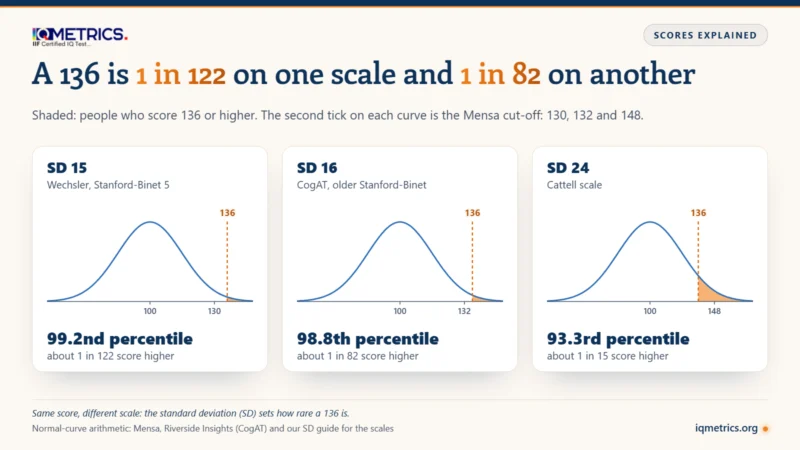 Scores & Scales
What Does an IQ of 136 Mean?
An IQ of 136 is the 99.2nd percentile on SD 15 (about 1 in 122) but the 98.8th on SD 16 (about 1 in 82) and the 93.3rd on the Cattell scale. How 136 stands against Mensa's own table, including the old Army tests that share the number, and how precise one score is.
 Scores & Scales
What an IQ of 135 Means
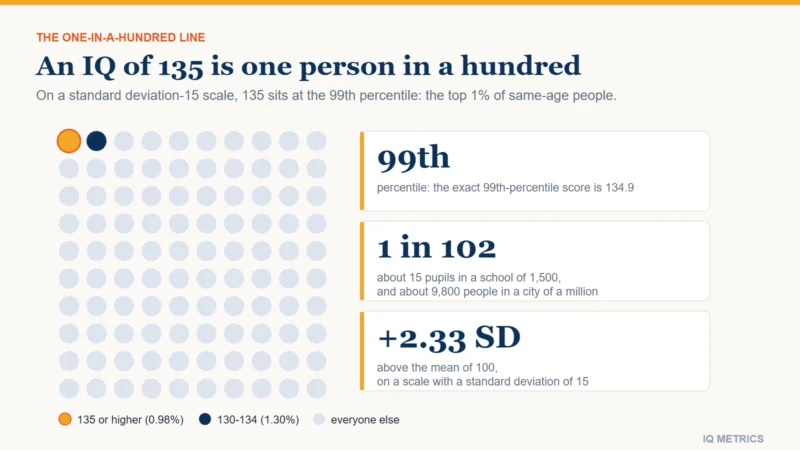
An IQ of 135 is the 99th percentile: one person in 102 on the Wechsler scale, but only 1 in 14 on the Cattell scale. Rarity of every score from 130 to 139, the cut-off Terman really used, how precise a 135 is, and what it predicts.
 Scores & Scales
Mensa IQ Score Requirements
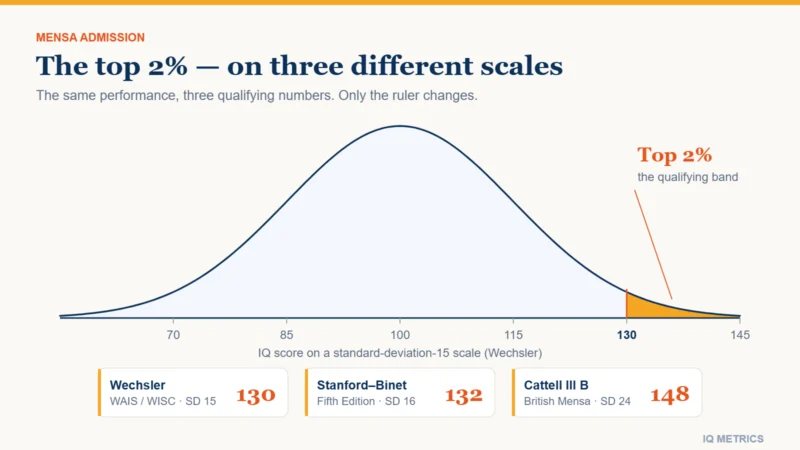
Mensa admits the top 2% of scorers, but "the top 2%" is a rank, not a number, and the number it maps to changes with the test you sat. Here is what qualifies on the Wechsler, Stanford-Binet and Cattell scales, the two routes to membership, and what the supervised admission test is actually like.