





What Is the Average IQ in Iran? Where the Figures Come From and What TIMSS and PIRLS Show
The average IQ in Iran is an estimate, not a test result: 80.01 in a 2019 compiled table of 3 studies and 104.80 in a 2025 online series of 10,538 takers, 24.8 points apart. The older figure of 84 rests on one sample. See where each number comes from and what TIMSS and PIRLS show.

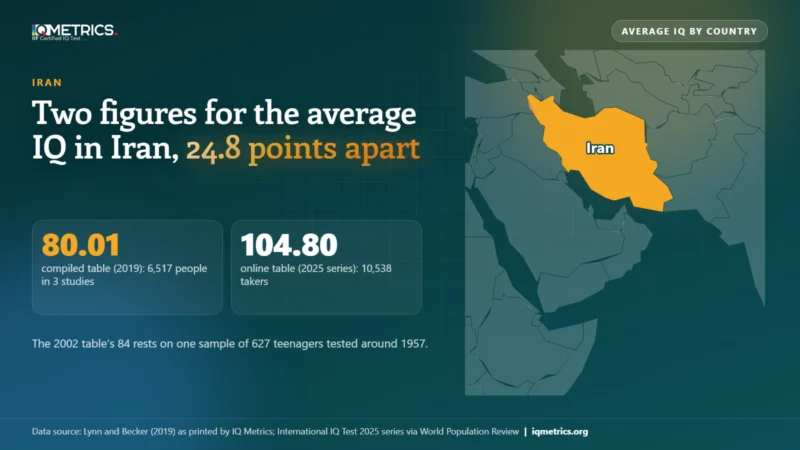
The average IQ in Iran is an estimate, not a test result. Two figures circulate: 80.01 from a 2019 compiled table (6,517 people in 3 studies) and 104.80 from the 2025 series of an online table (10,538 takers). They sit 24.8 points apart, and we found no nationally representative IQ sample of Iran behind either. Both describe samples and sources, not the people of a country.
New here: the older 2002 table built Iran’s 84 from one sample, 627 teenagers tested around 1957. Turkey sits 6.8 points above Iran in the compiled table and 7.8 below it in the online one, while school tests put Turkey ahead. Below: where each number comes from, what TIMSS and PIRLS show, and why the tables disagree.
Key takeaways
- An IQ test normed in Iran averages 100 by design. Comparing countries needs other data, and none of it is an IQ test of everyone in the country.
- Two numbers circulate: 80.01 (compiled, 3 studies, 6,517 people, 119th of 201) and 104.80 (online, 10,538 takers, 4th of 137 in our report). They differ by 24.8 points.
- The 2002 figure of 84 rests on one sample: 627 adolescents tested around 1957, scored at 80 against British norms and raised by 4 for the 22-year gap.
- IEA school tests give Iran 420 (grade 4) and 423 (grade 8) in TIMSS 2023 mathematics, against international averages of 503 and 478. PIRLS 2021 reading gives 413, against a centrepoint of 500. These are not IQ scores.
- Iran has no row in the OECD’s PISA 2025 results tables or the Survey of Adult Skills 2023 tables we searched. Every source but the online table puts Turkey ahead of Iran.
What is the average IQ in Iran?
On a test normed in Iran, the average is 100 by construction. A norm group is a large sample of people who took the test, and its mean is set to 100, with a standard deviation (SD) of 15 points. A person in Iran who scores 100 is average among that group. It says nothing about Iran against another country.
Several kinds of number get called the Iran average IQ. They answer different questions, so the table lists what stands behind each. The average IQ in Iran 2025 figure that circulates is the online one.
| Source | Figure | Sample | What it is |
|---|---|---|---|
| Lynn and Vanhanen (2002), IQ and the Wealth of Nations | 84 | 1 sample, 627 people | One 1957 result, adjusted and rounded |
| Lynn and Becker (2019), as printed on our average IQ by country page | 80.01 | 6,517 people in 3 studies | Published studies on different tests, compiled |
| International IQ Test, 2025 series (World Population Review, 2026 page) | 104.80 | 10,538 online takers | People who chose to take one website’s test |
| IEA TIMSS 2023 and PIRLS 2021 | Not an IQ | School samples in grades 4 and 8 | Mathematics and reading results, shown below |
Read these as three kinds of number: one old sample, a compilation of three studies we did not open, and the mean of volunteers on a website. They cannot be set side by side on one scale. Our guide to average IQ by country shows every country’s figure and its sample column, and the Israel and India pages apply the same questions to two other countries.
Where does the national IQ figure for Iran come from?
From one old sample. Lynn and Vanhanen’s 2002 book gives Iran an IQ of 84, which is a result of 80 raised by 4. The sample was not national.
| Step | Number | What it rests on |
|---|---|---|
| Valentine (1959), tested around 1957 | 80 | 627 adolescents aged about 15 on the Standard Progressive Matrices, scored against the British 1979 norms |
| Adjustment | +4 | The book raised the result because 22 years separate the two norm samples |
| Iran | 84 | The figure printed in the book’s table of national IQs |
The source is a paper titled “Psychometric testing in Iran” (Journal of Mental Science, 1959). We read the book’s account of it, not the paper. The same table gives Turkey 90, Iraq 87 and Lebanon 86.
How many studies stand behind the Iranian IQ level?
The 2019 compiled table prints 3 studies and 6,517 people for Iran. That is 10 times the 627 people behind the 2002 figure, and the number moved from 84 to 80.01, a drop of 4.0 points.
More people is not the same as a representative sample. Iran had about 90.6 million people in 2023 (World Bank), so 6,517 is about 1 person in 13,900. The online table’s 10,538 takers are about 1 in 8,600, and they chose to take the test. We did not open the three studies behind the 2019 figure, so we cannot say which tests they used or whom they sampled.
Our report on what country IQ rankings cannot support sets out the wider problem. On our hub Iran is 119th of 201 in the compiled table. In our report on the 2026 online ranking it is 4th of 137 countries with at least 100 takers. World Population Review’s own list also shows Hong Kong, Macau and Taiwan, and has Iran 7th.
What do TIMSS and PIRLS show for Iran, and is it in PISA?
Iran takes part in the IEA’s school studies TIMSS and PIRLS, and has no row in the OECD tables we searched. The IEA results describe pupils in grades 4 and 8, not adults and not IQ.
| Study and grade | Iran | International average | Turkey | Azerbaijan |
|---|---|---|---|---|
| TIMSS 2023 mathematics, grade 4 | 420 (4.2) | 503 (0.4) | 553 (4.1) | 494 (3.5) |
| TIMSS 2023 mathematics, grade 8 | 423 (3.6) | 478 (0.5) | 509 (4.3) | 479 (3.7) |
| PIRLS 2021 reading, grade 4 | 413 (4.9) | 500 (scale centrepoint) | 496 (3.4) | 440 (3.6) |
Both scales were set so that 100 points equal one standard deviation of the 1995 (TIMSS) or 2001 (PIRLS) combined distribution. In grade 4 mathematics Iran is 83 points below the international average, about 0.83 of that SD. In grade 8 it is 55 points below.
The IEA flags Iran’s TIMSS averages with a reliability reservation: more than 15% but not more than 25% of its students scored too low for the scale to estimate. Its PIRLS 2021 result comes from a test given one year later than first planned.
We did not convert these into IQ points, because a school scale and an IQ scale are different things. Our post on whether PISA is an IQ test explains why. Iran has no row in the PISA 2025 results tables or in the 2023 Survey of Adult Skills tables that we searched, so no OECD result was found for this article.
Where would your own score land?
Take the IIF-certified assessment and get your score with the scale it was measured on, the percentile it corresponds to and the confidence range around it — the three figures most online tests leave out.
Find your IQ score now! →Iran vs Turkey IQ: do the tables agree?
No. On Iran vs Turkey IQ, the compiled tables put Turkey ahead, the online table puts Iran ahead, and the school tests put Turkey ahead again.
| Country | 2002 table | 2019 compiled table | 2025 online series | TIMSS 2023 grade 8 |
|---|---|---|---|---|
| Iran | 84 | 80.01 | 104.80 | 423 |
| Turkey | 90 | 86.80 | 97.00 | 509 |
| Iraq | 87 | 89.28 | 93.62 | no result reported in the exhibit |
In the compiled tables Turkey is 6 points above Iran in 2002 and 6.8 in 2019. In the online table Iran is 7.8 above Turkey. On grade 8 mathematics Turkey is 86 points above Iran, and on PIRLS reading 83. Only the online table disagrees, and it counts volunteers. Iraq’s fourth-grade TIMSS results did not meet the IEA’s reporting standards.
A country-versus-country ranking therefore describes the list, not the countries. Change the list and the order changes. Our smartest countries study ranks countries by school results instead.
Why national IQ estimates differ for the same country
Why national IQ estimates differ for one country: each number comes from different people, a different test and a different decade, and the tables cannot separate those effects from ability. The Iran figures differ by 24.8 points for that reason.
Valentine’s teenagers took a matrices test in about 1957. The 2019 table compiles three studies on tests we did not read. The online series counts people who chose to visit one website. World Population Review, which prints that table, says its results come from people who chose to take an online test and are not a representative test of every resident.
Norms also age. The 2002 book raised the 1957 result by 4 points because the British norms it used were from 1979, a 22-year gap. Our report on the Flynn effect and why IQ norms expire explains that kind of adjustment. A culture-fair test removes some language and schooling content, but it does not remove practice or unequal test experience. Our guide to the culture-fair IQ test says what it can and cannot fix.
What does a country average say about you?
Nothing. A national figure is an average of a sample, and individual scores inside any country span a wide range. The only number that describes you is your own, with its scale and percentile, as our page on what an IQ of 124 means shows. Our IQ percentile calculator places any score on the curve. To see where your score falls, take the IQ test.
Quick answers
- What is the average IQ in Iran? No measured national figure exists that we found. 80.01 is a 2019 compiled estimate and 104.80 an online-table average.
- What is the Iran average IQ in the older table? 84, from one sample of 627 adolescents tested around 1957.
- Is there a measured Iranian IQ level? Not from a national sample. The figures are compiled studies or online volunteers.
- How does Iran compare with Turkey? Turkey is ahead in the compiled tables and in TIMSS and PIRLS, and behind in the online table.
- What do TIMSS and PIRLS show for Iran? 420 (grade 4) and 423 (grade 8) in TIMSS 2023 mathematics and 413 in PIRLS 2021 reading. Iran is not in the PISA 2025 tables we searched.
Sources
- Lynn R, Vanhanen T (2002). IQ and the Wealth of Nations. Praeger: the table of national IQs and the appendix entry for Iran, read in the Internet Archive scan.
- Valentine M (1959). Psychometric testing in Iran. Journal of Mental Science 105, 93-107 (title confirmed on Crossref; paper not read).
- Lynn R, Becker D (2019). The Intelligence of Nations, as printed on our average IQ by country page (dataset V1.3.2, read 17 November 2026); International IQ Test table via World Population Review and our 2026 ranking report.
- IEA. TIMSS 2023: Exhibit 1.1.1 (grade 4 mathematics), Exhibit 1.2.1 (grade 8) and the participants list (read 17 November 2026).
- IEA. PIRLS 2021 international results in reading, Exhibit 1.1 (read 17 November 2026).
- OECD, PISA 2025 results tables and Survey of Adult Skills 2023 annex tables (searched for Iran: no row); World Bank, population, total (2023).
- Percentage, ratio, score-difference and sample-share figures on this page are IQ Metrics arithmetic on the numbers above.
Keep reading
All articles →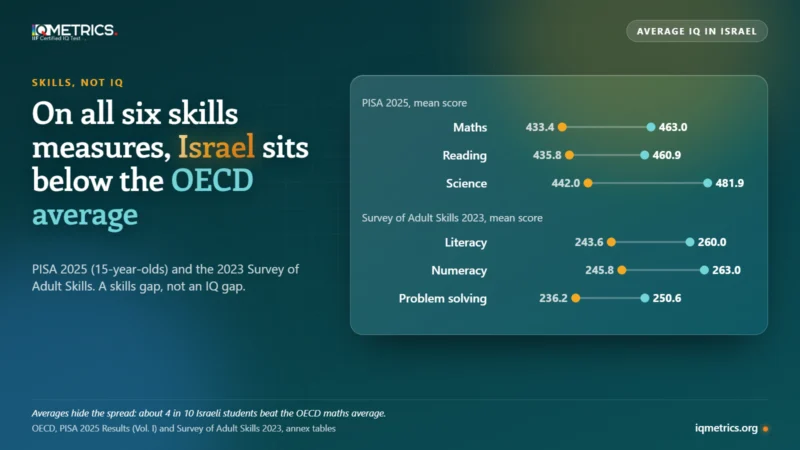 Scores & Scales
Average IQ in Israel
The average IQ in Israel is 100 on an Israeli-normed test. The circulating national figures are 98.57 from an online table and 92.43 from a compiled estimate. See PISA 2025 and adult skills against the OECD, how Israel compares with the US, Germany and South Korea, and what a country average cannot tell you.
 Scores & Scales
Average IQ in India
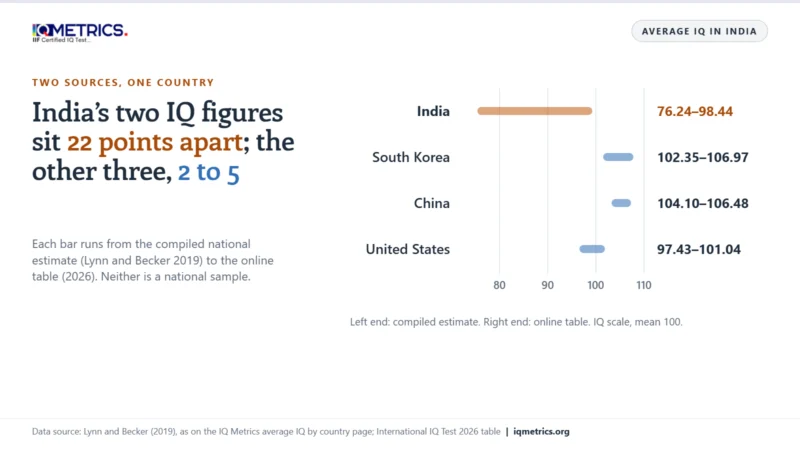
The average IQ in India is 100 on an Indian-normed test. The circulating national figures are 76.24 from a compiled estimate and 98.44 from an online table, 22 points apart. See where each comes from, what PISA 2009+ and ASER 2024 show, and how India compares with China, the US and South Korea.
 Scores & Scales
What Is the Average IQ in Nigeria?
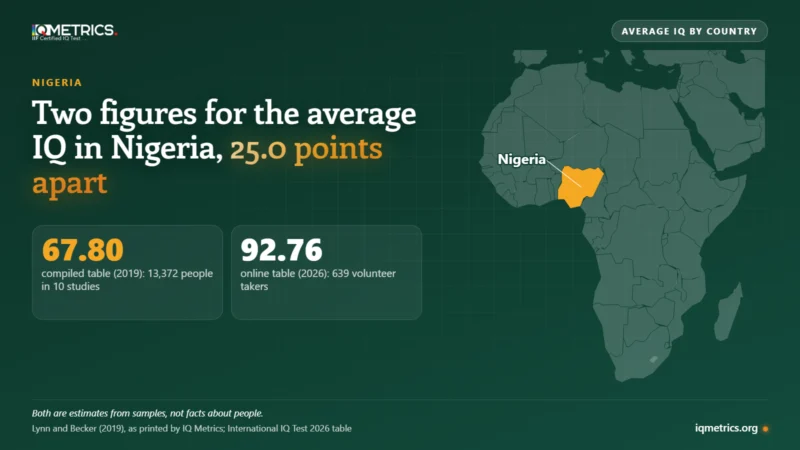
The average IQ in Nigeria is an estimate, not a test result: 67.80 in a 2019 compiled table of 10 studies and 92.76 in a 2026 online table of 639 takers, 25.0 points apart. The older figure of 67 rests on two samples. See where each number comes from and what school data show.