





Average Israeli IQ: What PISA, Adult Skills and Online Tests Show
The average IQ in Israel is 100 on an Israeli-normed test. The circulating national figures are 98.57 from an online table and 92.43 from a compiled estimate. See PISA 2025 and adult skills against the OECD, how Israel compares with the US, Germany and South Korea, and what a country average cannot tell you.

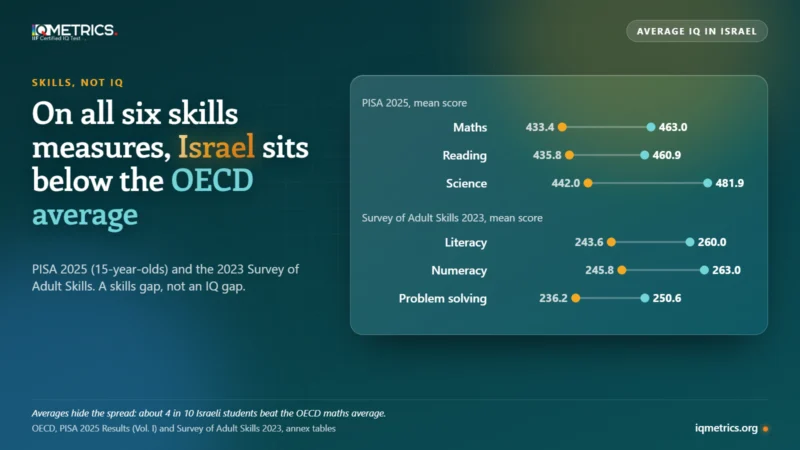
The average IQ in Israel is 100 on any test normed in Israel, because every IQ test sets its own average at 100. The figures quoted for the average Israeli IQ are 98.57 from an online table (8,385 takers) and 92.43 from a compiled national estimate (6 studies, 3,705 people). On school skills, Israeli 15-year-olds scored 433 in PISA 2025 maths, against an OECD average of 463.
This guide sets those figures beside PISA 2025 and the 2023 Survey of Adult Skills, and compares Israel with the US, Germany and South Korea. New here: scores inside Israel are more spread out than the OECD’s, so about 4 in 10 Israeli students still beat the OECD maths average. This page covers country-level data only. It says nothing about any group of people.
Key takeaways
- Any Israeli-normed IQ test averages 100 by design. National comparisons need skills data instead.
- Two numbers circulate: 98.57 (online table, 8,385 volunteers) and 92.43 (compiled estimate, 3,705 people in 6 studies). They are 6.1 points apart.
- In PISA 2025, Israel scored 433 in maths, 436 in reading and 442 in science, 30, 25 and 40 points below the OECD average (OECD tables).
- Israeli adults rank 26th of 31 in the 2023 Survey of Adult Skills, about 16 points below the OECD average.
- A country average says little about one person: Israel’s maths scores have a standard deviation of 103 points against 93 for the OECD.
What is the average IQ in Israel?
On a test normed in Israel, the average is 100 by construction. A norm group is a large sample of people who took the test. Its mean is set to 100, with a standard deviation (SD) of 15 points. An Israeli who scores 100 is average among Israelis. That says nothing about Israel against another country.
Four other numbers get called the average IQ in Israel. They answer different questions, and none is an IQ test of all Israelis. Search results for the Israel average IQ mostly print one of them with no sample. The IQ of Israelis, like that of any nation, has never been measured on one test given to a random sample of the whole country.
| Source | Israel | Sample | What it measures |
|---|---|---|---|
| Online test (International IQ Test 2026 table) | 98.57, 48th of 137 | 8,385 volunteers | People who chose to take one website’s test |
| Compiled national IQ estimate (our average IQ by country page) | 92.43, 49th of 201 | 3,705 people in 6 studies | Published studies on different tests, averaged |
| PISA 2025 maths (OECD) | 433.4 (standard error 3.1) | Representative samples of 15-year-olds | School maths skill, not IQ |
| Survey of Adult Skills 2023 (OECD) | 241.9, 26th of 31 | Representative samples of adults aged 16 to 65 | Literacy, numeracy and problem solving |
Where does the 92.43 for Israel come from?
From a compiled dataset of published IQ studies: Lynn and Becker’s The Intelligence of Nations (2019), which our average IQ by country page reproduces. For Israel it holds 3,705 people in 6 studies and gives 92.43, 49th of 201 countries.
The weakness is the sample, not the arithmetic. Those 3,705 people are about 3.8 in every 10,000 Israeli residents (World Bank population, 2023: 9,849,000), and they were not drawn at random from the whole country. We did not open the six studies, so we cannot say which tests or years they used. The same dataset gives the US 97.43 from 58 studies and Germany 100.74 from 12. Counts of studies differ widely, so the figures are not equally solid.
Our report on why country IQ rankings are weaker than the charts suggest sets out the wider problem with compiled tables.
Why does the online table show 98.57 for Israel?
It comes from one website’s annual table, updated on 1 January 2026 from people who took its test during 2025. Israel ranks 48th of 137 countries with 98.57, from 8,385 takers. With an SD of 15 the standard error is only 0.16 points. That makes the number precise for the volunteers, but not for Israel.
Those 8,385 takers are about 8.5 in every 10,000 residents, and they chose to take the test. Our report on the 2026 online ranking shows that countries with more takers score higher, which is the opposite of what a national comparison needs.
How does the average Israeli IQ compare with the US, Germany and South Korea?
An Israel IQ vs US comparison needs skills data, and on school skills Israel is below all three countries. On adult skills it trails Germany and the US and sits near South Korea. None of this is an IQ gap. It is a skills gap, measured on different people in different years, and the online and compiled figures are too weak to rank countries.
| Measure | Israel | US | Germany | South Korea |
|---|---|---|---|---|
| PISA 2025 maths | 433.4 | 462.8 | 463.8 | 522.3 |
| PISA 2025 reading | 435.8 | 489.5 | 465.3 | 500.6 |
| PISA 2025 science | 442.0 | 501.6 | 485.5 | 526.1 |
| Adult skills 2023 (mean of three) | 241.9 | 251.5 | 266.7 | 246.4 |
| Online IQ test 2026 | 98.57 | 101.04 | 99.32 | 106.97 |
| Compiled national IQ estimate | 92.43 | 97.43 | 100.74 | 102.35 |
Look at Israel against the US on maths. The gap is 29.5 points with a standard error of about 6.2, so it is not noise. The OECD marks the US results for sampling caution, so read that comparison with care. For the same kind of comparison, read our posts on the average IQ in Germany, South Korea and the UK against the US.
Where would your own score land?
Take the IIF-certified assessment and get your score with the scale it was measured on, the percentile it corresponds to and the confidence range around it — the three figures most online tests leave out.
Find your IQ score now! →What do PISA and adult skills show for Israel?
Israeli 15-year-olds scored below the OECD average in all three PISA 2025 subjects, and adults scored about 16 points below it in all three adult skills. PISA measures school skills, not IQ, as our guide to whether PISA is an IQ test explains.
| Measure | Israel | OECD average | Difference |
|---|---|---|---|
| PISA 2025 maths | 433.4 | 463.0 | -29.6 |
| PISA 2025 reading | 435.8 | 460.9 | -25.1 |
| PISA 2025 science | 442.0 | 481.9 | -39.9 |
| Adult literacy 2023 | 243.6 | 260.0 | -16.4 |
| Adult numeracy 2023 | 245.8 | 263.0 | -17.3 |
| Adult problem solving 2023 | 236.2 | 250.6 | -14.5 |
Israel’s 2025 scores are the lowest of any PISA cycle in the OECD’s trend tables, in all three subjects. Maths fell 24.5 points since 2022 and 33.1 since 2012. Reading fell 38.0 points since 2022, and science 22.7. These drops are several times their standard errors, so chance does not explain them. We do not explain them either, and a school-skills trend is not an IQ trend.
Adult skills rank Israel 26th of 31, above Italy, Lithuania, Portugal, Poland and Chile. In numeracy Israel (245.8) sits within 3 points of the US (248.8), a gap that is not clear given the margins. The OECD stars six systems in the PISA tables for sampling caution: Albania, Canada, the Netherlands, New Zealand, Norway and the US. Israel is not one of them.
Does a country average say anything about one person?
Very little. Inside Israel the spread of scores is far wider than the gap to the OECD average, so most of the difference between two Israelis is not the difference between two countries.
In PISA 2025 maths the Israeli SD is 103 points against 93 for the OECD average. Israel’s 10th percentile is 300 and its 90th is 569, a range of 269 points against 244 for the OECD. The OECD average of 463 sits about 0.4 of the way between Israel’s median (432) and its 75th percentile (506). By that interpolation, our estimate, about 4 in 10 Israeli students scored above the OECD maths average, even though the national average is 30 points lower.
The same logic applies to every country on our bell curve. Place your own score on it with our IQ percentile calculator.
How should you use these numbers?
- Treat 100 as the average Israeli IQ on any Israeli-normed test, and nothing more.
- Compare countries with PISA and the Survey of Adult Skills, which sample people at random and publish their errors.
- Read the online table as a picture of web visitors, and the compiled 92.43 as an average of six studies, not of a nation.
- Do not read a skills gap as an IQ gap: schooling, language and test habits all change the scores.
- For a score of your own, take the IQ test. To see what the questions look like, try our intelligence test sample. For more countries, see smartest European countries on PISA, adult skills and IQ estimates.
Quick answers
- What is the average IQ in Israel? The average Israeli IQ is 100 on any Israeli-normed test. Circulating national figures are 98.57 (online, 8,385 takers) and 92.43 (compiled, 6 studies).
- Where does the figure come from? The 92.43 comes from Lynn and Becker (2019), which our country page reproduces. The 98.57 comes from one website’s 2026 table.
- How does Israel compare with the US and Germany? Lower on PISA 2025 maths (433.4 against 462.8 and 463.8) and on adult skills (241.9 against 251.5 and 266.7). Those are skills, not IQ.
- Does a country average describe one person? No. About 4 in 10 Israeli students scored above the OECD maths average.
Sources
- OECD (2026). PISA 2025 Results, Volume I: results for countries and economies, tables I.B1.2a.1 to I.B1.2a.3 and I.B1.2a.36 to I.B1.2a.38.
- OECD. Do Adults Have the Skills They Need to Thrive in a Changing World? Survey of Adult Skills 2023, annex tables A.2.1.
- Lynn R, Becker D (2019). The Intelligence of Nations. Ulster Institute for Social Research (NIQ-DATASET V1.3.2), as reproduced on our average IQ by country page.
- International IQ Test 2026 country table (updated 1 January 2026), as read and recomputed in our 2026 online ranking report.
- World Bank. Population, total (SP.POP.TOTL), 2023.
Keep reading
All articles →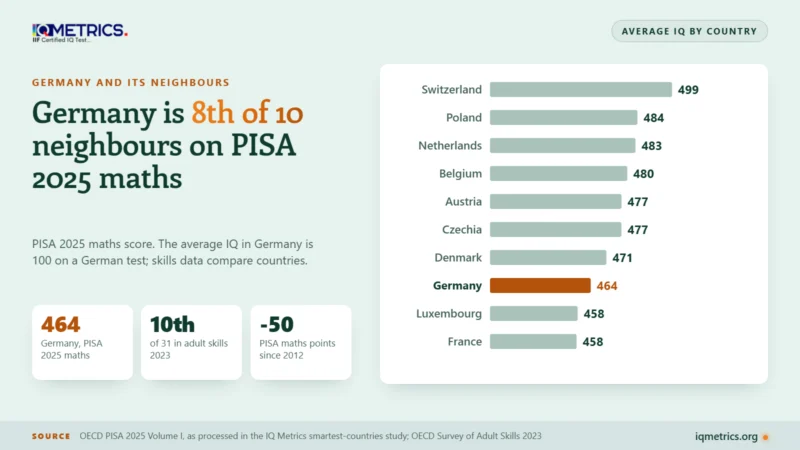 Scores & Scales
Average IQ in Germany
Average IQ in Germany is 100 on a German test. Germany's 15-year-olds scored 464 in PISA 2025 maths, adults rank 10th of 31 in adult skills, and an online test gives 99.32. See the UK, US and neighbour comparisons.
 Scores & Scales
Average IQ in South Korea
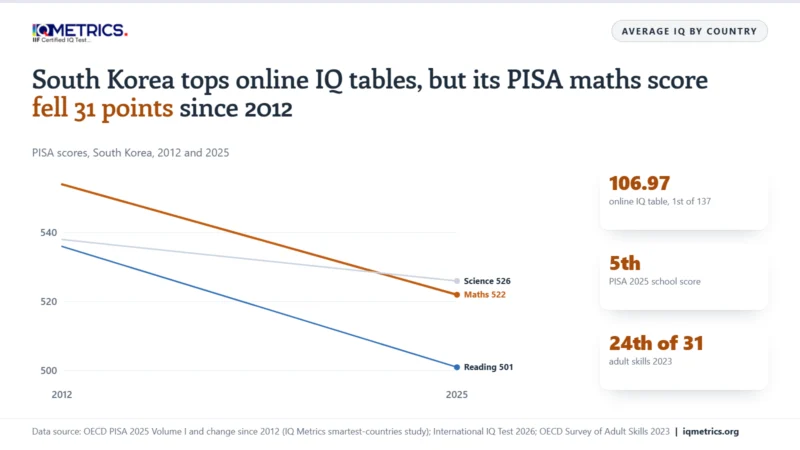
Average IQ in South Korea is 100 on a Korean test. The 106.97 online is 26,996 volunteers. Korean teenagers rank 5th on PISA 2025, yet adults rank 24th of 31 in adult skills. See why, and what we know about North Korea.
 Understanding IQ
PISA Test vs IQ Test
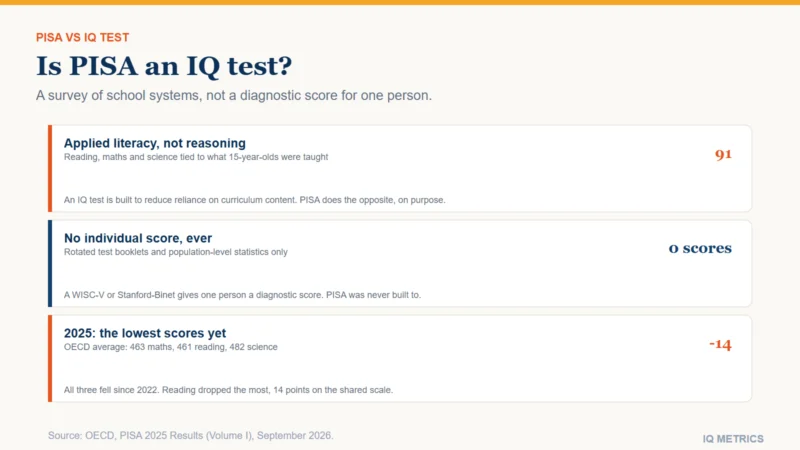
Is PISA an IQ test? No. PISA surveys applied school literacy across whole education systems and returns no individual score, while an IQ test diagnoses one person. See the new PISA 2025 results, published September 2026, and the real debate over using PISA as a national IQ proxy.