





What Is the Average IQ in Mexico? Estimates, PISA Results and What They Do and Do Not Show
No measured average IQ exists for Mexico. The 2002 figure of 87 rests on one study of 520 children from about 1961, a 2019 table prints 87.73 from 4 studies, and an online table prints 93.64 from 8,043 takers. See where each comes from and what PISA 2025 shows.

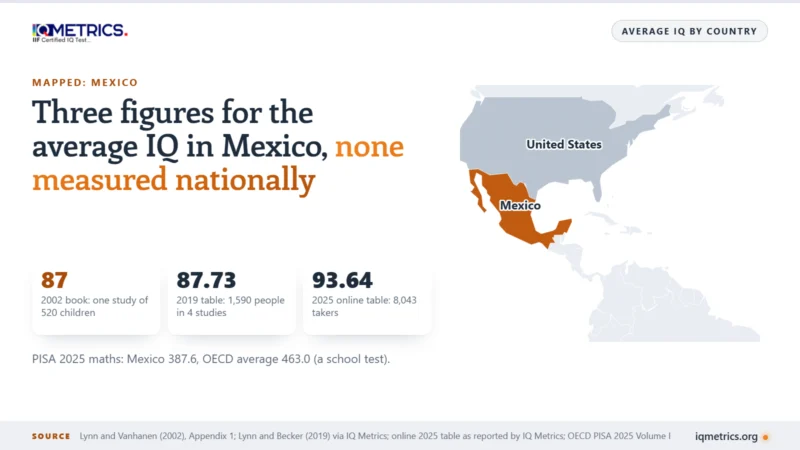
No national IQ test has been given to a sample of the whole of Mexico, so the average IQ in Mexico is an estimate. Three figures are in use: 87 from a 2002 book, 87.73 from a 2019 compiled table (1,590 people in 4 studies) and 93.64 from a 2025 online table (8,043 takers). They sit up to 6.6 points apart, and none comes from a nationally representative sample that we could confirm.
New here: the book’s 87 rests on one study from about 1961, of 520 children in southern Mexico. It adds an assumed 96 for the share of people the authors class as White. PISA 2025 measures learning, not IQ, and it shows 69.8% of Mexican students below Level 2 in maths against 34.8% across the OECD. Every number here describes samples and sources, not people.
Key takeaways
- The 2002 figure of 87 combines one study with an assumption. The study tested 520 children aged 6 to 13 in southern Mexico around 1961 (mean 86.5). The assumption is an IQ of 96 for the White share.
- Three US samples of Mexican-American children (597, 434 and 404 children) average 88 in the book. They lived in the United States, so they are support, not a Mexican sample.
- Our hub prints 87.73 from 4 studies and 1,590 people (rank 70 of 201). An online table prints 93.64 from 8,043 takers. The gap is 5.9 points.
- In PISA 2025 Mexico scored 413.6 in science, 407.9 in reading and 387.6 in maths, against OECD averages of 481.9, 460.9 and 463.0.
- We found no Mexico row in the OECD Survey of Adult Skills 2023 tables we searched.
What is the average IQ in Mexico, and is any figure measured?
The Mexico average IQ has not been measured for the whole country. The three figures in use are estimates built from different kinds of samples.
The average IQ of Mexicans, as a single number, would need a test given to a sample that represents every state, age group and school background. We could not confirm such a sample behind any of the three figures. Any figure for the average IQ in Mexico 2026 should come with its source, so the table lists the three we could trace and one direct measure of school learning.
| Source | Figure | Who was measured | What it is |
|---|---|---|---|
| Lynn and Vanhanen, IQ and the Wealth of Nations (2002), Table 6.1 and Appendix 1 | 87 | 520 children in southern Mexico (about 1961), plus an assumed 96 for the White share | A calculation from one study |
| Lynn and Becker, The Intelligence of Nations (2019), as printed on our hub | 87.73 | 1,590 people in 4 studies | A compiled estimate |
| An online IQ-test table, 2025 edition, as reported by us | 93.64 | 8,043 people who chose to take the test | A self-selected online sample |
| OECD PISA 2025, mathematics | 387.6 (OECD average 463.0) | A sample of 15-year-olds in school | A school test, not an IQ test |
Where does the estimate come from and how reliable is it?
The commonly quoted 87 comes from Lynn and Vanhanen’s 2002 book, where it rests on one Mexican study from about 1961 and one assumption. The book lists Mexico among its 81 countries with direct evidence.
The appendix says what that evidence is. Around 1961, 520 children aged 6 to 13, whom the book describes as Native American and Mestizo children in southern Mexico, took the Draw-a-Man test. Their mean was 86.5 against American norms of 100. The book then takes the population as 90 percent Native American and Mestizo and 9 percent White. It assumes an IQ of 96 for the White share, as in Argentina, and combines the two to reach 87.
The study is cited as Modiano (1962), “Mental testing among Tzeltal and Tzotzil children”, in conference proceedings. We did not read it, so we cannot say how the children were chosen or whether they stand for the whole country. The book gives three more samples as support, but they are children living in the United States.
| Sample | Children | Test and year | Raw mean | After adjustment |
|---|---|---|---|---|
| Native American and Mestizo children, southern Mexico (Modiano) | 520 | Draw-a-Man, about 1961 | 86.5 | Combined with 96 for the White share: 87 |
| Mexican children in California | 597 | Coloured Progressive Matrices, 1972 | 82 | 84 |
| Mexican-American children in Texas | 434 | Coloured Progressive Matrices, 1972 | 94 | 95 |
| Mexican-American children in Texas, aged 9 to 12 | 404 | Standard Progressive Matrices | 84 | 84 |
| Mean of the three US samples, which the book gives as support | 1,435 in all | 88 |
So the 87 is the product of a 65-year-old study and a choice about the White share of the population. A different choice would give a different number. The 2019 table is a separate compilation. Our hub, average IQ by country, prints Mexico at 87.73 from 4 studies and 1,590 people, about 1 person for every 82,000 residents (World Bank population, 2023). We did not open those 4 studies, so we cannot say who was tested.
What do PISA and adult-skills results show for Mexico?
Mexican 15-year-olds in school scored below the OECD average in all three PISA 2025 subjects: 68.3 points in science, 53.0 in reading and 75.4 in maths. PISA measures what students learned, not IQ.
PISA is the OECD’s test of 15-year-olds in school. The Volume I results came out on 8 September 2026, and we read the annex tables. Here are the Mexico PISA scores vs OECD average.
| Subject | Mexico mean (standard error) | OECD average | Gap |
|---|---|---|---|
| Science | 413.6 (2.0) | 481.9 | 68.3 points below |
| Reading | 407.9 (2.2) | 460.9 | 53.0 points below |
| Mathematics | 387.6 (1.9) | 463.0 | 75.4 points below |
In maths, 69.8% of the Mexican students tested scored below Level 2, the OECD’s baseline level (420 points), against 34.8% across the OECD. At the top, 0.1% reached Level 5 or 6, against 7.8% across the OECD.
These shares cover students in school. The OECD also publishes an upper bound for all 15-year-olds, which counts those not in secondary school or excluded from the test as low performers. On that bound, 79.0% of Mexican 15-year-olds were not in school, excluded or below Level 2 in maths, against 42.6% across the OECD.
| Year | Mathematics | Reading | Science |
|---|---|---|---|
| 2000 | 422.0 | ||
| 2003 | 385.2 | 399.7 | |
| 2006 | 405.7 | 410.5 | 409.7 |
| 2009 | 418.5 | 425.3 | 415.9 |
| 2012 | 413.3 | 423.6 | 414.9 |
| 2015 | 408.0 | 423.3 | 415.7 |
| 2018 | 408.8 | 420.5 | 419.2 |
| 2022 | 395.0 | 415.4 | 409.9 |
| 2025 | 387.6 | 407.9 | 413.6 |
The maths mean has fallen back to about its 2003 level (385.2 then, 387.6 now), and reading is 14.1 points below 2000. Science is within a few points of 2006. Differences of a few points between cycles sit inside the error margins, so read the direction, not each step.
Adult skills: we searched the three annex tables of the OECD Survey of Adult Skills 2023 and found no Mexico row. We did not check earlier rounds, so this page gives no adult-skills figure for Mexico.
Where would your own score land?
Take the IIF-certified assessment and get your score with the scale it was measured on, the percentile it corresponds to and the confidence range around it — the three figures most online tests leave out.
Find your IQ score now! →Why do average IQ figures differ by source?
Average IQ figures differ because each one rests on different people, a different test and a different year. The same three sources put Mexico between 87 and 93.64, and the gap to the United States shrinks from 11 points to 7.4.
| Source | Mexico | United States | Gap | Who was measured in Mexico |
|---|---|---|---|---|
| 2002 book (Table 6.1) | 87 | 98 | 11.0 | One study, about 1961 |
| 2019 compiled table (our hub) | 87.73 | 97.43 | 9.7 | 1,590 people in 4 studies |
| 2025 online table (our report) | 93.64 | 101.04 | 7.4 | 8,043 online takers |
The 6.6-point spread between sources is almost as large as the whole gap between Mexico and the United States in the newest one (7.4).
The online figure rests on 8,043 takers, about 1 for every 16,000 residents. Its standard error is only about 0.2 points, but that counts sampling noise and not who chose to take the test. Our report says the table measures an audience, not the intelligence of nations. For the same three-source pattern in other countries, see the average IQ in Pakistan, the Philippines and Nigeria.
Is the average IQ in Mexico low?
The figures in circulation sit below 100, but they are estimates from old, small or self-selected samples. None tells you what a Mexican person would score, and none uses a modern test normed on Mexico.
Two more points help. First, the spread of scores inside any country is much wider than the few points between two country averages. About 68% of people fall within 15 points of their own country’s average on an SD 15 scale. For how rare one score is on that scale, see what an IQ of 122 means. Second, the school results above reflect teaching and access, which can change. Our report on what country IQ rankings cannot support explains why a ranking cannot be read as a statement about people.
For a measure built to reduce the effect of language and schooling, see our culture-fair IQ test. For the school-test ranking of countries, see the research on the smartest countries in the world. To see where your own score falls on the curve, take the IQ test and check it with the percentile calculator.
Quick answers
- What is the average IQ in Mexico? No measured national figure exists. The circulating numbers are 87 (2002 estimate), 87.73 (2019 compiled table) and 93.64 (2025 online table).
- Where does the 87 come from? One study of 520 children in southern Mexico from about 1961, combined with an assumed 96 for the White share of the population.
- What do PISA scores show for Mexico? In 2025, 413.6 in science, 407.9 in reading and 387.6 in maths, below the OECD averages of 481.9, 460.9 and 463.0.
- Does Mexico appear in adult-skills surveys? Not in the 2023 Survey of Adult Skills tables we searched.
- Is the average IQ in Mexico low? The estimates are below 100, but they rest on old, small or self-selected samples and say nothing about an individual.
Sources
- Lynn, R. and Vanhanen, T. (2002). IQ and the Wealth of Nations. Praeger. Table 6.1 and Appendix 1 (Internet Archive scan, read on 19 November 2026).
- OECD (2026). PISA 2025 Results (Volume I), annex tables I.B1.2a.1 to 3, 12, 36 to 38 and 47 (read on 19 November 2026).
- Lynn and Becker (2019), as printed on our average IQ by country hub. The online table, as reported in our average IQ by country 2026 report. Both read on 19 November 2026.
- OECD Survey of Adult Skills 2023 annex tables: searched for a Mexico row on 19 November 2026. World Bank population 2023.
Keep reading
All articles →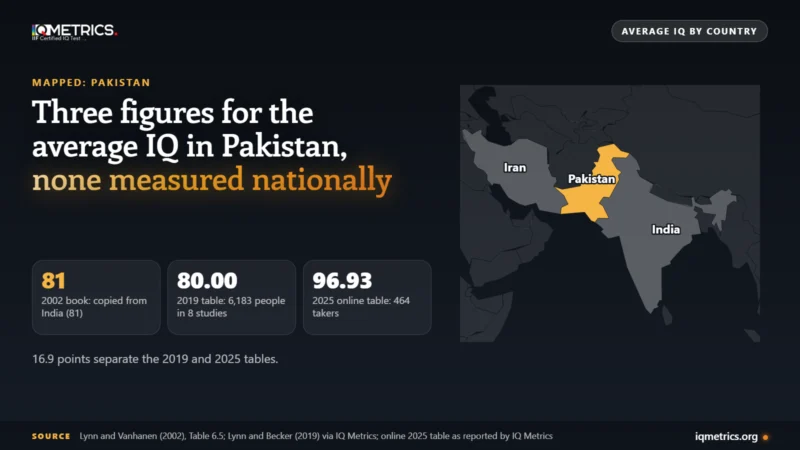 Research & Evidence
Average IQ in Pakistan
No measured average IQ exists for Pakistan. The 2002 figure of 81 was copied from India, a 2019 table prints 80.00 from 8 studies, and an online table prints 96.93 from 464 takers. See where each comes from and what ASER learning surveys show.
 Research & Evidence
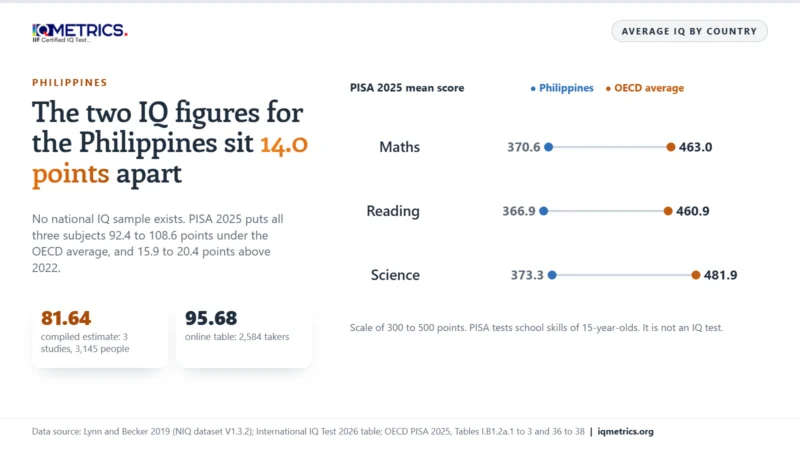
What Is the Average IQ in the Philippines?
The average IQ in the Philippines is 100 on any local test. Two national figures circulate, 81.64 and 95.68, 14.0 points apart, and neither is a national sample. PISA 2025 maths is 370.6 against an OECD average of 463.0, up 15.9 since 2022.
 Scores & Scales
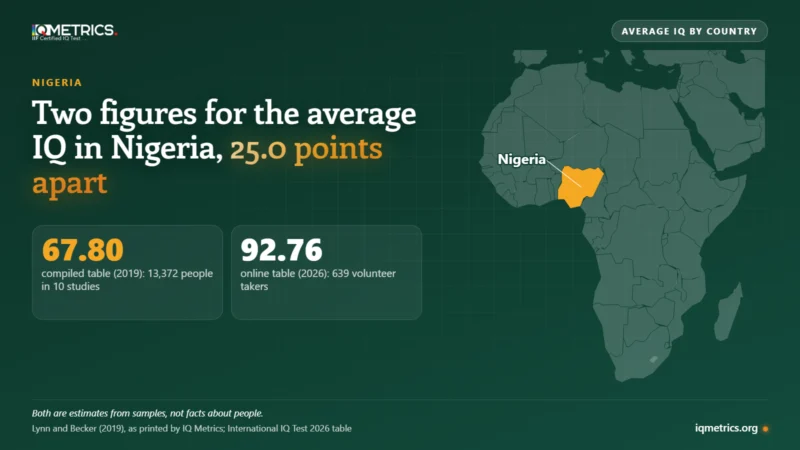
What Is the Average IQ in Nigeria?
The average IQ in Nigeria is an estimate, not a test result: 67.80 in a 2019 compiled table of 10 studies and 92.76 in a 2026 online table of 639 takers, 25.0 points apart. The older figure of 67 rests on two samples. See where each number comes from and what school data show.