



What was Henry Ford’s IQ?
In 1919 Tribune lawyers quizzed Henry Ford on history, and he called Benedict Arnold “a writer.” That was a recall quiz, not an IQ test.
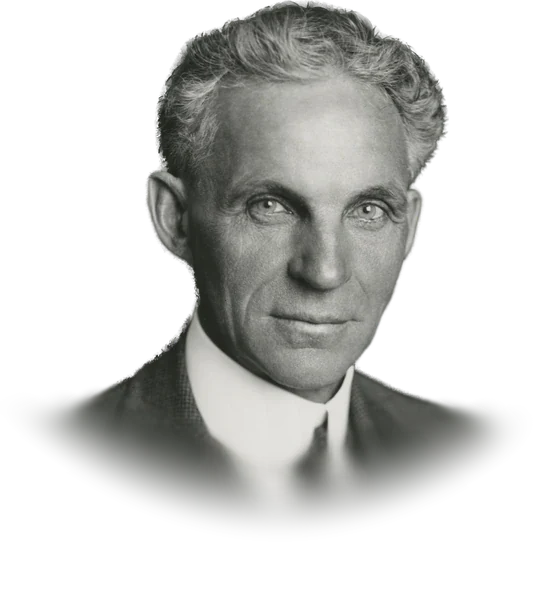
No Henry Ford IQ test result has been published, and the two figures online, 125 on CelebrityIQ.info and 165 on Geniuses.club, are both labeled estimates that cite no test. What is documented is an eighth-grade education, a machinist’s apprenticeship, a chief engineer’s post at Edison Illuminating by 1893 and the 1913 Highland Park assembly line. Henry Ford’s estimated IQ here is 130–150.
Henry Ford’s estimated IQ
- Formal schooling was short: he finished eighth grade at a one-room school and never attended high school (Wikipedia); The Henry Ford museum’s biography says he finished school at sixteen, and PBS dates his move to Detroit to December 1879.
- He trained as a machinist: a six-day job at Michigan Car Works, then an apprenticeship at James Flowers and Bros. (PBS reports $2.50 a week) and work at the Dry Dock Engine Company (The Henry Ford museum).
- He became an engineer at the Edison Illuminating Company of Detroit in 1891 and Chief Engineer in 1893 (Wikipedia); the National Inventors Hall of Fame says he built his first internal combustion engine in 1893 and his first automobile in 1896.
- Wikipedia counts 161 U.S. patents awarded to him; the National Inventors Hall of Fame (inducted 1982) lists U.S. Patent No. 1,005,186 for a transmission mechanism, and the Franklin Institute gave him its Elliott Cresson Medal in 1928.
- By his own account in My Life and Work (1922), moving-line assembly cut the labor on a chassis from twelve hours twenty-eight minutes to one hour thirty-three minutes, but the National Archives says he did not invent the moving assembly line, only perfected it.
No test result exists, so this estimate of Henry Ford’s IQ level is inferred from an engineering and organizing record, which is a poor proxy for a test score. Much of that record was shared with a team, and the 1919 cross-examination measured recalled facts, not reasoning. Treat 130–150 as looser than any range built from a real test.
- Born
- July 30, 1863, on a farm in Greenfield Township, Michigan (PBS says Springwells Township)
- Died
- April 7, 1947, at his estate, Fair Lane, in Dearborn, Michigan
- Education
- One-room school, finished eighth grade; never attended high school; bookkeeping course at a commercial school; several months at a Detroit business college
- Training
- Left for Detroit in December 1879; machinist’s apprentice (James Flowers and Bros.; Dry Dock Engine Company)
- Engineering post
- Engineer at the Edison Illuminating Company of Detroit (1891); Chief Engineer (1893)
- Known for
- Quadricycle (1896); Ford Motor Company (1903); Model T (1908); Highland Park moving assembly line (1913)
- Patents and honors
- 161 U.S. patents (Wikipedia); Elliott Cresson Medal (1928); National Inventors Hall of Fame (1982)
- IQ test on record
- None found; two unsourced estimates online, 125 (CelebrityIQ.info) and 165 (Geniuses.club)
What an IQ of 130–150 actually means
Set the claim aside for a moment. If someone genuinely scored in this range, here is what that would represent.
Average is 100 by construction, and about two-thirds of people fall between 85 and 115. Take the test to place your own score on this scale.
| Score range | Classification | Share of people | What it indicates |
|---|---|---|---|
| 85 – 114 | Average | ~68% | The range most people fall into. |
| 115 – 129 | Above average | ~13.6% | Roughly one person in seven. |
| 130 – 144 | Gifted | ~2% | The threshold most high-IQ societies use. |
| Above 144 | Highly gifted | ~0.1% | Figures above this range are extrapolated from the curve rather than measured. |
Percentages are approximate and describe a normal distribution. The same number means different things on tests with different standard deviations.
Thirty questions gives you a measured position on this exact scale — your score, your percentile and the ability breakdown behind it.
Find out in 30 minutes →Who Henry Ford was
Henry Ford was born on July 30, 1863, on a farm in Greenfield Township, Michigan. He began school in 1871 at a one-room schoolhouse and, by The Henry Ford museum’s account, finished school at sixteen; Wikipedia says he finished eighth grade, never attended high school and later took a bookkeeping course at a commercial school, and the museum adds several months at a Detroit business college. In December 1879 he left the farm for Detroit. His first job, at the Michigan Car Works, lasted six days; he then became a machinist’s apprentice at James Flowers and Bros., repaired watches at night in a jeweler’s shop and moved to the Dry Dock Engine Company to learn about steam engines. After his apprenticeship he went back to Dearborn to run a sawmill and repair Westinghouse portable steam engines.
In 1891 Ford became an engineer with the Edison Illuminating Company of Detroit, and Wikipedia reports his promotion to Chief Engineer in 1893. The National Inventors Hall of Fame says he built his first internal combustion engine, a small one-cylinder gasoline model, in 1893 and his first automobile in 1896: the Quadricycle; the museum’s booklet says he had to tear out part of the brick wall of the shed behind his home to get it into the alley. Wikipedia dates his introduction to Thomas Edison to 1896 and says Edison approved of his automobile experiments; Ford’s memoir recalls the first meeting as “probably about 1887” and calls Edison “one of my closest friends.” Wikipedia dates his founding of the Detroit Automobile Company, after he resigned from the Edison company, to August 5, 1899.
The Ford Motor Company was incorporated on June 16, 1903, with $28,000 in capital, and the first Model T debuted on October 1, 1908; Wikipedia gives a final production total of 15,007,034. Ford’s memoir says, “Along about April 1, 1913, we first tried the experiment of an assembly line,” on the flywheel magneto, and credits the idea in a general way to the overhead trolley Chicago meat packers used; by his account the best stationary chassis assembly had averaged twelve hours and twenty-eight minutes, and after the line was raised in early 1914 the labor per chassis fell to one hour thirty-three minutes. Wikipedia says the Highland Park plant became the first automobile plant to run a moving assembly line on October 7, 1913. The National Archives says Ford “did not invent the moving assembly line, but he did perfect it,” and Wikipedia’s entry on Clarence W. Avery says credit cannot be pinned on one person, naming Avery, Charles Sorensen, C. Harold Wills, Peter E. Martin and Charles Ebender among those who worked on it.
The Franklin Institute gave Ford its Elliott Cresson Medal in 1928, citing “Revolutionizing automobile industry, and industrial leadership.” The National Inventors Hall of Fame inducted him in 1982, the National Aviation Hall of Fame posthumously in 1985 (Wikipedia), and Wikipedia counts 161 U.S. patents awarded to him. Ford died on April 7, 1947, at his estate, Fair Lane, in Dearborn. Henry Ford’s estimated IQ here, 130–150, starts at the threshold discussed in is a 130 IQ genius and tops out near an IQ of 150; nothing measured stands behind it. This page covers the Henry Ford (1863–1947) who founded the Ford Motor Company, not Henry Ford II.
 By Elora Mercer, Celebrity Research WriterFigures checked by Leon Falkner, Data & Research Analyst
Reviewed by Aarav Vardhan, Editor-in-Chief · Last reviewed August 2026
.png)
Henry Ford: the documented record
The estimate above rests on this record. Every entry here is a matter of public fact, which is more than can be said for the number itself.
- 1863Born July 30 on a farm in Greenfield Township, Michigan.
- 1879Leaves the family farm for Detroit in December and becomes a machinist’s apprentice.
- 1891–96Becomes an engineer at the Edison Illuminating Company (1891) and Chief Engineer (1893); builds his first gasoline engine (1893) and the Quadricycle (1896).
- 1899Resigns from the Edison company and founds the Detroit Automobile Company on August 5.
- 1903The Ford Motor Company is incorporated on June 16 with $28,000 in capital.
- 1908The Model T debuts on October 1.
- 1913Ford’s memoir dates the first assembly-line trial, on the flywheel magneto, to about April 1; the Highland Park plant runs the first moving automobile assembly line on October 7.
- 1919The libel suit against the Chicago Tribune is tried at Mount Clemens; the jury awards six cents damages on August 14.
- 1928The Franklin Institute awards him the Elliott Cresson Medal.
- 1947Dies April 7 at Fair Lane, Dearborn, Michigan.
Where the 125–165 figure came from
Following a claim back to its first appearance is the part almost nobody does — and it is what most people are actually asking.
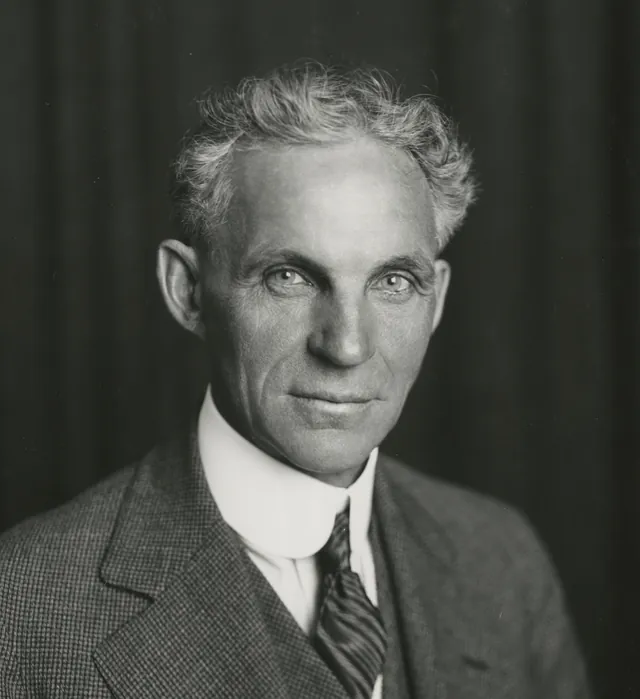
The Henry Ford IQ figures that circulate come from two IQ-listing sites, and they disagree by 40 points. CelebrityIQ.info shows “Estimated IQ 125” with “Score type Estimated” and says such figures are compiled from “academic records, biographical accounts, performance data, and expert analysis”; Geniuses.club lists an estimated 165 and states that “Figures of this kind are published estimates, not a measured, verified test score.” Neither names a test, a date or a source, so each Henry Ford IQ estimate is an opinion about his record, not a reading. Where celebrity IQ numbers come from traces how numbers like these travel.
What was Henry Ford’s IQ, if neither number is a score? No Henry Ford IQ test result appears in any source we opened, and the dates explain part of why. Intelligence tests existed in his lifetime: the Stanford revision of the Binet–Simon scale dates to 1916, when he was in his early fifties, and a second version followed in 1937. But the deviation IQ used today first appeared in the third Stanford–Binet edition in 1960, and the first WAIS was released in February 1955, both after he died on April 7, 1947; we found no report that he ever sat any test (see the history of intelligence testing). The sourced record supports a lower range than 165, a level where the IQ ceiling effect means few tests have items at all.
Was Henry Ford a genius? The best-documented intelligence episode of his life is a courtroom one, and it was a recall quiz. A June 1916 Chicago Tribune editorial had called him an “ignorant idealist,” and Ford sued for libel; the Macomb County circuit court proceedings ran from May 13 to August 14, 1919, according to the Benson Ford Research Center’s finding aid. A wire report datelined Mount Clemens, July 16, says Tribune attorney Elliott G. Stevenson was asking questions meant to show Ford was ignorant, that Ford described Benedict Arnold as “a writer,” and that in “a moment of petulence” he admitted to being an “ignorant idealist” and later declined to repeat the admission when formally asked. Another report says counsel “nagged” him for an hour about “his knowledge of literature and history and government.” Later retellings add that he dated the American Revolution to 1812; we found that only in a secondary account, not in the 1919 reports we could open. A jury awarded him six cents. The Henry Ford museum calls his testimony “shaky” and says he “mangled basic American history facts.”
The reply most often quoted from that cross-examination is longer: that Ford had “a row of electric push-buttons” on his desk to summon men who could answer any question, and asked why he should “clutter up my mind with general knowledge.” We found it only on modern pages, such as a May 15, 2025 post on The Unwritten Business Guide, and that post names no source; it appears in none of the 1919 reports we opened and we could not read the transcript, so we treat it as unverified, not as documented testimony. What Ford printed is easier to check: in My Life and Work (1922, written with Samuel Crowther) he wrote, “An educated man is not one whose memory is trained to carry a few dates in history—he is one who can accomplish things.” Recalling dates draws on crystallized knowledge (see fluid vs. crystallized intelligence), so a missed date says little about the reasoning an IQ test samples. Compare Thomas Edison, Ford’s friend, at 140–160 here and Walt Disney at 125–145: Ford’s hands-on engineering record puts him a little above Disney, while 161 patents against Edison’s 1,093 (Wikipedia) and an assembly line built by a team keep him below Edison.
How we read a number →The booklet confirms school begun in 1871, finishing school at sixteen, a business college, the six-day Michigan Car Works job, the Flowers apprenticeship, the Dry Dock Engine Company, the spring 1896 first run, the 1903 incorporation with $28,000 and the October 1908 Model T. The finding aid confirms Macomb County circuit court proceedings from May 13 to August 14, 1919. The collections page says his “shaky court testimony, in which he mangled basic American history facts, shocked lawyers but further endeared him to working people.” None contains an IQ score.
Ford’s own words: “Along about April 1, 1913, we first tried the experiment of an assembly line” on the flywheel magneto; the overhead-trolley idea from the Chicago packers; chassis assembly from twelve hours and twenty-eight minutes to one hour thirty-three minutes; Edison as “one of my closest friends,” met “probably about 1887”; and his definition of an educated man. A first-person account, not an audited record.
The Hall of Fame page lists U.S. Patent No. 1,005,186 (Transmission Mechanism), the first engine in 1893 and first automobile in 1896, and his 1905 vice presidency of the Society of Automotive Engineers. The Franklin Institute lists the 1928 Cresson Medal with the citation “Revolutionizing automobile industry, and industrial leadership.” The National Archives page says Ford “did not invent the moving assembly line, but he did perfect it.”
Confirms December 1879 as the month he left the farm for Detroit, the $2.50-a-week Flowers job, the 1896 Quadricycle, the 1903 incorporation, the 1913 Highland Park line, and that the Tribune called him an “ignorant idealist” and he faced “eight days of questioning” in 1919. No IQ score.
Wire reports read as OCR text on Historical Newspapers of South Carolina and the Gateway to Oklahoma History. They say Stevenson sought to show Ford was ignorant, that Ford described Benedict Arnold as “a writer” and, “in a moment of petulance,” admitted to being an “ignorant idealist” but later declined to repeat it when formally asked; that counsel “nagged” him for an hour about literature, history and government; and that on August 14 a jury awarded him 6 cents. These are newspaper copy, not the transcript.
A modern retelling, citing Steven Watts’s The People’s Tycoon, saying Ford claimed the American Revolution occurred in 1812 and called Benedict Arnold “a writer, I think.” Used only to show the 1812 detail appears in later retellings; we did not find it in the 1919 reports we opened.
Orientation and second-source checks: birth and death dates (Fair Lane, Dearborn); eighth grade, no high school; engineer in 1891, Chief Engineer in 1893; the 1903 incorporation and 1908 Model T; 161 U.S. patents; the October 7, 1913 first moving assembly line; the Avery team and the statement that credit cannot be pinned on one person; Edison’s 1,093 U.S. patents. The Stanford revision dates to 1916, the second version to 1937, deviation IQ’s first appearance to the 1960 third edition, and the first WAIS to February 1955. Wikidata confirms Q8768 is Henry Ford (born 1863-07-30, died 1947-04-07).
The only two pages found that print a number. CelebrityIQ.info: “Estimated IQ 125,” “Score type Estimated,” with no test named and no date. Geniuses.club: “an estimated IQ of 165,” with the note that such figures are “not a measured, verified test score” and no test, date or source. A biography page on Intelligence and IQ prints no IQ figure.
Prints the push-button reply (“a row of electric push-buttons on my desk … clutter up my mind with general knowledge”) as Ford’s answer in court, with no source for it. Cited only to show where the quotation circulates, not as evidence that it was said.
None appears in The Henry Ford museum’s booklet, Ford’s memoir, PBS, the National Inventors Hall of Fame, Wikipedia or the 1919 newspaper reports; Christian Post’s 2012 list and a 2023 Substack database of IQ estimates do not list him. The trial transcript is held by the Benson Ford Research Center and was not consulted.
The sources behind our estimate
The figures that circulate for Henry Ford, what we were able to confirm, and where the two diverge.
No Henry Ford IQ test result has been published, but two IQ-listing sites print a number for him and disagree by 40 points: CelebrityIQ.info shows “Estimated IQ 125” and Geniuses.club lists an estimated 165. Neither names a test, and the searches we ran for his IQ turned up no page that cites one.
Neither number has a test, date or source behind it. CelebrityIQ.info gives 125 as “Score type Estimated,” and Geniuses.club prints 165 with the note that such figures are “not a measured, verified test score.” The Henry Ford museum’s biography, Ford’s own memoir My Life and Work, PBS, the National Inventors Hall of Fame and Wikipedia contain no IQ score for him; a biography page on Intelligence and IQ prints none; and Christian Post’s 2012 “IQ Scores of Famous People” and a 2023 Substack database of IQ estimates do not list him.
The two circulating figures sit on either side of our 130–150 range and 40 points apart, which is what numbers produced without a test look like. On the usual scale (mean 100, standard deviation 15), 165 is more than four standard deviations above the mean, a level a normal curve puts at fewer than one person in 100,000; the 125 is not contradicted by the record but is no better sourced.
Want a number that does hold up? Every figure on this page is somebody’s claim. Take the 30-question test and get a percentile you can check rather than a figure you have to trust.
Henry Ford — frequently asked
What is Henry Ford’s IQ?
No IQ test result has been published for Henry Ford, and the two figures online, 125 on CelebrityIQ.info and 165 on Geniuses.club, are labeled estimates with no test or source. Our estimated IQ for him, 130–150, is inferred from his documented record: an eighth-grade education, a machinist’s apprenticeship, 161 U.S. patents and the Highland Park assembly line. It is an estimate, not a score.
Did Henry Ford ever take an IQ test?
We found no record of one. Intelligence tests existed in his lifetime, including the 1916 Stanford revision of the Binet–Simon scale, but no museum page, memoir or archive we opened reports a score. He died on April 7, 1947, before the deviation-IQ scoring used today appeared in the 1960 Stanford–Binet, so any Henry Ford IQ test result online is an estimate.
Was Henry Ford a genius?
Ford is honored as an engineer and organizer: the Franklin Institute gave him its Elliott Cresson Medal in 1928 and the National Inventors Hall of Fame inducted him in 1982. “Genius” is a label, not a measured IQ, and no test result exists to check it against. Ford himself wrote that an educated man is one “who can accomplish things.”
Where do the Henry Ford IQ figures of 125 and 165 come from?
Both appear on IQ-listing sites: CelebrityIQ.info shows an estimated 125, and Geniuses.club lists an estimated 165. Neither cites a test, date or source, and Geniuses.club itself says such figures are not a measured, verified test score. The 40-point gap between them shows how loosely any Henry Ford IQ estimate is anchored.
Did Henry Ford really think Benedict Arnold was a writer?
A wire report datelined Mount Clemens, July 16, 1919, says Ford described Benedict Arnold as “a writer” while a Tribune lawyer tested his knowledge during Ford’s libel suit. Later retellings add other answers, and a push-button reply is widely quoted, but we could not verify those in 1919 reports. A recall quiz is not an IQ test.
How much formal education did Henry Ford have?
Henry Ford finished eighth grade at a one-room school and never attended high school, later taking a bookkeeping course at a commercial school. The Henry Ford museum says he finished school at sixteen, and PBS dates his move to Detroit to December 1879. He then trained as a machinist’s apprentice at James Flowers and Bros. and the Dry Dock Engine Company.
How does Henry Ford’s estimated IQ compare with Thomas Edison’s and Walt Disney’s?
Our estimate for Henry Ford, 130–150, sits slightly above Walt Disney’s 125–145 and below Thomas Edison’s 140–160. None of the three has a test result and all left school early. Wikipedia counts 1,093 U.S. patents for Edison against 161 for Ford, and Ford’s best-known system, the assembly line, was shared work.
How does my IQ compare with Henry Ford?
You can find out in about fifteen minutes. The IQ Metrics assessment is 30 questions, scored on the same 100-mean scale used throughout this page, so your result and the estimate above are at least expressed in the same units — one measured, one inferred. Once you have a number, the leaderboard shows where it would sit, and how we score and norm it explains the benchmarking.
Where does this estimate come from?
From the documented record rather than a test — the method is named above and set out in full under how we read a number. Compare it against the other business & tech profiles, starting with Steve Jobs.
- Take the 30-question IQ test — get a measured score and percentile of your own
- Average IQ by country — how the scale behaves across populations
- How IQ Metrics scores its assessment — the method behind our own number
- More on how IQ testing works — reliability, error and what a score can and cannot say
- More business & tech profiles — same field, same method
More business & tech



Photograph by Tyren Redd, CC BY 4.0. Background removed for the portrait above. · Photograph by Nick Webb (May 2010), CC BY 2.0. Cropped and with background removed for the portrait above. · Photograph by Krd (LinuxCon Europe, October 2014; cropped by Von Sprat), CC BY-SA 4.0. Background removed for the portrait above.
.png)

.jpg)
An estimate is an inference.
Yours can be measured.
Thirty questions, scored against general-population benchmarks. Your score, your percentile, your ability breakdown and a printable IIF certificate.
Find your IQ score now! →