





DISC Personality Model Explained: The Four Styles and the Evidence
DISC sorts workplace behavior into four styles: Dominance, Influence, Steadiness and Conscientiousness. It began with a 1928 book by William Moulton Marston and became a family of training questionnaires. Here is how the model works, what the evidence says, and why it is not a hiring test.

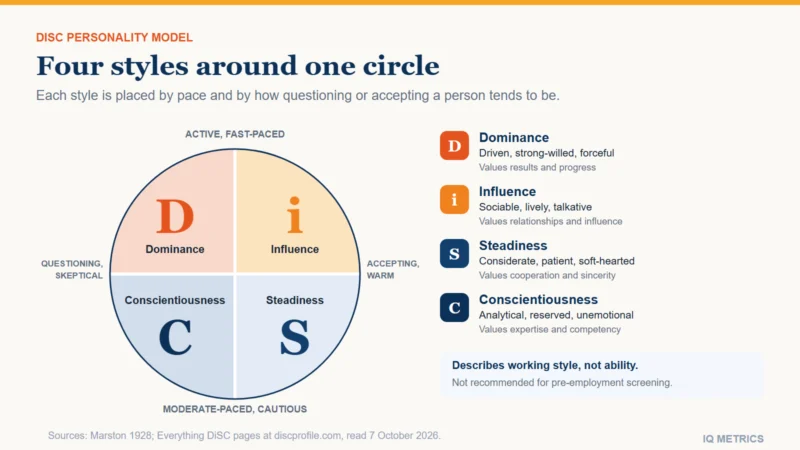
The DISC personality model describes four behavioral styles: Dominance (D), Influence (i), Steadiness (S) and Conscientiousness (C). It places people on two dimensions, fast-paced versus moderate-paced and cautious, and questioning and skeptical versus accepting and warm, and it is used mainly to improve communication and teamwork at work. DISC is not one test but a family of questionnaires built on a theory from 1928, so what a DISC result means depends on who published the test. This guide covers the four styles, where the model came from, how the questionnaires work, what the evidence supports, and what DISC should not be used for.
- Four styles: D (direct, results-focused), i (outgoing, enthusiastic), S (patient, dependable) and C (analytical, accuracy-focused). Most people are a blend of styles.
- Origin: William Moulton Marston’s 1928 book Emotions of Normal People, in which the four letters stood for Dominance, Inducement, Submission and Compliance.
- Many publishers: Marston never built a test, and many DISC questionnaires exist. The spelling with a lowercase i, DiSC, is a trademark of John Wiley & Sons, which publishes Everything DiSC.
- Evidence: the leading publisher reports good reliability (a median alpha of .87 and a median test-retest figure of .86), but independent, peer-reviewed evidence that DISC predicts outcomes is scarce.
- Not for hiring: a seller of Everything DiSC states that DiSC is not recommended for pre-employment screening, and that it does not measure intelligence or aptitude.
The topic sits next to two pages we already publish: the Big Five personality traits, the research model DISC is most often compared with, and IQ vs personality, which sets DISC, the Big Five, MBTI and IQ tests side by side.
What are the four DISC styles?
In the current Everything DiSC model the four styles sit around a circle. The vertical axis runs from active and fast-paced at the top to moderate-paced and cautious at the bottom; the horizontal axis runs from questioning and skeptical on the left to accepting and warm on the right. Each style occupies one quarter of that circle. The descriptions below use the publisher’s own adjectives.
| Style | Where it sits | Described as | Tends to value |
|---|---|---|---|
| D: Dominance | Fast-paced and questioning | Driven, strong-willed, forceful | Results and progress |
| i: Influence | Fast-paced and accepting | Sociable, lively, talkative | Relationships and influencing others |
| S: Steadiness | Moderate-paced and accepting | Considerate, patient, soft-hearted | Cooperation and sincerity |
| C: Conscientiousness | Moderate-paced and questioning | Analytical, reserved, unemotional | Expertise and competency |
Between the four corners, Everything DiSC also scores the blends: Di or iD (dynamic, adventurous, bold), iS or Si (trusting, cheerful, caring), SC or CS (careful, soft-spoken, self-controlled) and CD or DC (cautious, disciplined, critical), eight scales in all. A report usually shows you as a dot on the circle, placed toward the style you lean to.
Everyone uses all four styles; the profile describes the one you fall into most easily. The publisher’s own example is a strong D who can work slowly and methodically on a financial report, but needs more conscious effort to do it than an S colleague would. In its words, DiSC is “descriptive, not prescriptive.”
Where DISC came from
DISC starts with William Moulton Marston, a psychologist and promoter of the lie detector who also created the comic-book heroine Wonder Woman. In Emotions of Normal People (1928) he described four ways people express emotion in relation to their surroundings: Dominance, Inducement, Submission and Compliance. Marston never built a questionnaire to measure them.
The measurement came later. Industrial psychologist Walter V. Clarke built a checklist for selecting staff, the Activity Vector Analysis, and concluded that its four factors matched Marston’s model. In the 1970s John Geier, a University of Minnesota faculty member, founded Performax, the first publisher of a DiSC assessment; the company became Inscape Publishing and is now part of Wiley. Along the way the letters were renamed: Inducement became Influence, Submission became Steadiness and Compliance became Conscientiousness. Older material still uses Marston’s word Compliance for C, including our own comparison table on IQ vs personality.
Because Marston did not build a test of his own, many publishers have built DISC questionnaires since, each with its own items, scoring and comparison groups. That is why two DISC tests can describe the same person differently. The lowercase-i spelling, DiSC, is the trademark Wiley uses to mark its own assessments.
How a DISC assessment works
A DISC assessment is a self-report questionnaire: you respond to a series of words or statements about yourself, in a format that varies by publisher. There are no right or wrong answers, and you are treated as the expert on yourself.
The traditional Everything DiSC Workplace questionnaire takes about 15 to 20 minutes and has about 80 items; a longer version on Wiley’s Catalyst platform takes 20 to 30 minutes and about 120 items. Since 2013 these assessments have been computerized adaptive tests, which ask extra questions when earlier answers are inconclusive, so not everyone sees the same number of items.
The result is a style plus a written narrative: how you tend to work, communicate and handle disagreement, and how to work with each of the other styles. That narrative is the product. A DISC report gives no score to pass or fail.
Is DISC scientifically valid?
It depends on what you ask of it. On reliability, the figures published for Everything DiSC are good: a median internal consistency (coefficient alpha) of .87 and a median test-retest reliability of .86 across its scales. The publisher also reports that its eight scales relate to each other as a circle model predicts, and that they correlate with two established personality questionnaires, the NEO PI-R and the 16PF.
On validity, independent evidence is thin. The detailed validation studies are mostly the publishers’ own reports rather than independent peer-reviewed research, and the encyclopedia summary of the field is that the scientific validity of the DISC assessment has not been demonstrated. Psychologists have also criticized its use in recruitment.
The publisher’s manual is candid about one weakness. People rate the DiSC description of themselves as a good or excellent fit about 90% of the time, but the manual itself notes that, as documented under the Forer effect, it is not unusual for people to agree strongly with psychological test results. Agreeing with your profile is not proof that it is accurate.
Its observer study is more useful. When people’s DiSC styles were compared with observers’ ratings of their leadership behavior, the expected style had the highest average on 71% of the leadership practices and was among the top two on 88%.
Where would your own score land?
Take the IIF-certified assessment and get your score with the scale it was measured on, the percentile it corresponds to and the confidence range around it — the three figures most online tests leave out.
Find your IQ score now! →Can employers use DISC for hiring?
They are advised not to. DiSC Profile (discprofile.com), which sells Everything DiSC assessments, says that although DiSC profiles are often used in hiring and onboarding, “they’re not recommended for pre-employment screening”, because DiSC “does not measure specific skills, aptitudes, or other factors critical for a position.” The same site says DiSC does not measure intelligence, aptitude, mental health or values, and it points employers who want a selection tool to a separate assessment with personality and cognitive sections.
That fits the wider research on hiring. A 2022 reanalysis of hiring methods put structured interviews first and revised the figures for ability tests down, while still finding them useful; see what a cognitive ability test at work predicts and IQ tests in job interviews. If an employer invites you to an aptitude test rather than a DISC questionnaire, practice that format instead: our aptitude test practice page gathers timed tests such as the logical reasoning test and the Wonderlic-style practice test, and guides to the tests employers buy.
DISC vs the Big Five vs MBTI
The three answer different questions. The Big Five is the research standard for describing personality, with five continuous traits. The MBTI sorts people into 16 types from four preferences. DISC describes four behavioral styles at work and was built for training. The DiSC publisher itself says DiSC does not meaningfully measure two of the MBTI scales (judging-perceiving and sensing-intuition), while it finds some correlation with introversion-extraversion and a moderate relationship with thinking-feeling.
| DISC | Big Five | MBTI | |
|---|---|---|---|
| What it describes | Four behavioral styles at work | Five broad personality traits | Sixteen types from four preferences |
| What you get | A style, shown as a dot on a circle | Five scores, each on a spectrum | A four-letter type |
| Main use | Team building and communication training | Research; some clinical and selection use | Self-discovery and team workshops |
| Evidence base | Mostly publisher research | A large peer-reviewed literature | Types not supported; the scales map onto four of the Big Five |
There is no official conversion between DISC and the Big Five, but the overlap is easy to see in the descriptions: the fast-paced, outspoken top of the DISC circle reads like extraversion, and the warm, accepting right-hand side like agreeableness. Our guide to the Big Five personality traits explains those traits and what they predict.
If you would like a personality profile of your own, our sister site insightmetrics.org has a 60-question personality test that takes about 10 minutes and sorts your answers into one of 16 types. Like DISC, it describes preferences and style, not ability.
Getting real value from a DISC profile
- Use it to start a conversation, which is what it was built for: how you like to receive information, make decisions and handle disagreement, and how your colleagues differ.
- Look at the blend and the strength, not just the letter. Two people labeled D can sit in very different places on the circle.
- Expect the label to depend on the test. Different publishers use different items, scoring and comparison groups.
- Do not use it to decide who is hired or promoted, or to judge how capable someone is. It was not designed for that, and the people who sell it say so.
- Keep style and ability apart. A DISC profile says nothing about IQ or aptitude; for those you need an ability test.
Sources
- Marston, W.M. (1928): Emotions of Normal People.
- DiSC Profile: History of DiSC (Marston, Clarke, Geier, Performax, Inscape and Wiley; adaptive testing since 2013; the DiSC trademark), read 7 October 2026.
- DiSC Profile: Science behind DiSC (the eight scales and their adjectives; median alpha .87 and test-retest .86; NEO PI-R and 16PF; quotations from the Everything DiSC Manual), read 7 October 2026.
- DiSC Profile: How DiSC works (what DiSC does not measure; questionnaire length; relationship with MBTI scales), read 7 October 2026.
- DiSC Profile: Can I use DiSC for hiring?, read 7 October 2026.
- DiSC Profile: What is DiSC? (what each style tends to value), read 7 October 2026.
- Wikipedia: DISC assessment (Marston’s original terms; the state of independent validity evidence).
- McCrae, R.R. and Costa, P.T. (1989): Reinterpreting the Myers-Briggs Type Indicator from the perspective of the five-factor model of personality, Journal of Personality, 57(1), 17-40.
Keep reading
All articles →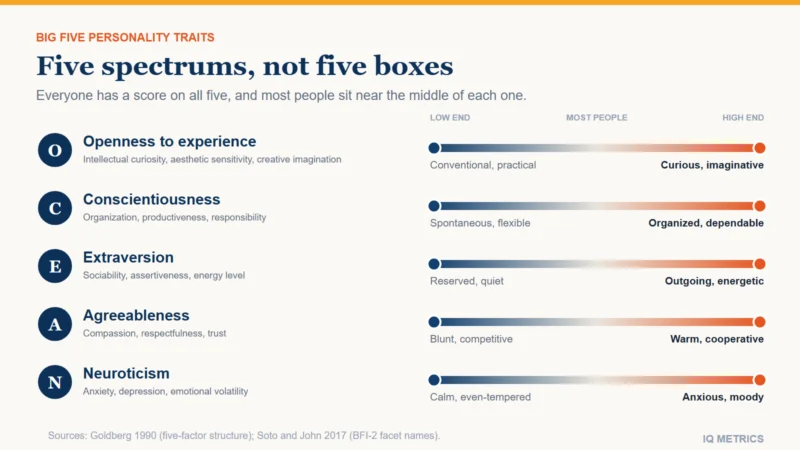 Mind & Everyday Life
Big Five Personality Traits
The Big Five personality traits are openness, conscientiousness, extraversion, agreeableness and neuroticism: five spectrums that came out of decades of research on the words people use to describe each other. Here is what each trait means, how it is measured, what it predicts and how it changes.
 Taking a Test
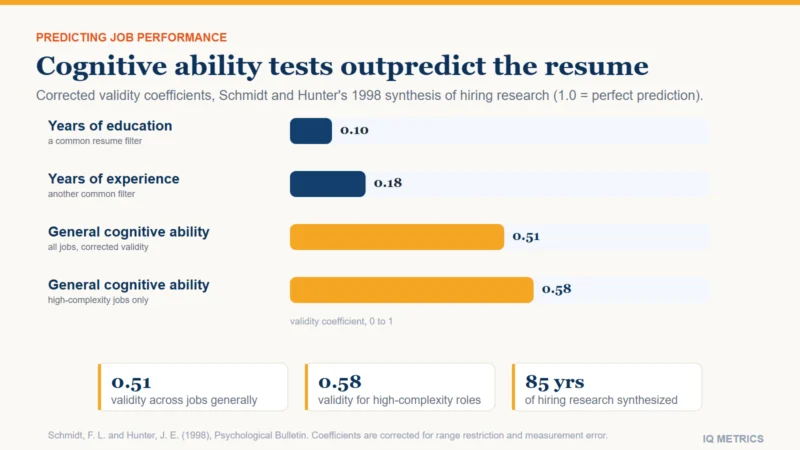
IQ Tests in Job Interviews
An IQ test for a job interview is usually branded a cognitive ability assessment, like the Wonderlic. What it actually measures, why a 1998 meta-analysis made employers take it seriously, whether it is legal, and how to prepare.
 Mind & Everyday Life
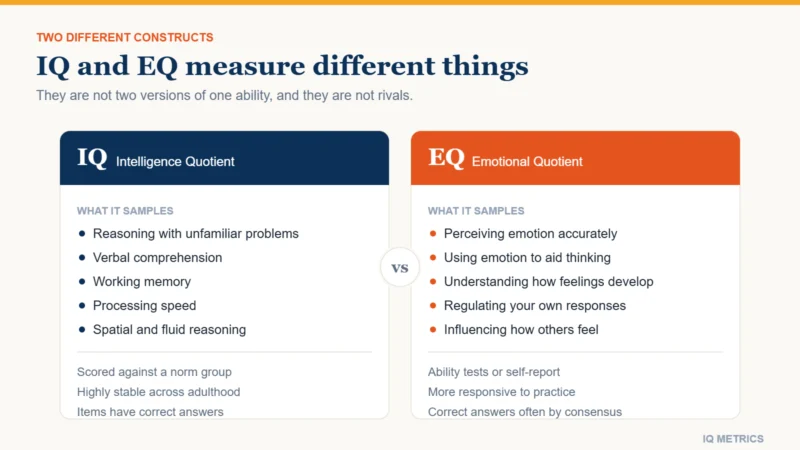
IQ vs EQ
IQ measures reasoning; EQ measures how well you read and manage emotion. They are different constructs, measured in different ways, with different amounts of evidence behind them. Here is what each one actually predicts, which is easier to change, and where the popular claim that EQ matters more comes from.