



How Much Data Can the Human Brain Store? What Was Measured
Published estimates of brain storage run from 125 megabytes to 2.5 petabytes. The best measurement behind them is 4.7 bits per synapse in rat hippocampus, which our arithmetic turns into about 88 terabytes for the human cortex.


What you need to know
- Nobody has measured the brain's storage in bytes. Published estimates run from about 125 megabytes (Landauer, 1986, learned information in long-term memory) to 2.5 petabytes (a 2010 magazine column), a spread of about 20 million times.
- The 2.5 petabyte figure comes from a one-paragraph reader answer in Scientific American Mind. It states about one billion neurons, the measured count is 86.1 billion, and the column shows no calculation.
- The one direct measurement is 4.7 bits per synapse (26 distinguishable strengths) in a 6 x 6 x 5 micrometre block of rat hippocampus with 449 synapses (Bartol and colleagues, 2015). The paper gives no total. The words "at least a petabyte" come from a press release.
- Our arithmetic: 4.7 bits times the 0.15 quadrillion synapses counted in the human neocortex is about 88 terabytes. One petabyte would need about 1.7 quadrillion synapses at 4.7 bits, and 2.5 petabytes would need about 133 bits per synapse.
How much data can the human brain store? Nobody knows. Published estimates run from about 125 megabytes to 2.5 petabytes, a gap of 20 million times. The only direct measurement behind the newer figures is 4.7 bits per synapse, taken from a speck of rat hippocampus in 2015. Multiplied by the 0.15 quadrillion synapses counted in the human neocortex, that gives about 88 terabytes, not a petabyte.
The new finding is where the famous numbers come from. The popular 2.5 petabytes is a 2010 magazine answer with no calculation shown. The petabyte tied to the 2015 synapse study comes from a press release, not from the paper. Below: each estimate, what it rests on, and arithmetic you can check yourself.
How much data can the human brain store in bytes?
So how much can the human brain store in bytes? No one has measured it. Estimates run from 125 million bytes to 2.5 quadrillion bytes, depending on what is counted and how. Brain storage capacity is a calculation, not a reading from an instrument.
- Landauer (Cognitive Science, 1986): about 10^9 bits, or 125 megabytes, of learned information in long-term memory. He worked it out several ways from measured rates of input and loss, and called it the functional information content, not the hardware capacity
- Bartol and colleagues (eLife, 2015) with our arithmetic: 4.7 bits per synapse times 0.15 quadrillion cortical synapses (Pakkenberg and colleagues, 2003) is 7.05 x 10^14 bits, about 88 terabytes
- Sejnowski, quoted in the Salk Institute press release of 20 January 2016: "at least a petabyte", in the same ballpark as the World Wide Web. The release does not show its arithmetic
- Reber (Scientific American Mind, May 2010): around 2.5 petabytes, from a one-paragraph answer to a reader question
These are not rival measurements of one thing. Landauer estimated what people actually remember. The other three estimate how much room the wiring could offer. The ratio of the largest to the smallest is 2.5 petabytes divided by 125 megabytes, or 20 million.
Is the brain's memory capacity really 2.5 petabytes?
No source shows it. Claims of a brain memory capacity in petabytes trace back to two places. The 2.5 petabytes comes from a reader question answered by Paul Reber, a psychology professor at Northwestern University, in Scientific American Mind in May 2010. It is an estimate in a magazine column, not a measurement, and the column shows no calculation.
Here is what the column says. The brain has "about one billion neurons", each with about 1,000 connections, so more than a trillion connections. Because each neuron helps with many memories, it says, capacity rises "exponentially" to around 2.5 petabytes. It does not show the step from a trillion connections to 2.5 quadrillion bytes.
The column adds that 2.5 petabytes would hold three million hours of television, which would take more than 300 years to watch. It also says the exact capacity is hard to calculate, because we do not know how to measure the size of a memory.
The neuron count is off too. Azevedo and colleagues (Journal of Comparative Neurology, 2009) counted 86.1 billion neurons, plus or minus 8.1 billion, in adult male brains. That is about 86 times the column's figure. Only 19% of those neurons sit in the cerebral cortex, which works out at about 16 billion by our arithmetic.
What did the 2015 synapse study actually measure?
Bartol and colleagues measured how finely a synapse's strength can be graded, in one tiny block of rat hippocampus. The block was 6 x 6 x 5 micrometres from area CA1 and held 449 synapses. It came from adult male rats, not people.
The team found pairs of synapses where one axon touched the same dendrite twice. Those pairs shared the same activity history, and their sizes were nearly identical, about 8% apart on average according to the Salk release. Because synapse size tracks strength, the team estimated at least 26 distinguishable strengths. That is log2(26), or 4.7 bits per synapse.
Think of a dimmer switch with 26 settings instead of an on-off switch. The paper calls it a lower bound on what a single synapse can store. Earlier thinking had allowed one to two bits.
The paper does not give a total for the brain. Its digest says the total "may have been underestimated by an order of magnitude" and that measurements in other brain regions are needed to confirm it. The words "at least a petabyte" appear in the Salk press release, as a quote from the co-senior author Terry Sejnowski.
Can you multiply 4.7 bits by the number of synapses?
You can, but the answer depends on assumptions nobody has tested. Pakkenberg and colleagues (Experimental Gerontology, 2003) put the synapses in the human neocortex at about 0.15 x 10^15, or 0.15 quadrillion. Here is the arithmetic, which is ours and not the authors':
- 0.15 quadrillion cortical synapses x 4.7 bits = 7.05 x 10^14 bits = about 88 terabytes
- To reach 1 petabyte at 4.7 bits per synapse you need about 1.7 quadrillion synapses, about 11 times the cortical count
- To reach 2.5 petabytes with 0.15 quadrillion synapses you need about 133 bits per synapse, about 28 times the measured 4.7
- Our 88 terabytes is 705,000 times Landauer's 125 megabytes, and the 2.5 petabyte figure is about 28 times our 88 terabytes
Three caveats apply. The 4.7 bits come from rat hippocampus, and nobody has measured the same thing across the human brain. The paper calls 4.7 bits a lower bound, so the true figure could be higher. And the neocortex count leaves out the hippocampus, the cerebellum and other regions. A petabyte is not impossible. It is not what the one measurement gives on its own.
Why do the estimates differ so much? Three choices drive the spread. The first is what you count: facts a person remembers, or the physical room in the wiring. The second is how many synapses you assume, which is 0.15 quadrillion in the neocortex alone and more if you add other regions. The third is how many bits you give each synapse, which was one or two before 2015 and 4.7 after. Change any one and the answer shifts a long way.
So how much data can the human brain store? The measured part of the answer is 4.7 bits per synapse in a patch of rat hippocampus. The rest is multiplication, and the multiplication gives about 88 terabytes for the human cortex, not the 2.5 petabytes in circulation.
The 2.5 petabyte figure is a column, not a measurement. The measured number is 4.7 bits, in a speck of rat brain.
Is storing bytes the right way to think about memory?
Only as an analogy. A synapse is not a storage cell. Its strength moves with activity, and the 2015 paper says the observed precision needs activity averaged over several minutes. The Salk release says synapses step up or down in size every 2 to 20 minutes.
A memory is also not a file. It is spread over many synapses and rebuilt each time you recall it. Landauer speculated in 1986 that the brain's hardware capacity is a large multiple of the information people actually need to keep. So a capacity in bytes tells you the size of the container under stated assumptions. It does not tell you how many facts you can remember. For how memory and test scores relate, see memory and IQ.
Does storage capacity have anything to do with IQ?
Not directly. IQ tests do not count what you can store. They compare how you solve new problems with a norm group, on a scale with an average of 100 and a standard deviation of 15 on most modern tests. The memory that tests do touch is working memory, which holds a few items at once, and it is a different thing from long-term storage. Our guide to working memory and reasoning explains the difference.
Two other numbers about the brain get repeated just as often. Our fact checks cover the 10% of the brain myth and what a correlation of 0.24 between brain size and IQ means. For people who seem to store more than most, see photographic memory and IQ and savant syndrome and IQ tests.
Where would your own score land?
Memory capacity is not what an IQ test scores. If you want to see where your reasoning sits against other people, the IQ Metrics test reports a score on the standard scale with its percentile.
Find your IQ score now! →Want a number you can check? Take the IQ test and read your result with the IQ tools, which turn a score into a percentile you can compare.
Common questions
How much data can the human brain store?
Nobody has measured it. Published estimates run from about 125 megabytes of learned information (Landauer, 1986) to 2.5 petabytes (a 2010 magazine column). The one direct measurement is 4.7 bits per synapse in rat hippocampus, which gives about 88 terabytes for the human neocortex by our arithmetic.
How much can the human brain store in bytes?
Estimates span 125 million bytes to 2.5 quadrillion bytes. Landauer's 10^9 bits is 125 megabytes. Multiplying 4.7 bits per synapse by 0.15 quadrillion cortical synapses gives about 88 terabytes (8.8 x 10^13 bytes). The 2.5 petabyte figure is 2.5 x 10^15 bytes.
Is the brain's memory capacity 2.5 petabytes?
No source shows it. The figure comes from a one-paragraph answer in Scientific American Mind in 2010. The column gives about one billion neurons, but the measured count is 86.1 billion, and it shows no calculation. At 0.15 quadrillion cortical synapses, 2.5 petabytes would need about 133 bits per synapse.
Where does the brain memory capacity in petabytes claim come from?
Two places. The 2.5 petabytes is from Paul Reber's 2010 column. The "at least a petabyte" is a quote from Terry Sejnowski in the Salk Institute's 2016 press release about a 2015 eLife study, which measured 4.7 bits per synapse in rat hippocampus but gave no total in the paper.
Sources for this story
- Bartol and colleagues (2015), Nanoconnectomic upper bound on the variability of synaptic plasticity, eLife 4:e10778 — eLife Sciences Publications
- Memory capacity of brain is 10 times more than previously thought (press release, 20 January 2016) — Salk Institute for Biological Studies
- Reber (2010), Ask the Brains: What is the memory capacity of the human brain?, Scientific American Mind 21(2):70 — Scientific American
- Landauer (1986), How much do people remember? Some estimates of the quantity of learned information in long-term memory, Cognitive Science 10(4):477-493 — Cognitive Science Society
- Pakkenberg and colleagues (2003), Aging and the human neocortex, Experimental Gerontology 38(1-2):95-99 — Elsevier
- Azevedo and colleagues (2009), Equal numbers of neuronal and nonneuronal cells make the human brain an isometrically scaled-up primate brain, Journal of Comparative Neurology 513(5):532-541 — Wiley
Corrections: spotted an error? Email corrections@iqmetrics.org and we will update this story and note the change here.
Related stories
All news →Working Memory and Reasoning Are Closely Related. They Are Not the Same Thing
The correlation between them is one of the sturdier findings in cognitive psychology. How strong it is, and what it implies about training either one, is where the agreement stops.
How Much of Our Brain Do We Use? The 10% Myth and What Scans Show
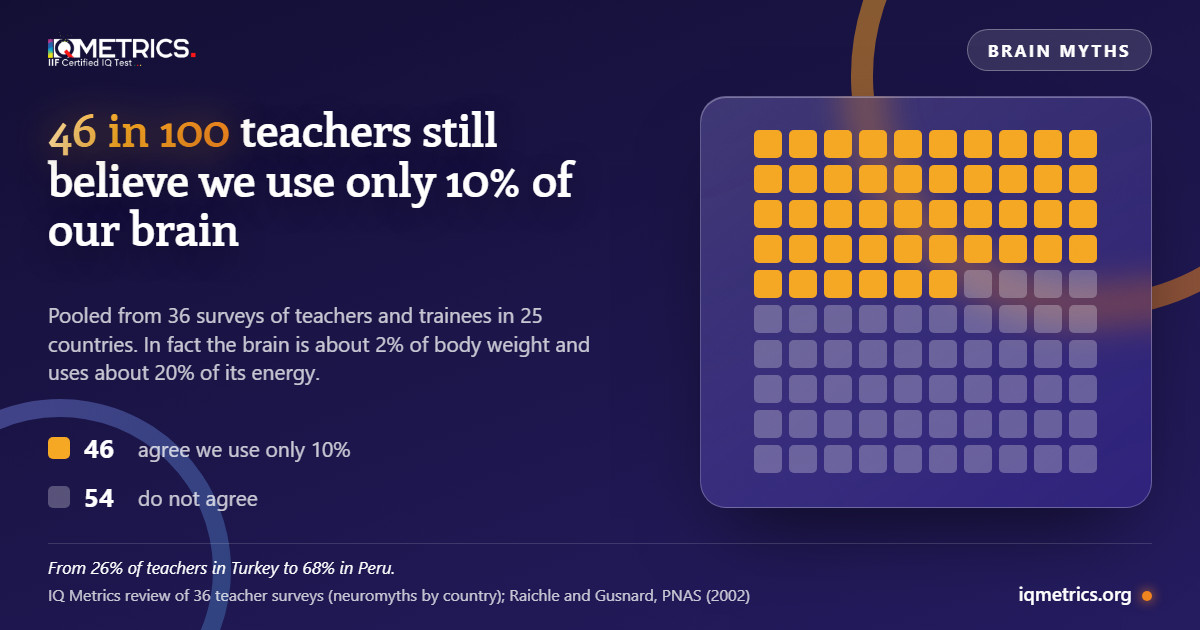
We use virtually all of our brain over a day. The 10% figure has no scientific source: it grew out of a 1907 essay that never mentioned brain tissue, yet about half of teachers in 36 surveys still agree with it.

Trail Making Test Scores by Age: Normal Times for Part A and Part B
Tombaugh’s norms for 911 adults put the typical Trail Making Test time at 22 seconds on Part A and 47 on Part B at ages 18 to 24, and 52 and 133 at ages 80 to 84. The popular 78 and 273 second cut-offs are not in that paper.
Read the research.
Then find your own number.
Our IIF-certified assessment reports your score with its scale, percentile and confidence range — and a breakdown of the cognitive domains behind it.
Start IQ Test →