





Fluid vs Crystallized Intelligence: What Each One Measures
Fluid intelligence is what you use on a problem you have never seen before. Crystallized intelligence is everything you have already banked. The distinction has survived eighty years of factor analysis because the two halves genuinely behave differently, and the clearest proof is what happens to each one as you get older.

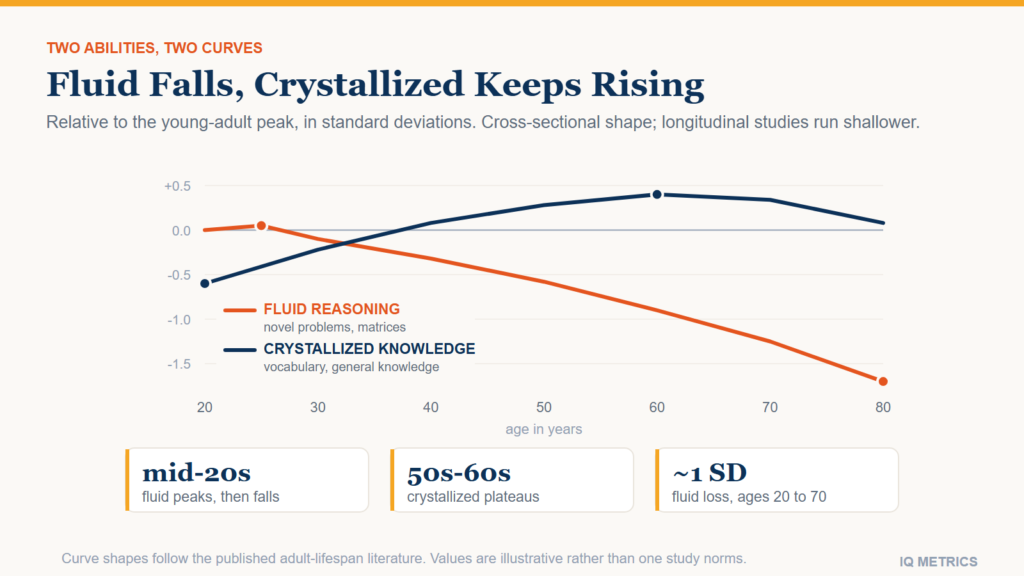
Fluid intelligence is what you use on a problem you have never seen before — finding the rule in a matrix, holding several constraints in mind at once, working out a relationship nobody taught you. Crystallized intelligence is everything you have already banked: vocabulary, facts, procedures, the accumulated residue of what you have learned and can still retrieve. Raymond Cattell drew that line in the 1940s and it has outlasted most of its rivals, because the two halves are not just conceptually tidy. They load on different subtests, they respond differently to schooling, and across a lifetime they move in almost opposite directions.
That last point is the one worth staying for. Most explanations of this pair stop at the definitions. What follows is where the split actually shows up — on a real score report, in the age curves, and in which half your own test result is sampling.
What fluid intelligence measures
The defining feature of a fluid task is that prior knowledge does not help much. A matrix item shows you a grid with one cell missing and asks which option completes it; the rule might be rotation, addition of elements, or alternation, and it is different on the next item. Nothing you studied prepares you for the specific pattern. What carries you is the ability to generate candidate rules, test them against the evidence and discard the ones that fail, all while keeping the partial answer in working memory.
This is why Raven’s Progressive Matrices became the reference instrument for fluid ability, and why culture-fair tests are built almost entirely from figural material. Strip out the words and you strip out most of what a particular education gave you. Fluid tasks also lean heavily on how quickly you can manipulate information, which is why processing speed correlates with fluid scores far more than with verbal ones.
What crystallized intelligence measures
Crystallized ability is knowledge that has been organised well enough to be used. A vocabulary subtest is the classic measure, and it is a better one than it looks: knowing what "reticent" means is not a fact you were taught in a lesson, it is a trace of years of reading, inference and retention. General knowledge and verbal-similarities items work the same way. They ask what has stuck, not what you can work out now.
The common objection — that this is just measuring privilege or trivia — is half right and worth taking seriously. Crystallized scores are more sensitive to schooling and to language background than fluid ones, which is exactly what makes them useful for some purposes and a liability for others. That trade-off is the substance of the cultural bias argument, and it applies unevenly across the two halves rather than to "IQ tests" as a block.
Where the two split on a score report
On a professionally administered test the distinction is not theoretical, it is printed. The Wechsler Adult Intelligence Scale is the most widely used adult battery, and its fifth edition, published in 2024, made the split sharper than before by breaking the old Perceptual Reasoning Index into two: a Visual Spatial Index and a Fluid Reasoning Index. Alongside them sit Verbal Comprehension, Working Memory and Processing Speed.
- Verbal Comprehension — vocabulary, similarities, general information. This is the crystallized index in all but name.
- Fluid Reasoning — matrix reasoning and figure weights, plus quantitative and inductive items. Novel problems, minimal prior content.
- Visual Spatial — block design and visual puzzles; spatial manipulation split out from reasoning proper.
- Working Memory and Processing Speed — the machinery both halves run on, reported separately because they can fail independently.
A single full-scale number averages all of this into one figure, which is precisely what hides the interesting result. Someone can sit two standard deviations apart on Verbal Comprehension and Fluid Reasoning and still land near 100 overall. That is why clinicians read the index scores before the composite, and why a report that gives you only one number has thrown away most of what the testing session found. If you are looking at a report now, reading it index by index is the difference between a label and information.
Where would your own score land?
Take the IIF-certified assessment and get your score with the scale it was measured on, the percentile it corresponds to and the confidence range around it — the three figures most online tests leave out.
Find your IQ score now! →The age curves are the strongest evidence
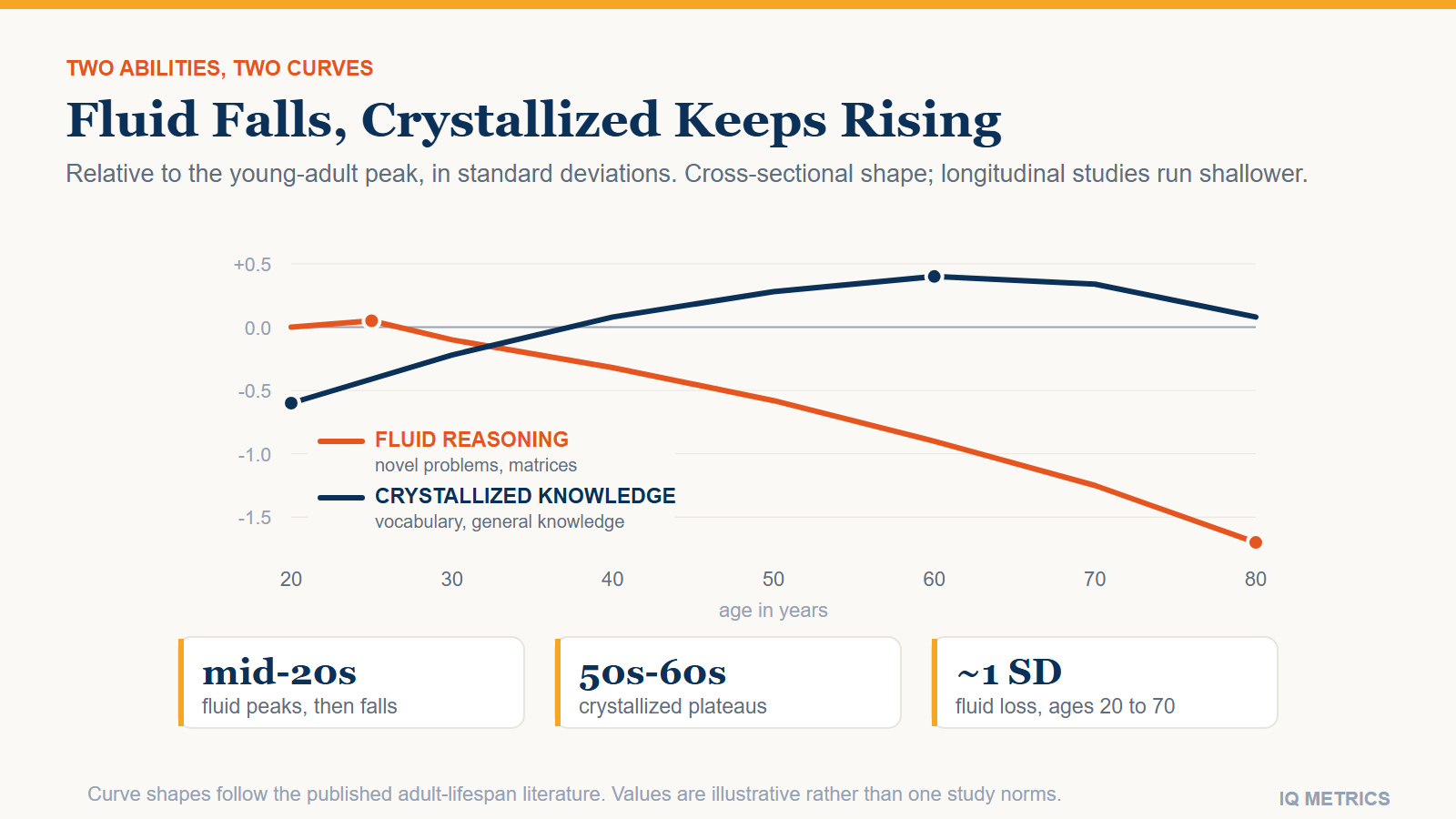
If fluid and crystallized ability were the same thing wearing two names, they would age the same way. They do not, and the gap is large. Fluid reasoning peaks in the mid-twenties and declines from there at roughly two-hundredths of a standard deviation per year, with the slope steepening after the mid-fifties. Between ages 20 and 70 that adds up to something between three-quarters of a standard deviation and a full one — eleven to fifteen points on the familiar scale.
Crystallized ability does the opposite. Vocabulary and general knowledge climb through middle age, plateau somewhere in the fifties and sixties, and hold up until quite late in life. This is the resolution of an old puzzle: people plainly get better at their work into their fifties while getting measurably slower at unfamiliar puzzles. Both things are true, of different abilities. The pattern is set out in more detail in the evidence on when intelligence peaks.
One honest caveat. Most of these curves come from cross-sectional data — different people of different ages measured at one time — and that design confounds ageing with generational differences in schooling and nutrition. Longitudinal studies that follow the same people tend to show the fluid decline starting later and running shallower. The direction of the two curves is not in dispute; the exact age at which the fluid one turns down is.
Investment theory: where crystallized ability comes from
Cattell did not propose two unrelated faculties. His investment theory says crystallized ability is what fluid ability turns into when it is spent on a culture: the child with more reasoning capacity extracts more from the same lesson, book or conversation, and that advantage accumulates as knowledge. It is a compounding account, and it explains two things a two-independent-abilities model cannot.
First, why the two correlate substantially rather than being independent — they share a cause and one feeds the other. Second, why they come apart with age exactly as they do: once the deposit is made, crystallized ability keeps paying out even as the fluid capacity that built it declines. It also predicts that an extra year of school should move crystallized scores more than fluid ones, which is roughly what the schooling evidence finds. Cattell’s pair was later folded into the broader Cattell-Horn-Carroll model that most modern batteries are built on, one of the theories that shaped IQ testing, and both sit underneath the general factor described in the account of g.
Which half is your online test measuring?
Almost always the fluid half, and mostly for practical reasons. Figural and matrix items can be generated in quantity, scored without judgment and used across languages, none of which is true of a vocabulary subtest that has to be normed against a specific population. So a short online reasoning test is sampling something real, but it is sampling one side of the pair. The distinction between the verbal and non-verbal halves of a score is the same split seen from the other direction.
The practical consequence: if your online result sits well below your sense of your own vocabulary and knowledge, that is not necessarily a contradiction, and neither number is lying. Full clinical batteries measure both because both are real. What those batteries look like is covered in the guide to professional IQ tests.
What this means for your own score
Three things follow. Ask which half a test sampled before treating the number as a summary of your intelligence. Expect the two to diverge with age, and read a mid-life score in that light rather than as decline across the board. And be sceptical of any claim to have raised "your IQ" that does not say which half moved: training reliably shifts crystallized measures, because that is what learning is, while moving fluid ability has proved far harder. How much of the outcome is fixed at all is the subject of the evidence on talent against practice, and how sharply both halves track family circumstances is covered in the article on socioeconomic status.
If you want to see where you sit on the fluid side specifically, a properly normed reasoning test will tell you more in half an hour than any amount of reading about the construct.
Keep reading
All articles →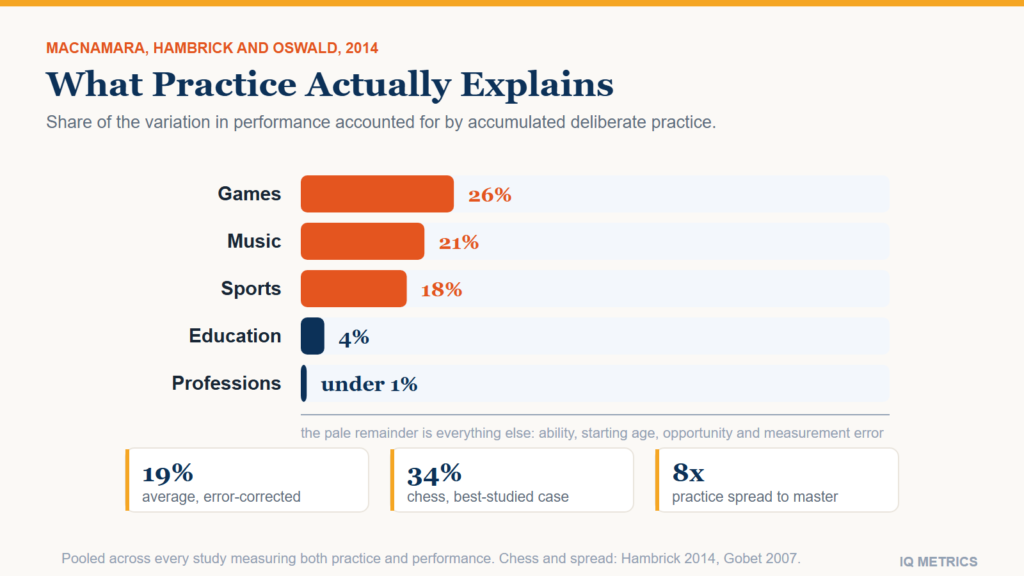 Research & Evidence
Talent vs Practice
The 10,000-hour rule made a strong claim: expert performance is built by practice, not given by talent. When researchers pooled the studies that had actually measured it, practice explained about a quarter of the difference between people in games and almost none in professional work. Here is what fills the rest of the gap.
 Research & Evidence
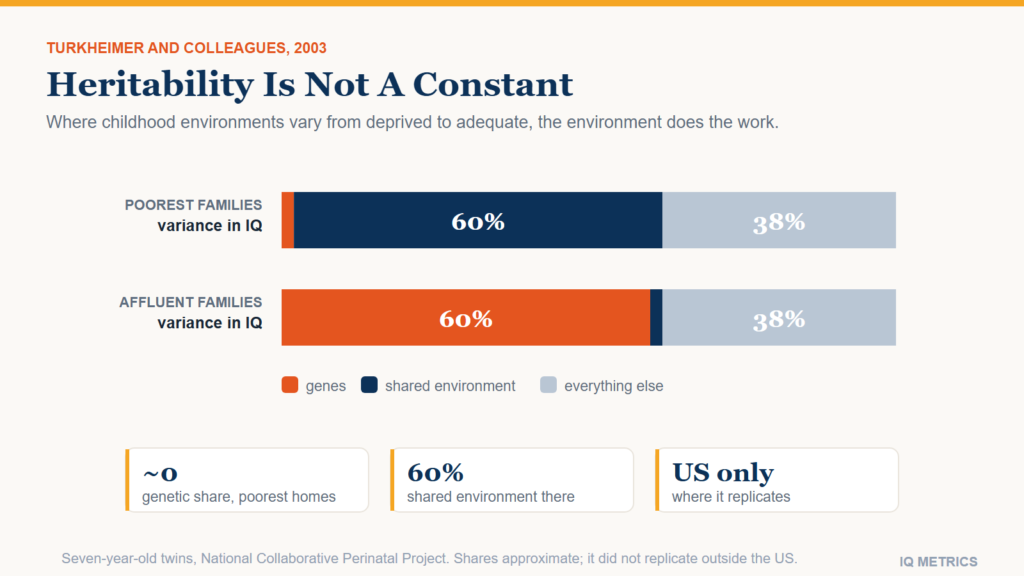
Socioeconomic Status and IQ
Family circumstances track IQ scores, and the relationship is stranger than a simple gap. In the poorest families studied, genes explained almost none of the variation in childhood scores and shared environment explained most of it. In affluent families the pattern reversed. Here is what that finding does and does not support.
 Understanding IQ
Processing Speed and IQ
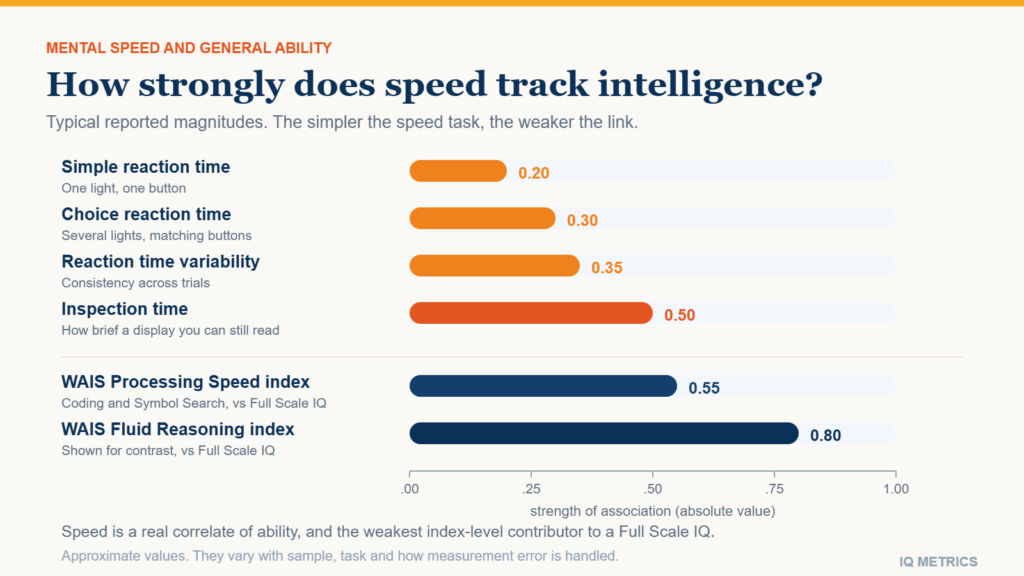
Fast thinkers are assumed to be smart thinkers, and there is a real finding underneath the stereotype: people who score higher on IQ tests do respond faster on tasks with no reasoning content at all. But the link is weaker than the folklore, and on a professional battery the speed index is the least g-loaded.