





Twice Exceptional (2e): What It Means and How Students Are Identified
Twice exceptional (2e) means gifted and disabled at the same time, such as high reasoning with dyslexia, ADHD or autism. See the research definition, how one IQ score can hide the pattern, how students are identified and what 2026 data show about how many are found.

Twice exceptional (2e) means a student is gifted and has a disability at the same time, such as strong reasoning ability together with dyslexia, ADHD or autism. The standard research definition, published by Reis, Baum and Burke in 2014, describes students with the potential for high achievement or creative productivity in one or more areas who also have one or more disabilities under federal or state criteria. This guide explains what that means in practice, why a single IQ score can hide the pattern, how students are identified, and what the newest data say about how many are actually found.
- What it is: an educational label for the combination of high potential and a disability, not a separate diagnosis. Two-sided by definition, and very varied from child to child.
- Why it is missed: each side can hide the other. Disabilities can limit how visible the strengths are, and strengths can compensate for the disability in the early grades.
- The IQ angle: a single full-scale score blends strengths and weaknesses; index scores show the spread.
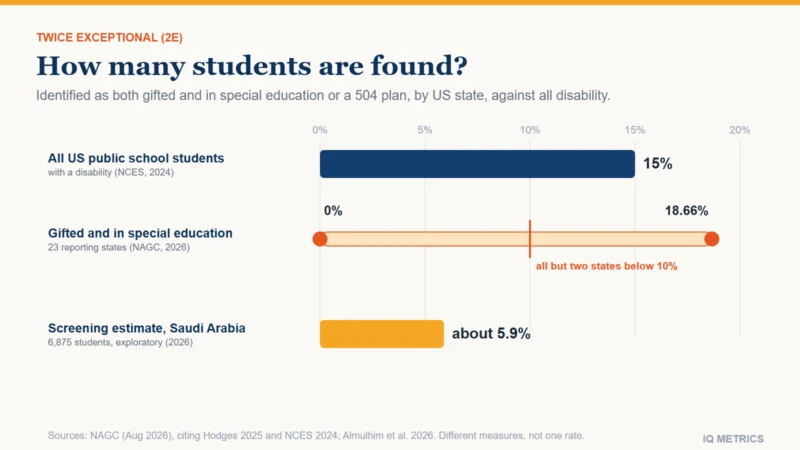
- How many: no settled figure. US states that reported identified from 0% to 18.66% of students as both gifted and in special education, with all but two under 10% (NAGC, 2026).
- What helps: strengths-based, talent-focused support alongside accommodations, with gifted and special education staff working together.
The pairing sits between topics our readers already ask about. Our guides to the signs of a gifted child, high IQ and ADHD, autism and IQ and dyslexia and IQ each cover one half. This page covers the combination itself.
What does twice exceptional mean?
The 2014 definition by Reis, Baum and Burke, published in Gifted Child Quarterly, offered an operational definition, and the National Association for Gifted Children (NAGC) uses it in its August 2026 position statement on identifying and serving twice-exceptional students. Two parts matter. The strength side is potential for high achievement or creative productivity in a domain such as math, science, the arts or another area of human productivity, which is wider than an IQ cut-off. The disability side is whatever federal or state eligibility criteria recognize, for example a specific learning disability, ADHD or autism.
NAGC stresses how varied the group is. Twice-exceptional students differ cognitively and emotionally, and their schooling can look uneven: inconsistent grades or test scores, frustration, insecurity or low motivation, and social or emotional skills that lag behind their reasoning. That unevenness is the signature, and it is also why a quick look at report-card grades or one score so often misses them. For how a gifted range is usually drawn on IQ scales, see our guide to gifted cut-off scores.
Which conditions can go with giftedness?
Any disability recognized under federal or state criteria can, in principle, pair with high ability. Common pairings in the research literature are specific learning disabilities such as dyslexia and dysgraphia, ADHD and autism. The studies below are small and specific, and each used a different design, so they illustrate the range of profiles rather than giving one typical 2e child.
| Pairing | Study | What it found |
|---|---|---|
| Gifted and autism | Assouline et al. (2012), 59 students with ability of 120 or above and an autism diagnosis | WISC-IV working memory and processing speed indexes were positively related to achievement in math, reading and written language. The autism diagnosis and Verbal Comprehension were not related to achievement. |
| Gifted and dyslexia | Alonso Benito et al. (2026), Spanish secondary students | Gifted students with dyslexia showed an uneven reading and writing profile: weaker lexical and syntactic processing, relatively stronger semantic skills. On some measures they scored above the dyslexia-only group and below the gifted-only group. |
| Gifted and ADHD | See our guide | Covered in high IQ and ADHD and ADHD and IQ; NAGC also cites a 2024 study of career outcomes for academically advanced students with ADHD, which varied. |
Why can one IQ score hide it?
A composite score averages. When a student’s strengths and weaknesses sit on different indexes, the full-scale number can land in a middle band that describes neither. The WISC-V illustrates the idea: its Full Scale IQ is built from seven subtests, while the optional General Ability Index uses five subtests (Similarities, Vocabulary, Block Design, Matrix Reasoning and Figure Weights) and leaves out working memory and speed. Our guides to WISC-V index scores and to full-scale IQ vs index scores show how the pieces fit together, and how to read an IQ test report explains the layout.
The autism study above shows why the pieces matter. Among 59 high-ability students, the working-memory and processing-speed indexes tracked achievement, while Verbal Comprehension did not. A reader who looked only at a strong verbal score would miss the part of the profile that was doing the predicting. NAGC makes the same point in plain terms: when identification relies on a composite instead of domain-specific scores, a disability can limit how much of the strength shows. See also processing speed and IQ and executive function vs IQ.
How do strengths and weaknesses mask each other?
NAGC describes two directions. A student’s disability may limit how far the strengths are visible. Or the strengths may compensate for the disability, especially in early grades, so nothing looks wrong enough to trigger an evaluation. The second route has a legal edge in the United States. To qualify for an Individualized Education Program or a Section 504 plan, a student must have a disability and need specially designed instruction or accommodations, and in practice that second step often depends on below-average grades or scores. Many twice-exceptional students do not show them, particularly under tiered support systems that screen on low achievement.
The result, in NAGC’s words, is that supports may arrive only when the demands finally outpace what the student can compensate for. The same logic explains why federal rules for specific learning disabilities do not require a severe gap between ability and achievement, a point covered in our guide to dyslexia and IQ. Even so, researchers still disagree on how to define unexpected underachievement. A 2006 review by Lovett and Lewandowski argued that uncritical acceptance of the idea of giftedness combined with a learning disability had led to unsound identification procedures, and that many suggested practices were unsupported or contradicted by research. A 2026 expert-panel (Delphi) study of specific learning disability found agreement on the importance of academic deficits and exclusionary criteria, but persistent disagreement about discrepancy methods and about what they mean for identifying twice-exceptional learners.
How many students are twice exceptional?
There is no settled number, and the available figures measure different things. In the United States, NAGC reports that representatives from 23 states gave the share of students identified as both gifted and in special education or a Section 504 plan, and the figures ranged from 0% to 18.66%, with all but two states below 10%. For comparison, the National Center for Education Statistics (2024) estimates that 15% of all public school students have a disability. NAGC reads that gap as a sign that twice-exceptional students are probably underrepresented in gifted programs.
| Figure | Source | What it counts |
|---|---|---|
| 0% to 18.66% | NAGC, citing the 2022-23 State of the States (23 reporting states) | Students already identified as both gifted and in special education or a 504 plan |
| 15% | National Center for Education Statistics, 2024 | All public school students with a disability |
| About 5.9% | Almulhim et al. (2026), 6,875 students in Saudi Arabia | A screening estimate of possible twice exceptionality; the authors call it exploratory |
The Saudi study is a useful reminder of how estimates are built. Students in grades 2 to 12 were first flagged for a possible learning disability when their achievement in two subjects differed by more than 1.5 standard deviations. That flagged 23.6% of them. A giftedness test then suggested that 24.5% of the flagged students might be gifted, which gave roughly 5.9% of the whole sample. The authors say broader replication is needed before policy conclusions. Treat it as one country’s screening estimate, not a US rate.
Where would your own score land?
Take the IIF-certified assessment and get your score with the scale it was measured on, the percentile it corresponds to and the confidence range around it — the three figures most online tests leave out.
Find your IQ score now! →Who gets missed?
NAGC points to a double bind. Students from minoritized groups are underserved by talent-development programs and overrepresented in special education, and students in special education are less likely to be referred for advanced learning. A twice-exceptional student from such a group faces both barriers.
One well-studied lever is universal screening. In a large urban district that began screening every second grader for gifted programs, Card and Giuliano (2016) found that, with no change in eligibility standards, the share of economically disadvantaged and minority students placed in gifted programs rose substantially. Black and Hispanic students, students receiving subsidized school lunches, English language learners and girls had all been underreferred when the district relied on parents and teachers. Our guide to universal screening for gifted programs covers the mechanics.
How is a twice-exceptional student identified?
NAGC says comprehensive assessment is the best way to understand the full range of a twice-exceptional student’s abilities, and it also says this is rarely feasible in gifted-identification systems because of limited funding. Its recommendations for schools are practical:
- Offer universal screening or eligibility assessment to all students rather than relying on referrals.
- Look at domain-specific strengths, such as math or language scores, not only a composite ability score.
- Use a broader view of educational impairment for disability supports, one that is not limited to below-average grades.
- Put special education and gifted specialists in the same conversation, with school psychologists and counselors involved.
- Train educators to use data to identify and serve these students.
For parents, the practical translation is to ask the school for a comprehensive evaluation that looks at both strengths and difficulties, and to ask for index-level scores rather than only a total. Our guide to IQ testing for children explains what the evaluations measure, and the WPPSI-IV and Woodcock-Johnson guides cover two tests that are often used. Evaluators can also add tasks beyond the IQ battery, such as timed word-generation tasks; our guide to the verbal fluency test describes one.
What helps a twice-exceptional student?
Few researchers have tested educational interventions for this group, partly because the profiles differ so much. The recommendations NAGC reports coalesce around a strengths-based, talent-development approach: psychological well-being, acceptance of difference, enough time for academic work and positive relationships, with accommodations for the area of difficulty and opportunities to excel in the talent area. A 2024 case study described three supports: a culture of acceptance, professional development on high-ability students and a learning specialist who understands twice exceptionality. NAGC also notes that families often carry the cost of the extra educational and psychological resources.
An online score cannot substitute for any of this. The IQ test on this site gives a total and is useful for curiosity, but it is not an evaluation, and it cannot identify a disability.
Quick answers
- What does twice exceptional (2e) mean? Gifted, or with high potential in a domain, and also having a disability under federal or state criteria.
- Is 2e a diagnosis? No. It is an educational label for the combination; the disability side is determined separately.
- Can a 2e student have an average IQ score? A composite can land in a middle band when strengths and weaknesses average out, which is why index scores and domain scores matter.
- How common is it? Unknown. US states that reported identified between 0% and 18.66% as both gifted and in special education or a 504 plan; one 2026 Saudi screening estimate was about 5.9%.
- Which program should a 2e student be in? NAGC recommends access to talent development and to accommodations, with both sets of specialists involved.
- Do 2e students need to be failing to get support? They often do not, which is the problem: eligibility for disability supports can depend on below-average performance.
Sources
- National Association for Gifted Children (August 2026): Identifying and Serving Gifted Children Who Are Twice Exceptional (position statement).
- Reis, S.M., Baum, S.M. and Burke, E. (2014): An operational definition of twice-exceptional learners: implications and applications, Gifted Child Quarterly, 58(3), 217-230.
- Card, D. and Giuliano, L. (2016): Universal screening increases the representation of low-income and minority students in gifted education, PNAS, 113(48), 13678-13683.
- Assouline, S.G., Foley Nicpon, M. and Dockery, L. (2012): Predicting the academic achievement of gifted students with autism spectrum disorder, Journal of Autism and Developmental Disorders, 42(9), 1781-1789.
- Alonso Benito, S. et al. (2026): Reading and writing profiles in twice-exceptional adolescents with intellectual giftedness and dyslexia, Journal of Intelligence, 14(6), 108.
- Almulhim, N. et al. (2026): Hidden potential: an exploratory study of the prevalence of twice-exceptional students in Saudi Arabia, Journal of Intelligence, 14(5), 83.
- Benson, N.F. et al. (2026): Redefining specific learning disabilities: an attempt to bridge research, policy, and practice through expert consensus, Journal of School Psychology, 116, 101549.
- Lovett, B.J. and Lewandowski, L.J. (2006): Gifted students with learning disabilities: who are they?, Journal of Learning Disabilities, 39(6), 515-527.
Keep reading
All articles →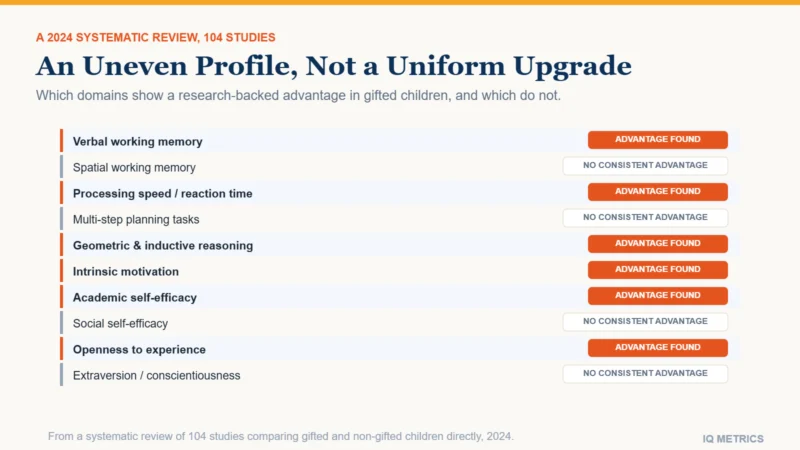 Understanding IQ
Signs of a Gifted Child
The "reads early, has a big vocabulary" checklist misses what a 2024 systematic review actually found: an uneven cognitive profile, a documented speed-accuracy tradeoff, asynchronous development, and real gaps in who gets identified. What the research says, and what to do with a hunch.
 Understanding IQ
High IQ and ADHD
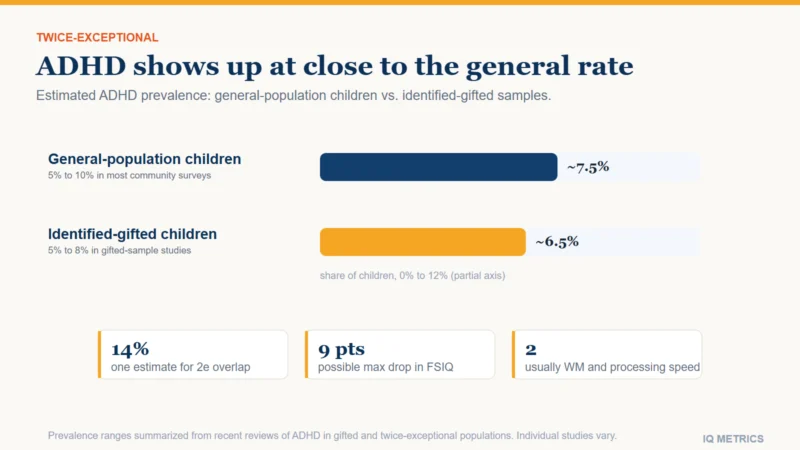
High IQ and ADHD can and do coexist, at close to the general-population rate. What twice-exceptional actually means, why the combination gets missed in both directions, and how ADHD can pull down a full-scale IQ score without touching real reasoning ability.
 Taking a Test
IQ Testing for Children
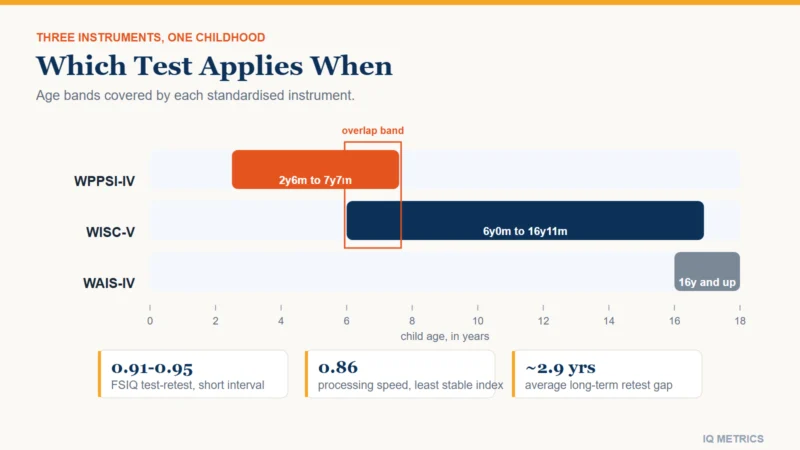
Children are not tested on the same instrument as adults, and the test itself changes twice before age eighteen. Here is which one applies when, how reliable an early score really is, and what a parent should and should not conclude from a single number.